Insulin Injection Aids Market Size, Share & Industry Analysis, By Product (Insulin Vial Aids, Syringe Aids, Injectors, Aids for Kids), By End-use, and Regional Forecast, 2026-2034
 Download Free Sample
Insulin Injection Aids Market Overview
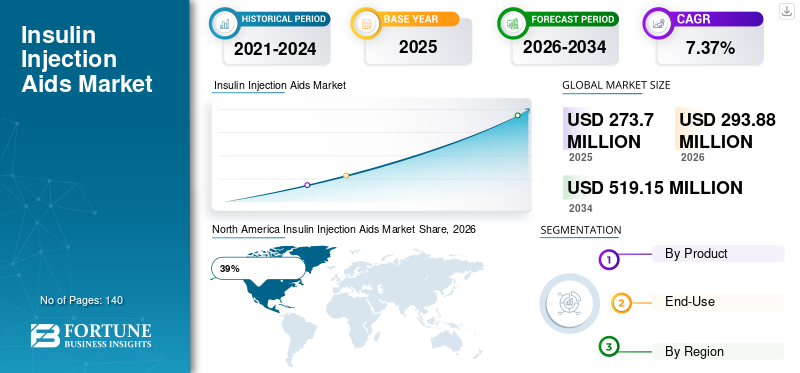
The global insulin injection aids market size was valued at USD 273.7 Million in 2025. The market is projected to grow from USD 293.88 Million in 2026 to USD 519.15 Million by 2034, exhibiting a CAGR of 7.37% during the forecast period.

The insulin injection aids market is experiencing sustained expansion due to the increasing prevalence of diabetes and the growing need for safer, more convenient insulin administration solutions. Insulin injection aids are designed to improve injection accuracy, reduce discomfort, and enhance adherence among patients requiring regular insulin therapy. The market includes vial aids, syringe aids, injectors, and pediatric-focused devices that simplify insulin delivery and support self-management. Healthcare providers are increasingly recommending these products to improve treatment outcomes and reduce administration errors. Growing awareness regarding diabetes management, rising healthcare accessibility, and continuous innovation in injection technologies are supporting the overall development of the insulin injection aids market. Demand is also increasing among elderly populations and patients requiring long-term insulin therapy.
The United States remains one of the most influential markets for insulin injection aids due to its large diabetic population, advanced healthcare infrastructure, and strong adoption of patient-centric medical devices. Healthcare organizations continue to promote insulin adherence programs, encouraging the use of aids that enhance comfort and precision. Home healthcare expansion has further increased demand for easy-to-use insulin delivery accessories. Manufacturers are actively introducing ergonomic and technology-enhanced products tailored to diverse patient needs. Rising awareness regarding diabetes complications and the importance of accurate insulin administration continue to strengthen demand for insulin injection aids across hospitals, clinics, pharmacies, and homecare settings throughout the country.
Download Free sample to learn more about this report.
Insulin Injection Aids Market Key Takeaways
 Global Market Size & Forecast
- 2025 Market Size: USD 273.70 Million
- 2026 Market Size: USD 293.88 Million
- 2034 Forecast Market Size: USD 519.15 Million
- CAGR: 7.37% from 2026-2034
 Market Share
- The market in North America dominated with a revenue share of 39% in 2025.
- Injectors dominated by product with the largest market share.
- Hospitals dominated by end-use with the largest market share.
 Key Regional Highlights
North America
North America led the market with a 39% share, supported by advanced healthcare infrastructure and strong diabetes care systems.
Europe
Europe accounted for 28% of the market, driven by established healthcare systems and growing adoption of diabetes management solutions.
Asia-Pacific
Asia-Pacific held a 25% share, supported by the rising diabetic population and expanding healthcare infrastructure.
U.S
The U.S. remains a key market, supported by advanced diabetes care and increasing demand for convenient insulin delivery solutions.
Japan
Japan accounted for approximately 22% of the Asia-Pacific market, supported by advanced healthcare infrastructure and established diabetes management services.
Read More

Insulin Injection Aids Market Latest Trends
The insulin injection aids market is witnessing notable technological advancements aimed at improving patient experience and treatment compliance. One major trend is the increasing adoption of ergonomic injection aids designed to minimize pain and simplify handling for elderly users. Lightweight and portable devices are becoming more popular among patients who require insulin administration outside healthcare facilities.
Download Free sample to learn more about this report.
Another significant trend involves the integration of smart monitoring capabilities with insulin delivery systems. Manufacturers are developing injection aids that support dosage tracking and patient adherence monitoring. Pediatric-focused solutions are also gaining attention, with products specifically designed to reduce anxiety and improve usability among children. Sustainability initiatives are encouraging the use of durable and reusable injection aids, helping reduce medical waste. Furthermore, healthcare providers are increasingly recommending supportive insulin accessories as part of comprehensive diabetes management programs. These trends continue to strengthen the insulin injection aids market report, insulin injection aids market analysis, Insulin Injection Aids industry report, and insulin injection aids market outlook across global healthcare systems.
Insulin Injection Aids Market Dynamics
DRIVER
Rising Prevalence of Diabetes and Increasing Need for Accurate Insulin Administration
The primary driver of the insulin injection aids market Growth is the expanding diabetic population worldwide. Diabetes management requires consistent and accurate insulin administration, creating substantial demand for products that improve injection precision and patient convenience. Insulin injection aids help reduce user errors, enhance dose consistency, and improve confidence among patients managing complex treatment schedules.
Healthcare professionals increasingly recommend these devices because they contribute to better treatment adherence. Elderly patients and individuals with dexterity limitations particularly benefit from supportive injection technologies. Rising awareness regarding diabetes-related complications has also encouraged patients to adopt advanced injection solutions. Additionally, government initiatives supporting diabetes education and disease management are increasing acceptance of insulin injection aids. As more patients shift toward self-administration and home-based care models, demand for user-friendly injection assistance devices continues to expand. This trend remains a fundamental factor shaping the insulin injection aids market Size and overall industry development.
RESTRAINT
Availability of Alternative Insulin Delivery Technologies
The presence of alternative insulin delivery methods acts as a restraint for the insulin injection aids market. Many patients are transitioning toward insulin pumps, wearable delivery systems, and advanced pen-based technologies that reduce dependence on traditional injection accessories. These alternatives often offer automated functions and greater convenience for certain patient groups.
Cost sensitivity also influences adoption patterns in several developing regions. Patients may prioritize essential insulin products over supportive accessories, limiting market penetration. In addition, limited awareness regarding the benefits of injection aids remains a challenge in some healthcare environments. Healthcare providers may focus primarily on medication therapy while giving less attention to accessory products. Regulatory requirements for medical device approvals can further delay product launches and market expansion. These factors collectively create barriers that manufacturers must address through education, innovation, and affordability strategies within the insulin injection aids market research report landscape.
OPPORTUNITY
Expansion of Home Healthcare and Personalized Diabetes Management
The rapid growth of home healthcare presents significant opportunities for the insulin injection aids market. Increasing numbers of patients prefer managing chronic conditions at home, creating demand for devices that simplify insulin administration without clinical supervision. Injection aids align well with this trend by improving usability, comfort, and confidence.
Personalized healthcare approaches are also driving innovation opportunities. Manufacturers are developing customized products tailored to specific age groups, physical capabilities, and treatment requirements. Pediatric solutions, ergonomic designs for seniors, and digitally enabled injection support devices are attracting strong interest. Emerging markets present additional growth opportunities as healthcare accessibility improves and diabetes awareness campaigns expand. Strategic collaborations among medical device companies, healthcare providers, and diabetes management organizations are expected to accelerate product adoption. These developments continue to strengthen the insulin injection aids market forecast and create long-term opportunities for industry participants.
CHALLENGE
Patient Education Gaps and Product Adoption Barriers
One of the major challenges affecting the insulin injection aids market is insufficient patient education regarding the availability and benefits of injection support products. Many patients continue to rely on conventional insulin administration techniques without understanding how injection aids can improve accuracy and comfort.
Healthcare professionals may also face limitations in providing comprehensive training due to time constraints and resource availability. Product complexity can discourage first-time users, particularly elderly patients unfamiliar with medical devices. Distribution challenges in rural and underserved areas further restrict accessibility. Manufacturers must invest in educational initiatives, training programs, and simplified product designs to overcome these barriers. Competitive pressure from established insulin delivery technologies also requires continuous innovation. Successfully addressing these challenges will remain essential for sustaining growth and strengthening the insulin injection aids market opportunities over the coming years.
Insulin Injection Aids Market Segmentation
By Product
Insulin vial aids represent a significant segment of the insulin injection aids market due to their ability to simplify insulin extraction from vials. These products assist patients who experience difficulties handling small medication containers, particularly elderly individuals and those with limited hand strength. By improving grip stability and dosage accuracy, vial aids help reduce administration errors and support treatment consistency. Healthcare providers frequently recommend insulin vial aids for patients transitioning to self-care environments. The segment benefits from strong demand in home healthcare settings where ease of use remains a priority. Manufacturers continue introducing ergonomic designs that improve portability and convenience.
Syringe aids are widely utilized to enhance injection accuracy and reduce handling difficulties associated with traditional insulin syringes. These products support patients with visual impairments, limited dexterity, and mobility challenges. Improved control during insulin administration helps minimize dosing errors and supports long-term treatment compliance. The segment maintains strong relevance in healthcare systems where conventional syringe-based insulin therapy remains common. Product enhancements focused on comfort, precision, and user safety continue to support demand. Healthcare professionals recognize syringe aids as valuable tools for promoting independent diabetes management. As patient populations age globally, syringe aids are expected to retain an important role within the insulin injection aids market report and industry report environment.
Injectors hold the largest share within the insulin injection aids market due to their advanced functionality and user-friendly operation. These devices simplify insulin delivery while reducing discomfort and injection anxiety. Many injectors incorporate ergonomic features that improve grip, positioning, and administration accuracy. Demand is particularly strong among patients seeking greater convenience and consistency in insulin therapy. Healthcare organizations increasingly promote injector technologies as part of comprehensive diabetes management strategies. Continuous innovation is driving the introduction of improved injector systems with enhanced usability and patient support features. Their broad applicability across multiple patient groups contributes significantly to the insulin injection aids market Growth and market share expansion.
Aids for kids are specifically designed to address the unique challenges associated with pediatric insulin administration. These products focus on reducing fear, discomfort, and resistance among children requiring regular insulin therapy. Child-friendly designs and educational features help improve treatment acceptance. Parents and healthcare providers increasingly value pediatric-focused injection aids because they support better adherence and emotional comfort. Manufacturers continue investing in innovative designs that combine functionality with engaging visual elements. Growing awareness regarding pediatric diabetes management is strengthening demand for specialized solutions. This segment remains an important contributor to the insulin injection aids market opportunities and market trends landscape.
End-Use
Hospitals account for the largest share of the insulin injection aids market because they serve as primary centers for diabetes diagnosis, insulin therapy initiation, and patient monitoring. Healthcare professionals in hospitals increasingly recommend insulin injection aids to improve dosage accuracy, reduce administration errors, and support patient safety. These products are widely utilized in inpatient diabetes management programs where proper insulin delivery is essential for maintaining blood glucose control. Hospitals also use insulin injection aids for elderly patients, individuals with limited hand mobility, and patients requiring long-term insulin therapy support. The growing diabetic population and rising hospitalization rates related to diabetes complications continue to strengthen demand for advanced injection assistance devices in healthcare institutions. Technological advancements in injection aids, combined with hospital-driven awareness programs, continue to expand market penetration. Hospitals remain a critical end-use segment within the insulin injection aids market report, supporting innovation, product adoption, and improved patient adherence across global healthcare environments.
Insulin Injection Aids Market Regional Outlook
North America
North America Insulin Injection Aids Market Share, 2025 (%)
To get more information on the regional analysis of this market, Download Free sample
North America remains the most established regional market for insulin injection aids due to the growing burden of diabetes, strong healthcare infrastructure, and widespread adoption of advanced diabetes management solutions. The region benefits from high awareness regarding insulin administration accuracy and the importance of patient adherence to treatment regimens. Healthcare providers across the United States and Canada actively encourage the use of injection support devices that improve comfort, minimize dosing errors, and enhance overall patient experience.
The increasing preference for home-based diabetes management has further accelerated demand for insulin injection aids across the region. Patients are seeking convenient and user-friendly products that simplify daily insulin administration and support long-term disease management. Technological advancements, including ergonomic injectors and specialized aids for elderly patients, continue to strengthen product adoption. North America accounted for approximately 39% of the global insulin injection aids market share, reflecting its dominant position in the industry. Strong reimbursement structures, extensive diabetes education programs, and continuous product innovation support sustained market expansion. In addition, strategic collaborations between healthcare organizations and device manufacturers are contributing to broader accessibility and increased utilization of insulin injection aids throughout hospitals, clinics, and homecare environments.
Europe
Europe represents a significant market for insulin injection aids, supported by advanced healthcare systems, increasing diabetes prevalence, and strong government initiatives aimed at chronic disease management. Healthcare providers throughout the region emphasize patient-centered care, encouraging the use of devices that improve insulin administration accuracy and treatment adherence. Growing awareness regarding diabetes complications has increased demand for products that simplify insulin delivery and enhance patient comfort.
The region has experienced rising adoption of injection assistance devices among elderly populations, particularly those requiring long-term insulin therapy. Home healthcare services continue to expand, creating additional demand for easy-to-use insulin administration solutions. Manufacturers are investing in product innovation and distribution expansion to strengthen their presence across key European countries. Europe held nearly 28% of the global insulin injection aids market share, making it one of the largest regional contributors. Favorable healthcare policies, increasing adoption of self-care practices, and a growing focus on preventive healthcare continue to support market development. The presence of established medical device companies and continuous technological improvements further reinforce Europe’s position as a major market for insulin injection aids.
Germany Insulin Injection Aids Market
Germany plays a leading role within the European insulin injection aids industry due to its highly developed healthcare infrastructure and strong emphasis on diabetes management. The country has witnessed increasing adoption of supportive insulin administration devices among both healthcare professionals and patients. Diabetes care programs actively promote products that improve injection accuracy and enhance treatment compliance, particularly among elderly individuals and patients managing complex insulin schedules.
The market is characterized by high awareness of diabetes-related complications and strong acceptance of innovative healthcare technologies. Hospitals, specialty clinics, and homecare providers continue integrating insulin injection aids into patient management strategies. Manufacturers are increasingly introducing ergonomic and user-friendly solutions tailored to the needs of German consumers. Germany contributes approximately 24% of the European insulin injection aids market, highlighting its importance within the regional landscape. Ongoing investments in healthcare modernization and digital health initiatives are creating favorable conditions for further market development. The country's strong regulatory standards and commitment to quality healthcare continue to encourage adoption of advanced insulin administration support products across multiple healthcare settings.
United Kingdom Insulin Injection Aids Market
The United Kingdom remains an important market for insulin injection aids, driven by the increasing prevalence of diabetes and growing emphasis on self-management strategies. Healthcare organizations across the country actively support patient education initiatives designed to improve insulin administration practices and encourage the use of supportive injection technologies. The market continues to benefit from rising awareness regarding treatment adherence and long-term diabetes management.
Demand for insulin injection aids is increasing among both newly diagnosed patients and individuals requiring long-term insulin therapy. Home healthcare services are expanding throughout the country, creating opportunities for products that simplify insulin administration and improve patient confidence. Manufacturers are focusing on innovative designs that enhance usability while reducing injection-related discomfort. The United Kingdom accounts for nearly 18% of the European Insulin Injection Aids Market, reflecting its significant contribution to regional demand. Government healthcare initiatives, strong diabetes awareness programs, and growing adoption of patient-focused medical technologies continue to support market Growth. The country's healthcare providers remain committed to improving treatment outcomes through the adoption of advanced insulin administration solutions.
Asia-Pacific
Asia-Pacific has emerged as one of the fastest-growing regions for insulin injection aids due to the rapidly increasing diabetic population and improving healthcare accessibility. Countries across the region are investing heavily in healthcare infrastructure and chronic disease management programs, creating favorable conditions for the adoption of insulin support devices. Growing awareness regarding diabetes treatment and self-care practices is encouraging patients to utilize products that improve injection accuracy and convenience.
Urbanization, rising healthcare spending, and expanding access to medical technologies are further supporting market expansion. Healthcare providers are increasingly recommending injection aids to improve patient adherence and reduce administration errors. Manufacturers are strengthening their regional presence through strategic partnerships and localized product development initiatives. Asia-Pacific represented approximately 25% of the global insulin injection aids market share, highlighting its growing importance within the industry. Demand is particularly strong in countries with large diabetic populations and expanding healthcare services. Continued improvements in healthcare delivery systems and increasing patient awareness are expected to create substantial opportunities for market participants operating throughout the region.
Japan Insulin Injection Aids Market
Japan is a highly developed market for insulin injection aids, supported by advanced healthcare infrastructure and a growing elderly population requiring diabetes management solutions. Healthcare providers emphasize precise insulin administration and treatment adherence, encouraging patients to utilize devices that improve injection comfort and accuracy. The country's strong focus on healthcare quality has contributed to widespread acceptance of innovative diabetes management products.
Demand for insulin injection aids is particularly strong among elderly individuals who may experience challenges with traditional insulin administration methods. Manufacturers continue introducing ergonomic and technologically advanced products designed to improve usability and support independent disease management. Japan contributes nearly 22% of the Asia-Pacific insulin injection aids market, making it a significant regional market. Increasing healthcare awareness, growing homecare adoption, and continuous innovation in medical device technology are driving market development. The country's commitment to improving chronic disease outcomes continues to support demand for advanced insulin injection assistance products.
China Insulin Injection Aids Market
China represents one of the most dynamic markets for insulin injection aids due to its large diabetic population and rapidly expanding healthcare sector. Government initiatives focused on chronic disease management and healthcare accessibility have significantly improved awareness regarding diabetes treatment and insulin administration practices. Patients are increasingly adopting supportive devices that enhance dosing accuracy and improve treatment adherence.
Healthcare providers throughout the country are emphasizing patient education and self-management strategies, creating favorable conditions for market Growth. Manufacturers are investing in local production, distribution expansion, and product customization to address evolving consumer needs. China accounts for approximately 35% of the Asia-Pacific Insulin Injection Aids Market, reflecting its substantial contribution to regional demand. Rising urbanization, growing healthcare expenditure, and increased access to advanced medical technologies continue to support market expansion. As diabetes prevalence continues to rise, demand for convenient and user-friendly insulin injection aids is expected to remain strong across both urban and rural healthcare settings.
Rest of World
The Rest of World region, encompassing Latin America, the Middle East, and Africa, is gradually becoming an important market for insulin injection aids. Growing awareness regarding diabetes management and increasing investments in healthcare infrastructure are supporting the adoption of insulin administration support devices. Healthcare organizations across these regions are focusing on improving patient outcomes through enhanced access to diabetes treatment solutions.
The market is benefiting from expanding healthcare services, rising chronic disease prevalence, and increasing educational initiatives related to insulin therapy. Manufacturers are introducing cost-effective products tailored to the needs of emerging markets, helping improve accessibility among diverse patient populations. The Rest of World region contributed around 8% of the global insulin injection aids market share, demonstrating its developing role within the industry. Improvements in healthcare accessibility, increasing government support, and growing emphasis on preventive healthcare continue to create opportunities for market expansion. As awareness and healthcare investments increase, demand for insulin injection aids is expected to strengthen across these developing regions.
List of Top Insulin Injection Aids Companies
- Medtronic Plc
- Convatec Inc.
- Becton, Dickinson and Co.
- AmbiMedInc.
- Medicool
- TickleTec Ltd
- Pain Care Labs
- Apothecary Products
- BIONIX LLC
- Prodigy Diabetes Care, LLC
Top Two Companies by Market Share
- Becton, Dickinson and Co. – 18%
- Medtronic Plc – 15%
Investment Analysis and Opportunities
Investment activity within the insulin injection aids market is increasingly focused on patient-centric technologies, ergonomic device design, and advanced insulin administration solutions. Investors are targeting companies capable of improving treatment adherence, reducing injection discomfort, and supporting home-based healthcare models. Strategic investments are also being directed toward pediatric-focused solutions and products designed for aging populations.
Emerging economies offer attractive opportunities due to rising diabetes prevalence and improving healthcare accessibility. Manufacturers are expanding production capabilities and strengthening regional distribution networks to capture untapped demand. Partnerships among medical device developers, healthcare providers, and diabetes management organizations continue creating new growth pathways. Innovation-driven investments in smart injection support technologies and user-friendly device platforms are expected to remain key drivers of future market expansion.
New Product Development
Product development efforts within the insulin injection aids market are increasingly centered on comfort, usability, and precision. Manufacturers are introducing lightweight injection aids with ergonomic grips that improve handling for elderly patients and individuals with limited dexterity. Enhanced safety mechanisms are also being incorporated to reduce accidental dosing errors.
Innovation is extending into pediatric-focused solutions featuring anxiety-reducing designs and interactive educational components. Smart device integration is becoming more common, enabling improved adherence monitoring and treatment tracking. Reusable and environmentally conscious designs are gaining attention as healthcare organizations emphasize sustainability. These developments continue strengthening the competitive landscape and supporting broader adoption across diverse patient populations.
Five Recent Developments (2023–2025)
- Becton, Dickinson and Co. expanded diabetes support device offerings with enhanced injection assistance features in 2023.
- Medtronic Plc strengthened patient-focused diabetes management solutions through accessory integration initiatives in 2024.
- Prodigy Diabetes Care introduced improved user-friendly insulin administration support products in 2024.
- Pain Care Labs advanced pain-reduction technologies applicable to injection support solutions in 2025.
- Multiple manufacturers expanded distribution partnerships across Asia-Pacific and North America during 2023–2025 to improve product accessibility.
Report Coverage
The insulin injection aids market report provides a comprehensive evaluation of industry trends, market dynamics, segmentation patterns, competitive developments, and regional performance. The report analyzes demand drivers, restraints, opportunities, and challenges influencing adoption across healthcare environments. Detailed assessment of product categories, end-use applications, and geographic markets provides actionable business intelligence for stakeholders.
Request for Customization to gain extensive market insights.
Coverage includes analysis of hospitals, clinics, homecare settings, and specialty diabetes centers, along with insights into innovation strategies, investment activity, and competitive positioning. The report also examines emerging opportunities related to personalized diabetes management, home healthcare expansion, and advanced insulin administration technologies. Comprehensive regional assessments and company profiles support strategic planning, market entry evaluation, and long-term business decision-making.
Frequently Asked Questions
Fortune Business Insights says that the global market value stood at USD 273.7 million in 2025 and is projected to reach USD 519.15 million by 2034.
The market is expected to exhibit a CAGR of 7.37% during the forecast period of 2026-2034.
Injectors held the largest share due to their advanced functionality, user-friendly operation, and ability to improve insulin delivery accuracy and reduce discomfort.
Key players include Medtronic Plc, Convatec Inc., Becton, Dickinson and Co., AmbiMedInc., Medicool, and TickleTec Ltd.
Major trends include the adoption of ergonomic, lightweight, and portable injection aids and integration of smart monitoring capabilities for dosage tracking and adherence. North America led the market with a 39% share.



- 2021-2034
- 2025
- 2021-2024
- 140
-

(Offer valid till 15th Oct 2026)
Get 30-60 hrs Free Customization
Expand Regional and Country Coverage, Segments Analysis, Company Profiles, Competitive Benchmarking, and End-user Insights.













.webp)






-
US +1 833 909 2966 ( Toll Free )
-
Get In Touch With Us