Insurance Fraud Detection Market Size, Share & Industry Analysis, By Deployment (Cloud and On Premise), By Fraud Type (Claims Fraud, Identity Fraud, Payment & Billing Fraud, Application Fraud (Fraud At Policy Issuance), and Others), By Insurance Line (Life Insurance, Health Insurance, Property & Casualty (P&C) Insurance, Motor Insurance, and Others (Marine, Etc.)), and Regional Forecast, 2026-2034
 Download Free Sample
KEY MARKET INSIGHTS
 Listen to Audio Version
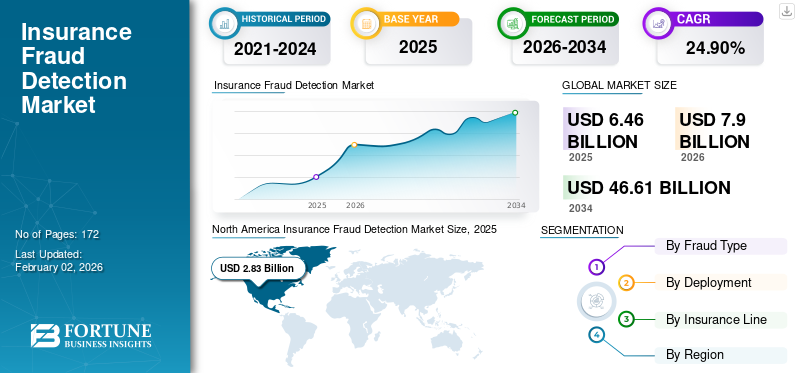
The global insurance fraud detection market size was valued at USD 6.46 billion in 2025 and is projected to grow from USD 7.90 billion in 2026 to USD 46.61 billion by 2034, exhibiting a CAGR of 24.90% during the forecast period. North America dominated the Insurance Fraud Detection Market with a market share of 43.80% in 2025.
Insurance fraud detection refers to the systems and services used to analyze and review data to uncover irregularities and detect fraudulent activities in insurance operations, such as claims, underwriting, and policy management. Such solutions are implemented with the help of software-based application such as artificial intelligence, machine learning, big data analytics, and predictive modeling to reveal suspicious activity by insurers, agents, or consumers aiming for unlawful gains.
The market is growing because of increased fraudulent activities, increased digital transactions, regulatory requirements, and the introduction of new and improved technologies including AI-powered automation, cloud computing, and IoT. Also, the increased insurance penetration and growing awareness among consumers around the world are driving the demand for effective fraud detection solutions and services.
The top companies in the market cover Verisk Analytics, LexisNexis Risk Solution, DXC Technology Company, Shift Technology, and IBM Corporation.
Download Free sample to learn more about this report.
Insurance Fraud Detection Market Key Takeaways
 Market Size & Forecast
- 2025 Market Size: USD 6.46 billion
- 2026 Market Size: USD 7.90 billion
- 2034 Forecast Market Size: USD 46.61 billion
- CAGR: 24.90% from 2026–2034
 Market Share
- North America dominated the Insurance Fraud Detection Market with a market share of 43.80% in 2025.
- The claims fraud segment dominates with a market share of USD 2.54 billion.
- The cloud segment held the largest revenue share of USD 4.39 billion in 2024.
 Key Regional Highlights
North America
In 2025, North America held 43.80% of the global market share, reaching a valuation of USD 2.83 billion, and is projected to grow to USD 3.51 billion in 2026.
Europe
The market in Europe reached USD 1.47 billion in 2025, representing 22.70% of total market revenue, and is projected to reach USD 1.77 billion in 2026.
Asia Pacific
Asia Pacific contributed approximately USD 1.44 billion to the global market in 2025, accounting for 22.20% share, and is expected to reach USD 1.76 billion in 2026.
U.S.
The U.S. market reached USD 2.18 billion in 2025 and is projected to reach USD 2.69 billion by 2026.
Japan
Japan is witnessing growth due to increasing digital transformation of insurance services and rising adoption of fraud detection technologies.
Read More

Impact of Gen AI
Generative AI Helps in Faster Integration Via Code and Tooling
Generative AI will transform the insurance fraud detection market by speeding up the data integration and analysis via automated code generation and tooling. It can generate data mappings, ETL pipelines, and API scaffolding in a short time, reducing integration schedules and simplifying engineering tasks. Generative AI increases efficiency in fraud detection by analyzing claims data in real time to identify the presence of anomalies and suspicious patterns and hence flagging any potential fraud processed faster and more accurately. The technology saves considerable amount of time spent on investigations, reduces operational costs and increases the rate of detection.
MARKET DYNAMICS
Market Drivers
Urge in Organized Fraud Rings and Staged Accident Networks to Drive Market Growth
The market is highly growing as the sophistication of the organized fraud rings and staged accidents network increases. The coordination of fraudulent activities has become extremely well organized in carriers, geographies, and channels, making it hardly manageable by the Special Investigation Units (SIUs) of the past. The result of this growing number of sophisticated and high-value fraud cases is a great deal of money wasted by insurers. As a result, the insurance companies are swiftly embracing high-order analytics, machine learning algorithms and cross-carrier intelligence to enhance their detection, operational efficiency, and rapid identification of suspect patterns before they cause significant financial losses.
Market Restraints
Data Silos and Inconsistent Data Quality Across Lines Hinder Growth
The nature of data structures and its poor quality in different business lines are challenges to the growth of the insurance fraud detection market. Keeping policy, claims, billing, and third-party information isolated in silos, restricts the effectiveness of building a single trustworthy fraud detection platform. A lack of proper data integration will impede entry resolution, making it challenging to establish a linkage between fraudulent activities. Moreover, inconsistent and unfinished data sets produce unreliable model results, diminishing the predictive analytics accuracy. All these restrictions can only be overcome through seamless data interoperability, standardization, and advanced analytics, enabling accurate and effective risk assessment and fraud detection.
Market Opportunities
Growing Partnerships with Data Vendors to Drive Growth Opportunities
The insurance fraud detection market is experiencing massive growth prospects of widening partnerships with various data sellers. Alliances with telematics applications, automobile repair chains, telephone transmitters, credit scoring services, medical billing applications, and geospatial information companies are improving the analysis of the industry. These strategic partnerships enhance the accuracy of models, enhance controls over pre-payment verifications, and enable more accurate fraud risk assessments. With the combination of diverse data points, the insurers will be able to facilitate validation of claims, lower loss ratios, and enhance effectiveness of their operations. These alliances will lead to a high level of uptake of the state-of-the-art fraud detection products by mid-sized and regional insurance carriers in search of affordable innovation.
INSURANCE FRAUD DETECTION MARKET TRENDS
Growing Shift from Batch Rules to Real-Time, ML- and Graph-Based Fraud Analytics is a Major Trend
There is a growing trend in the insurance fraud detection market toward the use of advanced machine learning and graph-based analytics instead of the traditional use of a batch of rules to detect fraud. This revolution is making insurers to be able to detect suspicious individuals, networked relationships, and patterns of fraud within seconds as claims or quotes are made. Using the graph link analysis and predictive modeling, companies would be able to detect more accurately, reduce financial leakage, and speed up the decision-making process. Real-time analytics also promote uninterrupted customer journeys by enabling valid claims to be submitted in real time, which enhances operational performance and trust, as well as boosting the overall fraud prevention system throughout the insurance value chain.
Download Free sample to learn more about this report.
SEGMENTATION ANALYSIS
By Deployment
Accelerated Modernization to SaaS Analytics Boosts Cloud Segment Growth
Based on the deployment, the market is segmented into cloud and on premise.
The cloud segment held the largest revenue share of USD 4.39 billion in the overall global market in the year 2024. The increase in revenue is due to widespread migration of core insurance workloads to cloud platforms that offer elastic compute, turnkey AI or ML services, and enterprise-grade security and compliance.
Cloud also holds the highest CAGR of 84.43% in the global market. The growth is mainly due to the accelerated modernization from on-premise SIU tools to SaaS analytics. The rapid adoption by mid-size and regional carriers that can access advanced capabilities without heavy capex also drives this growth.
By Fraud Type
Claims Fraud Segment Dominates Market Owing to High Volume and Fast Payout Cycles
Based on fraud type, the market is divided into claims fraud, identity fraud, payment & billing fraud, application fraud (fraud at policy issuance), and others.
The claims fraud segment dominates with a market share of USD 2.54 billion and contributes particularly in lines with high claim volumes and fast payout cycles.
Identity fraud holds the highest CAGR of 45.70% in the global market. The segment is expected to grow with the shift toward digital onboarding and straight-through processing, which increases exposure to synthetic identities and account takeovers.
By Insurance Line
To know how our report can help streamline your business, Speak to Analyst
Higher Average Claim Values Augments the Property & Casualty (P&C) Insurance Segment Growth
Based on the insurance line, the market is divided into life insurance, health insurance, Property & Casualty (P&C) Insurance, motor insurance, and others (marine, etc.).
The Property & Casualty (P&C) Insurance segment for accounted for the largest insurance fraud detection market share at USD 1.84 billion in 2024 & 33.80% in 2026. The segment’s growth is attributable to large claim volumes, diverse fraud typologies (staged accidents, inflated repairs, contractor collusion), and higher average claim values.
Health insurance represent the largest CAGR at 27.1% in the global market. The segment’s growth is attributable to intensifying provider and billing-related schemes (upcoding, unbundling, phantom providers) and the expansion of telemedicine and digital claims.
INSURANCE FRAUD DETECTION MARKET REGIONAL OUTLOOK
Geographically the market is segmented into North America, Europe, Asia Pacific, South America and Middle East & Africa.
North America
North America Insurance Fraud Detection Market Size, 2025 (USD Billion) To get more information on the regional analysis of this market, Download Free sample
In 2025, North America held 43.80% of the global market share, reaching a valuation of USD 2.83 billion, and is projected to grow to USD 3.51 billion in 2026. The region’s growth is attributable holds the majority share due to a mature insurance ecosystem with high IT intensity, strong SIU mandates, and rigorous compliance expectations.
The U.S. is at the forefront of the North American market, with expected revenue of USD 2.18 billion in 2025. The growth is attributable to high cost of fraud, which reaches billions of dollars annually, and the increasing sophistication of fraudulent activities due to digitization. The U.S. market is projected to reach USD 2.69 billion by 2026.
Europe
The market in Europe reached USD 1.47 billion in 2025, representing 22.70% of total market revenue, and is projected to reach USD 1.77 billion in 2026. This growth is due to increased digitalization, stringent regulations such as GDPR and the AMLD, and the rising complexity of fraud. U.K., Germany, and France are some of the leading contributors to the growth in the market, with the required revenue stake of USD 0.36 billion, USD 0.24 billion, and USD 0.16 billion, respectively by 2026.
Asia Pacific
Asia Pacific contributed approximately USD 1.44 billion to the global market in 2025, accounting for 22.20% share, and is expected to reach USD 1.76 billion in 2026. The region’s growth is due to rapid digitization of distribution and claims (insurtech, bancassurance, super-apps) and expanding regulatory eKYC/AML frameworks across major markets. India and China are major contributors to the insurance fraud detection market growth with an expected revenue share of USD 0.38 billion and USD 0.56 billion, respectively, by 2026.
South America and the Middle East & Africa
The markets of South America and the Middle East & Africa region captured 6.60% of the global market in 2025, generating USD 0.42 billion in revenue, and is projected to reach USD 0.49 billion in 2026. The growth is attributable to increasing insurance adoption and fraud incidents in these regions. GCC countries are predicted to have a market share of USD 0.17 billion by 2025.
COMPETITIVE LANDSCAPE
Key Industry Players
Key Players are Focusing On Adopting Various Strategies to Lead in the Industry
The key players working in the industry are Verisk Analytics, LexisNexis Risk Solution, DXC Technology Company, Shift Technology, and IBM Corporation. These firms focus on leveraging advanced AI and machine learning, acquiring companies to expand their reach, and developing cloud-based solutions. They are also forming strategic partnerships to integrate their offerings, which are essential for a comprehensive and multi-layered approach to fraud prevention that includes identity verification, real-time monitoring, and behavioral analytics.
LIST OF KEY INSURANCE FRAUD DETECTION COMPANIES PROFILED
- Verisk Analytics (U.S.)
- LexisNexis Risk Solution (U.S.)
- DXC Technology Company (U.S.)
- Shift Technology (France)
- IBM Corporation (U.S.)
- SAS Institute (U.S.)
- Experian (Ireland)
- FICO (U.S.)
- BAE System (U.K.)
- Comply Advantage (U.K.)
- Feedzai (U.S.)
- Idfy (India)
- Clari5 (India)
KEY INDUSTRY DEVELOPMENTS
- October 2025- The IFB has launched Connected to Protect, its five-year strategy developed in response to members’ needs and aimed at propelling the industry into a new era of fighting insurance fraud. Connected to Protect promises to increase the quantity and quality of data held by the IFB, unlock opportunities for the industry in the U.K. as well as globally, and further raise public understanding of insurance fraud.
- September 2025- Veridox, an AI-powered platform for detecting document and image manipulation in insurance claims, has raised USD 1.31 million. The round was led by Outward VC with participation from Solo Investments Holdings Limited.
- August 2025- Verisk, a leading global data analytics and technology provider, announced a strategic alliance with Legentic, a fraud and financial crime detection and prevention company, to launch two advanced fraud detection and asset location tools into its ClaimSearch® platform. Available for the first time in the U.S., Digital Commerce Detector can help insurers automate the identification of suspicious activity on online marketplaces tied to stolen or total loss assets. Additionally, Digital Asset Finder helps streamline insurers’ location and recovery efforts of legitimately stolen vehicles and property post claim-payout.
- June 2025- Instnt announces a strategic partnership with Munich Re to expand reinsurance capacity for its innovative Fraud Loss Insurance product. Instnt’s first-of-its-kind solution combines AI-led verification and insurance-backed protection to provide a path to recovery, growth, and lasting resilience against fraud.
- February 2025- Financial data company Perfios has acquired Clari5 to enhance its fraud prevention and risk management capabilities using Clari5’s real-time financial crime management platform. Clari5 offers AI driven fraud detection tools, including customer-looped alerts, identity resolution, trade-based AML, and real-time transaction monitoring across multiple channels.
- June 2023- Kyndryl, the world’s largest IT infrastructure services provider, announced that it has implemented a suite of technology services for ClaimSearch Israel Ltd., a subsidiary of Verisk, Israel's official fraud detection database operator for the country’s compulsory insurance market. The new solution leverages Kyndryl’s powerful computing resources and Verisk’s deep domain expertise to quickly analyze new auto claims for bodily injury and detect indications of fraud.
REPORT COVERAGE
The global report provides a detailed analysis of the market and focuses on key aspects such as prominent companies, deployment modes, types, and end users of the product. Besides this, it offers insights into the insurance fraud detection market trends and highlights key industry developments and market share analysis for key companies. In addition to the aforementioned factors, the report encompasses several factors that have contributed to the growth of the market over recent years.
Request for Customization to gain extensive market insights.
|
ATTRIBUTE |
DETAILS |
|
Study Period |
2021-2034 |
|
Base Year |
2025 |
|
Estimated Year |
2026 |
|
Forecast Period |
2026-2032 |
|
Growth Rate |
CAGR of 24.90% from 2026-2034 |
|
Historical Period |
2019-2023 |
|
Unit |
Value (USD Billion) |
|
Segmentation |
By Fraud Type, Deployment, Insurance Line and Region |
|
ByFraud Type |
· Claims Fraud · Identity Fraud · Payment & Billing Fraud · Application Fraud (fraud at policy issuance) · Others |
|
ByDeployment |
· Cloud · On Premise |
|
ByInsurance Line |
· Life Insurance · Health Insurance · Property & Casualty (P&C) Insurance · Motor Insurance · Others (Marine, Etc.) |
|
By Region |
· North America (By Fraud Type, Deployment, Insurance Line and Country/Sub-region) o U.S. o Canada o Mexico · Europe (By Fraud Type, Deployment, Insurance Line and Country/Sub-region) o U.K. o Germany o France o Italy o Spain o Russia o Benelux o Nordics o Rest of Europe · Asia Pacific (By Fraud Type, Deployment, Insurance Line and Country/Sub-region) o China o India o Japan o South Korea o ASEAN o Oceania o Rest of Asia Pacific · South America (By Fraud Type, Deployment, Insurance Line and Country/Sub-region) o Argentina o Brazil o Rest of South America · Middle East & Africa (By Fraud Type, Deployment, Insurance Line and Country/Sub-region) o Turkey o Israel o GCC o South Africa o North Africa o Rest of the Middle East & Africa |
Frequently Asked Questions
Fortune Business Insights says that the global market stood at USD 6.46 billion in 2025 and is projected to reach USD 46.61 billion by 2034.
The market is expected to exhibit steady growth at a CAGR of 24.90% during the forecast period.
Urge in organized fraud rings and staged accident networks is speeding up the market growth.
Verisk Analytics, LexisNexis Risk Solution, DXC Technology Company, Shift Technology, and IBM Corporation are some of the top players in the market.
The North America region held the largest market share.
North America was valued at USD 2.83 billion in 2025.



- 2021-2034
- 2025
- 2021-2024
- 172
Get 30-60 hrs Free Customization
Expand Regional and Country Coverage, Segments Analysis, Company Profiles, Competitive Benchmarking, and End-user Insights.












-
US +1 833 909 2966 ( Toll Free )
-
Get In Touch With Us