Intelligent Flow Meter Market Size, Share & Industry Analysis, By Product Type (Coriolis Flow Meter, Electromagnetic (Mag) Flow Meter, Ultrasonic Flow Meter, Vortex Flow Meter, Thermal Mass Flow Meter, Differential Pressure (DP) Flow Meter, Turbine Flow Meter, and Positive Displacement (PD) Flow Meter), By Application (Industrial (Oil and Gas, Chemicals and Petrochemicals, Power Generation, Food and Beverages, Water and Wastewater, Pharmaceuticals and Biotechnology, Pulp, Paper, and Textile, and Others (Mining, etc.)), Commercial, and Residential), and Regional Forecast, 2026-2034
 Download Free Sample
KEY MARKET INSIGHTS
 Listen to Audio Version
The global intelligent flow meter market size was valued at USD 3460.6 million in 2025 and is projected to grow from USD 3615.7 billion in 2026 to USD 5,376.60 billion by 2034, exhibiting a CAGR of 5.10% during the forecast period. Asia Pacific dominated the intelligent flow meter market with a market share of 37.90% in 2025.
An intelligent flow meter is a state-of-the-art device that accurately measures and keeps real time monitoring of how much liquid or gas is passing through a system. The features include digital communication, remote monitoring, and self-checking functions. Unlike traditional models, these meters use built-in sensors, processors, and transmitters to deliver more precise data. They possess the capability of measuring flow in both directions and are often managed remotely through computer systems.
The market is growing quickly due to advances in technology, Industry 4.0 developments, and the rising need for real-time monitoring. The growth of the market is also attributed to the increasing use of sensors, wireless connectivity, and data analysis tools, as well as a focus on efficiency and adherence to regulatory standards in industries such as oil and gas, chemicals, and water treatment.
The top firms in the industry include Endress+Hauser, Siemens, Emerson Electric, ABB, Yokogawa Electric, Azbil Corporation, and Badger Meter.
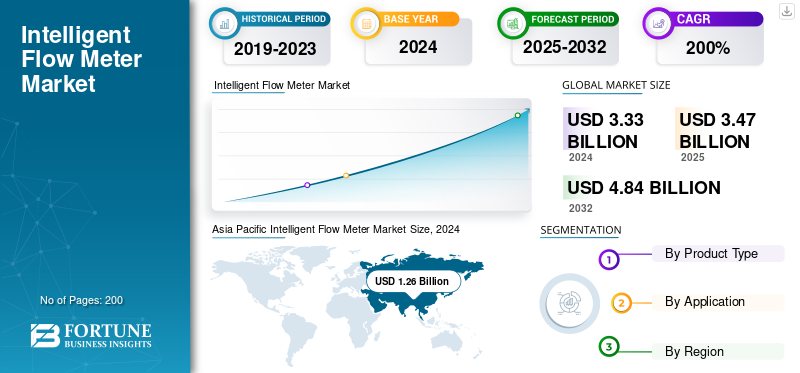
Download Free sample to learn more about this report.
Intelligent Flow Meter Market Key Takeaways
 Market Size & Forecast
- 2025 Market Size: USD 3,460.6 million
- 2026 Market Size: USD 3,615.7 million
- 2034 Forecast Market Size: USD 5,376.6 million
- CAGR: 5.10% from 2026–2034
 Market Share
- Asia Pacific dominated the market with a 37.90% share in 2025.
- Coriolis flow meters are projected to hold a 26.77% share in 2026.
- The industrial segment is projected to account for 63.39% of the market in 2026.
 Key Regional Highlights
North America
North America held a 29.60% market share in 2025, valued at USD 1,024.27 million.
Asia Pacific
Asia Pacific led the market with USD 1,310.4 million in 2025.
Europe
Europe held a 21.40% market share in 2025, valued at USD 739.57 million.
U.S.
The U.S. market is projected to reach USD 742.3 million by 2026.
Japan
The Japan market is projected to reach USD 255.3 million by 2026.
Read More

MARKET DYNAMICS
Market Drivers
Growing Demand for Precision and Automation Drives Market Growth
The market for intelligent flow meters is driven by the growing industrial requirement for reliable and automated flow measurement technology. The oil and gas, water management, energy, and chemical processing industries require real-time and accurate flow measurements to improve processes, decrease operational costs, and comply with regulations related to environmental protection. The adoption of advanced Industry 4.0 practices and smart factory initiatives promotes the integration of intelligent flow meters and IoT, and analytical platforms, allowing for predictive maintenance and operational efficiencies. The rapid product innovation related to sensor technologies and connectivity attributes by major players supports the intelligent flow meter market growth.
Market Restraints
High Costs and Complex Implementation Hinder Growth
Despite strong demand, high installation and calibration costs, along with complex maintenance and integration issues, act as barriers to further expansion of the intelligent flow meters market. Industry requirements for specialized knowledge of these systems for installation and troubleshooting present hurdles for customers in developing areas and small-to-medium-sized enterprises. Existing infrastructure can be a barrier to compatibility, and the need to train staff and provide ongoing technical support can impact operating costs and total cost of ownership. Technological challenges and the upfront capital expenditures required for deployment can delay the adoption of intelligent flow meters, despite realizing the return on investment and efficiency benefits in the future, which further curbs extensive market growth.
Market Opportunities
Technological Advancements and Sustainability Focus Open New Prospects for Growth
Ongoing advances in artificial intelligence, sophisticated sensors, and cloud-based monitoring systems are opening new prospects for growth in the intelligent flow meter market. The increasing demand of industries for precision flow measurement purposes in applications across the oil and gas, water, and energy sectors leads to an uptake in these devices. The development and globalization of sustainable development goals are also inciting industries to embark on the transition toward eco-efficient systems with little to no resource waste. Intelligent flow meters are well-positioned to leverage the potential for data autonomy and optimization, furthering these goals. As industries begin to transition toward smart infrastructure and digital ecosystems, manufacturers have opportunities to develop smart, connected and efficient measurement systems for the intelligent flow meter market.
INTELLIGENT FLOW METER MARKET TRENDS
Digital Integration Driving Smart Measurement Emerges as a Major Market Trend
The global intelligent flow meter market is being significantly influenced by drivers of digital integration and IoT-enabled connectivity. Manufacturers of flow meters are embedding smart sensors, wireless communication modules, and advanced software for analytics and predictive diagnostics. This digital transformation allows operational data to be monitored and reviewed in real time, ensuring improved maintenance, and optimal operational reliability within the industrial context. The market is also moving toward fully automated, self-calibrated systems with minimal downtime and operating costs. As there is greater adoption of Industry 4.0 principles in other industries, intelligent flow systems become integral components in smart measurement environments focused on transparency, accuracy, and sustainable performance controlling practices.
Download Free sample to learn more about this report.
SEGMENTATION ANALYSIS
By Product Type
High Accuracy and Reliability Boosts Coriolis Flow Meter Segment Growth
Based on the product type, the market is segmented into Coriolis flow meter, electromagnetic (Mag) flow meter, ultrasonic flow meter, vortex flow meter, thermal mass flow meter, Differential Pressure (DP) flow meter, turbine flow meter, and Positive Displacement (PD) flow meter.
The Coriolis flow meter segment will hold the largest share of the overall global market with 26.77% of share in 2026. The increase in revenue is driven by its high accuracy, reliability, and ability to measure mass flow directly across various fluids. Its increasing adoption in oil & gas, chemical, and food & beverage industries for precise flow and density measurement drives its rapid expansion globally.
Of all the segments, Coriolis flow meter segment holds the highest CAGR of 6.1% in the global market. The growth is mainly due to their superior measurement accuracy, ability to handle various fluid types such as liquids, gases, slurries, and low maintenance requirements. Their rising adoption in oil & gas, chemical, and food processing industries for precise mass flow and density measurement further accelerates demand.
By Application
To know how our report can help streamline your business, Speak to Analyst
Industrial Segment Leads Market Owing to Its High Demand for Precise and Reliable Flow Measurement
Based on application, the market is divided into industrial, commercial, and residential. The industrial segment is further divided into oil and gas, chemicals and petrochemicals, power generation, food and beverages, water and wastewater, pharmaceuticals and biotechnology, pulp, paper, and textile, and others (mining, etc.).
The industrial segment will dominates with an intelligent flow meter market share with 63.39% of share in 2026. The segment’s growth is attributable to its high demand for precise and reliable flow measurement across applications such as oil & gas, chemical processing, power generation, and water treatment. These industries rely on automation, process optimization, and real-time monitoring to enhance efficiency, reduce downtime, and ensure regulatory compliance, all of which drive the extensive adoption of intelligent flow meters.
Commercial sector has the maximum CAGR of 5.9% in the market. The segment’s growth is mainly due to increasing deployment of smart water and energy management systems in commercial buildings, hospitals, and data centers. Rising emphasis on sustainability, leak detection, and efficient resource utilization is also fueling the demand for intelligent flow meters in this segment.
INTELLIGENT FLOW METER MARKET REGIONAL ANALYSIS
Geographically the market is segmented into North America, Europe, Asia Pacific, South America and Middle East & Africa.
North America
Asia Pacific Intelligent Flow Meter Market Size, 2025 (USD Million) To get more information on the regional analysis of this market, Download Free sample
The North America market is rapidly expanding. In 2025, the North America market stood at USD 1024.27 Million, representing 29.60% of global demand, and is projected to grow to USD 1080.6 Million in 2026. The region’s growth is attributable to rapid adoption of advanced flow measurement technologies, strong presence of key manufacturers, and increasing investments in industrial automation and digitalization. Additionally, strict regulatory standards for water and energy efficiency drive continuous upgrades to intelligent flow systems.
The U.S. market is projected to reach USD 742.3 million by 2026. The growth of the country’s market is attributable to strong industrial automation, infrastructure upgrades, and regulatory compliance.
Europe
The Europe region captured 21.40% of the global market in 2025, generating USD 739.57 Million in revenue, and is projected to reach USD 761.75 Million in 2026. The region’s growth is attributable to energy-saving regulations, Industry 4.0 adoption, and the digitalization of industries. Key growth drivers include stringent environmental rules such as the EU's Green Deal and the Water Framework Directive, along with a demand for smarter utility infrastructure and process optimization in sectors such as chemical manufacturing, oil and gas, and water/wastewater treatment.
The UK market is projected to reach USD 147.8 million by 2026, while the Germany market is projected to reach USD 187.3 million by 2026.
Asia Pacific
Asia Pacific is currently at the forefront of the global market. Asia Pacific maintained a strong presence in the global market, reaching USD 1310.36 Million in 2025, accounting for 37.90% share, and is expected to reach USD 1373.26 Million in 2026. The region’s growth is attributable to expanding industrial base, rising infrastructure development, and increasing demand for water and energy management across countries such as China, India, and Japan. The region’s growing manufacturing and process industries further boost large-scale deployment of intelligent flow meters.
The Japan market is projected to reach USD 255.3 million by 2026, the China market is projected to reach USD 555 million by 2026, and the India market is projected to reach USD 181.5 million by 2026.
Middle East & Africa and Latin America
The Middle East & Africa market accounted for USD 187.44 Million in 2025, representing 5.40% of the global industry, and is expected to reach USD 195.5 Million in 2026. The growth is attributable to the increasing demand for accurate measurement and monitoring in various industries such as oil & gas, and water and wastewater treatment. In 2025, Latin America represented USD 198.99 Million, accounting for 5.80% of the worldwide market, and is projected to grow to USD 204.56 Million in 2026.
GCC countries are predicted to have a market share of USD 0.09 billion by 2025.
COMPETITIVE LANDSCAPE
Key Industry Players
Key Players Employ Various Strategies to Lead the Industry
The key players in the industry include Endress+Hauser, Siemens, Emerson Electric, ABB, Yokogawa Electric, Azbil Corporation, and Badger Meter. The players are employing strategies focused on technological advancement, integration of digital features such as real-time data and advanced diagnostics, and expanding into high-growth sectors to capitalize on the increasing demand for precise flow measurement. Other strategies include expanding product portfolios and adapting to specific industry needs like those in the oil & gas and wastewater treatment sectors.
LIST OF KEY INTELLIGENT FLOW METER COMPANIES PROFILED
- Endress+Hauser (Switzerland)
- Siemens (Germany)
- Emerson Electric (U.S.)
- ABB (Switzerland)
- Yokogawa Electric (Japan)
- Azbil Corporation (Japan)
- Badger Meter (U.S.)
- Krohne Messtechnik (Germany)
- Schneider Electric (France)
- Honeywell International (U.S.)
- Brooks Instrument (U.S.)
- EBTRON Inc. (U.S.)
KEY INDUSTRY DEVELOPMENTS
- July 2025- Yokogawa India Limited (YIL), a leading name in industrial automation and process control, proudly marked a significant milestone with the first delivery of its next-generation AXG magnetic flowmeters in Maharashtra.
- May 2025- MLCan is on a mission to revolutionize the oil and gas industry with their flow measurement solution. Powered by AI, their smart flow meter is designed to help oil and gas producers access real-time data to make better decisions.
- August 2024- ABB launched its latest generation of electromagnetic flowmeters bringing unmatched accuracy, connectivity and flexibility to industrial and utility applications. With this launch, ABB streamlines its product portfolio, converging on two highly versatile and advanced products – ProcessMaster and AquaMaster. The products combine high performance, modularity and IoT connectivity.]
- August 2024- State-owned PT Pertamina Geothermal Energy launched Flow2Max, a technological breakthrough that allows for the real-time measurement of two-phase fluid streams in geothermal facilities. Flow2Max is the world’s first flow meter capable of providing more reliable, easy, real-time, accurate, flexible, and dependable measurement of two-phase (liquid and vapor) fluid flow. It enables companies to evaluate well performance more regularly, predict production well productivity, and detect technical problems in wells early.
- April 2024- ABB launched ProcessMaster FEW630, a new robust and easy to use electromagnetic flowmeter for municipal and industrial water and wastewater flow measurement. With this launch, ABB simplifies the selection, operation, maintenance and servicing of its electromagnetic flowmeters in response to the evolving needs of the water and wastewater industry.
- August 2023- Emerson agreed to acquire a Germany-based maker of flow metering devices to enhance its intelligent devices portfolio.
- May 2021- Ecolab, a water, hygiene and infection prevention solutions and services company, launched Water Flow Intelligence, a digital service that it says provides industry with real-time visibility of water usage at the enterprise, site and asset levels. Water Flow Intelligence aims to enable food and beverage producers to identify opportunities that help improve water management across their operations, deliver on sustainability goals and reduce operational costs by combining smart water meters and sensors with advanced water flow measurement and monitoring, asset performance insights and machine learning.
REPORT COVERAGE
The global intelligent flow meter market report provides a detailed analysis of the market and focuses on key aspects such as prominent companies, deployment modes, types, and end users of the product. Besides this, it offers insights into the market trends and highlights key industry developments and market share analysis for key companies. In addition to the aforementioned factors, the report encompasses several factors that have contributed to the growth of the market over recent years.
Request for Customization to gain extensive market insights.
Report Scope & Segmentation
|
ATTRIBUTE |
DETAILS |
|
Study Period |
2021-2034 |
|
Base Year |
2025 |
|
Estimated Year |
2026 |
|
Forecast Period |
2026-2034 |
|
Growth Rate |
CAGR of 5.10% from 2026-2034 |
|
Historical Period |
2021-2024 |
|
Unit |
Value (USD Billion) |
|
Segmentation |
By Product Type
By Application Industrial
By Region North America (By Product Type, Application and Country/Sub-region)
Europe (By Product Type, Application and Country/Sub-region)
Asia Pacific (By Product Type, Application and Country/Sub-region)
South America (By Product Type, Application and Country/Sub-region)
Middle East & Africa (By Product Type, Application and Country/Sub-region)
|
Frequently Asked Questions
Fortune Business Insights says that the global market stood at USD 3460.6 million in 2025 and is projected to reach USD 5,376.60 million by 2034.
The market is expected to exhibit steady growth at a CAGR of 5.10% during the forecast period.
Rising demand for precision and automation is speeding up the market growth.
Endress+Hauser, Siemens, Emerson Electric, ABB, Yokogawa Electric, Azbil Corporation, and Badger Meter are some of the top players in the market.
The Asia Pacific region held the largest market share.
Asia Pacific was valued at USD 1310.4 million in 2025.


- 2021-2034
- 2025
- 2021-2024
- 200
Get 30-60 hrs Free Customization
Expand Regional and Country Coverage, Segments Analysis, Company Profiles, Competitive Benchmarking, and End-user Insights.















-
US +1 833 909 2966 ( Toll Free )
-
Get In Touch With Us