International Express Delivery Market Size, Share & Industry Analysis, By Service Type (Document Express, Parcel/Package Express, and Heavy/Freight Express), By End-user Industry (E-commerce, Manufacturing, Healthcare, Automotive, and Others), By Mode of Transport (Air, Road, and Waterways), By Delivery Speed Tier (Same-day, Next-day, and Deferred), By Consumer Type (B2B, B2C, and C2C), and Regional Forecast, 2026-2034
 Download Free Sample
(Offer valid till 15th Oct 2026)

KEY MARKET INSIGHTS
 Listen to Audio Version
The global international express delivery market size was valued at USD 67.47 billion in 2025 and is projected to grow from USD 72.50 billion in 2026 to USD 138.44 billion by 2034, exhibiting a CAGR of 8.4% during the forecast period. Asia Pacific dominated the market, accounting for 45.81% of the market share in 2025.
International express delivery refers to the fast, time-bound transportation of documents, parcels, and goods across international borders using premium courier networks. It offers expedited pickup, customs clearance, tracking, and guaranteed delivery timelines. Businesses and consumers use these services for urgent, high-value, or time-sensitive shipments globally.
The market is driven by rising cross-border e-commerce, demand for fast shipping, global trade expansion, supply chain digitalization, improved logistics infrastructure, and customer expectations for real-time tracking. Additionally, SME exports, premium service adoption, and growth in time-sensitive sectors such as healthcare and electronics strengthen market growth.
Key players in the global market include DHL Express, FedEx Corporation, UPS, SF Express, and Aramex. These international delivery service providers focus on expanding cross-border networks, improving last-mile delivery, and enhancing tracking visibility. Investments in automation, air cargo capacity, digital customs clearance, and sustainable global logistics solutions strengthen their competitiveness. Strategic partnerships with e-commerce platforms and technology providers support faster, more reliable global delivery services.
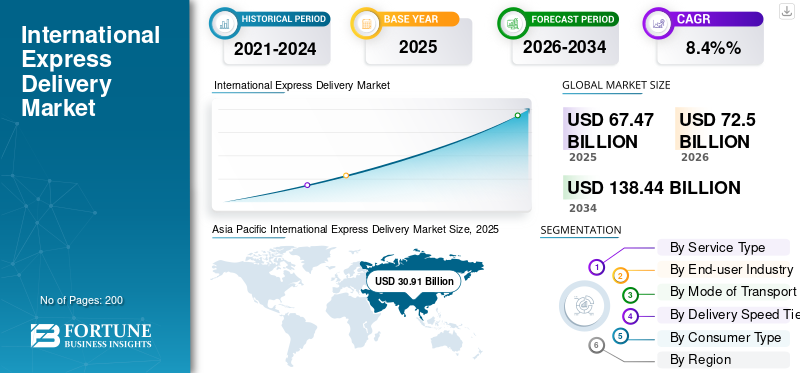
Download Free sample to learn more about this report.
International Express Delivery Market Key Takeaways
 Global Market Size & Forecast
- 2025 Market Size: USD 67.47 billion
- 2026 Market Size: USD 72.50 billion
- 2034 Forecast Market Size: USD 138.44 billion
- CAGR: 8.4% from 2026–2034
 Market Share
- Asia Pacific dominated the international express delivery market with a 45.81% share in 2025.
- Parcel/package express segment held the leading position due to strong cross-border parcel demand.
- E-commerce segment dominated the market with rising global online retail shipments.
 Key Regional Highlights
Asia Pacific
Asia Pacific generated USD 30.91 billion in 2025 and remained the largest and fastest-growing regional market.
Europe
Europe held the second-largest market share, supported by strong cross-border trade and integrated logistics networks.
North America
North America maintained a significant market share, driven by robust B2B demand and advanced logistics infrastructure.
U.S.
Growth supported by e-commerce exports and logistics infrastructure.
Japan
Growth driven by digital adoption and efficient delivery networks.
Read More

MARKET DYNAMICS
MARKET DRIVERS:
Rising Cross-Border E-Commerce Volumes Accelerate Express Delivery Demand
Growing global e-commerce activity is significantly increasing cross-border parcel delivery flows, driving sustained demand for fast, predictable, and trackable international courier services. Consumers expect shorter delivery windows, while brands and SMEs rely on express networks to reach international buyers without operating local warehouses. This shift reshapes fulfilment models and strengthens reliance on premium delivery solutions.
As marketplaces expand global seller programs and international shopping events scale, the volume of small parcels requiring express shipping services continues to surge, reinforcing long-term market growth. In August 2025, India’s Ministry of Commerce invited proposals to establish e-commerce export hubs aimed at small and medium exporters and artisans, offering integrated services such as customs clearance, packaging, and off-port warehousing to streamline cross-border shipping. This is expected to boost the international express delivery market growth in the coming years.
MARKET RESTRAINTS:
High Operational and Air-Freight Costs Limit Service Adoption
Elevated transportation costs, including fuel charges, constrain the fast international courier market. These cost pressures make express services expensive for price-sensitive shippers, particularly SMEs and low-margin exporters. Fluctuating air-cargo capacity and geopolitical disruptions further increase operational expenses for carriers. As a result, some users opt for economy services or deferred shipping, limiting mass-market adoption and moderating the overall expansion of premium express delivery offerings.
MARKET OPPORTUNITIES:
Digitalization and Automated Fulfilment Enable Scalable Global Delivery
Rapid adoption of automation, robotics, AI-driven routing, and digital customs systems presents a major opportunity for express carriers to enhance speed, accuracy, and scalability. Automated hubs improve parcel and document express services, while predictive analytics optimize aircraft loading, route planning, and delivery timelines. Digital trade documentation and integrated cross-border compliance tools make international shipping and logistics more accessible for SMEs.
As more businesses digitize their supply chains and e-commerce expands, express carriers can leverage these technologies to create differentiated, high-efficiency international express delivery solutions. In January 2025, Amazon announced major upgrades to its delivery operations, integrating AI-driven logistics, advanced predictive systems, and new warehouse robots to accelerate order processing, reduce delays, and improve global fulfillment speed as shipment volumes increase.
MARKET CHALLENGES:
Limited Air-Cargo Capacity and Network Congestion Restrict Service Reliability
International express delivery heavily depends on reliable air-cargo capacity, yet global networks face constraints from ageing freighter fleets, airport congestion, irregular belly-hold availability, and geopolitical airspace restrictions. Weather disruptions and peak-season surges further pressure capacity, causing delays and increased operating costs. Carriers must invest significantly in aircraft, long-term charters, and hub expansion to maintain service consistency. These constraints make scalability difficult during high-demand periods and pose a long-term challenge to operational resilience.
INTERNATIONAL EXPRESS DELIVERY MARKET TRENDS:
Shift toward Time-Definite and Premium Cross-Border Services is a Key Market Trend
A growing portion of global shippers now prioritize time-definite, next-day, and two-day international express delivery options, reflecting rising customer expectations and competitive pressure on retailers. This trend is supported by the expansion of air-freighter fleets, improved international parcel tracking systems, and enhanced network optimization. Direct-to-consumer brands increasingly use premium express tiers to strengthen customer experience and reduce cart abandonment.
As convenience becomes a core buying factor, carriers continue shifting focus toward guaranteed delivery windows and premium-tier service differentiation. In June 2024, FedEx Express introduced new time-definite international express delivery options, giving businesses greater flexibility with clearly defined delivery windows. The enhanced service aims to support international export and import services, streamline cross-border shipments, and meet rising demand for predictable, premium express delivery solutions across key global trade lanes.
Download Free sample to learn more about this report.
Segmentation Analysis
By Service Type
Extensive Cross-Border Small-Parcel Demand Sustains Parcel/Package Express Segment Dominance
Based on service type, the market is segmented into document express, parcel/package express, and heavy/freight express.
The parcel/package express segment represents both the dominating and fastest-growing service type in the global market. Its dominance stems from its ability to efficiently manage large volumes of lightweight, time-sensitive cross-border shipments supported by well-established international air networks, automated sorting hubs, and reliable international last-mile delivery infrastructure.
At the same time, it records the highest growth rate as expanding e-commerce activity, rising direct-to-consumer exports, and increasing SME participation accelerate demand for rapid, trackable, and premium international parcel-delivery solutions. In January 2022, FedEx Express launched International Priority Express service, offering businesses early-day cross-border delivery windows by 10:30 a.m. or noon to select destinations and enhancing the flexible, time-critical shipping market for exporters and e-commerce sellers.
By End-user Industry
Surging Global Online Retail Activity Propels E-Commerce Segment Growth
Based on end-user industry, the market is categorized into e-commerce, manufacturing, healthcare, automotive, and others.
The e-commerce segment is both the dominating and fastest-growing end-user industry in the global market. Its dominance is driven by high volumes of e-commerce cross-border shipping, rapid order fulfillment requirements, and strong consumer expectations for fast, trackable international express delivery. Simultaneously, it records the highest growth as digital retail penetration rises, direct-to-consumer brands expand globally, and marketplaces increasingly rely on express networks to ensure reliable, time-bound international parcel movements. In November 2024, Amazon expands its cross-border logistics programme, the global selling seller exports and delivery (SEND). The company launched an Export Navigator feature in its dashboard to assist sellers with all compliance requirements related to overseas shipment.
To know how our report can help streamline your business, Speak to Analyst
By Mode of Transport
Road Segment Leads Due to Extensive Regional Connectivity and Flexibility
By mode of transport, the market is segmented into air, road, and waterways.
The road segment dominates the market due to its extensive cross-border connectivity, cost efficiency for short and mid-haul routes, and flexibility in handling frequent parcel movements across neighboring countries. Its ability to support dense delivery networks, enable rapid ground-based customs clearance, and provide reliable door-to-door international shipping services strengthens its leading position. Road transport remains the preferred mode for regional express shipments where time sensitivity aligns with ground transit capabilities.
Air is the fastest-growing mode in the global market. The segment is driven by rising demand for expedited cross-border deliveries, international freight forwarding, increasing e-commerce exports, and the need for guaranteed time-bound international parcel movement enabled by global air cargo and express freighter networks. In May 2025, Air India launched its Airport-to-Door international cargo transportation of pharmaceuticals. The shipment is aimed to be delivered to Brussels, in cold storage, and maintain the effectiveness of the pharmaceuticals.
By Delivery Speed Tier
Deferred Segment Commands Owing to Cost Efficiency and High Volume Handling
By delivery speed tier, the market is segregated into same-day, next-day, and deferred.
The deferred segment dominates the global market as it offers a balanced combination of cost efficiency and reliable cross-border transit for non-urgent parcels. It supports high shipment volumes for businesses prioritizing affordability over speed, especially in B2B and bulk e-commerce exports. Established multimodal networks, optimized routing, and predictable delivery windows reinforce its leading share by aligning with customer segments that value economical international shipping without stringent time constraints.
Same-day international delivery is the fastest-growing tier, fueled by rising expectations for ultra-rapid cross-border fulfillment, expanding premium e-commerce services, and increased adoption of expedited shipping by brands seeking competitive differentiation. In September 2025, Allcargo Gati launched a 24-hour air-express delivery service across eight Indian metro cities, enabling same-day and night international routes, expedited processing for e-commerce exports, and improved competitiveness in time-sensitive logistics.
By Consumer Type
B2B Segment Dominates Due to High Shipment Value and Recurring Cross-Border Trade
Based on consumer type, the market is categorized into B2B, B2C, and C2C.
The B2B segment dominates the market as businesses consistently require reliable, time-bound movement of high-value components, samples, spare parts, and contract-based shipments. Its leadership is supported by structured supply chains, predictable shipping cycles, and the need for strict documentation, compliance, and end-to-end visibility. Manufacturers, distributors, and service providers rely on express networks for operational continuity, international procurement efficiency, and urgent replenishment, reinforcing the dominant share of B2B users in global express delivery demand.
The C2C segment is the fastest growing, driven by rising global gifting, second-hand marketplace activity, and increased consumer participation in cross-border resale and personal shipping. In June 2024, JD Logistics and Geopost partnered to enhance international express services with a focus on strengthening C2C cross-border parcel movements. The collaboration expands network connectivity, improves delivery speed, and supports growing consumer demand for reliable global personal-to-personal shipments.
International Express Delivery Market Regional Outlook
By geography, the market is categorized into Europe, North America, Asia Pacific, and the Rest of the World.
Asia Pacific International Express Delivery Market Size, 2025 (USD billion)
To get more information on the regional analysis of this market, Download Free sample
Asia Pacific
Asia Pacific leads and grows fastest in the global market due to massive e-commerce volumes, strong manufacturing exports, dense SME trade participation, and rapidly expanding cross-border retail activity. China, Japan, India, and Southeast Asia contribute significantly through rising digital adoption and increasing consumer preference for fast, trackable deliveries.
Extensive air-cargo expansion, growing fulfillment centers, and strengthened regional logistics corridors further accelerate market growth, positioning Asia Pacific as the core engine of global express delivery demand. In November 2025, FedEx Corporation released survey findings revealing that 85% of Asia Pacific SMEs plan to begin or expand trade with Europe over the next two years, while it also announced adding five new weekly flights linking Asia Pacific and Europe to support this growth.
Europe
Europe represents the second-largest international express delivery market share, supported by mature cross-border trade flows, integrated regional logistics frameworks, and strong regulatory standardization across the EU. High consumer preference for reliable international express delivery, well-developed road and air networks, and strong parcel volumes from fashion, electronics, and luxury sectors sustain its market position.
E-commerce penetration, inter-EU shipment consolidation, and stable B2B demand contribute to steady growth, though expansion remains moderate compared to the Asia Pacific due to market maturity and slower demographic growth. In September 2025, EuroCommerce reported renewed growth in European e-commerce, highlighting the sector’s resilience amid shifting consumer behavior and regulatory changes. The update noted stronger cross-border parcel activity and increasing retailer investment in digital fulfilment to support faster, more reliable online delivery across the region.
North America
North America maintains a significant share, driven by strong express delivery adoption among enterprises, robust B2B demand, and high e-commerce export activity. Advanced air-cargo networks, technology-driven last-mile systems, and large-scale automated hubs enhance operational efficiency across the region. Growth is supported by increasing cross-border trade with the Asia Pacific and Europe, rising SME exports, and expanding premium delivery services.
The region shows steady expansion, though overall growth rates are moderate compared to the Asia Pacific due to higher market maturity. In July 2024, XPO, Inc. launched the XPO Mexico Plus service, significantly expanding cross-border LTL (less-than-truckload) operations between the U.S. and Mexico by increasing capacity, covering around 99.0% of Mexican postal codes, adding real-time tracking, and seven new border-crossing points.
The U.S. dominates the North American market due to its vast export base, advanced digital logistics infrastructure, and strong adoption of premium delivery services. High outbound parcel flows from the technology, healthcare, and retail sectors drive sustained demand. Major express carriers operate large hubs and air fleets within the U.S., enabling faster global connectivity. E-commerce sellers, DTC brands, and industrial shippers increasingly use international express networks, reinforcing the country’s leadership position within the region.
Rest of the World
The rest of the World, including South America, the Middle East & Africa, experiences steady growth supported by rising cross-border retail activity, improving logistics infrastructure, and increasing digital payment adoption. The market expansion in the region is driven by growing demand for reliable parcel movement from developing economies and enhanced air express delivery services.
Although structural challenges remain, such as uneven customs processes and capacity limitations, ongoing investment in logistics corridors and airport modernization continues to gradually strengthen the region’s participation in global express delivery flows. In April 2025, Emirates launched Emirates Courier Express, a new global express delivery service offering time-definite shipping, real-time tracking, and rapid cross-border parcel movement. The service leverages Emirates SkyCargo’s extensive network to support growing demand for premium international express deliveries.
COMPETITIVE LANDSCAPE
Key Industry Players:
Global Network Expansion and Premium Cross-Border Capabilities Shape Competitive Landscape
The global international express delivery market features a concentrated competitive landscape, with leaders such as DHL Express, FedEx Corporation, UPS, SF Express, and Aramex commanding the majority of global coverage and premium service contracts. These global express logistics companies continuously expand global air-freight capacity, invest in automated hubs, and enhance digital customs-clearance systems.
Strategic alliances with e-commerce platforms and regional logistics firms, and international delivery service providers, support localized fulfilment, lower cost-to-serve, and differentiated service tiers. In April 2025, Mayple Global signed a partnership with Emirates Courier Express to enhance cross-border delivery capabilities, enabling faster parcel movement, expanded international coverage, and improved logistics support for businesses seeking reliable global shipping services.
LIST OF KEY INTERNATIONAL EXPRESS DELIVERY COMPANIES PROFILED:
- DHL Express (Germany)
- FedEx Express (U.S.)
- UPS (U.S.)
- SF Express (China)
- JD Logistics (China)
- YTO Express International (China)
- China Postal Express & Logistics (China)
- Aramex (UAE)
- Geopost (France)
- TNT Express (Netherlands)
- Japan Post EMS (Japan)
- Yamato Transport (Japan)
- CJ Logistics (South Korea)
- Australia Post (Australia)
- Canada Post (Canada)
- Singapore Post (Singapore)
- Saudi Post (Saudi Arabia)
- Pos Malaysia (Malaysia)
- Correos Express (Spain)
- Poste Italiane (Italy)
- S. Postal Service USPS (U.S.)
- Qatar Post (Qatar)
KEY INDUSTRY DEVELOPMENTS:
- May 2026: DHL Express expanded its Time Definite International portfolio with Heavy Weight Express (HWX), supporting shipments up to 1,000 kilograms per piece and 3,000 kilograms per shipment across more than 220 countries and territories. The strategic objective was to address heavyweight express demand. Capabilities involved included dedicated aviation, ground handling, shipment control, and predictable transit management for international express delivery.
- March 2026: Federal Express Corporation (FedEx) expanded its collaboration with Japan Post by managing air transportation, customs clearance, and final delivery for Japan Post’s U-Global Express shipments to the United States and Canada. The strategic objective was to support Japan’s cross-border e-commerce flows. Capabilities involved included international air transport, customs clearance, domestic pickup, final-mile delivery, and international express delivery.
- In October 2025, Emirates SkyCargo opened a new operations centre at Kochi airport in India, strengthening international cargo connectivity to the Middle East and Europe. The facility is expected to boost textile exports and encourage more international courier services and freight forwarders to use Kochi as a regional logistics hub while easing congestion at larger nearby airports.
- In August 2025, Mayple Global announced a strategic partnership with Emirates Courier Express, using a hub and spoke logistics model in Dubai to centralise American brands’ inventory and ship parcels worldwide via Emirates aircraft. The collaboration offers faster, more cost-efficient cross-border delivery for U.S. e-commerce merchants, while simplifying fulfillment operations and returns management.
- In June 2025, DHL announced changes to its international small package and parcel services for private customers in Germany, including aligning small package zones with parcel zones and launching a new online-only up to 2-kilogram parcel product for non-EU destinations. The update clarifies pricing and options for light cross-border shipments, popular with occasional shippers.
- In December 2024, JD Logistics agreed to acquire the remaining 36.43% stake in Kuayue Express Group for approximately CNY 6.48 billion (USD 891.9 million), consolidating its ownership of the time-sensitive express carrier. The deal is intended to integrate resources, cut costs, and improve operational efficiency across JD’s freight and express delivery network, strengthening competitiveness in China’s express sector.
REPORT COVERAGE
The global international express delivery market analysis provides an in-depth study of the market size & forecast by all the market segments included in the report. It includes details on the market dynamics and market trends expected to drive the market over the forecast period. It offers information on the technological advancements, new product launches, key automotive industry developments, and details on partnerships, mergers & acquisitions. The market report scope also encompasses a detailed competitive landscape with information on the market share and profiles of key operating players.
Request for Customization to gain extensive market insights.
Report Scope & Segmentation
| ATTRIBUTE | DETAILS |
| Study Period | 2021-2034 |
| Base Year | 2025 |
| Forecast Period | 2026-2034 |
| Historical Period | 2021-2024 |
| Growth Rate | CAGR of 8.4% from 2026 to 2034 |
| Unit | Value (USD Billion) |
| Segmentation | By Service Type, By End-user Industry, By Mode of Transport, By Delivery Speed Tier, By Consumer Type, and By Region |
| By Service Type |
|
| By End-user Industry |
|
| By Mode of Transport |
|
| By Delivery Speed Tier |
|
| By Consumer Type |
|
| By Region |
|
Frequently Asked Questions
Fortune Business Insights says that the global market value stood at USD 67.47 billion in 2025 and is projected to reach USD 138.44 billion by 2034.
In 2025, the market value stood at USD 30.91 billion.
The market is expected to exhibit a CAGR of 8.4% during the forecast period of 2026-2034.
The e-commerce segment led the market by end-user industry.
Cross-border e-commerce, global trade expansion, and digitalization are the primary drivers.
Key players in the global international express delivery market include DHL Express, FedEx Corporation, UPS, SF Express, and Aramex.
Asia Pacific held the largest share in the market in 2025.



- 2021-2034
- 2025
- 2021-2024
- 200
-
(Offer valid till 15th Oct 2026)
Get 30-60 hrs Free Customization
Expand Regional and Country Coverage, Segments Analysis, Company Profiles, Competitive Benchmarking, and End-user Insights.




















-
US +1 833 909 2966 ( Toll Free )
-
Get In Touch With Us