Interstitial Lung Disease Treatment Market Size, Share & Industry Analysis, By Drug Class (Tyrosine Kinase Inhibitors, Pyridones, Corticosteroids, Immunosuppressants, Monoclonal Antibodies, Prostacyclin Analogues), By Disease Indication (Idiopathic Pulmonary Fibrosis, Progressive Pulmonary Fibrosis, Systemic Sclerosis-associated ILD), By Age Group (Pediatric and Adults), By Type (Branded and Generic), By Route of Administration (Oral and Parenteral), By Distribution Channel (Hospital Pharmacies, Retail Pharmacies/Drug Stores, Online Pharmacies), and Regional Forecast, 2026-2034
 Download Free Sample
Interstitial Lung Disease Treatment Market Size and Future Outlook
 Listen to Audio Version
The global interstitial lung disease treatment market size was valued at USD 5.88 billion in 2025. The market is projected to grow from USD 6.47 billion in 2026 to USD 11.30 billion by 2034, exhibiting a CAGR of 7.22% during the forecast period. North America dominated the interstitial lung disease treatment market with a market share of 42.86% in 2025.
The global interstitial lung disease treatment market refers to the treatment landscape for a wide group of lung disorders that cause inflammation, scarring, and progressive loss of lung function. The market is gaining momentum as Interstitial Lung Diseases (ILDs) are often progressive and can lead to irreversible lung damage if not treated early. As awareness improves and high-resolution imaging becomes more widely used, more patients are being identified at earlier stages, increasing demand for long-term treatment. Additionally, the limited ability of existing therapies to fully stop or reverse fibrosis is encouraging companies to develop new treatment options. This is creating a stronger pipeline and expanding the commercial opportunity for companies active in antifibrotic and pulmonary fibrosis therapies.
- For instance, in October 2025, Boehringer Ingelheim announced that the U.S. FDA approved JASCAYD (nerandomilast) tablets for adults with idiopathic pulmonary fibrosis. The approval was based on two clinical trials that showed a reduction in forced vital capacity decline versus placebo, making it the first new treatment option for IPF in more than a decade. The development highlighted how companies are focusing on therapies that can slow lung function decline and address the high unmet need in fibrotic lung diseases.
Key players, such as Boehringer Ingelheim International GmbH, United Therapeutics Corporation, F. Hoffmann-La Roche Ltd, and Liquidia Corporation, are actively pursuing pipeline development, regulatory approvals, strategic collaborations and acquisitions, and investment initiatives to expand their market presence.
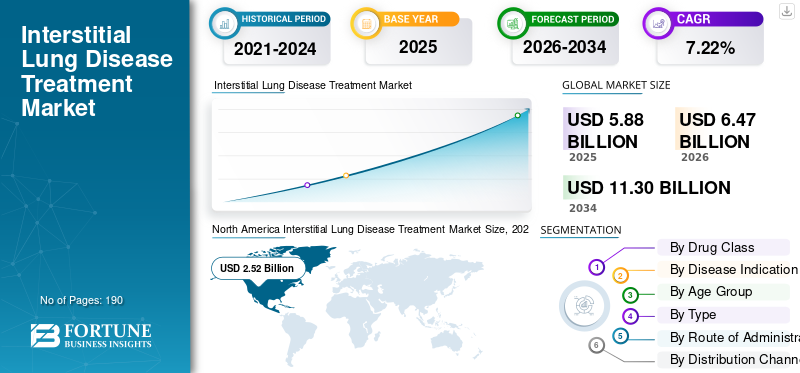
Download Free sample to learn more about this report.
Interstitial Lung Disease Treatment Market Key Takeaways
 Global Market Size & Forecast
- 2025 Market Size: USD 5.88 billion
- 2026 Market Size: USD 6.47 billion
- 2034 Forecast Market Size: USD 11.30 billion
- CAGR: 7.22% from 2026–2034
 Market Share
- North America dominated the interstitial lung disease treatment market with a market share of 42.86% in 2025.
- The others segment is expected to grow at a CAGR of 16.41% over the forecast period.
- The online pharmacies segment is projected to grow at a CAGR of 12.48% over the forecast period.
 Key Regional Highlights
North America
North America held the dominant interstitial lung disease treatment market share in 2024, valued at USD 2.31 billion, and maintained its leading position in 2025 with USD 2.52 billion.
Europe
Europe is projected to grow at 6.34% over the forecast period, making it the second-highest region across the region. The market is expected to reach a valuation of USD 15.62 billion in 2026.
Asia Pacific
The regional market is expected to reach USD 1.18 billion in 2026, supported by expanding respiratory care infrastructure and increasing availability of branded treatment options.
U.S.
The U.S. market is estimated to reach around USD 2.55 billion in 2026, accounting for around 39.42% of the global sales.
Japan
The Japanese market in 2026 is poised to reach around USD 0.42 billion, accounting for approximately 6.42% of the global sales.
Read More

INTERSTITIAL LUNG DISEASE TREATMENT MARKET TRENDS
Increasing Shift Toward the Development of Novel Therapies for Progressive Pulmonary Fibrosis Boosts Market Growth
The global interstitial lung disease treatment market is witnessing a clear shift toward the development of novel therapies for progressive pulmonary fibrosis, as many ILD patients continue to experience worsening lung scarring despite existing treatment options. Progressive pulmonary fibrosis causes a continuous decline in lung function, creating a strong demand for therapies that can slow disease progression, reduce the risk of severe respiratory impairment, and support long-term disease management. As a result, pharmaceutical companies are increasing investment in new antifibrotic and immunomodulatory drugs that target the underlying disease process rather than only managing symptoms.
- For instance, in December 2025, Boehringer Ingelheim announced that the U.S. FDA approved JASCAYD® (nerandomilast) tablets for adults with progressive pulmonary fibrosis. The company stated that JASCAYD is a new treatment option in the U.S. for this debilitating lung condition and is the first and only preferential PDE4B inhibitor with immunomodulatory and antifibrotic effects approved for this indication. This development reflects the market trend toward newer mechanisms of action that aim to slow lung function decline in patients with progressive fibrosing ILDs.
MARKET DYNAMICS
MARKET DRIVERS
Download Free sample to learn more about this report.
Rising Burden of Fibrotic Lung Diseases to Drive Market Growth
The global interstitial lung disease treatment market is growing, as the burden of fibrotic lung diseases continues to increase across major healthcare systems. Conditions such as idiopathic pulmonary fibrosis, progressive pulmonary fibrosis, and autoimmune-associated ILD can cause permanent scarring of lung tissue, which gradually reduces lung capacity and makes breathing difficult. As more patients are diagnosed with progressive and chronic forms of ILD, the need for long-term therapies that can slow lung function decline is rising. This is encouraging greater use of antifibrotic and disease-modifying treatments, while also prompting companies to invest in new therapies that can address unmet needs in severe fibrotic lung diseases.
- For instance, in September 2025, Boehringer Ingelheim announced that the U.S. FDA approved JASCAYD (nerandomilast) tablets as the first new treatment option for adults with idiopathic pulmonary fibrosis in over a decade. The company stated that IPF is a progressive disease that causes a continuous decline in lung function and the approval was supported by clinical trials showing a reduction in forced vital capacity decline versus placebo. This development shows how the rising burden of fibrotic lung diseases is directly supporting demand for new treatment options that can slow disease progression.
MARKET RESTRAINTS
Delayed Diagnosis and Treatment Initiation to Restrict Market Growth
The global interstitial lung disease treatment market faces a major restraint from delayed diagnosis, as ILD symptoms such as breathlessness, chronic cough, fatigue, and reduced exercise tolerance often look similar to other common respiratory diseases. Due to this overlap, patients may initially be treated for asthma, COPD, infection, or cardiac conditions before ILD is confirmed. This delays specialist referral, high-resolution CT imaging, pulmonary function testing, and multidisciplinary evaluation. As a result, many patients begin treatment only after lung fibrosis has already progressed, limiting the clinical benefit of available therapies and reducing timely treatment adoption.
- For instance, in March 2025, Pliant Therapeutics discontinued its Phase 2b/3 BEACON-IPF trial evaluating bexotegrast in patients with idiopathic pulmonary fibrosis after a safety review found higher rates of treatment-emergent adverse events in the treatment arms compared with placebo. This negative development highlights how safety concerns and treatment tolerability issues can slow the progress of new ILD therapies, delay pipeline advancement, and restrict the availability of broader treatment options for patients with fibrotic lung diseases.
MARKET OPPORTUNITIES
Expanding Pipeline of Novel Antifibrotic Therapies to Create New Growth Opportunities
The global interstitial lung disease treatment market is expected to benefit from the expanding pipeline of novel antifibrotic therapies, as current treatment options mainly slow disease progression and do not fully reverse lung scarring. This creates a strong unmet need for therapies with new mechanisms of action, better tolerability, and broader use across idiopathic pulmonary fibrosis and progressive pulmonary fibrosis. As companies advance next-generation antifibrotic and immunomodulatory candidates, the treatment landscape is likely to expand beyond older standard therapies, creating new opportunities for product launches, label expansions, and stronger physician adoption.
- For instance, in September 2025, Boehringer Ingelheim announced that the U.S. FDA approved JASCAYD (nerandomilast) tablets as the first new treatment option for adults with idiopathic pulmonary fibrosis in over a decade. The company stated that JASCAYD is the first and only preferential PDE4B inhibitor approved for IPF and showed a reduction in forced vital capacity decline compared with placebo in clinical trials. This approval highlights how novel antifibrotic mechanisms can create fresh growth opportunities in a market with long-standing unmet treatment needs.
MARKET CHALLENGES
Limited Availability of Curative Treatment Options to Challenge Long-term Market Growth
The global market continues to face a major challenge due to the limited availability of curative treatment options. Most approved therapies for ILD, especially antifibrotic drugs used in idiopathic pulmonary fibrosis and progressive fibrosing ILD, are mainly designed to slow lung function decline rather than reverse existing lung scarring. As a result, patients may continue to experience disease progression even after treatment initiation. This limits treatment satisfaction, increases dependence on supportive care such as oxygen therapy and pulmonary rehabilitation, and creates uncertainty for physicians when managing advanced-stage patients. In turn, the lack of curative therapies restricts broader interstitial lung disease treatment market growth despite the rising disease burden.
- For instance, in June 2025, Pliant Therapeutics announced that it had discontinued development of bexotegrast in idiopathic pulmonary fibrosis following the review of data from its terminated BEACON-IPF Phase 2b/3 clinical trial. This setback reflects the difficulty of developing effective and safe disease-modifying therapies for fibrotic lung diseases. It highlights why limited curative treatment availability remains a key challenge for the ILD treatment market.
Segmentation Analysis
By Drug Class
Tyrosine Kinase Inhibitors Segment Led the Market Due to Strong Disease-modifying Efficacy
Based on drug class, the market is categorized into tyrosine kinase inhibitors, pyridones, corticosteroids, immunosuppressants, monoclonal antibodies, prostacyclin analogs, PDE5 inhibitors, endothelin receptor antagonists, and others.
The tyrosine kinase inhibitors dominated the segment, as nintedanib has become a key antifibrotic therapy for idiopathic pulmonary fibrosis and other progressive fibrosing ILDs. These diseases involve ongoing scarring of lung tissue, and physicians prefer therapies that can slow lung function decline rather than only manage symptoms. As a result, nintedanib’s established clinical efficacy, broad label across fibrotic ILD indications, and strong physician acceptance have reinforced the dominance of the segment in the market.
- For instance, in March 2020, Boehringer Ingelheim announced that the U.S. FDA approved OFEV as the first treatment for chronic fibrosing ILDs with a progressive phenotype. OFEV slowed lung function decline in the Phase III INBUILD trial, supporting its use beyond idiopathic pulmonary fibrosis and further strengthening the position of tyrosine kinase inhibitors in ILD treatment.
The others segment is expected to grow at a CAGR of 16.41% over the forecast period.
To know how our report can help streamline your business, Speak to Analyst
By Disease Indication
Idiopathic Pulmonary Fibrosis Segment Dominated Due to High Disease Burden and Established Treatment and Reimbursement Pathways
Based on disease indication, the market is segmented into idiopathic pulmonary fibrosis, progressive pulmonary fibrosis, systemic sclerosis-associated ILD, autoimmune/connective tissue disease-associated ILD, hypersensitivity pneumonitis-associated ILD, sarcoidosis-associated ILD, and others.
In 2025, the idiopathic pulmonary fibrosis segment dominated the market. It is one of the most recognized, severe, and commercially established forms of ILD. IPF causes progressive and irreversible lung scarring, which creates a strong need for early diagnosis and long-term antifibrotic treatment. Since approved therapies such as pirfenidone and nintedanib were initially developed and commercialized for IPF, this indication has a stronger treatment base, higher physician awareness, and better-defined reimbursement pathways compared with several other ILD subtypes.
- For instance, in April 2026, Cipla received U.S. FDA approval for Nintedanib Capsules (100 mg and 150 mg) for the treatment of idiopathic pulmonary fibrosis. IPF is a chronic, progressive lung disease marked by irreversible scarring of lung tissue and declining lung function. The approvals expand the availability of nintedanib, supporting patient access and reinforcing the growth of the segment.
The progressive pulmonary fibrosis segment is projected to grow at a CAGR of 12.03% during the forecast period.
By Age Group
Adults Segment Led Due to Higher Prevalence of Fibrotic ILDs
Based on age group, the market is segmented into pediatric and adult.
The adults segment held the largest interstitial lung disease treatment share of the market. Most fibrotic ILDs, particularly idiopathic pulmonary fibrosis and progressive pulmonary fibrosis, are more commonly diagnosed in adult and older patient populations. Since adult patients account for the majority of clinically treated ILD cases, pharmaceutical companies largely design pivotal trials, product labels, and commercial access programs around the aging population. This contributes to higher treatment volume among adults as compared with pediatric patients, where occurrence of ILD is rarer, and the treatment pathways are less standardized.
- For instance, in May 2025, Liquidia Corporation announced that the U.S. FDA approved YUTREPIA for adults with pulmonary arterial hypertension and pulmonary hypertension associated with interstitial lung disease.
The pediatric segment is projected to grow at a CAGR of 10.79% during the forecast period.
By Type
Branded Drugs Segment Dominated Due to Strong Clinical Evidence and Physician Preference
Based on type, the market is segmented into branded and generic.
In 2025, the branded drugs segment dominated the market as ILD treatment is largely driven by patented or branded specialty therapies supported by strong clinical trial evidence, regulatory approvals, and physician familiarity. Since fibrotic ILDs are serious and progressive diseases, clinicians generally prefer branded therapies that have proven efficacy in slowing lung function decline or improving exercise ability in ILD-associated complications. This has allowed branded products to maintain stronger pricing, better reimbursement support, and higher market value compared with generic options.
- For instance, in May 2022, United Therapeutics announced that the U.S. FDA approved Tyvaso DPI for the treatment of pulmonary arterial hypertension and pulmonary hypertension associated with interstitial lung disease to improve exercise ability. The approval of a branded dry powder inhaler expanded branded treatment options for ILD complications and reinforced the strong market position of branded specialty therapies.
The generic segment is projected to grow at a CAGR of 11.96% over the forecast period.
By Route of Administration
Oral Segment Dominated Due to Convenience for Long-term ILD Management
Based on route of administration, the market is segmented into oral and parenteral.
Oral therapies dominated the market, as ILD treatment often requires long-term disease management, and oral drugs are easier for patients to use consistently outside hospital settings. Antifibrotic drugs such as nintedanib and pirfenidone are administered orally, which supports wider adoption among patients requiring continuous therapy. This convenience reduces treatment burden, improves suitability for chronic care, and makes oral therapies more practical than parenteral options for many ILD patients.
- For instance, in April 2026, DifGen Pharmaceuticals, in collaboration with Apotex Inc., announced that the U.S. FDA approved generic Nintedanib Soft Gel Capsules (100 mg and 150 mg), therapeutically equivalent to OFEV. The approval expands access to high-quality and more affordable treatment options for patients in the U.S.
The parenteral segment is projected to grow at a CAGR of 10.24% over the forecast period.
By Distribution Channel
Specialty Pharmacies Segment Dominated Due to Specialized Support for High-Cost ILD Therapies
Based on distribution channel, the market is segmented into hospital pharmacies, retail pharmacies/drug stores, online pharmacies, and specialty pharmacies.
In 2025, specialty pharmacies dominated the market as ILD therapies are often high-cost specialty medicines that require reimbursement support, patient education, monitoring, and home delivery coordination. Since patients may need long-term therapy, dose management, adverse event support, and insurance authorization, specialty pharmacies play an important role in improving treatment initiation and continuity. These capabilities make them better suited than conventional retail channels for managing advanced ILD-related therapies.
- For instance, in October 2025, Orsini, a leader in rare disease pharmacy solutions, was selected by Boehringer Ingelheim as a specialty pharmacy partner for JASCAYD (nerandomilast), a phosphodiesterase 4 (PDE4) inhibitor indicated for the treatment of idiopathic pulmonary fibrosis (IPF) in adult patients.
The online pharmacies segment is projected to grow at a CAGR of 12.48% over the forecast period.
Interstitial Lung Disease Treatment Market Regional Outlook
By geography, the market is categorized into Europe, North America, Asia Pacific, Latin America, and the Middle East & Africa.
North America
North America Interstitial Lung Disease Treatment Market Size, 2025 (USD Billion)
To get more information on the regional analysis of this market, Download Free sample
North America held the dominant interstitial lung disease treatment market share in 2024, valued at USD 2.31 billion, and maintained its leading position in 2025 with USD 2.52 billion. The North American market is growing due to strong diagnosis rates, wider access to pulmonologists, and higher adoption of branded antifibrotic and specialty therapies. A broad portfolio of commercially available treatments, better reimbursement policies, and active clinical research further support early treatment initiation and long-term therapy adherence.
U.S. Interstitial Lung Disease Treatment Market
Given North America's substantial contribution and the U.S. dominance in the region, the U.S. market is estimated to reach around USD 2.55 billion in 2026, accounting for around 39.42% of the global sales.
Europe
Europe is projected to grow at 6.34% over the forecast period, making it the second-highest region across the region. The market is expected to reach a valuation of USD 15.62 billion in 2026. Growth is supported by increasing awareness of idiopathic pulmonary fibrosis and progressive pulmonary fibrosis, along with strong specialist networks and guideline-based treatment adoption. Public healthcare systems and rare disease-focused programs are also improving access to advanced ILD therapies.
U.K. Interstitial Lung Disease Treatment Market
The U.K. market is estimated to reach USD 0.38 billion in 2026, accounting for roughly 5.92% of the global sales.
Germany Interstitial Lung Disease Treatment Market
Germany's market is projected to reach approximately USD 0.46 billion in 2026, equivalent to around 7.10% of the global sales.
Asia Pacific
Asia Pacific is estimated to reach USD 1.18 billion in 2026, securing the third-largest position in the market. Regional growth is driven by expanding access to specialty respiratory care and increasing availability of branded therapies.
Japan Interstitial Lung Disease Treatment Market
The Japanese market in 2026 is poised to reach around USD 0.42 billion, accounting for approximately 6.42% of the global sales.
China's Interstitial Lung Disease Treatment Market
China's market is projected to be among the largest worldwide, with revenues standing at around USD 0.44 billion in 2026, accounting for approximately 6.84% of global sales.
India Interstitial Lung Disease Treatment Market
The Indian market is estimated to reach around USD 0.14 billion in 2026, accounting for roughly 2.22% of global revenues.
Latin America and the Middle East & Africa
The Latin America and Middle East & Africa regions are expected to witness growth in this market during the forecast period and are estimated to reach a valuation of USD 0.30 billion. Growth in the region is driven by improving the diagnosis of chronic respiratory diseases and the gradual expansion of specialty care in major countries such as Brazil and Mexico. In the Middle East & Africa, the GCC is set to reach USD 0.09 billion in 2026.
South Africa Interstitial Lung Disease Treatment Market
The South African market is projected to reach approximately USD 0.05 billion in 2026, accounting for roughly 0.76% of global revenues.
COMPETITIVE LANDSCAPE
Key Industry Players
Key Companies Focus on New Product Developments to Maintain their Market Expansion
The global interstitial lung disease treatment market is characterized by the presence of established pharmaceutical companies, specialty respiratory drug developers, and emerging pipeline-focused players. Key companies are focusing on expanding antifibrotic therapy options, improving treatment for pulmonary hypertension-associated ILD, developing inhaled formulations, and advancing novel mechanisms that can slow lung function decline. The market is also witnessing growing investment in oral PDE4B inhibitors, inhaled treprostinil products, inhaled antifibrotics, and disease-modifying pipeline therapies to address the unmet needs of patients with idiopathic pulmonary fibrosis, progressive pulmonary fibrosis, and other fibrotic ILDs.
- For instance, in December 2025, Boehringer Ingelheim received U.S. FDA approval for JASCAYD (nerandomilast) for adults with idiopathic pulmonary fibrosis and progressive pulmonary fibrosis, marking an important development in the treatment landscape with a new oral mechanism for fibrotic lung diseases.
Major players such as Boehringer Ingelheim, United Therapeutics, Roche, and Liquidia Corporation are actively competing through product approvals, pipeline development, formulation improvements, generic launches, and specialty distribution expansion. Companies with established branded antifibrotic products, strong clinical evidence, broad geographic presence, and robust specialty pharmacy support are expected to maintain their leading position in the market. Additionally, rising demand for therapies is encouraging companies to develop differentiated products that improve long-term disease management and strengthen treatment access across major regions.
LIST OF KEY INTERSTITIAL LUNG DISEASE TREATMENT COMPANIES PROFILED
- Boehringer Ingelheim International GmbH (Germany)
- United Therapeutics Corporation (U.S.)
- Hoffmann-La Roche Ltd (Switzerland)
- Liquidia Corporation (U.S.)
- Teva Pharmaceutical Industries Ltd. (Israel)
- Cipla Limited (India)
- Accord Healthcare Ltd.(U.K.)
- Viatris Inc. (U.S.)
- Johnson & Johnson (U.S.)
- Gilead Sciences, Inc. (U.S.)
KEY INDUSTRY DEVELOPMENTS
- May 2026: Quince Therapeutics, Inc. acquired a clinical-stage biotechnology company called Orphai Therapeutics Inc. The acquisition added Orphai’s lead program, LAM-001, an inhaled formulation of rapamycin (mTOR inhibitor) for the treatment of rare pulmonary diseases, to Quince’s development pipeline.
- April 2026: Dexcel Pharma U.S. received approval from its Abbreviated New Drug Application (ANDA) for Nintedanib Capsules (100 mg and 150 mg), the generic equivalent of OFEV (nintedanib) capsules1. Nintedanib is indicated for the treatment of Idiopathic Pulmonary Fibrosis (IPF), a chronic, progressive lung disease.
- January 2026: Brainomix collaborated with Boehringer Ingelheim International GmbH, a leading biopharmaceutical company, to provide objective, quantitative HRCT imaging biomarkers as a co-primary endpoint in the DROP-FPF Phase 3 study evaluating treatments for ILD.
- August 2025: Aurobindo Pharma Limited received U.S. FDA approval for its Abbreviated New Drug Application (ANDA) Pirfenidone Tablets for USP (267 mg and 801 mg), an AB-rated generic equivalent to Esbriet. These tablets are indicated for the treatment of Idiopathic pulmonary fibrosis (IPF).
- October 2024: Liquidia Corporation collaborated with Pharmosa Biopharm (Pharmosa) for the development and commercialization of L606, an inhaled sustained-release formulation of treprostinil being evaluated in a clinical trial for the treatment of pulmonary arterial hypertension (PAH) and pulmonary hypertension associated with interstitial lung disease (PH-ILD).
REPORT COVERAGE
The report provides a detailed global interstitial lung disease treatment market analysis. It focuses on key aspects, including leading companies, major drug classes, disease indications, age groups, therapy types, routes of administration, and distribution channels. It also offers insights into the growing adoption of antifibrotic therapies, corticosteroids, immunosuppressants, pulmonary hypertension therapies, and supportive treatment options for the management of interstitial lung diseases. In addition, the report covers the impact of recent product approvals, pipeline drug development, treatment advancements, and strategic initiatives by key market players. The report further evaluates market trends, drivers, restraints, opportunities, and the competitive landscape across major regions. It also highlights key industry developments, regulatory approvals, and company strategies that are expected to shape the growth of the global market during the forecast period.
Request for Customization to gain extensive market insights.
Report Scope & Segmentation
| ATTRIBUTE | DETAILS |
| Study Period | 2021-2034 |
| Base Year | 2025 |
| Estimated Year | 2026 |
| Forecast Period | 2026-2034 |
| Historical Period | 2021-2024 |
| Growth Rate | CAGR of 7.22% from 2026 to 2034 |
| Unit | Value (USD Billion) |
| Segmentation | By Drug Class, Disease Indication, Age Group, Type, Route of Administration, Distribution Channel, and Region |
| By Drug Class |
|
| By Disease Indication |
|
| By Age Group |
|
| By Type |
|
| By Route of Administration |
|
| By Distribution Channel |
|
| By Region |
|
Frequently Asked Questions
According to Fortune Business Insights, the global market value stood at USD 5.88 billion in 2025 and is projected to reach USD 11.30 billion by 2034.
In 2025, the market value stood at USD 2.52 billion.
The market is expected to grow at a CAGR of 7.22% over the forecast period.
By drug class, the tyrosine kinase inhibitors segment led the market.
Rising burden of fibrotic lung diseases is a key factor driving the market.
Boehringer Ingelheim International GmbH, United Therapeutics Corporation, F. Hoffmann-La Roche Ltd, and Liquidia Corporation are among the top players in the global market.
North America dominated the market in 2025.



- 2021-2034
- 2025
- 2021-2024
- 190
Get 30-60 hrs Free Customization
Expand Regional and Country Coverage, Segments Analysis, Company Profiles, Competitive Benchmarking, and End-user Insights.













.webp)






-
US +1 833 909 2966 ( Toll Free )
-
Get In Touch With Us