Intra Abdominal Pressure Measurement Devices Market Size, Share & Industry Analysis, By Product (Disposables and Equipment), By Procedure (Muscle and Abdomen), By Application (Intra-compartment Pressure and Intra-abdominal Hypertension), By End-user (Hospitals & ASCs, Specialty Clinics, and Others), and Regional Forecast, 2026-2034
 Download Free Sample
Intra Abdominal Pressure Measurement Devices Market Size and Future Outlook
 Listen to Audio Version
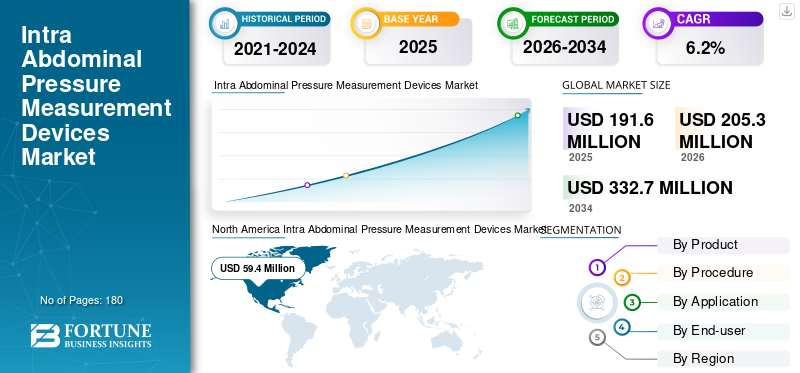
The intra abdominal pressure measurement devices market size was valued at USD 191.6 million in 2025 and is projected to grow from USD 205.3 million in 2026 to USD 332.7 million by 2034, exhibiting a CAGR of 6.2% during the forecast period. North America dominated the intra abdominal pressure measurement devices market with a market share of 31.% in 2025.
The market includes products used to monitor pressure within the abdominal cavity, primarily to support the diagnosis and management of intra-abdominal hypertension and abdominal compartment syndrome. These devices are used most often in intensive care, trauma, and post-surgical settings, where timely pressure monitoring can influence clinical decisions and patient outcomes.
Market growth is being supported by the rising burden of critically ill patients, growing awareness of pressure-related complications in abdominal and trauma care, and the broader push toward protocol-driven monitoring in hospitals. Another important growth factor is the continued clinical reliance on bladder-based pressure measurement, which has remained the reference standard for intermittent intra-abdominal pressure monitoring. As hospitals focus more on early detection, complication prevention, and critical care workflow efficiency, demand for both disposable kits and pressure measurement equipment continues to rise.
Furthermore, ConvaTec Group plc, Accuryn Medical, Sentinel Medical Technologies, and Spiegelberg GmbH & Co. KG held the largest market share, driven by increased investments and strategic initiatives, including new product launches, collaborations, and partnerships.
Download Free sample to learn more about this report.
INTRA ABDOMINAL PRESSURE MEASUREMENT DEVICES MARKET KEY TAKEAWAYS
 Market Size & Forecast
- 2025 Market Size: USD 191.6 million
- 2026 Market Size: USD 205.3 million
- 2034 Forecast Market Size: USD 7.76 billion
- CAGR: 6.2% from 2026–2034
 Market Share
- North America dominated the intra abdominal pressure measurement devices market with a market share of 31.% in 2025.
- The equipment segment is projected to grow at a CAGR of 4.5% during the forecast period.
- The muscle segment is estimated to grow at a CAGR of 4.4% during the forecast period.
 Key Regional Highlights
North America
North America held the largest revenue share in 2024, at USD 55.8 million, and is expected to reach USD 59.4 million in 2025.
Europe
Europe is expected to achieve a 5.7% growth rate in the coming years, the second-highest globally, reaching USD 59.3 million by 2026.
Asia Pacific
In 2026, the Asia Pacific market is predicted to be valued at USD 54.1 million.
U.S.
In 2026, the U.S. market is forecasted to represent USD 55.5 million, capturing 27.0% of total global revenue.
Japan
Japan is projected to generate approximately USD 12.1 million in revenue by 2026, contributing nearly 5.9% to the global market.
Read More

INTRA ABDOMINAL PRESSURE MEASUREMENT DEVICES MARKET TRENDS
Demand for Disposable-Centric Monitoring Models in Hospital Workflows is Emerging Market Trend
A notable market trend is the growing importance of disposable-led monitoring models. Intra-abdominal pressure measurement is closely tied to procedural and patient-episode usage, which naturally supports recurring demand for sterile single-use components. Hospitals often favor disposable kits as they simplify workflow, reduce reprocessing needs, and fit more easily into infection control practices and critical care routines. This trend is especially relevant in settings where monitoring must be repeated over time, as serial measurements increase consumable pull-through even when capital equipment demand remains more stable. Similarly, the broader market is moving toward more integrated monitoring pathways, where pressure measurement is increasingly seen as part of a larger critical care surveillance framework rather than as a standalone niche intervention. Over time, manufacturers that align disposables with ease of use, compatibility, and protocol-based care are likely to capture stronger repeat demand than those relying mainly on equipment placement.
MARKET DYNAMICS
MARKET DRIVERS
Download Free sample to learn more about this report.
Rising Critical Care Burden is Expanding Need for Timely Pressure Monitoring and Fueling Market Growth
One of the significant drivers of this market is the increasing clinical burden of critically ill and post-operative patients who are vulnerable to elevated intra-abdominal pressure. Patients with sepsis, major abdominal trauma, fluid overload, pancreatitis, bowel dysfunction, or complex abdominal surgery are more likely to require close monitoring for pressure-related deterioration. In these settings, intra-abdominal pressure is not just an additional metric; it can be an important diagnostic and management tool, especially when clinical examination may fail to identify worsening abdominal pressure early enough.
Guidance from the World Society of the Abdominal Compartment Syndrome has long reinforced the importance of structured measurement, particularly through the bladder-based method, which remains the accepted reference approach for intermittent monitoring. At the same time, federal U.S. data continue to show that sepsis and other high-acuity hospital conditions place a heavy burden on inpatient care, indirectly supporting the need for tools that can improve surveillance and intervention in unstable patients. As more hospitals standardize critical care pathways, device adoption is becoming more routine in high-risk units.
MARKET RESTRAINTS
Limited Standardization Across Care Settings Continues to Restrict Market Growth
Despite the clinical value of intra-abdominal pressure monitoring, the market still faces adoption constraints due to inconsistent protocolization across hospitals and regions. In many facilities, pressure monitoring is used selectively rather than routinely, and its implementation may depend heavily on physician preference, ICU training, or local critical care culture. This creates inconsistency in procedure volumes and slows broader penetration, especially outside top-tier hospitals and major trauma centers.
Moreover, another restraint is the narrow and specialized nature of the use case. These devices are not used across all patient categories but rather in defined high-risk populations, which limits their scale compared with more generalized monitoring technologies. In addition, the FDA has described intra-abdominal pressure monitoring devices as prescription devices intended to aid in diagnosing abdominal compartment syndrome, highlighting the category's focused, clinically specific nature. When awareness is lower or workflow integration is weaker, hospitals may rely on clinical judgment until complications become more apparent. Budget pressures in emerging markets and lower prioritization in smaller institutions can further limit adoption, particularly for equipment purchases beyond essential consumables.
MARKET OPPORTUNITIES
Expanding Monitoring Protocols in Emerging and Mid-Tier Hospitals Creates Significant Growth Opportunities
A major opportunity for the market growth lies in expanding the use of intra-abdominal pressure monitoring beyond highly specialized intensive care environments into a broader mix of surgical, emergency, and secondary care settings. Many countries are continuing to strengthen hospital infrastructure, critical care access, and perioperative monitoring capabilities, creating room for wider adoption of both disposables and compatible pressure measurement systems. Global and regional health statistics continue to show large differences in bed capacity and hospital resources, suggesting that a meaningful portion of the addressable market remains underpenetrated, particularly in parts of the Asia Pacific, Latin America, and the Middle East & Africa. This creates an opening for manufacturers to offer easier-to-use, lower-cost, and workflow-friendly products that can support monitoring in hospitals that may not yet have formalized abdominal pressure surveillance.
There is also a clear opportunity in education-led adoption. As awareness of the value of serial measurements in high-risk patients increases, hospitals are more likely to adopt disposable-heavy monitoring protocols that are easier to scale. In practical terms, future growth will not come only from advanced tertiary centers, but also from broader clinical diffusion into hospitals seeking earlier intervention tools.
MARKET CHALLENGES
Limited Clinical Indications and Uneven Awareness to Challenge Market Growth
The biggest challenge in this market is that its growth depends not only on product availability, but also on whether clinicians actively recognize elevated intra-abdominal pressure as a condition that warrants structured measurement. In many hospitals, abdominal pressure monitoring still competes with broader critical care priorities, and the category can remain underused unless there is clear awareness of the consequences of delayed diagnosis. This is particularly challenging as the product is significant while surgery, trauma, emergency medicine, and intensive care, which means no single department always owns the monitoring pathway.
In addition, the overall device remains relatively specialized, and the market does not benefit from the broad routine usage seen in high-volume monitoring categories such as cardiac or respiratory devices. Manufacturers, therefore, face a dual challenge as they must sell products, but also support training, protocols, and clinical confidence. Without stronger education and guideline-led implementation, even technically effective devices may struggle to achieve full utilization. This challenge is more pronounced in lower-resource settings, where competing capital priorities and uneven ICU practices can further delay adoption.
Segmentation Analysis
By Product
Disposables Lead Market as Repeated Monitoring Creates Recurring Demand
Based on product, the market is segmented into disposables and equipment.
To know how our report can help streamline your business, Speak to Analyst
Disposables account for the largest share of the market as intra-abdominal pressure monitoring is closely linked to ongoing patient management rather than one-time equipment placement. Hospitals also prefer disposable products as they align with infection control requirements, reduce reprocessing steps, and enable faster bedside use in acute settings.
Additionally, the equipment segment is projected to grow at a CAGR of 4.5% during the forecast period.
By Procedure
Abdomen Segment Dominates as Core Clinical Need is Centered on Abdominal Pressure Monitoring
By procedure, the market is classified into the muscle and abdomen.
The abdomen segment holds highest share as the market is fundamentally built around measuring pressure within the abdominal cavity to support the diagnosis and monitoring of intra-abdominal hypertension and abdominal compartment syndrome. These devices are primarily designed for abdominal and critical care applications, especially in patients undergoing major abdominal surgery, trauma management, or intensive care. Moreover, the segment is projected to hold a 84.0% share in 2026.
Additionally, the muscle segment is estimated to grow at a CAGR of 4.4% during the forecast period.
By Application
Intra-abdominal Hypertension Holds Largest Share as It Drives Routine Monitoring Use
By application, the market is classified into intra-compartment pressure and intra-abdominal hypertension.
Intra-abdominal hypertension represents the leading application segment as it is the principal clinical condition for which intra-abdominal pressure monitoring is performed in practice. Hospitals use these devices not only when abdominal compartment syndrome is strongly suspected, but also when patients are considered at risk of progressing toward serious pressure-related complications. Moreover, the segment is projected to hold a 68.5% share in 2026.
Additionally, the intra-compartment pressure segment is estimated to grow at a CAGR of 31.5% during the forecast period.
By End-user
Hospitals and ASCs Segment Dominate as High-Acuity Care and Post-Surgical Monitoring are Concentrated in these Settings
On the basis of end-user, the market is classified into hospitals & ASCs, specialty clinics, and others.
Hospitals and ASCs account for the largest intra abdominal pressure measurement devices market share as they handle the majority of patients who may require intra-abdominal pressure monitoring. Intensive care units, emergency departments, trauma centers, and surgical recovery areas are all concentrated within hospital-based systems, making these settings the natural center of demand. Furthermore, the segment is set to hold 82.3% share in 2026.
In addition, the specialty clinics segment is projected to grow at a CAGR of 8.3% during the forecast period.
Intra Abdominal Pressure Measurement Devices Market Regional Outlook
Based on geography, the market is classified into North America, Europe, Asia Pacific, Latin America, and Middle East & Africa.
North America
North America Intra Abdominal Pressure Measurement Devices Market Size, 2025 (USD Million)
To get more information on the regional analysis of this market, Download Free sample
North America held the largest revenue share in 2024, at USD 55.8 million, and is expected to reach USD 59.4 million in 2025. North America is expected to grow steadily due to its strong critical care infrastructure, high procedural volumes, and greater use of protocol-based monitoring in ICUs, trauma centers, and post-surgical settings. The U.S. remains main growth engine, with healthcare spending exceptionally high as national health expenditure reached USD 5.3 trillion in 2024, while hospital spending alone rose to USD 1.63 trillion. The region also benefits from high awareness of complications linked to elevated intra-abdominal pressure, better access to trained intensivists and surgeons, and stronger purchasing capacity for both consumables and compatible monitoring equipment.
U.S. Intra Abdominal Pressure Measurement Devices Market
In 2026, the U.S. market is forecasted to represent USD 55.5 million, capturing 27.0% of total global revenue.
Europe
Europe is expected to achieve a 5.7% growth rate in the coming years, the second-highest globally, reaching USD 59.3 million by 2026. Europe is projected to grow due to its broad hospital base, large surgical and critical care patient pool, and relatively strong inpatient infrastructure across major markets such as Germany, the U.K., France, Italy, and Spain. Compared to other regions, Europe benefits from greater hospital bed availability and a robust public health system, which supports the use of monitoring devices in high-risk abdominal and ICU cases.
U.K. Intra Abdominal Pressure Measurement Devices Market
The U.K. market is projected to reach USD 9.4 million by 2026, accounting for 4.6% of the global market revenue.
Germany Intra Abdominal Pressure Measurement Devices Market
Germany's market is forecasted to reach about USD 10.6 million by 2026, representing roughly 5.2% of global revenue.
Asia Pacific
In 2026, the Asia Pacific market is predicted to be valued at USD 54.1 million, ranking as the third-largest globally. Asia Pacific is expected to record the fastest growth, as the region combines a large patient base with expanding hospital infrastructure, rising critical care capacity, and improved access to monitored hospital care. While healthcare expenditure per capita remains below that of North America and Europe overall, the region’s lower starting base leaves considerable room for adoption gains, particularly in China, India, and Southeast Asia. Large tertiary hospitals in China and Japan already support advanced monitoring use. At the same time, India and Southeast Asia are likely to benefit from rising ICU capacity, more surgical procedures, and broader access to disposable-led monitoring products that are easier to implement than high-cost capital systems.
Japan Intra Abdominal Pressure Measurement Devices Market
Japan is projected to generate approximately USD 12.1 million in revenue by 2026, contributing nearly 5.9% to the global market.
China Intra Abdominal Pressure Measurement Devices Market
China’s market is forecast to reach approximately USD 17.4 million by 2026, contributing about 8.5% to global revenues.
India Intra Abdominal Pressure Measurement Devices Market
India is forecast to contribute approximately USD 6.7 million to the market by 2026, corresponding to about 3.3% of global revenues.
Latin America and Middle East & Africa
Both Latin America and the Middle East & Africa are anticipated to witness moderate intra abdominal pressure measurement devices market growth, with Latin America expected to reach around USD 15.0 million by 2026. Latin America is projected to grow at a healthy pace as large markets such as Brazil and Mexico continue to expand access to hospital care, critical care services, and surgical treatment, even though spending levels remain below those of developed regions. The Middle East and Africa region is expected to grow from a smaller base, supported by healthcare investment in the Gulf countries, gradual expansion of hospital infrastructure, and improving awareness of advanced monitoring in major referral hospitals. Moreover, the region remains uneven, with spending capacity and access to critical care differing sharply between the GCC, South Africa, and lower-resource parts of Africa.
GCC Intra Abdominal Pressure Measurement Devices Market
By 2026, the GCC is expected to generate approximately USD 5.0 million in the market, accounting for nearly 2.4% of global revenues.
COMPETITIVE LANDSCAPE
Key Industry Players
Robust Product Innovation to Reinforce the Market Position of Prominent Players
The competitive landscape of the market is niche and moderately concentrated, with a small group of clearly identifiable IAP-focused players and a broader fringe of adjacent pressure-monitoring suppliers. The market is led by companies with dedicated branded IAP products such as ConvaTec Group plc, Accuryn Medical, Sentinel Medical Technologies, and Spiegelberg GmbH & Co. KG. Their product portfolios show two main competitive clusters that are disposable/intermittent bladder-based systems and continuous monitoring platforms, with bladder-based monitoring remaining the core workflow in the market.
Moreover, other key players, such as ITL BioMedical, Centurion Medical Products Corp., ICU Medical, Inc., and Edwards Lifesciences Corp., compete through ongoing technological developments, the growing demand for improved healthcare infrastructure, and efforts to improve procedural outcomes.
LIST OF KEY INTRA ABDOMINAL PRESSURE MEASUREMENT DEVICE COMPANIES PROFILED
- ConvaTec Group plc (U.K.)
- Accuryn Medical (Potrero Medical, Inc.) (U.S.)
- Sentinel Medical Technologies (U.S.)
- Spiegelberg GmbH & Co. KG (Germany)
- ITL BioMedical (Australia)
- Centurion Medical Products Corp. (U.S.)
- ICU Medical, Inc. (U.S.)
- Edwards Lifesciences Corp. (U.S.)
- Medline Industries, LP (U.S.)
- Merit Medical Systems, Inc. (U.S.)
KEY INDUSTRY DEVELOPMENTS
- April 2024: Sentinel Medical Technologies received another FDA 510(k) clearance for TraumaGuard with updated labeling.
- January 2024: Sentinel Medical Technologies announced that the TraumaGuard System has been validated as the ONLY Continuous Intra-Abdominal Pressure (IAP) measurement device against four other monitoring devices in a new publication by the Journal of Clinical Medicine (JCM), MDPI.
- January 2023: Potrero Medical, Inc. announced that the FDA cleared an updated Accuryn Monitoring System submission.
- September 2022: Potrero Medical received FDA Breakthrough Device Designation for its Accuryn AKI Predict algorithm.
- July 2022: Sentinel Medical Technologies commercially launched TraumaGuard as the first hands-free device designed to continuously monitor real-time intra-abdominal pressure and core body temperature in critical care patients.
REPORT COVERAGE
The report provides an in-depth analysis of all market segments, highlighting key drivers, trends, opportunities, restraints, and challenges. It also provides insights into technological advancements, key industry developments, company market share analysis, and profiles of leading companies.
Request for Customization to gain extensive market insights.
Report Scope & Segmentation
| ATTRIBUTE | DETAILS |
| Study Period | 2021-2034 |
| Base Year | 2025 |
| Estimated Year | 2026 |
| Forecast Period | 2026-2034 |
| Historical Period | 2021-2024 |
| Growth Rate | CAGR of 6.2% from 2026-2034 |
| Unit | Value (USD Million) |
| Segmentation | By Product, Procedure, Application, End-user, and Region |
| By Product |
|
| By Procedure |
|
| By Application |
|
| By End-user |
|
| By Geography |
|
Frequently Asked Questions
Fortune Business Insights says that the global market value stood at USD 191.6 million in 2025 and is projected to reach USD 332.7 million by 2034.
In 2025, the North America market value stood at USD 59.4 million.
The market is expected to exhibit a CAGR of 6.2% during the forecast period of 2026-2034.
The disposables segment led the market by product.
The key factors driving the market are rising critical care burden, which is expanding the need for timely pressure monitoring.
ConvaTec Group plc, Accuryn Medical, Sentinel Medical Technologies, and Spiegelberg GmbH & Co. KG are some of the major players in the market.
North America dominated the market in 2025.



- 2021-2034
- 2025
- 2021-2024
- 180
Get 30-60 hrs Free Customization
Expand Regional and Country Coverage, Segments Analysis, Company Profiles, Competitive Benchmarking, and End-user Insights.













.webp)






Related Reports
-
US +1 833 909 2966 ( Toll Free )
-
Get In Touch With Us