Isobutyric Acid Market Size, Share & Industry Analysis, By Type (Synthetic, and Renewable), By Application (Pharmaceuticals & Cosmetics, Animal Feed, Chemical, Food & Flavors, and Others), and Regional Forecast, 2026-2034
 Download Free Sample
KEY MARKET INSIGHTS
 Listen to Audio Version
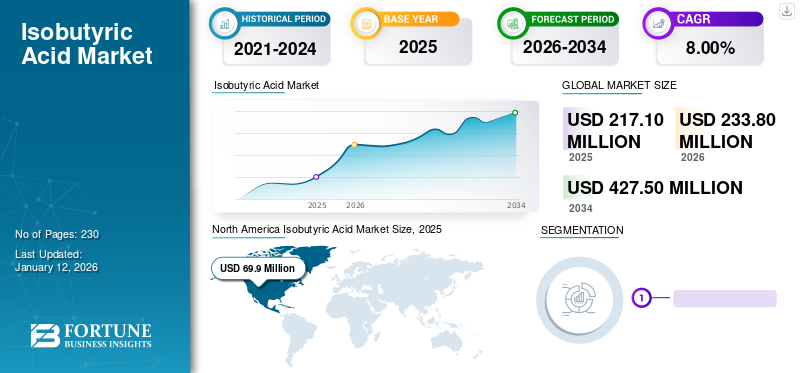
The global isobutyric acid market size was valued at USD 217.1 million in 2025 and is projected to grow from USD 233.8 million in 2026 to USD 427.5 million by 2034, exhibiting a CAGR of 8.00% during the forecast period. North America dominated the isobutyric acid market with a market share of 32.00% in 2025.
Isobutyric acid, also known as isobutanoic acid or 2-methylpropanoic acid, is a type of carboxylic acid exhibiting the structural formula (CH₃)₂CHCOOH. It is an isomer of n-butyric acid synthesized by different methods, including hydrolysis of isobutyronitrile, oxidation of isobutanol in the presence of potassium dichromate and sulfuric acid, and the reaction of 4-chlorophenol, chloroform, and acetone in the presence of an alkali. It is a colorless liquid with different applications, including chemicals, pharmaceuticals & cosmetics, animal feed, and food & flavors. The growing pharmaceutical industry and rising product preference from food and animal feed applications will drive market growth. The increasing awareness of bio-based product use among end-users will provide market growth opportunities during the forecast period.
Download Free sample to learn more about this report.
Isobutyric Acid Market Key Takeaways
 Global Market Size & Forecast
- 2025 Market Size: USD 217.1 million
- 2026 Market Size: USD 233.8 million
- 2034 Forecast Market Size: USD 427.5 million
- CAGR: 8.00% from 2026–2034
 Market Share
- North America dominated the isobutyric acid market with a 32.00% share in 2025.
- The synthetic segment accounted for the largest market share of 92.51% in 2026.
- The pharmaceuticals & cosmetics segment is projected to hold a 46.49% share in 2026.
 Key Regional Highlights
North America
North America Held a 32.00% share in 2025, valued at USD 69.9 million, and is projected to reach USD 75.4 million in 2026.
Europe
Europe Market valued at USD 61.3 million in 2025 and is projected to reach USD 65.9 million in 2026.
Asia Pacific
Asia Pacific Market valued at USD 54.8 million in 2025 and is projected to reach USD 59.4 million in 2026.
U.S.
U.S. Market projected to reach USD 60.7 million by 2026.
Japan
Japan Market projected to reach USD 12.5 million by 2026.
Read More

COVID-19 IMPACT
Disruption of Supply Chains during COVID-19 Pandemic Hampered Market Growth
The outbreak of the COVID-19 pandemic had a considerable impact on the market's growth. Movement restrictions and lockdowns imposed by the world's major economies during the pandemic disrupted supply chains, leading to shortages of raw materials required for the manufacturing of products. The scarcity of raw materials caused partial or complete stoppages in manufacturing by many market players. However, as control over the spread of the pandemic gradually improved in 2021, companies started production, and many companies were operating at full capacity from the beginning of 2022.
Isobutyric Acid Market Trends
Manufacturing of Products from Renewable Materials to Present Lucrative Market Opportunities
Conventionally, isobutyric acid is manufactured from petroleum-based raw materials, contributing to significant levels of carbon emissions. Manufacturing products from crude oil-based raw materials is associated with carbon emissions, making it difficult to comply with environmental regulations prescribed by governments of different countries and international organizations. This has prompted the manufacturers of isobutyric acid to focus on research & development and manufacturing of the product from renewable raw materials obtained from plant sources. Therefore, rising environmental awareness is pushing the production of bio-based products and presenting lucrative opportunities for market growth. North America witnessed a isobutyric acid market growth from USD 69.9 Million in 2025 to USD 75.4 Million in 2026.
Download Free sample to learn more about this report.
Isobutyric Acid Market Growth Factors
Rising Product Demand from Animal Feed and Food & Flavor Applications to Drive Market Growth
Isobutyric acid and its several derivatives are used in animal feed to enhance palatability and encourage feed consumption. It is also used to enhance the nutritional benefits and promote the animal's growth. The increasing scarcity of natural grazing land and the rising dairy industry across the globe are resulting in increased demand for animal feed, creating positive growth perspectives for market growth.
Isobutyric acid is also witnessing an increased demand for applications in food and flavors. It is increasingly being used as a flavoring agent for different food products, contributing to their aroma. The flavoring and aroma imparting characteristics of the isobutanoic acid make it ideal for processed and packaged food items such as butter, cheese, and beef. Therefore, increasing demand for processed and packaged food is anticipated to drive the isobutyric acid market growth.
RESTRAINING FACTORS
Concerns Associated with Storage and Handling of Product to Limit Market Growth
Isobutyric acid handling requires proper precautions due to its potential to cause burns to the eyes, skin, and mucous membranes upon contact. Prolonged exposure to heat may lead to the containers exploding, and its vapors can form explosive mixtures in the air. Inhalation of isobutyric acid causes throat pain, coughing, and other respiratory issues, while continuous exposure can impair vision. Such health hazards associated with the handling and storage of the product are anticipated to limit the market's growth.
Isobutyric Acid Market Segmentation Analysis
By Type Analysis
Synthetic Segment Accounted for the Largest Share owing to its Cost Effectiveness
Based on type, the isobutyric acid market is segmented into synthetic and renewable.
The synthetic segment led the market accounting for 92.51% market share in 2026. The well-established method of manufacturing synthetic products from petroleum-based raw materials allows for lower production costs compared to renewable products.
Renewable products have emerged as an alternative to synthetic products. They are anticipated to witness a significant rise in their demand in the near future owing to the rising need for renewable products to avoid pollution and combat increasing carbon footprint.
By Application Analysis
To know how our report can help streamline your business, Speak to Analyst
Pharmaceutical & Cosmetics Segment Held the Largest Share Owing to Higher Product Demand
Based on the applications, the isobutyric acid market is segmented into pharmaceuticals & cosmetics, animal feed, chemical, food & flavors, and others.
The pharmaceuticals & cosmetics segment is projected to dominate the market with a share of 46.49% in 2026. The market due to higher product consumption in different applications, including solvent, intermediate, and development and manufacturing of active pharmaceutical ingredients. The product is used to manufacture different pharmacological products, including anti-inflammatory medications, anticonvulsants, and antibiotics. It is used for creams and lotions, perfumes and deodorants, shampoos, and antiperspirants in cosmetics.
The product is also widely used in animal feed to enhance the nutritional value and palatability of the feed. The increasing product adoption in animal feed will drive the segment growth. In the chemical industry, it is widely used as a solvent, starting material, and intermediate for synthesizing several drugs. In the food industry, it acts as a flavoring agent for processed and packaged foods, including butter, cheese, and meat. Hence, the growth of the chemical and food industries will drive product consumption in respective segments. The food and flavours segment is expected to hold a 11.3% share in 2024.
REGIONAL ISOBUTYRIC ACID MARKET ANALYSIS
Based on region, the market is categorized into Europe, North America, Asia Pacific, Latin America, and the Middle East & Africa.
North America
North America Isobutyric Acid Market Size, 2025 (USD Million)
To get more information on the regional analysis of this market, Download Free sample
The North America region captured 32.00% of the global market in 2025, generating USD 69.9 million in revenue, and is expected to reach USD 75.4 million in 2026. Higher product prices in the region are one of the major reasons behind it holding the major share of the market in terms of revenue. Along with the higher demand for products from pharmaceuticals and cosmetics, the ever-growing demand for animal feed and food and flavors is anticipated to drive market growth in the region. The US market is projected to reach USD 60.7 Million by 2026.
- In North America, the food and flavours segment is estimated to hold a 11% market share in 2024..
To know how our report can help streamline your business, Speak to Analyst
Asia Pacific
In 2025, Asia Pacific generated USD 54.8 million, contributing 25.00% to global market revenue, and is expected to reach USD 59.4 million in 2026. Asia Pacific held a significant global market share, witnessing significant industrial development in the 21st century. The region has a considerably well-developed pharmaceutical & cosmetics industry, the largest application for the product, which is anticipated to further grow significantly in the near future, driving the demand for the product. Major economies including China and India are witnessing industrialization at a higher rate and are anticipated to play a key role in driving product demand. The chemical and food & beverage industry in the region is growing faster owing to a significant rise in consumer expenditure, positively impacting the market's growth. The Japan market is projected to reach USD 12.5 Million by 2026, the China market is projected to reach USD 21.8 Million by 2026, and the India market is projected to reach USD 8.4 Million by 2026.
Europe
Europe maintained a strong presence in the global market, reaching USD 61.3 million in 2025, accounting for 28.00% share, and is expected to reach USD 65.9 million in 2026. Europe is relatively mature in terms of the demand for the product for conventional applications in pharmaceuticals & cosmetics, and chemicals. The ever-growing animal feed industry in the region is anticipated to drive and keep the momentum of market growth owing to increasing demand for the product as an animal feed additive. The European Union to achieve net zero emissions by 2050 and is placing several efforts in place to achieve this target, coupled with initiatives to encourage the manufacturing of bio-based products, is anticipated to present lucrative opportunities for renewable product manufacturers. The UK market is projected to reach USD 12.1 Million by 2026, while the Germany market is projected to reach USD 15.1 Million by 2026.
Latin America and Middle East & Africa
Latin America and the Middle East & Africa are witnessing a considerable demand for the product owing to rising industrialization in the region. Factors such as relatively favorable tax laws, availability of labor at relatively lower cost, and less stringent environmental regulations are attracting foreign investment, fostering industrialization in these regions and positively impacting market growth. The Latin America market generated USD 19.8 million in 2025, representing 9.00% of the global market landscape, and is expected to reach USD 21.1 million in 2026. Middle East & Africa recorded a market size of USD 11.3 million in 2025, capturing 5.00% of the global market share, and is projected to reach USD 12 million in 2026.
List of Key Companies in Isobutyric Acid Market
Companies Focus on Expansion of Production Capacity and Development of Renewable Products to Gain a Competitive Edge
The market is moderately fragmented, with major players, including Eastman Chemical Company, OQ Chemicals GmbH, Tokyo Chemical Industry Co., Ltd. and Evonik Industries AG., holding considerable market share. These companies possess significant production capabilities for synthetic products and invest in research and development for renewable products. Other key players are focusing on enhancing their manufacturing capacities to meet the rising demand for products in this market.
LIST OF KEY COMPANIES PROFILED IN ISOBUTYRIC ACID MARKET:
- Eastman Chemical Company (U.S.)
- OQ Chemicals GmbH (Germany)
- Tokyo Chemical Industry Co., Ltd. (Japan)
- AFYREN (France)
- Shanghai Aladdin Biochemical Technology Co., Ltd. (China)
- Evonik Industries AG (Germany)
- Snowco (China)
- Nanjing Chemical Material Corp. (China)
- CAMEO Chemicals
- Yufeng International Group Co., Ltd. (China)
KEY INDUSTRY DEVELOPMENTS:
- January 2023: OQ Chemicals announced plans to increase its production capacity for carboxylic acids. The company also focused on investments in the reorganization of its global network of multi-purpose production facilities to enhance efficiency and strengthen its production capabilities.
- January 2023: AFYREN, a global greentech company that offers bio-based and low-carbon ingredients manufactured by using fermentation technology, and Mitr Phol, a Thailand-based company, a leading producer of cane sugar and its derivatives. They entered into a partnership to establish a bio-refinery in Thailand. With this move, AFYREN aims to target the Asian market, constituting 25% of the global carboxylic acids market.
- November 2018: Eastman Chemical Company announced the completion of its new isobutyric acid manufacturing plant at its Kingsport site in the U.S. Construction of this manufacturing facility enabled the company to double its isobutyric acid manufacturing capacity to meet the rising demand in the market.
REPORT COVERAGE
The research report provides both qualitative & quantitative insights into the market worldwide. Quantitative insights include market sizing in terms of value (USD Million) across each segment, sub-segment, and region profiled in the scope of the study. In addition, it provides market analysis and growth rates of segments, sub-segments, and key counties across each region. Qualitative insight covers the elaborative analysis of key market drivers, restraints, growth opportunities, and industry trends related to the market. The competitive landscape section covers detailed company profiling of the key players operating in the industry.
Request for Customization to gain extensive market insights.
Report Scope & Segmentation
|
ATTRIBUTE |
DETAILS |
|
Study Period |
2021-2034 |
|
Base Year |
2025 |
|
Estimated Year |
2026 |
|
Forecast Period |
2026-2034 |
|
Historical Period |
2021-2024 |
|
Growth Rate |
CAGR of 8.00% from 2026-2034 |
|
Unit |
Value (USD Million), Volume (Kiloton) |
|
Segmentation |
By Type
|
|
By Application
|
|
|
By Geography
|
Frequently Asked Questions
According to Fortune Business Insights, the global market size was USD 217.1 million in 2025 and is projected to reach USD 427.5 million by 2034.
Growing at a CAGR of 8.00%, the market will exhibit steady growth in the forecast period.
By application, the pharmaceuticals & cosmetics segment held the market share.
Rising product demand from animal feed and food & flavor applications is driving the market.
North America held the largest market share in 2025.
Eastman Chemical Company, OQ Chemicals GmbH, Tokyo Chemical Industry Co., Ltd., and Evonik Industries AG are the leading players in the market.



- 2021-2034
- 2025
- 2021-2024
- 230
Get 30-60 hrs Free Customization
Expand Regional and Country Coverage, Segments Analysis, Company Profiles, Competitive Benchmarking, and End-user Insights.


















Related Reports
-
US +1 833 909 2966 ( Toll Free )
-
Get In Touch With Us