 Download Free Sample



Get a Quote
Receive a tailored pricing based on your needs.
- Choose license type
- Multiple user options
- Custom scope & coverage
- Fast turnaround
"Smart Strategies, Giving Speed to your Growth Trajectory"
 Listen to Audio Version
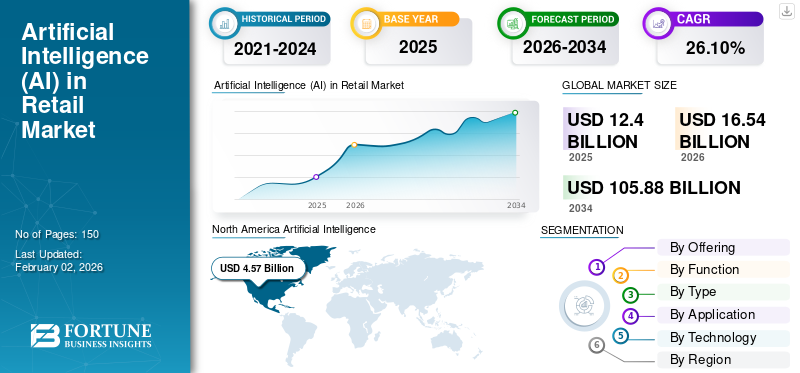
The global artificial intelligence (AI) in the retail market size was valued at USD 12.40 billion in 2025 and is projected to grow from USD 16.54 billion in 2026 to USD 105.88 billion by 2034, exhibiting a CAGR of 26.10% during the forecast period. North America dominated the global market with a share of 36.90% in 2025. The U.S. artificial intelligence in retail market is predicted to grow significantly, reaching an estimated value of USD 17.76 billion by 2032.
Artificial intelligence in the retail market is entering a new investment phase, driven by operational automation, predictive analytics, and personalized commerce. Retailers are shifting from isolated artificial intelligence (AI) applications toward integrated systems connecting merchandising, inventory, pricing, fulfillment, and customer engagement.
Artificial intelligence in retail market growth will increasingly depend on measurable operating improvements rather than technology adoption alone. Retailers are prioritizing demand forecasting, inventory availability, automated customer support, and workforce productivity.
Rising demand for personalized shopping experiences, automation in operations, AI-powered chatbots, predictive analytics, and visual/voice search technologies are fueling market growth. Increased cloud adoption, digital transformation in retail, and strategic partnerships among tech giants are accelerating the deployment of AI solutions across global retail ecosystems.
The artificial intelligence in retail market size will reflect spending across software solutions, implementation services, managed platforms, and specialized infrastructure. However, comparable global estimates remain difficult because providers classify AI-enabled retail spending differently.
Artificial intelligence in retail market share will increasingly favor vendors with established retail integrations, secure data environments, and proven deployment capabilities. North America will benefit from enterprise technology investment, while Asia-Pacific will present opportunities through digital commerce and large retail ecosystems.
Retail businesses need to prioritize productivity to remain competitive in the market. Artificial Intelligence (AI) supports retailers in automating their operations, thus increasing profits and optimizing business processes. The report covers solutions, such as automated inventory management, demand forecasting, customer assistance, predictive analytics, and more to enhance retail operations.
The digital transformation in the retail industry is driving the adoption of artificial intelligence in the retail sector. Retailers and brands across the world are rapidly implementing AI technology to optimize automation in retail stores. AI in retail technology is helping retailers introduce automation in both online and offline services and customer-facing solutions.
Moreover, companies are rapidly incorporating the cloud into these advanced technologies to provide better customer experiences. For instance, in February 2023, Google, along with Accenture, launched new tools to help retailers innovate their businesses and benefit from cloud technology. With this partnership, Accenture AI.RETAIL Platform was integrated with Google Cloud to build on joint customer successes.
Download Free sample to learn more about this report.
 Market Size & Forecast
 Market Share
 Key Regional Highlights
North America
North America accounted for USD 4.57 billion in 2025 and is projected to reach USD 5.90 billion in 2026.
Asia Pacific
Asia Pacific generated USD 3.37 billion in 2025 and is expected to reach USD 4.62 billion in 2026.
Europe
Europe is expected to rank second, driven by retail technology investments and efficiency gains.
U.S.
The artificial intelligence (AI) in retail market is projected to reach USD 4.01 billion by 2026.
Japan
The AI in retail market is projected to reach USD 1.29 billion by 2026, driven by AI adoption.
Read More

AI-driven Visual and Voice Search to Propel Market Opportunities
E-commerce platforms and virtual shops are growing rapidly. Today, consumers can use new techniques, such as product images, videos, and voice, to search for new products. Artificial Intelligence (AI) in visual search optimizes its functionality by processing inquiries and mining metadata. The visual search engine utilizes AI features to analyze, track, and predict growing shopping trends, thereby enhancing shoppers’ experience and engagement.
For instance, in January 2024, Google Cloud launched various new-gen AI-powered technologies to allow retailers to modernize operations, personalize online shopping, and transform in-store technology rollouts. To help customers find and buy products more quickly, Google Cloud's search technology for retailers has been improved with the ability to use large language models. The increasing use of such digital tools can make the artificial intelligence retail experience more seamless and spontaneous.
Thus, it has become essential for retailers to implement AI-based search engines to enhance customer service and boost revenue growth. In addition, retailers gain valuable insights into consumer trends and make better business decisions through AI-powered searches. A rich database and potential growth opportunities for retailers are expected to be provided by AI-driven search engines over the coming years.
Artificial intelligence in retail is shifting from isolated automation toward coordinated decision-making across merchandising, commerce, and store operations. Retailers are integrating forecasting, pricing, customer analytics, and fulfillment tools to improve decisions across the product lifecycle.
Generative AI is reshaping digital shopping experiences. Conversational assistants can interpret product requirements, compare attributes, summarize reviews, and guide product discovery. Retailers are also applying large language models to product descriptions, catalog enrichment, service responses, and internal knowledge retrieval. Accuracy and brand control remain essential.
Agentic AI is an emerging direction. Systems are being developed to execute multistep tasks, such as researching products, checking availability, and supporting service workflows. Broad deployment will depend on reliable permissions, transaction controls, and human oversight.
Download Free sample to learn more about this report.
Rising Use of AI-powered Chatbots for Improved Customer Experience to Drive Market Growth
AI-powered chatbot assistance is gaining vast popularity across the retail industry owing to its highly efficient customer service. A chatbot offers dedicated and personalized responses to customers to boost their experience. For instance, in May 2023, smart appliances brand upliance.ai integrated ChatGPT into its products. DelishUp, a smart cooking assistant, simplified cooking by automating the process. Moreover, the company plans to launch products in the home appliances category, thus setting a strong footprint in Artificial Intelligence in the retail industry.
The AI chatbots are equipped with Natural Language Processing (NLP) and Machine Learning (ML) technologies. These technologies offer real-time insights regarding customer preferences. Also, they help the chatbot understand customers’ sentiments and behavior patterns, which assist it in responding to customer queries and building relationships.
Retailers are prioritizing artificial intelligence (AI) to improve margins, forecast demand, and coordinate increasingly complex omnichannel operations. Rising assortment complexity and volatile purchasing patterns make manual planning less effective. Machine learning enables retailers to combine transaction histories, promotions, seasonality, and external signals when estimating demand.
Inventory productivity remains a central driver. Better forecasts can reduce stockouts, excess inventory, and markdown exposure while improving product availability. These gains matter particularly in grocery, fashion, consumer electronics, and other categories with short selling windows or frequent replenishment.
Customer expectations are also changing. Shoppers increasingly expect relevant recommendations, rapid service, accurate availability information, and consistent experiences across digital and physical channels. Generative AI and natural language processing can support conversational product discovery, automated service, and product-content generation.
For instance, Levi’s has implemented a chatbot platform, Levi’s Virtual Stylist, to provide recommendations to its customers. The bot asks users for basic details, such as size, fit, material, and even preferred brands, to offer quick suggestions. Thus, the AI-driven chatbot is expected to drive artificial intelligence in retail market growth.
Lack of Infrastructure and Higher Implementation Costs to Limit Adoption of AI in the Retail Sector
Well-established retail brands continuously invest in innovative technologies to enhance customer engagement; however, different factors are likely to limit the market growth. Large enterprises and global-level retailers, such as Walmart, have already implemented AI technology for in-store operations and to manage online portals.
However, today, new start-ups and small & medium-sized enterprises face challenges in adopting the technology due to a lack of infrastructure and technical expertise. As per IBM's cloud-data service insights, 37% of respondents stated that lack of AI expertise was an obstacle in implementing such technology. The high implementation cost associated with AI in retail solutions is also a major barrier for small retailers, which is limiting its implementation. These factors are expected to hamper Artificial Intelligence in retail market expansion.
Data fragmentation remains a major constraint on artificial intelligence adoption in retail. Sales, inventory, customer, pricing, and supply-chain records often reside in separate systems. Inconsistent identifiers and incomplete histories weaken model accuracy and limit enterprise-wide deployment.
Implementation costs also restrict adoption. Retailers must fund data engineering, cloud infrastructure, system integration, cybersecurity, employee training, and ongoing model monitoring. Smaller retailers may lack the technical teams needed to maintain complex deployments.
Model reliability presents additional risks. Inaccurate forecasts can create excess stock or missed sales, while flawed recommendations can reduce customer trust. Generative AI may produce incorrect product details, unsuitable advice, or inconsistent service responses without effective controls.
The artificial intelligence in the retail market offers opportunities where operational complexity creates measurable financial value. Inventory optimization is a leading priority. Retailers can combine sales histories, promotions, supplier performance, and local demand signals to improve replenishment and reduce avoidable markdowns.
Personalized commerce presents another opportunity. Recommendation engines and conversational shopping assistants can help customers navigate large assortments, compare products, and discover relevant alternatives. Retailers will need to balance personalization with transparency, privacy, and customer control.
Physical stores offer opportunities through computer vision and edge AI. Shelf monitoring, queue analysis, checkout support, and planogram compliance can improve store execution. Successful deployments will depend on camera coverage, reliable detection, and clear operating procedures.
Generative AI can also reduce content-production costs. Retailers can automate product descriptions, translate catalogs, summarize reviews, and assist service teams. Human review remains important for regulated products, pricing claims, and brand-sensitive communications.
The artificial intelligence in retail market is segmented by offering, function, retail channel, application, and technology. Adoption depends on the retailer’s operating model, data maturity, transaction volume, and ability to integrate AI into existing workflows. Commercial value increasingly depends on measurable improvements in margin, inventory productivity, conversion, and service efficiency.
Increasing Automation in Retail Industry to Fuel AI-based Solution Adoption
Based on offering, Artificial Intelligence in the retail market is segmented into solutions and services.
Solutions
The solutions segment is anticipated to hold a dominant market share of 63.73% in 2026. Some of the popular AI solutions include smart stores, e-commerce, intelligent customer insights, smart delivery, intelligent supply chain, and more. The growing challenges in managing various retail operations are likely to drive the development of new & innovative automation solutions in the retail industry. AI-based retail solutions help retailers manage logistics, supply chain operations, and warehouse management, and improve customer experience. This is expected to fuel the implementation of AI in the retail sector.
AI solutions include forecasting platforms, recommendation engines, inventory optimization software, computer vision systems, conversational shopping tools, and automated decision engines. Retailers typically adopt these solutions to address specific operational problems before expanding across business functions.
Demand forecasting and inventory intelligence remain foundational applications. They connect historical transactions, promotions, supplier data, and seasonal patterns to replenishment decisions. Recommendation systems support product discovery and personalization, while computer vision improves visibility into physical-store execution.
Enterprise buyers increasingly favor platforms that integrate with existing commerce, merchandising, and planning systems. Standalone tools can deliver focused benefits but often create additional data silos. Vendors with interoperable architectures and transparent performance measurement will hold stronger positions in complex retail environments.
Services
The services segment is likely to showcase the highest growth rate during the forecast period. Retailers need additional support from vendors in specific services, such as installation, management, maintenance, and more. Thus, the rapid implementation of AI solutions is driving the demand for services.
Services include consulting, implementation, data engineering, model customization, integration, monitoring, and managed AI operations. These capabilities are essential because retail data is frequently distributed across legacy platforms, stores, marketplaces, and supply chains.
Large retailers often require tailored integration and governance. Smaller retailers generally prefer standardized deployments with predictable costs and limited technical overhead. Services providers will therefore compete through implementation speed, retail-specific expertise, and ongoing optimization.
Growing Demand for Efficient Operations to Boost Usage of Operations-focused Functions
Based on function, the market is bifurcated into operations-focused and customer-facing.
Operations-Focused
The operation-focused segment is anticipated to hold a dominant market share of 64.81% in 2026. Some of the popular operation-focused solutions include Intel Movidius VPUs, Taskdesk Virtual Agents, RetailNext Store Layout, and ViSenze merchandising planning. Retailers are implementing AI to boost the efficiency of their operations, such as merchandising, logistics, supply chain, on-time delivery, and more. Proper management of backend functions helps retailers focus on revenue expansion and new growth strategies.
Operations-focused AI improves internal processes, including forecasting, replenishment, pricing, workforce scheduling, logistics, fraud detection, and loss prevention. Adoption is driven by pressure to protect margins while managing complex assortments and fluctuating demand.
Inventory management is particularly important because forecasting errors affect availability, working capital, and markdown exposure. Predictive systems can help planners identify demand changes earlier and prioritize replenishment. However, performance depends on accurate product data, supplier visibility, and reliable integration with execution systems.
Computer vision can support shelf monitoring, checkout analytics, and compliance checks. These applications require clear performance benchmarks and appropriate privacy controls. Retailers will favor deployments that demonstrate operational improvements without adding excessive maintenance or false alerts.
Customer-Facing
The customer-facing segment is likely to showcase the highest growth during the forecast period owing to the increasing demand for a solution to improve customer experience. To reduce customer complaints and enhance brand loyalty, retailers are adopting AI-driven solutions. In addition, due to its highly efficient customer service, AI-based chatbot assistance is becoming more and more popular in the consumer sector. To increase consumer satisfaction, these chatbots provide personalized and dedicated customer responses.
Customer-facing AI includes personalized recommendations, conversational commerce, virtual assistants, automated service, and targeted promotions. Retailers use these capabilities to reduce search friction, improve relevance, and support customers across digital channels.
Generative AI enables shoppers to express needs in natural language rather than navigate fixed filters. Recommendation systems can then combine product attributes, preferences, and contextual signals to refine results. The commercial opportunity depends on relevance, product availability, response accuracy, and conversion outcomes.
Efficient Management of In-Store Operations to Boost Product Adoption in Offline Stores
Based on type, the market is bifurcated into online and offline.
Online Retail
Online retail provides a strong environment for AI because digital interactions generate structured behavioral and transaction data. Retailers can apply machine learning to search ranking, recommendations, demand forecasting, pricing, fraud detection, and customer service.
Generative AI will increasingly support conversational product discovery and automated catalog enrichment. Online platforms can test changes through controlled experiments and compare conversion, returns, basket value, and customer satisfaction. However, data privacy, algorithmic bias, and the risk of inaccurate product descriptions remain important constraints.
Offline Retail
The offline segment is anticipated to hold a dominant market share of 63.29% in 2026 and is also expected to record the highest CAGR during the forecast period. The demand for AI technology is growing due to its capabilities, such as managing in-store operations, enhancing merchandising & assortment, and automating personalized product recommendations, among others, to enhance customer shopping experiences.
Offline retail uses AI to improve physical-store execution, inventory visibility, queue management, checkout, merchandising, and loss prevention. Computer vision can identify shelf gaps and support compliance checks, while forecasting tools can tailor replenishment to local demand.
Physical deployments require cameras, connectivity, edge computing, and store-level process changes. Environmental differences across stores can affect model performance. Retailers must also evaluate employee and customer privacy, signage, consent requirements, and data-retention policies.
In addition, the implementation of AI technologies that can help retailers improve their business growth is also improving online customer service capabilities. For instance, ViSenze offers a wide range of intelligent e-commerce solutions, such as cross-device experience, smart recommendations, discovery, and inspiring SEO marketing.
Rapidly Changing Customer Behavior to Drive Use of AI in Retail Technology in Predictive Analytics
Based on applications, the market is categorized into predictive analytics, in-store visual monitoring and surveillance, Customer Relationship Management (CRM), market forecasting, inventory management, and others.
Predictive Analytics
The predictive analytics segment is anticipated to hold a dominant market share of 26.57% in 2026. Some of its key solutions are demographic segmentation, store operations, shelf management, inventory management, labor optimization, and more. Retailers are implementing AI-based predictive analytics to understand future market opportunities and customer behavior. AI is also used to gain real-time analysis of different locations, countries, cultures, gender, age, and other demographics.
Predictive analytics supports demand estimation, customer behavior analysis, churn prediction, promotion planning, and operational risk detection. Its value increases when forecasts directly inform purchasing, replenishment, staffing, and pricing decisions.
In-Store Visual Monitoring and Surveillance
Computer vision supports shelf availability, queue analysis, checkout monitoring, and loss prevention. Deployment requires reliable detection, careful handling of video data, and controls against excessive surveillance.
Customer Relationship Management
AI-enabled customer relationship management (CRM) combines purchase histories, loyalty interactions, and engagement signals to improve segmentation and personalization. Retailers must ensure that data use aligns with consent and applicable privacy requirements.
The customer relationship management segment is likely to record the highest growth during the forecast period, owing to increasing demand for better customer engagement. AI-driven virtual assistance, chatbots, search engines, and more help retailers maintain strong customer relationships and loyalty.
The demand for AI in market forecasting is also gaining traction owing to the uncertain and rapid changes in customer buying behavior. Similarly, the use of AI in in-store visual monitoring and surveillance is likely to showcase steady growth. Continuous surveillance offers high security and captures customer insights, shelf replenishment alerts, control fraud & shrinkage, face recognition, and more.
Market Forecasting
Market forecasting tools analyze historical sales, seasonal patterns, competitor signals, and external variables. They help retailers assess demand shifts and adjust category, pricing, and inventory plans. Forecast quality depends on data freshness and the ability to distinguish structural changes from temporary fluctuations.
Inventory Management
Inventory management remains a commercially important application because stockouts and excess inventory directly affect sales and working capital. AI can recommend replenishment quantities, identify slow-moving items, and improve allocation across stores and distribution centers.
To know how our report can help streamline your business, Speak to Analyst
Highly Accurate Customer Insights to Boost Adoption of Machine Learning
Based on technology, the market is divided into computer vision, machine learning, natural language processing, and others.
By Technology
Computer Vision
Computer vision interprets images and video to support visual merchandising, shelf monitoring, checkout operations, and store analytics. Its effectiveness depends on camera quality, store layout, lighting, and representative training data. Edge processing can improve responsiveness and reduce unnecessary video transfers.
Machine Learning
Machine learning supports forecasting, recommendations, pricing, segmentation, fraud detection, and inventory optimization. Models improve when retailers maintain consistent data and evaluate outcomes continuously. Monitoring is essential because consumer behavior, product assortments, and supply conditions change over time.
Machine learning holds the largest share and is expected to continue its dominance in the market during the forecast period. Retailers are keen on understanding their customers’ behavior, emotions, personality type, and more to provide customized services. Machine Learning (ML) offers quick, deep insights from the collected information and is useful in providing personalized experiences to customers. To boost inventory productivity, it helps retailers optimize their supply chain plans and demand forecasts.
For instance, Amazon SageMaker is a fully managed service that deploys machine learning models for any application, from predictive analytics to customer experience. Similarly, the implementation of computer vision is expanding significantly in the retail industry. AI-based computer vision is being adopted to gain insights from facial recognition and video searches.
Natural Language Processing
Natural language processing (NLP) enables search, conversational shopping, sentiment analysis, automated service, and product-content processing. Large language models extend these capabilities through natural-language interaction and content generation. Retailers must control hallucinations, protect customer information, and verify product claims.
Across technologies, the most defensible strategy is to connect models with retail workflows and measurable business outcomes. Retailers will gain greater value from governed, integrated AI than from isolated tools that lack operational ownership.
Geographically, the market is fragmented into five major regions, such as North America, Europe, Asia Pacific, the Middle East & Africa, and South America. They are further categorized into countries.
North America Artificial Intelligence (AI) in Retail Market Size, 2025 (USD Billion)
To get more information on the regional analysis of this market, Download Free sample
North America maintained a strong presence in the global market, reaching USD 4.57 billion in 2025, accounting for a 36.90% share, and is expected to reach USD 5.9 billion in 2026. The retailers in this region are focusing on extracting data based on customers’ preferences to boost customer service efficiency. The U.S. is an early adopter of AI technology and is witnessing technology investment in AI. The country is also witnessing notable growth in the network of new startups and small enterprises due to the rising demand for this technology. This factor is expected to boost Artificial Intelligence (AI) in retail market growth.
North America benefits from advanced retail technology infrastructure, established cloud providers, and substantial enterprise investment. Retailers prioritize demand forecasting, personalization, inventory optimization, and generative AI for customer service. Competition centers on integration with commerce platforms and measurable returns. Data privacy, implementation costs, and legacy systems remain constraints. Vendors with scalable architectures and proven retail workflows will maintain an advantage across large chains.
United States Artificial Intelligence in Retail Market
The U.S. market is projected to reach USD 4.01 billion by 2026. The United States is a key market for enterprise retail AI adoption. Walmart, Amazon, and Target are investing in automation, forecasting, personalization, and digital shopping experiences. Large transaction volumes support model development and testing. Retailers will prioritize applications that improve inventory availability, conversion, and labor productivity. Competitive differentiation will depend on proprietary data, integration capabilities, governance, and measurable operating outcomes.
To know how our report can help streamline your business, Speak to Analyst
Asia-Pacific combines large digital commerce ecosystems, mobile-first consumers, and diverse retail infrastructure. China, Japan, India, and South Korea present distinct adoption patterns. AI supports recommendations, automated service, forecasting, and logistics optimization. Retailers will prioritize localized models, multilingual interfaces, and scalable cloud platforms. Data regulation, uneven technology maturity, and fragmented supply chains will shape deployment speed and vendor selection across the region.
The Asia Pacific market accounted for USD 3.37 billion in 2025, representing 27.20% of the global industry, and is expected to reach USD 4.62 billion in 2026. The region’s retail industry is going through a rapid transition phase. This is driving the demand for advanced AI technologies to improve operations and customer experience. For instance, as per SAP SE’s analysis, in 2020, China secured a 23.4% share of AI investments for its commerce & retail industry. Moreover, investments in this technology are expected to reach USD 18.8 billion by 2027.
India is anticipated to register the highest CAGR due to the high demand for automation tools to improve decision-making capabilities and operations. The Japan market is projected to reach USD 1.29 billion by 2026, the China market is projected to reach USD 2.07 billion by 2026, and the India market is projected to reach USD 0.57 billion by 2026.
Japan Artificial Intelligence in Retail Market
Japan's retail market emphasizes operational precision, service quality, and workforce productivity. Labor constraints strengthen interest in automated checkout, demand forecasting, inventory management, and customer-service tools. Retailers require reliable systems that integrate with existing store infrastructure. Adoption will favor applications with clear productivity benefits and low disruption. Robotics, computer vision, and predictive analytics will remain relevant as retailers modernize operations and address staffing pressures.
China Artificial Intelligence in Retail Market
China's retail AI market benefits from extensive digital commerce, integrated payment ecosystems, and advanced platform capabilities. Alibaba, JD.com, and Tencent provide technologies relevant to personalization, logistics, advertising, and consumer analytics. Retailers will use AI to coordinate online discovery, fulfillment, and customer engagement. Competition is intense, while data governance and platform dependence influence strategy. Localized capabilities and rapid execution remain important differentiators.
Europe will likely capture the second largest market share. The current large-scale retailers across the region in cosmetics, fashion, and apparel sectors are actively investing in advanced technologies to boost customer experience. This is expected to drive demand for artificial intelligence in the retail industry. The UK market is projected to reach USD 1.69 billion by 2026, and the Germany market is projected to reach USD 1.48 billion by 2026.
Europe's market is shaped by mature retail networks, cross-border commerce, and stringent data-protection requirements. Retailers are applying AI to forecasting, customer engagement, pricing, and supply-chain planning. The European Union's AI Act adds governance considerations, depending on the system and its use. Vendors must demonstrate responsible data handling, explainability where relevant, and reliable integration. Adoption will vary by country and retailer scale.
Germany Artificial Intelligence in Retail Market
Germany's retail sector offers opportunities in inventory planning, automated logistics, customer analytics, and store operations. Retailers face pressure to improve efficiency while managing complex supply chains and price-sensitive consumers. Adoption depends on integration with established enterprise systems and reliable data quality. Vendors must address privacy expectations and operational reliability. Solutions that demonstrate measurable productivity gains will appeal to retailers balancing digital investment with cost discipline.
United Kingdom Artificial Intelligence in Retail Market
The United Kingdom benefits from mature e-commerce, established omnichannel retailers, and strong digital payment adoption. Retailers apply AI to recommendations, demand forecasting, customer service, and fraud detection. Generative AI is expanding product discovery and content operations. Data protection, consumer trust, and integration costs remain central considerations. Vendors with clear governance, rapid deployment, and evidence of commercial impact will be better positioned to secure enterprise contracts.
The Middle East & Africa region will showcase prominent growth opportunities for the market in the coming years due to the increasing shift toward implementing innovative solutions to boost customer engagement. Similarly, Latin America is set to witness steady growth owing to the rise in investment in AI in the retail industry. In 2025, Middle East & Africa represented USD 0.16 billion, accounting for 1.30% of the worldwide market, and is projected to grow to USD 0.21 billion in 2026.
The Middle East and Africa present varied adoption opportunities across modern retail, digital commerce, and logistics. Gulf markets are investing in digital transformation, while other markets face infrastructure and affordability constraints. AI applications include personalization, forecasting, automated service, and inventory optimization. Adoption will depend on local data requirements, workforce capabilities, connectivity, and implementation economics. Regional partnerships will support deployment and localization.
Latin America contributed 2.50% to the global market in 2025, with a valuation of USD 0.31 billion, and is projected to reach USD 0.4 billion in 2026. Latin America's retail AI adoption is supported by expanding digital commerce, mobile payments, and demand for better inventory control. Brazil and Mexico offer important deployment opportunities, although infrastructure and investment vary. Retailers will prioritize fraud detection, demand forecasting, personalized promotions, and service automation. Affordability and integration with existing systems remain decisive. Vendors offering flexible pricing and regional implementation support will be well positioned.
New and Innovative Product Launches to Boost Market Positions of Key Players
The key players in the market are continuously investing in innovative solutions. These solutions help retailers quickly adapt to new services offered by companies. The growing data volume in the retail industry is further driving the implementation of AI. Thus, the market players are launching tailored and customer-targeting solutions. By leveraging advanced technologies, companies are strengthening their product portfolios to stay ahead in the market competition. Further, the key players are implementing partnership, merger, and acquisition strategies to expand their market share.
The artificial intelligence in the retail market is shaped by competition among cloud infrastructure providers, enterprise software vendors, commerce platforms, and specialist AI developers. Competitive advantage increasingly depends on integration, proprietary retail data, deployment scale, and measurable operating performance.
Amazon combines retail operations with AI-enabled recommendations, demand planning, logistics automation, and conversational shopping capabilities. Its vertically integrated model links customer interactions with fulfillment and inventory decisions. Walmart is advancing AI across merchandising, supply chains, store operations, and customer-facing experiences. Its extensive physical footprint creates opportunities to connect store-level execution with digital commerce.
Microsoft, Google, and Amazon Web Services compete through cloud infrastructure, machine learning services, generative AI, and enterprise integration. Their platforms enable retailers to develop applications without building every component internally. However, retailers must assess infrastructure costs, model portability, data governance, and dependence on individual providers.
Enterprise software vendors occupy another strategic position. Salesforce applies AI to customer relationship management, marketing, commerce, and service workflows. Adobe combines customer data, personalization, content generation, and digital experience capabilities. SAP and Oracle connect AI with merchandising, enterprise resource planning, inventory, and supply-chain processes. Their advantage lies in established enterprise relationships and integration with core systems.
Request for Customization to gain extensive market insights.
The artificial intelligence in the retail market report highlights leading regions across the world to offer a better understanding of the market. Furthermore, the report provides insights into the latest industry trends and analyzes technologies deployed at the global level. It further highlights some of the growth-stimulating factors and restraints, helping the reader gain in-depth knowledge about the market.
|
ATTRIBUTE |
DETAILS |
|
Study Period |
2021-2034 |
|
Base Year |
2025 |
|
Estimated Year |
2026 |
|
Forecast Period |
2026-2034 |
|
Historical Period |
2021-2024 |
|
Growth Rate |
CAGR of 26.10% from 2026 to 2034 |
|
Unit |
Value (USD billion) |
|
Segmentation |
By Offering
By Function
By Type
By Application
By Technology
By Region
|
According to Fortune Business Insights, the market is projected to reach USD 105.88 billion by 2034.
In 2025, the market size stood at USD 12.40 billion.
The market is projected to record a CAGR of 26.10% during the forecast period of 2026-2034.
In 2026, Predictive analytics led the market.
The rising usage of automation to enhance customer experience is likely to drive market growth.
Amazon.com, Inc., Google LLC, IBM Corporation, Intel Corporation, Microsoft Corporation, Nvidia Corporation, Oracle Corporation, and SAP SE are the top players in the market.
North America dominated the global market with a share of 36.90% in 2025.
Asia Pacific is expected to record a remarkable CAGR.

Get 30-60 hrs Free Customization
Expand Regional and Country Coverage, Segments Analysis, Company Profiles, Competitive Benchmarking, and End-user Insights.




















Related Reports
Get In Touch With Us
US +1 833 909 2966 ( Toll Free )
Receive a tailored pricing based on your needs.
Discuss your questions with our industry experts.
Have questions? Get quick answers before you purchase.

