Kids Furniture Market Size, Share & Industry Analysis, By Product (Beds/Cribs, Tables & Chairs, Storage Units, Dressers & Chest, and Others), By Material (Wood, Metal, Plastic, and Others), By End-user (Residential and Commercial), By Distribution Channel (Specialty Stores, Supermarkets & Hypermarkets, Online Stores, and Others), and Regional Forecast, 2026-2034
 Download Free Sample
(Offer valid till 30th Sep 2026)

Kids Furniture Market Size and Future Outlook
 Listen to Audio Version
The global kids furniture market size was valued at USD 31.19 billion in 2025 and is projected to grow from USD 34.69 billion in 2026 to USD 94.68 billion by 2034, exhibiting a CAGR of 13.37% during the forecast period. North America dominated the kids' furniture market with a market share of 34.52% in 2025. The industry growth is driven by rising urban households, expanding child population, premium nursery products, safety-compliant furniture demand, and e-commerce distribution expansion worldwide.
The global kids furniture market represents a specialized segment within the broader household furniture industry, focused on products designed for infants, toddlers, and children. Market growth reflects demographic patterns, evolving parenting preferences, and increasing emphasis on safety-compliant home environments. As disposable incomes rise across many regions, parents increasingly invest in purpose-built furniture designed for children's comfort, safety, and developmental needs.
The kids' furniture industry encompasses a wide range of products, including cribs, beds, study tables, storage units, chairs, and multifunctional furniture. Product design priorities typically focus on ergonomic safety, durability, non-toxic materials, and adaptability for growing children. Regulatory frameworks in many countries also influence product standards, particularly regarding safety certification, materials, and manufacturing practices.
Demand patterns within the kids' furniture market vary across geographic regions. Mature markets in North America and Europe emphasize premium designs, modular functionality, and sustainability features. Emerging economies in the Asia-Pacific and Latin America are experiencing stronger volume growth due to expanding middle-class households and rising birth rates.
E-commerce platforms have become an important distribution channel within the kids' furniture market. Online retail allows parents to compare safety certifications, product specifications, and pricing across multiple brands. Digital channels also enable furniture manufacturers and SMEs to reach broader consumer bases without extensive physical retail networks. However, the market remains sensitive to fluctuations in raw material costs and economic conditions that influence discretionary household spending. Wood, plastics, and metal components contribute significantly to production costs.
Kids' furniture products mainly include beds, cribs, study desks, chairs, storage solutions, and other multifunctional items created to meet children's developmental stages and safety requirements. These products are tailored for varying age groups, prioritizing practicality, comfort, and safety, for use both at home and in educational settings. Rising disposable income, increased demand for online retail, and rapid urbanization contribute to increased spending on high-quality, functional kids' furniture.
Prominent companies, such as IKEA, Steelcase, Williams Sonoma, and Ashley Furniture, are launching new stores and collaborating to broaden their reach and enhance brand visibility. Additionally, D2C startups and niche brands lead in customization technology, space-saving furniture, modular, and sustainable packaging.
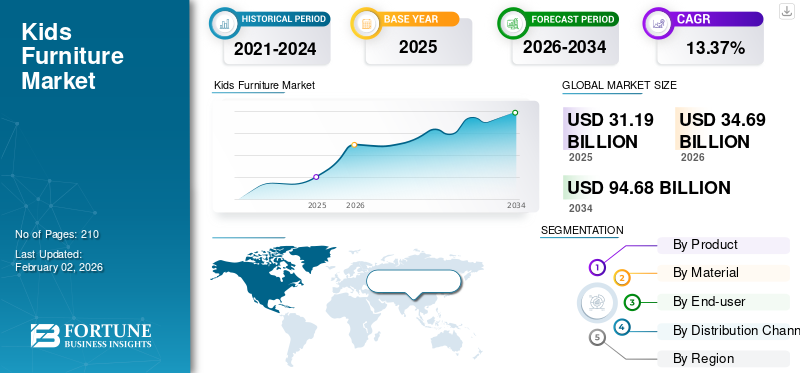
Download Free sample to learn more about this report.
Kids Furniture Market Key Takeaways
 Market Size & Forecast
- 2025 Market Size: USD 31.19 billion
- 2026 Market Size: USD 34.69 billion
- 2034 Forecast Market Size: USD 94.68 billion
- CAGR: 13.37% from 2026–2034
 Market Share
- North America dominated the kids' furniture market with a market share of 34.52% in 2025.
- The beds/cribs segment accounted for 31.65% of the market share in 2026.
- The wood segment holds the majority of the market share and captured 44.95% in 2026.
 Key Regional Highlights
North America
North America contributed approximately USD 10.76 billion to the global market in 2025, accounting for 34.52% share, and is expected to reach USD 11.9 billion in 2026.
Europe
In 2025, the Europe market representing 29.86% of global demand, and is projected to grow to USD 10.42 billion in 2026, driven by steady demand for functional, durable, and aesthetically appealing children's furniture.
Asia Pacific
The Asia Pacific region captured 25.76% of the global market in 2025, and is projected to reach USD 9.06 billion in 2026, supported by rapid urbanization, housing development projects, and expanding e-commerce channels.
U.S.
The U.S. market benefits from high consumer spending power and strong demand for high-quality, safe, and stylish kids’ furniture.
Japan
Japan’s kids' furniture market is characterized by high-quality manufacturing standards and strong demand for space-efficient and multifunctional furniture solutions.
Read More

Kids Furniture Market Trends
Growing Demand for Eco-friendly Furniture Products to Support Market Expansion
In recent times, the increasing environmental awareness among parents has led to a higher preference for furniture made from eco-friendly, non-toxic, and responsibly sourced materials such as certified wood, recycled plastics, and organic fabrics. This shift aligns with parental concerns about children's health and safety, along with reflecting broader societal trends toward sustainability. In August 2024, POLYWOOD launched kids' outdoor furniture collections made from recyclable lumber with extended durability guarantees, emphasizing eco-friendliness alongside design and functionality.
The kids' furniture market is evolving as consumer expectations regarding safety, functionality, and aesthetics continue to change. One of the most prominent trends involves the growing demand for multifunctional furniture designed to adapt to children’s developmental stages. Parents increasingly favor products that can serve multiple purposes over several years, such as convertible cribs that transition into toddler beds or modular desks that adjust in height.
Urban living patterns also influence product design trends within the kids' furniture industry. Many families reside in compact urban apartments where space efficiency becomes a critical purchasing factor. Manufacturers, therefore, design bunk beds, loft beds, and storage-integrated furniture that maximize usable space within children’s bedrooms.
Sustainability considerations are gaining importance among consumers. Parents increasingly seek products manufactured from environmentally responsible materials, including certified wood, water-based paints, and low-emission adhesives. As environmental awareness increases, manufacturers are adopting sustainable production practices and eco-friendly material sourcing.
Design aesthetics have also evolved. Contemporary kids' furniture often integrates playful visual elements with modern interior design styles. Neutral color palettes combined with subtle design themes enable furniture to remain visually appealing as children grow older. Digital commerce platforms further influence consumer purchasing behavior. Online retailers allow parents to review safety certifications, compare prices, and evaluate product features before purchase.
Download Free sample to learn more about this report.
Key Market Dynamics
Market Drivers
Technological Innovation and Smart Storage in Kids' Furniture Fosters Growth
Modern furniture products include AI-driven storage, voice-command access, and modular units that serve as play, study, or rest areas. These smart and interactive features assist in keeping rooms tidy and foster organization skills, while also engaging kids through technology. Many brands offer AR tools that let parents virtually place furniture in their home before purchasing. In November 2023, Pottery Barn Kids officially launched its first store in India at Jio World Plaza in Mumbai, marking a significant expansion of the premium American kids' furniture and decor brand. The brand promotes organization and arrangement through its smart storage solutions that integrate smoothly with any style of decor.
Several structural factors contribute to the steady expansion of the kids' furniture market across global household consumption patterns. Demographic demand represents one of the most fundamental growth drivers. Birth rates and population growth in many emerging economies continue to create sustained demand for children's household products.
Urbanization also plays an important role in shaping the kids' furniture industry. As families move into urban housing environments, they often invest in complete furnishing solutions tailored for children’s rooms. Dedicated nursery spaces and study areas have become common in modern household layouts.
Rising disposable income levels in developing economies represent another major growth factor. Expanding middle-class populations increasingly allocate spending toward specialized household products that improve living comfort and child safety. This shift encourages parents to purchase purpose-built furniture rather than repurposing general household items.
Educational priorities also influence furniture purchasing decisions. Parents increasingly seek furniture that supports early childhood learning environments. Study desks, reading corners, and organized storage units help create structured learning spaces within the home. Retail expansion further supports industry development. Organized furniture retailers and online marketplaces provide wider product availability, allowing manufacturers to reach broader consumer bases.
Market Restraints
High Raw Material and Shipping Costs to Limit Market Growth
The cost of essential raw materials such as wood, engineered panels, foam, metal, and plastic is highly volatile due to supply chain disruptions, currency fluctuations, and global demand changes. These fluctuations make it difficult for companies to maintain consistent pricing and tighten profit margins, reducing the ability to compete with low-cost alternatives. Consequently, the cost of production increases and limits the demand for kids’ furniture.
Despite positive long-term demand drivers, several constraints influence purchasing patterns within the kids' furniture market. One major challenge involves the relatively short product lifecycle associated with children's furniture. As children grow rapidly, furniture designed for early developmental stages may only remain relevant for a limited time.
This short usage period often encourages households to adopt cost-conscious purchasing strategies. Parents may choose budget furniture options or delay replacement purchases, particularly during periods of economic uncertainty. Price sensitivity represents another important constraint. Children's furniture is frequently categorized as discretionary household spending. Economic downturns or inflationary pressures can therefore influence consumer purchasing decisions within the kids' furniture industry.
Raw material cost volatility also affects manufacturing operations. Wood, metal components, plastics, and upholstery materials represent significant production inputs. Fluctuations in these materials can increase manufacturing costs and influence retail pricing.
Supply chain logistics create additional challenges. Furniture products are often bulky and require careful packaging, transportation, and assembly. Shipping costs can significantly influence pricing structures, particularly for online retail channels. Safety regulations also impose strict compliance requirements. Manufacturers must adhere to structural testing standards, chemical safety guidelines, and product certification procedures.
Market Opportunities
Expansion of E-commerce Platforms and Retail Channels to Propel Market Growth
Online platforms provide parents with the convenience of browsing a wide range of furniture designs, price points, and customization options from the comfort of their homes, saving time and effort. Features such as price transparency, customer reviews, and augmented reality (AR) assist in visualizing furniture in home settings and enhance purchase confidence and convenience for busy parents. For instance, in September 2024, Smartsters partnered with HomeTown to expand its retail presence across 18 locations nationwide.
The kids' furniture market offers several opportunities as consumer lifestyles evolve and parents increasingly prioritize child-specific home environments. One of the most promising opportunities lies in modular furniture systems designed to grow with children. Adjustable desks, expandable beds, and multifunctional storage systems extend product lifespan while improving value for households.
Educational furniture also presents a growing market opportunity. Increasing emphasis on early childhood learning has encouraged parents to invest in study desks, reading corners, and creative activity furniture. These products support structured learning environments within residential settings.
E-commerce platforms represent another major growth opportunity for the kids' furniture industry. Online marketplaces enable manufacturers and SMEs to reach global consumer bases without relying solely on physical showrooms. Digital product visualization tools and augmented reality features also improve online purchasing experiences.
Sustainability innovation creates additional opportunities. Eco-friendly furniture materials such as responsibly sourced wood, recyclable plastics, and low-emission coatings are gaining popularity among environmentally conscious consumers. Customization technologies also open new product development possibilities. Digital design tools allow consumers to select colors, dimensions, and storage configurations tailored to their household needs.
Segmentation Analysis
By Product
Beds/Cribs Segment Dominates as it Caters to Diverse Consumer Preferences
Based on product, the market is categorized into beds/cribs, tables & chairs, storage units, dressers & chests, and others.
Beds, Cribs, and Cots
The beds/cribs segment dominates the market as they are essential for children's daily routines, especially for sleep and rest, which are critical to their growth and well-being. Moreover, multifunctional beds such as bunk beds, loft beds, and themed designs cater to diverse consumer preferences, adding to their popularity. with a share of 31.65% in 2026
Beds, cribs, and cots represent the most fundamental category within the kids' furniture market. These products are often the first furniture purchases made after childbirth, making them a foundational segment in the overall industry. Demand in this segment is heavily influenced by safety standards, product durability, and multifunctional design capabilities.
Parents increasingly prioritize certified products that meet established safety regulations. Structural stability, non-toxic finishes, and protective guardrails are critical design elements. Regulatory standards in North America and Europe particularly shape product development practices within this segment. Manufacturers frequently highlight compliance certifications as part of their product positioning strategies.
Convertible cribs have become a dominant product trend. These designs transition from infant cribs to toddler beds and sometimes into full-size children's beds. This adaptability extends product lifespan and improves value perception among consumers. Urban housing trends also affect bed design innovations. Compact sleeping solutions such as bunk beds and loft beds help maximize space utilization in smaller apartments. Storage-integrated bed frames further enhance functionality within limited living environments.
Tables and Study Desks
Tables and study desks represent an increasingly important category within the kids' furniture industry, driven by rising educational priorities and the growing emphasis on structured learning environments at home. Parents increasingly invest in dedicated study areas designed to support children's academic activities.
Height-adjustable desks are gaining popularity in this segment. These desks allow modifications as children grow, improving ergonomic comfort and extending product usability across multiple developmental stages. Adjustable features also support proper posture during prolonged study sessions.
Modern study desks frequently integrate technological functionality. Cable management systems, tablet stands, and storage compartments accommodate digital learning tools used in contemporary education environments. As hybrid learning models become more common, demand for home-based study furniture continues to expand.
Educational institutions also contribute to demand within this segment. Schools, tutoring centers, and learning institutes require specialized desks designed for classroom settings. Durable materials and ergonomic seating compatibility remain important considerations for institutional buyers.
Chairs and Seating
Chairs and seating products form an essential component of the kids' furniture market due to their versatility across multiple household activities. These products are commonly used alongside study desks, play areas, and dining tables. Ergonomic design plays a central role in product development within this segment. Adjustable seating heights, lumbar support structures, and cushioned seat surfaces help maintain comfort during prolonged usage. Such ergonomic considerations have become increasingly important as children spend more time engaging in academic and digital activities.
Lightweight construction also remains a priority for children's chairs. Materials such as molded plastic, lightweight metals, and engineered wood allow children to move furniture safely and independently. Rounded edges and anti-tip designs further enhance safety. Design aesthetics influence purchasing decisions significantly. Colorful themes, character-based designs, and playful shapes appeal to younger consumers and contribute to room personalization. At the same time, neutral design styles cater to older children transitioning toward more mature room layouts.
Storage Units and Cabinets
Storage furniture represents an essential functional segment within the kids' furniture industry. Products within this category include toy storage boxes, wardrobes, shelving units, and modular cabinets designed specifically for children's rooms. Parents prioritize storage solutions that help maintain organized living environments. Children's rooms often contain large volumes of toys, books, clothing, and educational materials. Effective storage furniture helps reduce clutter while promoting organizational habits among children.
Safety considerations strongly influence design within this segment. Anti-tip brackets, soft-close drawers, and rounded edges help prevent injuries. These safety features are especially important in products intended for younger children. Modular storage systems have gained popularity due to their adaptability. Adjustable shelves, removable compartments, and expandable units allow furniture to evolve alongside children's changing storage needs.
Urban housing constraints also increase demand for multifunctional storage furniture. Beds with integrated drawers, storage benches, and vertical shelving units help maximize space efficiency within smaller apartments. The storage units segment is expected to grow at the fastest CAGR during the forecast period.
To know how our report can help streamline your business, Speak to Analyst
By Material
Wood is the Most Preferred Material Owing to its Safety and Customization
Based on material, the market is divided into wood, metal, plastic, and others.
Wood
The wood segment holds the majority of the market share and captured 44.95% in 2026. Wooden furniture offers superior aesthetic appeal and versatility, and suits a wide range of interior décor styles. They can be customized through painting, staining, or finishes with the child’s evolving preference. Furthermore, wooden furniture is often considered safer and healthier compared to plastic or metal alternatives.
Wood remains the most widely used material within the kids' furniture market due to its durability, natural aesthetic appeal, and structural reliability. Solid wood furniture is often perceived as premium quality and long-lasting.
Manufacturers frequently use hardwoods such as oak, maple, and pine in children's furniture production. Engineered wood materials, including medium-density fiberboard (MDF) and plywood, provide cost-effective alternatives while maintaining sufficient strength.
Environmental sustainability considerations are becoming increasingly important in this segment. Consumers often prefer furniture produced using responsibly sourced wood and eco-friendly coatings. Certification programs for sustainable forestry practices also influence purchasing decisions. Wood furniture offers strong customization capabilities. It can be easily shaped, painted, or decorated to suit a child's room aesthetics. Manufacturers frequently incorporate playful design elements while maintaining structural durability.
Despite higher production costs compared with plastic furniture, wood products continue to dominate the kids' furniture market due to their durability, safety perception, and visual appeal.
Plastic
The plastic segment is expected to grow at the fastest CAGR of 15.23% during the forecast period. Plastic furniture remains widely used within the kids' furniture industry due to its lightweight structure, affordability, and colorful design possibilities. These products are particularly popular among households seeking budget-friendly options for younger children. Plastic chairs, tables, and toy storage units are common items within this category. Their lightweight nature allows easy movement, enabling flexible room arrangements for play and learning activities.
Manufacturers frequently use molded plastic technologies to create vibrant colors and playful shapes that appeal to young children. Such designs often stimulate creative engagement and imaginative play. Plastic furniture also offers water resistance and easy maintenance, making it suitable for both indoor and outdoor environments. Childcare centers and preschools often utilize plastic furniture due to its practicality and durability.
However, environmental concerns related to plastic waste are gradually influencing consumer preferences. Manufacturers are increasingly adopting recyclable plastics and biodegradable materials in response to sustainability demands.
Metal
Metal furniture represents a smaller but strategically important segment within the kids' furniture market. Metal frames are commonly used in bunk beds, loft beds, and modular desk structures due to their strength and durability. Steel frames provide strong load-bearing capacity while allowing thinner structural designs. This helps optimize space utilization within compact bedroom layouts. Metal also offers resistance to wear and long-term structural stability.
Manufacturers frequently combine metal frames with wooden panels or plastic components to create hybrid furniture structures. These combinations provide both structural integrity and visual appeal. Metal furniture also plays an important role in institutional environments such as schools and dormitories, where durability requirements are higher.
By End-user
Residential Segment Leads Owing to Rising Investment in Home Renovations
Based on end-user, the market is bifurcated into residential and commercial.
Residential
In 2026, the residential segment dominated, accounting for 63.79% of the kids' furniture market share. The segment benefits from frequent renovations, a preference for personalized and stylish furniture, and evolving lifestyle trends that increase demand for functional home setups. Moreover, as children grow, residential buyers generally invest in ergonomics, safety certifications, and sustainable materials.
The residential segment represents the dominant share of the kids furniture market, driven primarily by household demand for dedicated children’s living spaces. Parents increasingly prioritize creating functional and safe environments tailored specifically to children’s daily activities, including sleeping, studying, and recreational play.
Modern residential interior design trends encourage the development of themed children's rooms that combine practicality with visual appeal. Furniture designed for residential use often incorporates playful colors, soft materials, and compact layouts that integrate well within home interiors. Products such as convertible cribs, bunk beds, study desks, and toy storage systems are commonly purchased for home use.
Rising disposable income levels in many urban households have also encouraged higher spending on children's room furniture. Families increasingly view such purchases as long-term investments that contribute to both comfort and developmental support.
Urban housing patterns further shape demand within the residential segment. Smaller living spaces encourage the adoption of multifunctional furniture designs such as loft beds with integrated desks or storage compartments. These space-efficient solutions allow households to optimize limited room areas.
Commercial
The commercial segment is expected to grow at the fastest CAGR of 14.23% during the forecast period. The commercial segment of the kids' furniture market includes demand from institutional environments such as schools, daycare centers, preschools, hospitals, and recreational facilities. Although smaller in size compared with residential demand, this segment plays an important role in supporting industry stability through institutional procurement.
Educational institutions represent the primary contributors within the commercial segment. Schools and early learning centers require durable and ergonomically designed furniture that can withstand frequent use while maintaining safety standards. Study desks, classroom chairs, storage cabinets, and activity tables are common product categories supplied to these institutions.
Childcare centers and daycare facilities also require specialized furniture that accommodates younger age groups. Products designed for these environments often feature lightweight structures, bright colors, and enhanced safety features suitable for toddlers and preschool children.
Hospitals and pediatric healthcare facilities represent another institutional demand source. Waiting rooms, pediatric wards, and therapy centers frequently incorporate child-friendly furniture to create comfortable environments for young patients.
Commercial buyers typically prioritize durability, safety compliance, and bulk purchasing efficiency when selecting furniture suppliers. As governments and private institutions continue investing in educational and childcare infrastructure, demand within the commercial segment is expected to contribute steadily to overall kids' furniture market growth.
By Distribution Channel
Demand for Expert Guidance to Boost the Growth of the Specialty Stores Segment
Based on distribution channel, the market is classified into specialty stores, supermarkets & hypermarkets, online stores, and others.
Offline Retail
Offline retail channels continue to play a significant role in the kids' furniture market. Furniture showrooms, specialty stores, and large home furnishing retailers allow consumers to physically evaluate product quality before purchase. Parents often prefer offline stores because they can directly inspect structural safety, material quality, and ergonomic comfort. Sales representatives also provide guidance on product features and assembly requirements.
Large retail stores frequently display complete children's room setups, helping consumers visualize furniture arrangements. Such physical displays can strongly influence purchasing decisions. Despite growing online sales, offline retail remains an important distribution channel for bulky furniture items that require tactile evaluation.
The specialty stores segment led the global market with a 36.58% market share in 2026. Specialty stores offer expert guidance, customer service, and curated collections that attract consumers seeking durable and premium kids' furniture. Moreover, these stores offer a curated selection of high-quality, often customizable furniture that appeals to parents.
Online Retail
The online segment is expected to grow at the fastest CAGR of 15.96% during the forecast period. Online retail has rapidly expanded within the kids' furniture industry due to increased digital commerce adoption. E-commerce platforms allow consumers to browse large product catalogs, compare pricing, and review customer feedback. Digital visualization technologies improve the online shopping experience. Augmented reality tools allow consumers to preview furniture placement within their homes before purchase.
Direct-to-consumer sales models are also gaining traction. Many manufacturers sell products through proprietary online platforms, reducing dependence on third-party retailers. Online channels also enable small and medium-sized enterprises to reach wider audiences without investing heavily in physical retail infrastructure.
As digital commerce infrastructure continues improving globally, online distribution channels are expected to capture a growing share of the kids' furniture market revenue.
Regional Insights
By region, the global kids furniture market analysis is segmented into North America, Europe, Asia Pacific, South America, and the Middle East & Africa.
North America Kids Furniture Market Analysis
North America contributed approximately USD 10.76 billion to the global market in 2025, accounting for 34.52% share, and is expected to reach USD 11.9 billion in 2026. The region has a high standard of living and significant consumer spending power. Therefore, families invest in high-quality, safe, and stylish kids’ furniture, which contributes to the region’s kids' furniture market growth. With such strong factors, the U.S. and Canada are estimated to reach USD 9.83 billion and USD 1.44 billion, respectively, in 2026.
North America represents a mature yet innovation-driven segment of the global kids furniture market. Strong consumer purchasing power and well-established retail infrastructure support steady demand for specialized children’s furniture. Parents in this region prioritize certified safety standards, ergonomic designs, and premium materials. Growth is further supported by rising interest in modular nursery furniture, increasing online furniture retail penetration, and continuous product innovation among established manufacturers.
United States Kids Furniture Market
The United States accounts for the largest share of the North American kids' furniture market due to high consumer spending on home interiors and children’s products. Parents increasingly invest in multifunctional furniture such as convertible cribs, adjustable desks, and storage-integrated beds. Expansion of e-commerce platforms has significantly improved product accessibility. Additionally, strict safety standards and certification requirements strongly influence product design and manufacturing practices.
North America Kids Furniture Market Size, 2025 (USD billion)
To get more information on the regional analysis of this market, Download Free sample
Europe Kids Furniture Market Analysis
In 2025, the Europe market stood at USD 9.31 billion, representing 29.86% of global demand, and is projected to grow to USD 10.42 billion in 2026. The U.K., Germany, and France are each anticipated to record a market size of USD 1.69 billion, USD 1.99 billion, and USD 1.46 billion, respectively, in 2026. Europe maintains a stable position in the global kids' furniture market, supported by strong consumer awareness regarding product safety and sustainability. European consumers increasingly favor environmentally responsible furniture manufactured from certified wood and low-emission materials. Countries across the region also emphasize ergonomic design and minimalist aesthetics. Expanding online retail channels and growing demand for multifunctional children’s furniture continue to support steady market expansion.
Germany Kids Furniture Market
Germany represents a key contributor to the European kids' furniture market due to its well-developed furniture manufacturing sector and strong domestic demand. German consumers emphasize product durability, safety compliance, and sustainable material sourcing when purchasing children’s furniture. Local manufacturers frequently integrate modular designs and ergonomic functionality into product offerings. Rising interest in environmentally friendly furniture production further influences industry development.
United Kingdom Kids Furniture Market
The United Kingdom kids' furniture market demonstrates consistent demand driven by urban household trends and strong e-commerce penetration. Parents increasingly prioritize compact furniture solutions that accommodate smaller living spaces. Bunk beds, storage-integrated furniture, and adjustable study desks have become particularly popular. Online furniture retailers continue expanding product availability, allowing consumers to compare safety certifications and design features before making purchasing decisions.
Asia-Pacific Kids Furniture Market Analysis
The Asia Pacific region captured 25.76% of the global market in 2025, generating USD 8.03 billion in revenue, and is projected to reach USD 9.06 billion in 2026. Asia Pacific and Europe are expected to grow at the fastest CAGR during the forecast period. Asia Pacific is projected to exhibit a robust CAGR of 14.13% and achieve the position of third-largest region Investments in construction and smart city projects across these regions boost urban housing developments, creating new opportunities for manufacturers. The market size of China is estimated to reach USD 2.75 billion in 2025. In addition, the expansion of e-commerce and organized retail channels enhances product accessibility and market reach.
Asia-Pacific represents the fastest-growing region within the global kids furniture market. Rapid urbanization, rising middle-class populations, and increasing household formation rates contribute to expanding demand for children’s furniture. Countries across the region show strong interest in affordable yet functional products. Domestic furniture manufacturers continue expanding production capacity while e-commerce platforms significantly improve accessibility for consumers in both urban and semi-urban areas.
Japan Kids Furniture Market
Japan’s kids' furniture market is characterized by high-quality manufacturing standards and strong demand for space-efficient furniture solutions. Compact housing environments encourage the development of multifunctional furniture designs such as loft beds and integrated storage units. Japanese consumers also prioritize product durability and minimalist aesthetics. Domestic manufacturers often emphasize ergonomic features and premium craftsmanship to meet evolving consumer expectations.
China Kids Furniture Market
China represents one of the largest manufacturing hubs within the global kids' furniture market. Rapid urban development and growing middle-class populations continue driving domestic demand for children’s furniture. Local manufacturers benefit from strong production capabilities and extensive supply chain networks. Additionally, expanding online retail platforms enable consumers to access a wide range of affordable furniture products across multiple design categories.
Latin America Kids Furniture Market Analysis
Latin America’s kids' furniture market demonstrates gradual expansion supported by improving household income levels and rising urbanization. Countries across the region show increasing demand for affordable furniture designed for children's bedrooms and study areas. Organized retail infrastructure continues to develop, while online sales channels provide broader product availability. Domestic manufacturers focus primarily on cost-efficient production to meet price-sensitive consumer demand.
South America
South America contributed 6.15% to the global market in 2025, with a valuation of USD 1.92 billion, and is projected to reach USD 2.07 billion in 2026. South America is expected to grasp a considerable share of the market. Government regulations and increasing focus on early childhood education across these regions encourage investments in furniture that promotes learning, creativity, and safety. South America is set to record USD 1.92 billion.
Middle East & Africa Kids Furniture Market Analysis
The Middle East & Africa are set to attain USD 1.16 billion. The Middle East and Africa kids' furniture market remains relatively smaller but shows emerging growth potential. Expanding urban populations and rising household spending on residential interiors contribute to gradual demand increases. Educational infrastructure development and increasing retail investments also support industry expansion. Manufacturers targeting this region often emphasize affordable products with durable designs suitable for varying household income levels.
Competitive Landscape
Rising Investment by Key Beauty Brands in Innovative Coffee Formulation to Boost Market Growth
In recent times, collaborations have assisted brands to combine expertise and resources to introduce innovative and diverse product lines, blending furniture expertise with popular apparel branding. Partnerships and acquisitions have further helped companies to broaden their geographic reach and customer base, accelerating sales and market penetration in untapped regions. In November 2022, Delta Children partnered with Gap Inc. to launch the first-ever ‘babyGap’ branded nursery furniture and baby gear collection in the U.S. This collaboration allowed Delta Children to combine their product expertise with Gap’s strong brand recognition in kids and baby apparel, creating high-quality, versatile products that enhanced parent appeal and market reach.
The global kids furniture market remains moderately fragmented, with a combination of multinational furniture manufacturers, regional producers, and specialized children’s furniture brands competing across residential and institutional segments. Competition primarily revolves around product safety standards, design innovation, pricing strategies, and distribution network expansion.
Large furniture companies leverage extensive retail infrastructure and brand recognition to maintain market presence. These companies frequently introduce complete children’s room furniture collections that include beds, study desks, wardrobes, and storage solutions. Integrated product lines allow manufacturers to strengthen brand loyalty while increasing average transaction values.
Product innovation remains a central competitive strategy within the kids' furniture industry. Manufacturers increasingly focus on modular and multifunctional furniture systems that adapt as children grow. Convertible cribs, expandable beds, and adjustable study desks have become common offerings among leading vendors.
Safety certification and material quality also represent critical differentiators in the market. Parents often prioritize furniture that meets recognized safety standards and incorporates non-toxic materials. Companies that emphasize safety compliance and product durability tend to build stronger consumer trust.
Digital commerce has become particularly important in expanding global reach. Many companies now invest in online visualization tools, augmented reality room planners, and customizable furniture options to enhance digital shopping experiences. Regional manufacturers also maintain strong positions in local markets due to cost-efficient production and proximity to consumer bases. These companies often compete through competitive pricing and flexible product customization.
List of Key Kids Furniture Companies Profiled in the Report:
- IKEA (Netherlands)
- Ashley Furniture Industries (U.S.)
- Pottery Barn Kids (U.S.)
- Wayfair Inc. (U.S.)
- Delta Children (U.S.)
- Romina Furniture (U.S.)
- Babyletto (U.S.)
- Alondra (Spain)
- Clafbebe (China)
- Piccalio (U.S.)
Key Industry Developments
- October 2025: Piccalio expanded its presence into the kids' furniture market. The furniture products focus on multifunctional designs that blend with home décor while encouraging child development and independence.
- September 2025: Furlenco launched a kids’ furniture collection for rent. This rental-based collection is designed specifically for growing families, allowing parents to access furniture as their children move through different stages of childhood
- March 2025: IKEA introduced a new modular children’s bedroom furniture collection designed to adapt to different childhood stages. The initiative aimed to extend product lifespan through convertible beds, adjustable desks, and modular storage units, utilizing lightweight engineered wood materials and sustainable coatings.
- January 2025: Delta Children launched an expanded line of convertible cribs and multifunctional nursery furniture designed to transition from infant to toddler stages. The product line integrates reinforced frame structures, child-safe finishes, and adjustable mattress platforms to improve durability and safety.
- September 2024: Ashley Furniture Industries expanded its children's furniture portfolio by introducing space-efficient bunk beds and integrated study desks. The initiative targeted urban households seeking multifunctional furniture solutions designed to maximize limited bedroom space.
- June 2024: Sauder Woodworking Company introduced a new range of children's study furniture emphasizing ergonomic design and educational functionality. The collection includes height-adjustable desks, integrated storage compartments, and durable engineered wood construction suitable for home learning environments.
- February 2024: KidKraft expanded its children’s furniture manufacturing capacity to support growing global demand for nursery furniture and playroom storage systems. The expansion focuses on scalable production technologies and sustainable material sourcing to improve supply chain efficiency.
REPORT COVERAGE
The market research report provides a comprehensive analysis, focusing on key elements such as key players, market segmentation, competitive landscape, regional analysis, supply chain analysis, competitive dynamics, product, material, end-user, and distribution channel. Additionally, it offers insights into market trends and highlights significant developments within the industry. Beyond these aspects, it also examines various factors that have contributed to market growth in recent years.
Request for Customization to gain extensive market insights.
Report Scope & Segmentation
| ATTRIBUTE | DETAILS |
| Study Period | 2021-2034 |
| Base Year | 2025 |
| Estimated Year | 2026 |
| Forecast Period | 2026-2034 |
| Historical Period | 2021-2024 |
| Growth Rate | CAGR of 13.37% from 2026 to 2034 |
| Unit | Value (USD Billion) |
| Segmentation |
By Product
By Material
By End-user
By Distribution Channel
By Region North America (By Product, Material, End-user, Distribution Channel, and Country)
Europe (By Product, Material, End-user, Distribution Channel, and Country)
Asia Pacific (By Product, Material, End-user, Distribution Channel, and Country )
South America (By Product, Material, End-user, Distribution Channel, and Country)
Middle East & Africa (By Product, Material, End-user, Distribution Channel, and Country)
|
Frequently Asked Questions
The global kids furniture market size was valued at USD 31.19 billion in 2025. The market is projected to grow from USD 34.69 billion in 2026 to USD 94.68 billion by 2034
Fortune Business Insights says that the global market value stood at USD 31.19 billion in 2025.
The global market will exhibit a CAGR of 13.37% during the forecast period.
By product, the beds/cribs segment is predicted to dominate the market during the forecast period.
Technological innovation is a key factor driving the global market.
IKEA, Steelcase, and Ashley Furniture are some of the leading players globally.
North America dominated in 2025 and held the largest market share.



- 2021-2034
- 2025
- 2021-2024
- 210
-
(Offer valid till 30th Sep 2026)
Get 30-60 hrs Free Customization
Expand Regional and Country Coverage, Segments Analysis, Company Profiles, Competitive Benchmarking, and End-user Insights.



















-
US +1 833 909 2966 ( Toll Free )
-
Get In Touch With Us