Lanolin Market Size, Share & Industry Analysis, By Product (Isopropyl Lanolate, Laneth, Lanogene, Lanosterols, Quaternium 33, PEG-75, Lanolin Fatty Acid), By Application (Personal Care & Cosmetics, Baby Care) and Regional Forecast, 2026-2034
 Download Free Sample
Lanolin Market Overview
The lanolin market size was valued at USD 315.78 million in 2025. The market is projected to grow from USD 329.56 million in 2026 to USD 463.78 million by 2034, exhibiting a CAGR of 4.36% during the forecast period.

The lanolin market continues to gain momentum as manufacturers increase the use of naturally derived ingredients across personal care, pharmaceutical, baby care, and industrial applications. Lanolin, extracted from sheep wool grease, is widely recognized for its moisturizing, emollient, and protective properties, making it a preferred ingredient in premium skincare formulations. The lanolin market report highlights growing demand for multifunctional ingredients that support clean-label product development and sustainable sourcing practices. Lanolin market analysis indicates that consumer preference for natural and bio-based ingredients is reshaping procurement strategies across cosmetic manufacturers. Lanolin market research report findings show increased utilization of lanolin derivatives such as lanolin fatty acids, lanosterols, and PEG-75 in advanced formulations. Expanding product innovation and growing awareness of skin barrier protection continue to strengthen the lanolin industry report outlook.
The United States represents one of the most established markets for lanolin-based ingredients due to strong demand from skincare, therapeutic ointment, and baby care manufacturers. The lanolin market size in the country benefits from a mature cosmetics sector that increasingly incorporates natural moisturizers into premium formulations. Domestic brands are investing heavily in ingredient transparency, encouraging the use of refined and ultra-purified lanolin in lip care, wound care, and sensitive-skin products.
The lanolin market growth in the USA is further supported by increasing consumer awareness regarding natural skin hydration products. Lanolin market trends show rising adoption in dermatological creams, anti-aging products, and protective skincare solutions. Manufacturers are also introducing pharmaceutical-grade lanolin variants to meet strict quality standards, strengthening the overall lanolin market outlook throughout the country.
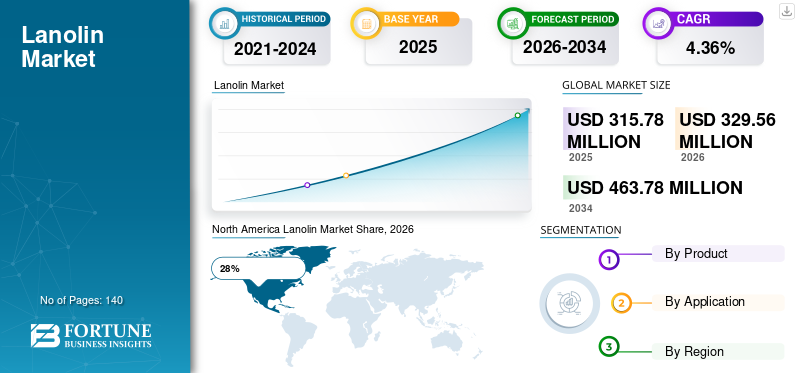
Download Free sample to learn more about this report.
Lanolin Market Key Takeaways
 Global Market Size & Forecast
- 2025 Market Size: USD 315.78 Million
- 2026 Market Size: USD 329.56 Million
- 2034 Forecast Market Size: USD 463.78 Million
- CAGR: 4.36% from 2026-2034
 Market Share
- The market in Europe dominated with a revenue share of 30% in 2025.
- Personal Care & Cosmetics dominated by application with a market share of approximately 68%.
- Isopropyl Lanolate dominated by product with a market share of approximately 18%.
 Key Regional Highlights
Europe
Europe led the market with a 30% share, supported by strong demand for personal care and cosmetic products.
North America
North America accounted for 28% of the market, driven by growing demand for premium skincare and beauty products.
Asia-Pacific
Asia-Pacific held a 26% share, supported by expanding beauty markets and rising demand for cosmetic ingredients.
U.S
The U.S. remains a key market, supported by strong demand for skincare, cosmetics, and specialty personal care products.
Japan
Japan accounted for approximately 19% of the Asia-Pacific market, supported by advanced personal care markets and demand for premium skincare products.
Read More

Lanolin market Latest Trends
The lanolin market is experiencing significant transformation as consumers prioritize naturally sourced ingredients over synthetic alternatives. One of the most notable lanolin market trends is the rapid adoption of purified lanolin in premium skincare products designed for dry, sensitive, and damaged skin. Cosmetic manufacturers are incorporating lanolin into lip balms, moisturizers, barrier creams, and anti-aging formulations because of its ability to mimic the natural lipids present in human skin. Growing demand for sustainable beauty products has further increased the use of lanolin derivatives in clean-label cosmetic applications.
Download Free sample to learn more about this report.
Another important trend shaping the lanolin industry analysis is the expansion of pharmaceutical-grade lanolin production. Manufacturers are investing in advanced purification technologies to reduce allergenic compounds and improve product consistency. Baby care brands are increasingly utilizing highly refined lanolin in diaper rash creams and breastfeeding products. Lanolin market insights also indicate growing industrial applications, including lubricants, leather treatments, and protective coatings. The emergence of multifunctional formulations combining lanolin with botanical extracts is creating new opportunities across global markets. Continuous innovation in derivative products such as lanosterols and lanolin alcohols remains a major contributor to lanolin market opportunities and future product diversification.
Lanolin market Dynamics
DRIVER
Rising Demand for Natural and Multifunctional Skincare Ingredients
The most significant growth driver influencing the Lanolin market growth is the increasing demand for natural skincare ingredients. Consumers worldwide are becoming more conscious about ingredient safety, sustainability, and effectiveness. Lanolin possesses exceptional moisturizing and emollient properties that help restore skin hydration and strengthen protective barriers. This makes it highly attractive for cosmetic manufacturers seeking alternatives to synthetic petroleum-based ingredients.
The lanolin market forecast remains favorable because premium beauty brands increasingly position lanolin as a naturally sourced ingredient suitable for sensitive skin applications. Demand is especially strong within lip care, hand creams, facial moisturizers, and therapeutic skin treatments. The rise of clean beauty movements and eco-conscious purchasing behavior is encouraging manufacturers to develop lanolin-enriched formulations. Growing usage across pharmaceutical ointments, wound-healing products, and baby care solutions continues to strengthen overall market demand. Increasing awareness regarding skin health and hydration further supports long-term expansion within the lanolin industry report.
RESTRAINT
Limited Raw Material Availability and Supply Chain Dependency
One major restraint affecting the lanolin market is the dependence on sheep wool production as the primary source of raw material. Since lanolin extraction relies on wool scouring processes, fluctuations in sheep farming activities directly influence production volumes. Variations in climatic conditions, livestock management practices, and wool production rates can create supply disruptions and pricing instability.
The lanolin market research report identifies supply concentration as an important challenge for manufacturers. Production remains heavily dependent on specific wool-producing regions, limiting supply diversification. Furthermore, extensive purification requirements increase processing costs and manufacturing complexity. Some consumers also associate lanolin with potential allergenic reactions despite significant advancements in refining technologies. These perceptions may encourage the adoption of alternative plant-based emollients in certain applications. As a result, producers must invest continuously in purification technologies, quality assurance systems, and consumer education initiatives to maintain competitiveness and preserve lanolin market share.
OPPORTUNITY
Expansion of Premium Baby Care and Pharmaceutical Applications
Growing demand for specialized baby care and pharmaceutical products presents a significant opportunity for the lanolin market. Highly refined lanolin is increasingly used in products formulated for infants and breastfeeding mothers due to its soothing and protective characteristics. As healthcare awareness expands globally, consumers are seeking products that provide gentle hydration and skin barrier protection without harsh additives.
Lanolin market opportunities are also emerging through advanced pharmaceutical applications. Pharmaceutical manufacturers continue to incorporate lanolin into topical ointments, medicated creams, and dermatological products. The development of ultra-purified grades with improved hypoallergenic profiles is attracting healthcare professionals and premium brands. Rising healthcare expenditures and increasing awareness regarding skin disorders create favorable conditions for market expansion. Companies introducing innovative derivative products tailored to specialized therapeutic needs are expected to benefit substantially. These developments contribute positively to the overall lanolin market outlook and long-term industry growth.
CHALLENGE
Competition from Synthetic and Plant-Based Substitutes
The lanolin market faces increasing competition from synthetic moisturizers and plant-derived alternatives that appeal to vegan and animal-free product consumers. Ingredients such as shea butter, coconut derivatives, jojoba oil, and advanced synthetic emollients are frequently marketed as sustainable alternatives to animal-derived products. This shift in consumer preferences creates challenges for traditional lanolin manufacturers.
Lanolin industry analysis indicates that brands targeting vegan beauty categories often avoid animal-derived ingredients altogether, limiting potential market penetration in certain segments. Additionally, maintaining consistent purity standards requires sophisticated processing infrastructure and regulatory compliance. Manufacturers must continuously address concerns related to sourcing transparency, animal welfare practices, and environmental sustainability. Increasing competition from alternative moisturizers also places pressure on pricing strategies. To maintain lanolin market share, producers are investing in responsible sourcing programs, traceability initiatives, and technological improvements that enhance product purity and performance.
Lanolin market Segmentation
By Product
Isopropyl Lanolate accounts for approximately 18% of the lanolin market share and remains widely utilized in cosmetic formulations due to its lightweight texture and excellent skin-conditioning properties. This derivative provides superior spreadability and enhances product absorption without leaving a greasy residue. Manufacturers frequently incorporate Isopropyl Lanolate into facial creams, lotions, sunscreens, and makeup products. Its compatibility with various active ingredients increases its value in multifunctional formulations. The lanolin market analysis indicates that demand for Isopropyl Lanolate continues to rise as premium cosmetic brands seek ingredients that improve sensory performance while maintaining natural-origin positioning. Increased consumer preference for smooth and non-sticky skincare products supports ongoing adoption across global markets.
Laneth holds nearly 14% of the lanolin market size and serves as a highly effective emulsifying agent in personal care formulations. It facilitates the blending of oil and water phases, enabling manufacturers to create stable creams and lotions with improved texture. Laneth derivatives are frequently used in cleansing products, conditioners, and moisturizing formulations. The lanolin market research report highlights growing utilization of Laneth in advanced skincare products designed for hydration and skin barrier restoration. Increasing investments in premium beauty products and multifunctional cosmetic formulations continue to support demand for this segment. Its versatility remains a key advantage within the broader lanolin industry analysis.
Lanogene contributes approximately 12% of the global lanolin market share. This derivative is valued for its conditioning and moisturizing properties, particularly in premium skincare and haircare products. Manufacturers use Lanogene to enhance product performance and improve moisture retention in cosmetic formulations. Lanolin market trends indicate expanding application of Lanogene in luxury beauty products where texture enhancement and long-lasting hydration are essential. Growing demand for naturally inspired cosmetic ingredients is creating favorable opportunities for manufacturers specializing in Lanogene production and formulation technologies.
Lanosterols represent close to 16% of the lanolin market and play an important role in high-performance skincare applications. These compounds are recognized for their skin-conditioning characteristics and compatibility with premium cosmetic formulations. Lanosterols are increasingly used in anti-aging products, repair creams, and specialized dermatological treatments. The lanolin market outlook remains positive for this segment as consumers seek products focused on skin barrier enhancement and moisture preservation. Research activities targeting functional skincare ingredients continue to expand the commercial potential of lanosterol-based products worldwide.
Quaternium 33 accounts for nearly 11% of the lanolin market share and is widely utilized in hair conditioning products. It improves hair softness, manageability, and moisture retention while reducing static buildup. Personal care manufacturers increasingly incorporate Quaternium 33 into shampoos, conditioners, and styling products. Lanolin market insights suggest that rising consumer spending on premium haircare products is supporting demand for this derivative. Product innovation within conditioning formulations remains a major growth catalyst for the segment.
PEG-75 contributes roughly 13% of the lanolin industry report market segmentation. This derivative functions as an emulsifier, moisturizer, and conditioning agent across multiple cosmetic applications. Manufacturers value PEG-75 for its ability to improve product stability while delivering effective hydration benefits. Lanolin market opportunities continue to emerge as formulators develop multifunctional skincare and haircare products requiring advanced emulsification performance. Expanding usage across professional and retail beauty sectors supports long-term segment development.
Lanolin Fatty Acid represents approximately 16% of the lanolin market size and serves as a key ingredient in cosmetics, industrial lubricants, and specialty formulations. The segment benefits from strong demand across skincare applications where emollient and protective properties are essential. Lanolin market forecast assessments indicate continued expansion due to increasing interest in bio-based specialty chemicals. Growing emphasis on sustainable ingredients and performance-driven formulations enhances the commercial attractiveness of lanolin fatty acid products.
To know how our report can help streamline your business, Speak to Analyst
By Application
Personal Care & Cosmetics dominate the lanolin market with an estimated 68% market share. Lanolin is widely utilized in facial moisturizers, lip balms, body lotions, sunscreens, foundations, and anti-aging products because of its superior moisturizing characteristics. Its ability to replicate natural skin lipids makes it highly effective for hydration-focused formulations. The lanolin market growth within this segment is supported by rising consumer demand for natural beauty products and premium skincare solutions. Manufacturers increasingly incorporate purified lanolin derivatives into multifunctional cosmetic products that address dryness, sensitivity, and skin barrier protection. Expanding global beauty markets and growing interest in clean-label ingredients continue to strengthen demand.
Baby Care accounts for approximately 32% of the lanolin market share and remains one of the fastest-evolving application segments. Highly purified lanolin is extensively used in diaper rash creams, protective ointments, and breastfeeding support products. Its gentle moisturizing properties make it suitable for delicate infant skin. The lanolin market research report identifies increasing parental awareness regarding ingredient safety as a major contributor to segment expansion. Premium baby care brands continue investing in formulations containing pharmaceutical-grade lanolin to enhance product effectiveness. Growing demand for natural infant skincare products and protective treatments creates favorable opportunities for manufacturers operating within this segment.
Lanolin market Regional Outlook
North America
North America Lanolin Market Share, 2025 (%)
To get more information on the regional analysis of this market, Download Free sample
North America accounts for approximately 28% of the global lanolin market share. The region benefits from a highly developed personal care industry, advanced pharmaceutical manufacturing capabilities, and strong consumer demand for natural skincare ingredients. The United States remains the largest contributor due to widespread utilization of lanolin in premium cosmetic and dermatological formulations. Growing awareness regarding skin barrier protection and clean-label beauty products continues to support market expansion.
The lanolin industry report indicates increasing investments in product innovation and ingredient purification technologies throughout North America. Manufacturers focus on developing highly refined lanolin grades suitable for sensitive skin applications. Strong distribution networks and advanced regulatory frameworks further strengthen regional competitiveness.
Europe
Europe represents approximately 30% of the lanolin market share and remains a major production and consumption hub. The region benefits from a mature cosmetics industry and long-standing expertise in lanolin processing technologies. Countries such as Germany, the United Kingdom, France, and Italy maintain strong demand for premium skincare and pharmaceutical products containing lanolin derivatives.
Lanolin market trends in Europe emphasize sustainability, ingredient transparency, and product performance. Cosmetic manufacturers increasingly promote lanolin as a naturally derived ingredient that aligns with consumer preferences for environmentally responsible products. Advanced research capabilities and established supply chains contribute to continued regional growth.
Germany Lanolin market
Germany accounts for approximately 27% of the European lanolin market. The country possesses one of the largest cosmetics manufacturing sectors in Europe and demonstrates consistent demand for premium skincare ingredients. German consumers place strong emphasis on product quality, ingredient safety, and dermatological effectiveness, supporting widespread adoption of refined lanolin.
Lanolin market analysis indicates growing utilization across pharmaceutical ointments, moisturizing creams, and specialized dermatological products. Domestic manufacturers continue investing in formulation technologies that combine lanolin with advanced active ingredients. Increasing demand for sustainable cosmetic products and high-performance skincare solutions reinforces Germany’s importance within the regional market landscape.
United Kingdom Lanolin market
The United Kingdom contributes nearly 22% of the European lanolin market. The country's beauty and personal care industry maintains strong demand for naturally sourced ingredients used in skincare, lip care, and baby care products. Lanolin continues to benefit from consumer interest in moisturizing formulations that provide long-lasting hydration.
lanolin market insights reveal increasing adoption of premium and therapeutic skincare products throughout the United Kingdom. Manufacturers are introducing innovative lanolin-based formulations designed for sensitive skin and barrier repair applications. The combination of established cosmetic brands and evolving consumer preferences supports steady market development across the country.
Asia-Pacific
Asia-Pacific accounts for approximately 26% of the global lanolin market share and remains a rapidly expanding regional market. Rising disposable incomes, growing beauty consciousness, and expanding personal care industries contribute significantly to regional demand. Countries including China, Japan, India, and South Korea represent major consumption centers for lanolin-containing products.
The lanolin market forecast for Asia-Pacific remains favorable due to increasing adoption of premium skincare products and expanding manufacturing capacity. The region also benefits from substantial wool production activities that support raw material availability. Growing investments in cosmetic innovation and healthcare products further strengthen market potential.
Japan Lanolin market
Japan represents approximately 19% of the Asia-Pacific lanolin market. The country's sophisticated beauty industry places strong emphasis on product quality, ingredient functionality, and advanced skincare technologies. Lanolin is widely incorporated into moisturizing creams, lip care products, and specialized skincare formulations targeting hydration and skin barrier enhancement.
Lanolin market growth in Japan is supported by aging demographics and increasing demand for premium anti-aging products. Manufacturers focus on developing highly refined ingredients that meet strict quality standards. Consumer preference for scientifically formulated skincare solutions continues to support market expansion throughout the country.
China Lanolin market
China accounts for approximately 35% of the Asia-Pacific lanolin market, making it the region's largest contributor. The country's rapidly expanding cosmetics and personal care industries generate substantial demand for lanolin-based ingredients. Domestic manufacturers increasingly utilize lanolin derivatives in skincare, baby care, and pharmaceutical formulations.
Lanolin market opportunities in China are supported by rising consumer spending on beauty products and growing awareness regarding skin health. Product innovation, manufacturing scale, and expanding e-commerce channels continue to strengthen market penetration. Increasing demand for premium and naturally derived cosmetic ingredients enhances long-term growth prospects.
Rest of World
The Rest of World region holds approximately 16% of the lanolin market share. Markets across Latin America, the Middle East, Africa, and Oceania demonstrate growing interest in natural skincare ingredients and premium cosmetic formulations. Expanding healthcare infrastructure and rising beauty product consumption contribute positively to regional demand.
Lanolin market research report findings indicate increasing adoption of lanolin in pharmaceutical ointments, moisturizers, and protective skincare products. Manufacturers are strengthening distribution networks and expanding product portfolios to capture emerging opportunities. Rising awareness regarding ingredient performance and sustainability supports continued market development throughout these regions.
List of Top Lanolin Companies
- The Lubrizol Corporation
- Imperial-Oel-Import Handelsgesellschaft mbH
- Nippon Fine Chemical Co., Ltd
- NK CHEMICALS CHINA LTD
- Lanotec
- Industria Quimica del Centro S.A. de C.V.
- Rolex Lanolin Products Limited
- Croda International Plc
- Esperis S.p.A.
- Sancai(lanolin) CO., LTD
Top Two Companies by Market Share
- Croda International Plc – 17%
- The Lubrizol Corporation – 14%
Investment Analysis and Opportunities
The lanolin market is attracting growing investment from cosmetic ingredient manufacturers, specialty chemical producers, and pharmaceutical companies seeking exposure to natural ingredient categories. Investors are increasingly supporting projects focused on advanced purification technologies that improve product quality and reduce allergenic compounds. Expansion of sustainable sourcing programs and traceable wool supply chains has become a major area of capital allocation.
Lanolin market opportunities are particularly strong in premium skincare, baby care, and pharmaceutical applications where demand for natural moisturizing ingredients continues to increase. Companies are investing in research and development initiatives targeting innovative lanolin derivatives with enhanced performance characteristics. Geographic expansion into emerging markets presents additional opportunities as consumer awareness regarding skincare and personal wellness products continues to rise. Strategic partnerships between ingredient suppliers and cosmetic manufacturers are further strengthening market competitiveness and encouraging long-term industry development.
New Product Development
Innovation remains a key competitive factor within the lanolin market. Manufacturers are introducing ultra-purified lanolin grades designed specifically for sensitive skin and pharmaceutical applications. These advanced products undergo extensive refining processes to reduce impurities while maintaining beneficial moisturizing characteristics. Product developers are also creating multifunctional derivatives that combine conditioning, emulsifying, and protective properties within a single ingredient platform.
Lanolin market trends indicate growing interest in hybrid formulations that integrate lanolin with botanical extracts, vitamins, peptides, and antioxidant compounds. New product development efforts increasingly focus on improving sensory characteristics, texture, and formulation stability. Premium skincare brands are launching lanolin-based repair creams, intensive hydration products, and specialized baby care solutions. Continuous advancements in extraction and purification technologies are expected to generate additional opportunities for product differentiation and market expansion.
Five Recent Developments (2023-2025)
- Croda International expanded development of highly purified lanolin ingredients for premium skincare applications in 2023.
- The Lubrizol Corporation increased focus on natural-origin personal care ingredients, including lanolin-derived specialty formulations in 2023.
- Nippon Fine Chemical Co., Ltd introduced enhanced lanolin derivative solutions targeting cosmetic manufacturers in 2024.
- Lanotec expanded distribution activities across international markets for lanolin-based industrial and skincare products in 2024.
- Multiple manufacturers invested in advanced purification technologies during 2025 to improve hypoallergenic lanolin production for baby care and pharmaceutical applications.
Report Coverage Of Lanolin market
The lanolin market report provides comprehensive coverage of market structure, industry dynamics, competitive developments, and growth opportunities across global regions. The report evaluates key product categories including Isopropyl Lanolate, Laneth, Lanogene, Lanosterols, Quaternium 33, PEG-75, and lanolin Fatty Acid. Detailed analysis of application sectors such as Personal Care & Cosmetics and Baby Care is included to support strategic decision-making.
Request for Customization to gain extensive market insights.
The lanolin market research report also examines regional performance across North America, Europe, Asia-Pacific, and Rest of World markets. Coverage includes supply chain developments, raw material trends, technological innovations, regulatory influences, and competitive positioning. Market participants, investors, distributors, and manufacturers can utilize the report to assess emerging opportunities, identify demand patterns, and evaluate future business strategies. The study further provides insights into evolving consumer preferences, sustainability initiatives, and product development activities influencing the overall lanolin industry analysis.
Frequently Asked Questions
Fortune Business Insights says that the global market value stood at USD 315.78 million in 2025 and is projected to reach USD 463.78 million by 2034.
The market is expected to exhibit a CAGR of 4.36% during the forecast period of 2026-2034.
Personal Care & Cosmetics was the leading application segment, accounting for approximately 68% of the market, driven by lanolin’s superior moisturizing and skin-conditioning properties.
Key players include The Lubrizol Corporation, Imperial-Oel-Import Handelsgesellschaft mbH, Nippon Fine Chemical Co., Ltd, NK CHEMICALS CHINA LTD, Lanotec, and Croda International Plc.
Major trends include rising adoption of purified lanolin in premium skincare and growing use of pharmaceutical-grade lanolin with advanced purification technologies. Europe led the market with a 30% share in 2025.



- 2021-2034
- 2025
- 2021-2024
- 140
-

(Offer valid till 15th Oct 2026)
Get 30-60 hrs Free Customization
Expand Regional and Country Coverage, Segments Analysis, Company Profiles, Competitive Benchmarking, and End-user Insights.


















-
US +1 833 909 2966 ( Toll Free )
-
Get In Touch With Us