Laparoscopic Electrodes Market Size, Share & Industry Analysis, By Application (Bariatric, General Surgeries), By Product (Monopolar, Bipolar Electrodes), By End User (Hospital, Ambulatory), and Regional Forecast, 2026-2034
 Download Free Sample
Laparoscopic Electrodes Market Overview
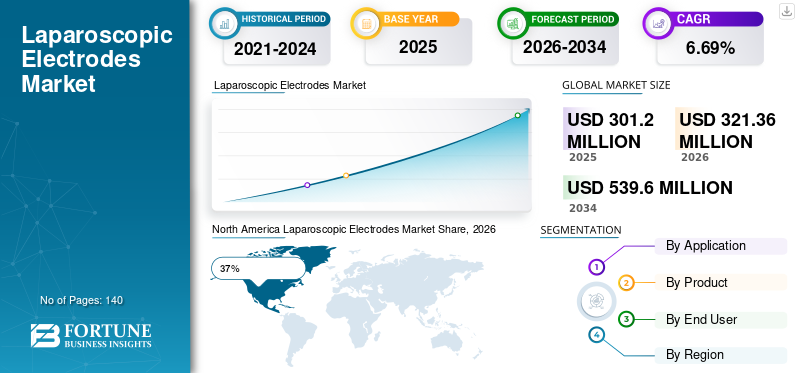
The global laparoscopic electrodes market size was valued at USD 301.2 billion in 2025. The market is projected to grow from USD 321.36 billion in 2026 to USD 539.6 billion by 2034, exhibiting a CAGR of 6.69% during the forecast period.

The laparoscopic electrodes market is an essential segment of the minimally invasive surgical devices industry, supporting a wide range of laparoscopic procedures through advanced electrosurgical energy delivery systems. Laparoscopic electrodes are used for tissue dissection, coagulation, cutting, and hemostasis during minimally invasive surgeries. The laparoscopic electrodes market report highlights increasing demand driven by the growing preference for minimally invasive procedures that offer reduced hospital stays, lower complication rates, and faster patient recovery. Technological advancements in electrosurgical instruments and increasing surgical procedure volumes continue to support market expansion. The laparoscopic electrodes market analysis indicates strong adoption across hospitals and ambulatory surgical centers globally.
The United States represents one of the largest markets for laparoscopic electrodes due to the widespread adoption of minimally invasive surgical techniques and advanced healthcare infrastructure. Hospitals and ambulatory surgical centers increasingly perform laparoscopic procedures for bariatric, gastrointestinal, gynecological, and urological applications. The growing prevalence of obesity and chronic diseases requiring surgical intervention continues to support demand for laparoscopic instruments. The laparoscopic electrodes market research report indicates that ongoing investments in surgical technology, physician training programs, and healthcare facility modernization contribute significantly to market growth. Strong adoption of advanced electrosurgical systems further strengthens the U.S. market position.
Download Free sample to learn more about this report.
Laparoscopic Electrodes Market Key Takeaways
 Global Market Size & Forecast
- 2025 Market Size: USD 301.20 Billion
- 2026 Market Size: USD 321.36 Billion
- 2034 Forecast Market Size: USD 321.36 Billion
- CAGR: 6.69% from 2026-2034
 Market Share
- The market in North America dominated with a revenue share of 37% in 2025.
- Monopolar Electrodes dominated by product with a market share of approximately 62%.
- Hospitals dominated by end user with a market share of approximately 76%.
 Key Regional Highlights
North America
North America led the market with a 37% share, supported by advanced surgical infrastructure and strong adoption of minimally invasive procedures.
Europe
Europe accounted for 29% of the market, driven by established healthcare systems and increasing adoption of laparoscopic surgeries.
Asia-Pacific
Asia-Pacific held a 25% share, supported by expanding healthcare infrastructure and rising demand for minimally invasive surgical technologies.
U.S
The U.S. remains a key market, supported by advanced surgical facilities and widespread adoption of electrosurgical technologies.
Japan
Japan accounted for approximately 29% of the Asia-Pacific market, supported by advanced healthcare infrastructure and established laparoscopic surgical practices.
Read More

Laparoscopic Electrodes Market Latest Trends
The laparoscopic electrodes market trends are increasingly shaped by the evolution of minimally invasive surgery and advanced energy-based surgical technologies. Healthcare providers are adopting sophisticated laparoscopic electrodes designed to improve surgical precision, reduce thermal tissue damage, and enhance procedural efficiency. Innovations in energy delivery systems have enabled surgeons to perform increasingly complex procedures through minimally invasive approaches. One significant trend involves the growing integration of laparoscopic electrodes with advanced electrosurgical generators and digital control systems. These technologies provide improved energy regulation, enhancing safety and procedural consistency. Manufacturers are also developing disposable and single-use electrode solutions to address infection prevention concerns and improve workflow efficiency.
Download Free sample to learn more about this report.
The increasing popularity of robotic-assisted surgery is creating additional opportunities within the laparoscopic electrodes market outlook. Electrode manufacturers are designing products compatible with robotic surgical platforms, expanding their application scope. Demand for bipolar energy devices is also increasing due to enhanced precision and reduced collateral tissue effects. Furthermore, healthcare providers are emphasizing cost-effective surgical solutions, encouraging innovation in reusable electrode systems and maintenance-efficient product designs. These developments continue to drive technological advancement and support long-term market growth.
Laparoscopic Electrodes Market Dynamics
DRIVER
Rising Adoption of Minimally Invasive Surgical Procedures
The primary driver of the laparoscopic electrodes market growth is the increasing adoption of minimally invasive surgery across multiple medical specialties. Patients and healthcare providers increasingly prefer laparoscopic procedures because they offer reduced postoperative pain, shorter recovery times, lower infection risks, and improved cosmetic outcomes. As surgical volumes continue to rise globally, demand for advanced laparoscopic electrodes used in tissue cutting, coagulation, and dissection continues to increase. Hospitals are investing in modern surgical technologies to improve clinical outcomes and operational efficiency. The laparoscopic electrodes market insights indicate that expanding surgical capabilities and increasing physician expertise further support product adoption across healthcare systems worldwide.
RESTRAINT
High Costs Associated with Advanced Electrosurgical Technologies
One of the major restraints affecting the laparoscopic electrodes market is the cost associated with advanced electrosurgical systems and specialized laparoscopic instruments. Healthcare facilities, particularly in cost-sensitive markets, may face budget limitations that restrict the adoption of premium surgical technologies. The need for compatible generators, maintenance requirements, and staff training can further increase overall ownership costs. Smaller healthcare providers may delay equipment upgrades due to financial constraints. Additionally, reimbursement limitations in certain healthcare systems can influence purchasing decisions. These factors may limit market penetration in developing regions and cost-conscious healthcare environments.
OPPORTUNITY
Expansion of Robotic-Assisted and Advanced Laparoscopic Surgery
The growing utilization of robotic-assisted surgical systems presents significant opportunities for the laparoscopic electrodes market. Surgeons increasingly perform complex procedures using robotic platforms that require highly specialized energy delivery instruments. Manufacturers have opportunities to develop innovative electrode solutions optimized for robotic compatibility and enhanced procedural performance. Expanding healthcare infrastructure in emerging economies also creates new growth prospects as hospitals increase investments in advanced surgical technologies. Rising demand for outpatient surgical procedures and ambulatory care services further supports product adoption. The laparoscopic electrodes market opportunities landscape continues to expand through innovation and procedural diversification.
CHALLENGE
Stringent regulatory requirements and product safety standards
A major challenge within the laparoscopic electrodes market is compliance with strict regulatory and safety requirements governing medical devices. Electrosurgical instruments must meet rigorous performance, quality, and safety standards before commercialization. Manufacturers face significant investments in product testing, clinical validation, and regulatory approvals. Product recalls or safety concerns can negatively affect market confidence and company reputation. Rapid technological advancement also requires continuous research and development investment. Maintaining product reliability while meeting evolving clinical expectations remains a key challenge for industry participants operating in highly regulated healthcare markets.
Laparoscopic Electrodes Market Segmentation
By Application
Bariatric surgeries account for 41% market share in the laparoscopic electrodes market. The growing prevalence of obesity worldwide has significantly increased the number of laparoscopic bariatric procedures performed annually. Laparoscopic electrodes play a critical role in tissue dissection, vessel sealing, and hemostasis during weight-loss surgeries. Surgeons increasingly prefer advanced energy devices that improve procedural efficiency and minimize tissue trauma. Rising awareness regarding obesity management and increasing access to bariatric surgery continue to support segment growth. Healthcare providers are investing in advanced laparoscopic technologies to improve surgical outcomes and patient recovery experiences.
General surgeries hold 59% market share in the laparoscopic electrodes market and represent the largest segment. Laparoscopic electrodes are widely used in procedures including cholecystectomy, appendectomy, hernia repair, colorectal surgery, and gastrointestinal interventions. The broad applicability of minimally invasive techniques across general surgery contributes to strong demand for electrosurgical instruments. Hospitals continue expanding laparoscopic surgery programs to improve clinical outcomes and reduce hospital stays. Continuous technological innovation and increasing surgeon expertise further strengthen adoption across general surgical applications.
To know how our report can help streamline your business, Speak to Analyst
By Product
Monopolar Electrodes account for 62% market share in the laparoscopic electrodes market and remain the most widely used product type across minimally invasive surgical procedures. These electrodes are extensively utilized for tissue cutting, dissection, coagulation, and hemostasis during laparoscopic surgeries. Surgeons prefer monopolar devices because of their versatility, ease of use, and compatibility with a broad range of electrosurgical generators. The technology is commonly applied in general surgery, bariatric surgery, gynecology, and urology procedures. Continuous advancements in insulation materials and energy control systems have improved safety and performance.
Bipolar Electrodes hold 38% market share in the laparoscopic electrodes market and are gaining popularity due to their enhanced precision and controlled energy delivery. These devices pass electrical current directly between electrode tips, reducing the risk of unintended tissue damage and minimizing thermal spread. Bipolar electrodes are particularly valuable in delicate surgical procedures where precision and tissue preservation are critical. Surgeons increasingly utilize bipolar technology in advanced laparoscopic interventions and vessel-sealing applications. Continuous technological improvements have enhanced coagulation efficiency and procedural safety.
By End User
Hospitals account for 76% market share in the laparoscopic electrodes market and represent the largest end-user segment. Large hospitals perform a high volume of laparoscopic procedures across multiple specialties, including general surgery, bariatric surgery, colorectal surgery, gynecology, and urology. Advanced operating room infrastructure and access to specialized surgical teams support extensive utilization of laparoscopic electrodes. Hospitals continue investing in modern electrosurgical technologies to improve clinical outcomes, enhance procedural efficiency, and reduce patient recovery times. Growing demand for minimally invasive procedures further strengthens product adoption. Healthcare providers prioritize advanced energy devices that improve surgical precision and safety.
Ambulatory Surgical Centers hold 24% market share in the laparoscopic electrodes market and are becoming increasingly important end users of minimally invasive surgical technologies. These facilities focus on delivering efficient outpatient procedures with reduced hospitalization requirements and lower healthcare costs. Laparoscopic electrodes are widely utilized in ambulatory settings due to their ability to support precise tissue management and faster patient recovery. Growing patient preference for outpatient surgical care continues to drive demand. Ambulatory centers are expanding procedural capabilities by adopting advanced electrosurgical systems and modern operating room equipment.
Laparoscopic Electrodes Market Regional Outlook
North America Laparoscopic Electrodes Market Share, 2026 (%)
To get more information on the regional analysis of this market, Download Free sample
North America
North America holds 37% market share in the laparoscopic electrodes market and remains the leading regional market due to its advanced healthcare infrastructure and widespread adoption of minimally invasive surgery. Hospitals and ambulatory surgical centers perform a high volume of laparoscopic procedures across general surgery, bariatric surgery, gynecology, and urology. Growing demand for faster recovery times and reduced postoperative complications continues to encourage the use of advanced electrosurgical instruments. Healthcare providers increasingly invest in monopolar and bipolar electrode technologies that improve surgical precision and patient outcomes. The presence of major medical device manufacturers supports continuous innovation. Robotic-assisted surgery adoption is also increasing across the region. Strong reimbursement systems and physician training programs further support market growth. Rising obesity rates and chronic disease prevalence contribute to procedural demand. These factors collectively reinforce North America's leadership position.
Europe
Europe accounts for 29% market share in the laparoscopic electrodes market and represents a technologically advanced market for minimally invasive surgical devices. The region benefits from strong healthcare systems and increasing demand for efficient surgical interventions. Hospitals are expanding laparoscopic surgery programs to improve patient outcomes and reduce hospitalization durations. Growing utilization of advanced electrosurgical technologies supports procedural precision and safety. Surgeons increasingly prefer minimally invasive approaches for gastrointestinal, bariatric, colorectal, and gynecological procedures. Continuous healthcare modernization initiatives support adoption of innovative laparoscopic equipment. Manufacturers are introducing advanced bipolar energy systems and vessel-sealing technologies to meet clinical requirements. Increasing patient awareness regarding minimally invasive procedures also contributes to growth. Government healthcare investments strengthen surgical infrastructure. These factors maintain Europe’s strong position within the global market.
Germany Laparoscopic Electrodes Market
Germany represents 25% market share in the global laparoscopic electrodes market and serves as a major European center for surgical innovation. The country benefits from advanced hospital infrastructure and strong expertise in minimally invasive procedures. German healthcare providers prioritize precision, patient safety, and technology-driven surgical outcomes. Demand for laparoscopic electrodes is supported by increasing volumes of bariatric, gastrointestinal, and gynecological surgeries. Hospitals continue investing in advanced electrosurgical systems and robotic-assisted surgical platforms. The presence of established medical device manufacturers contributes to continuous technological advancement. Research and development activities remain strong throughout the healthcare sector. Growing adoption of sophisticated energy-based surgical instruments further supports demand. Healthcare modernization programs continue improving surgical capabilities. These factors contribute to Germany’s significant market position.
United Kingdom Laparoscopic Electrodes Market
The United Kingdom holds 34% market share in the laparoscopic electrodes market and continues to expand its use of minimally invasive surgical technologies. Healthcare providers increasingly focus on improving patient outcomes while reducing hospital stays and recovery times. Hospitals are adopting advanced laparoscopic equipment to support growing surgical procedure volumes. General surgery, bariatric surgery, and gynecological interventions remain major application areas. Continuous investments in healthcare infrastructure support technology upgrades across surgical departments. Physician training initiatives enhance adoption of modern electrosurgical systems. Demand for precise and efficient energy delivery devices continues to increase. Growing awareness of minimally invasive treatment benefits further encourages procedural growth. Healthcare modernization efforts remain a key market driver. These factors support ongoing expansion in the United Kingdom market.
Asia-Pacific
Asia-Pacific accounts for 25% market share in the laparoscopic electrodes market and represents one of the fastest-growing regions globally. Rapid healthcare infrastructure development and increasing surgical procedure volumes are major growth drivers. Governments and private healthcare providers continue investing in advanced operating room technologies and minimally invasive surgery programs. Rising prevalence of obesity, gastrointestinal diseases, and chronic health conditions contributes to growing procedural demand. Hospitals across the region are expanding laparoscopic capabilities to meet increasing patient needs. Healthcare accessibility improvements further support market expansion. Manufacturers are strengthening distribution networks and introducing cost-effective solutions tailored to regional requirements. Increasing physician training and clinical expertise improve adoption rates. Technological modernization remains a priority across healthcare systems. These trends position Asia-Pacific as a major growth engine for the market.
Japan Laparoscopic Electrodes Market
Japan contributes 29% market share to the laparoscopic electrodes market and remains a leading adopter of advanced surgical technologies. The country is known for its sophisticated healthcare system and emphasis on precision medicine. Hospitals increasingly utilize advanced electrosurgical instruments for minimally invasive procedures across multiple specialties. Growing demand from an aging population supports the need for efficient surgical interventions. Healthcare providers prioritize technologies that improve patient safety and procedural accuracy. Continuous investments in surgical innovation contribute to strong market development. Robotic-assisted surgery adoption is increasing across major healthcare institutions. Physician expertise and high clinical standards support advanced technology utilization. Demand for minimally invasive procedures remains strong. These factors sustain Japan’s important role within the regional market.
China Laparoscopic Electrodes Market
China holds 12% market share in the laparoscopic electrodes market and represents one of the most significant growth opportunities worldwide. Rapid healthcare modernization and expanding hospital infrastructure are driving demand for advanced surgical technologies. Government initiatives aimed at improving healthcare accessibility support adoption of laparoscopic procedures. Increasing awareness of minimally invasive surgery benefits encourages both patients and healthcare providers to choose advanced treatment approaches. Hospitals continue investing in modern electrosurgical systems to improve clinical outcomes. Rising procedure volumes across general surgery, bariatric surgery, and gynecology contribute significantly to market demand. Domestic and international manufacturers are expanding product availability. Physician training programs continue improving procedural expertise. Healthcare infrastructure investments remain strong. These factors support long-term market growth across China.
Rest of World
Rest of World accounts for 9% market share in the laparoscopic electrodes market and includes Latin America, the Middle East, and Africa. These regions are experiencing gradual adoption of minimally invasive surgery as healthcare infrastructure improves. Hospitals are increasingly investing in laparoscopic equipment to enhance patient outcomes and reduce recovery periods. Growing awareness regarding the benefits of advanced surgical procedures supports demand for laparoscopic electrodes. Expanding private healthcare sectors contribute significantly to technology adoption. Medical tourism activities in selected countries further stimulate market growth. Manufacturers continue strengthening regional distribution networks and providing clinical training programs. Government healthcare investments support modernization initiatives. Surgical procedure volumes continue increasing across multiple specialties. These developments create sustained opportunities throughout emerging healthcare markets.
List of Top Laparoscopic Electrodes Companies
- Medtronic
- Ethicon U.S., LLC. (Johnson and Johnson)
- Olympus Corp.
- CONMED Corp.
- B. Braun Melsungen AG
- Millennium Surgical Corp.
- LiNA Medical ApS
- AngioDynamics
- Bovie Medical (Apyx Medical)
- RUDOLF Medical
Top Two Companies with Highest Market Share
- Medtronic — 24% estimated market share
- Ethicon U.S., LLC. — 19% estimated market share
Investment Analysis and Opportunities
The laparoscopic electrodes market continues to attract capital because minimally invasive surgery is now a structural priority for hospitals, ambulatory surgical centers, and device distributors. Investors are favoring manufacturers with broad energy portfolios, strong clinical differentiation, and compatibility across laparoscopic platforms. Medtronic’s multi-format electrode line and Ethicon’s advanced energy ecosystem show why portfolio depth matters: hospitals want one supplier that can serve multiple procedures, minimize switching costs, and maintain consistency across OR workflows. That creates room for investment in product engineering, surgical energy software, insulated electrode design, and disposable accessories.
The strongest opportunities are in bariatric surgery, general surgery, and robotic-assisted surgery, where surgeons need precise energy delivery and low thermal spread. There is also strong commercial logic in smoke management, suction-integrated electrodes, and energy devices that support enhanced recovery pathways. CONMED’s AirSeal-related content and smoke-evacuation portfolio show that laparoscopy is increasingly tied to OR safety and workflow efficiency, not just cutting and coagulation performance. In parallel, manufacturers that can produce cost-efficient bipolar and monopolar options for price-sensitive markets will continue to win volume. The laparoscopic electrodes market opportunities profile is strongest for companies that combine clinical evidence, reliability, and a full procedure ecosystem.
New Product Development
New product development in the laparoscopic electrodes market is centered on precision, safety, and procedural flexibility. Medtronic’s portfolio illustrates this direction clearly: its CleanCoat laparoscopic electrode, Valleylab retractable laparoscopic electrode, non-retractable laparoscopic electrode with aspiration holes, solid electrode, stainless steel electrode, and electrode extension are all designed to address different access and tissue-handling requirements. This diversity matters because surgeons need different electrode behaviors depending on the depth of the surgical field, the amount of suction required, and the amount of tissue dissection being performed.
Ethicon and Olympus are also pushing product development toward smarter energy delivery. Ethicon’s GEN11 generator is designed to work with HARMONIC and ENSEAL devices, while its 2024 ECHELON 3000 launch demonstrates the broader move toward digitally enabled surgical systems. Olympus expanded its POWERSEAL family in 2024 and launched THUNDERBEAT II in 2025, reflecting the industry’s shift toward advanced bipolar and hybrid energy tools with improved sealing, dissection, and thermal control. Across the market, innovation is being shaped by one core requirement: better surgical control with less collateral tissue damage. That is where the next generation of laparoscopic electrodes is heading.
Five Recent Developments (2023–2025)
- 2025: Olympus launched THUNDERBEAT II, a next-generation hybrid energy device for laparoscopic and open surgery.
- 2024: Olympus expanded its POWERSEAL 5 mm advanced bipolar vessel-sealing device portfolio.
- 2024: Ethicon introduced the ECHELON 3000 Stapler, enhancing its minimally invasive surgery platform.
- 2023: Medtronic strengthened its laparoscopic energy portfolio through continued expansion of Valleylab™ and LigaSure™ technologies.
- 2023: CONMED advanced its laparoscopic surgery solutions by expanding adoption of AirSeal® insufflation and smoke evacuation technologies
Report Coverage
The laparoscopic electrodes market report covers the full commercial structure of the industry, including product design, procedural use, buying patterns, and competitive positioning. It evaluates demand for monopolar and bipolar electrodes used in laparoscopic bariatric and general surgery, with attention to how hospitals and ambulatory surgical centers choose products based on precision, thermal control, and procedural efficiency. The report also examines how manufacturers differentiate through electrode geometry, insulation quality, suction integration, and compatibility with electrosurgical platforms.
Request for Customization to gain extensive market insights.
Medtronic’s portfolio breadth and Ethicon’s energy ecosystem are good examples of how product range and generator compatibility shape market appeal. The coverage also includes regional demand patterns, distributor dynamics, and technology shifts across North America, Europe, Asia-Pacific, and Rest of World. It assesses procurement behavior in high-volume hospitals and ambulatory centers, where cost control, surgeon preference, and device reliability influence purchasing decisions. The report further tracks developments in robotic surgery, smoke management, and advanced bipolar sealing, because these themes are changing the role of laparoscopic electrodes in modern OR workflows.
Frequently Asked Questions
Fortune Business Insights says that the global market value stood at USD 301.2 billion in 2025 and is projected to reach USD 539.6 billion by 2034.
The market is expected to exhibit a CAGR of 6.69% during the forecast period of 2026-2034.
Monopolar electrodes led the product segment with a 62% share, owing to their versatility, ease of use, and compatibility with a broad range of electrosurgical generators.
Key players include Medtronic, Ethicon U.S., LLC. (Johnson and Johnson), Olympus Corp., CONMED Corp., B. Braun Melsungen AG, and Millennium Surgical Corp.
Major trends include integration of laparoscopic electrodes with advanced electrosurgical generators and digital control systems, along with growing adoption of robotic-assisted surgery and bipolar energy devices. North America led the market with a 37% share.



- 2021-2034
- 2025
- 2021-2024
- 140
-

(Offer valid till 15th Oct 2026)
Get 30-60 hrs Free Customization
Expand Regional and Country Coverage, Segments Analysis, Company Profiles, Competitive Benchmarking, and End-user Insights.













.webp)






-
US +1 833 909 2966 ( Toll Free )
-
Get In Touch With Us