LEO Tracking Antenna Market Size, Share & Industry Analysis, By Antenna Type (Parabolic Reflector Antennas , Phased Array Antennas , Hybrid Antenna Systems, and Patch / Low-Profile Antennas), By Frequency band (S band, X band, Ku Band, Ka Band, and Q/V band), By Platform (Fixed Ground Stations, Transportable Ground Terminals, Maritime Platforms, & Others), By Application (Broadband Connectivity, Defense & Military Communications, Telemetry, Tracking & Command, & Others), By End User (Commercial Satellite Operators, Defense Ministries / Armed Forces, & Others) and Regional Forecast, 2026-2034
 Download Free Sample
LEO Tracking Antenna Market Size and Future Outlook
 Listen to Audio Version
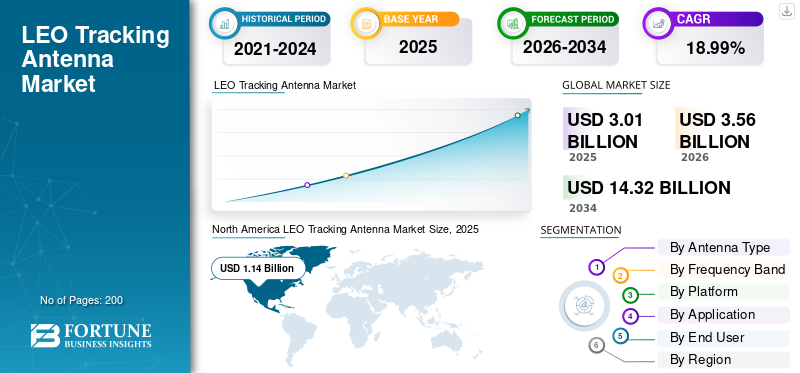
The global LEO tracking antenna market size was valued at USD 3.01 billion in 2025. The market is projected to grow from USD 3.56 billion in 2026 to USD 14.32 billion by 2034, exhibiting a CAGR of 18.99% during the forecast period. North America dominated the leo tracking antenna market with a market share of 37.87% in 2025.
LEO tracking antennas are specialized ground station antennas, such as X/Y mount or phased array systems, designed to precisely track fast moving Low Earth Orbit (LEO) satellites by eliminating blind spots and enabling program or automatic single pulse tracking in S/X bands. They include full motion earth stations from 3.5m to 18m, supporting UHF to V-band for TT&C, data downlink, and handover. These antennas are used in earth observation, defense communications, IoT, autonomous vehicles, search & rescue, and satellite gateways for remote sensing and secure operations. Driving factors include LEO constellation growth (e.g., Starlink), demand for low-latency broadband/IoT, advances in phased array tech, and space infrastructure investments.
Key players include Cobham, Kratos, Viasat, L3 Harries, among others. These players develop the TRACKER series for LEO/MEO gateways and earth observation(EO) with low power 3-axis tracking, also offer GEO/LEO/MEO earth stations for high reliability satcom.
Download Free sample to learn more about this report.
LEO TRACKING ANTENNA MARKET KEY TAKEAWAYS
 Market Size & Forecast
- 2025 Market Size: USD 3.01 Billion
- 2026 Market Size: USD 3.56 Billion
- 2034 Forecast Market Size: USD 14.32 Billion
- CAGR: 18.99% from 2026–2034
 Market Share
- North America dominated the LEO tracking antenna market with a 37.87% share in 2025.
- Phased array antennas held the leading share due to their multi-beam capability and fast satellite tracking performance.
- Ka band dominated the market in 2025 owing to strong demand for high-speed broadband and 5G backhaul connectivity.
 Key Regional Highlights
North America
North America dominated the market with a valuation of USD 1.14 billion in 2025
Europe
Europe is projected to reach USD 0.88 billion in 2026
Asia Pacific
Asia Pacific is expected to reach USD 0.98 billion in 2026
U.S.
The market is projected to reach USD 0.82 billion in 2026
Japan
The market is estimated at USD 0.18 billion in 2026
Read More

LEO TRACKING ANTENNA MARKET TRENDS
Rapid Adoption of Electronically Steered Phased Array Antennas is a Key Market Trend
Electronically steered phased array antennas (ESAs/AESAs) enable rapid electronic beam steering without mechanical parts, making them ideal for tracking fast-moving LEO satellites that are visible for only brief periods and outperforming traditional gimbaled systems in agility and multi-target handling. This trend accelerates as LEO mega-constellations demand seamless handovers, low latency links, and multi-beam operations for broadband/IoT/defense.
U.S. Tariff War Impact
U.S. tariffs imposed since January 2025 have significantly disrupted LEO tracking antenna supply chains by increasing costs on critical imports, such as GaN semiconductors, RF modules, and phased array components, predominantly sourced from China and Southeast Asia. This forces reshoring to U.S. facilities such as Safran DSI's Georgia plant, accelerating domestic manufacturing but inflating lead times and CAPEX for Kratos/L3Harris systems. Global players face compliance hurdles under tightened ITAR/export controls, delaying the rollouts of mega-constellation ground stations for Starlink/Kuiper.
Download Free sample to learn more about this report.
MARKET DYNAMICS
MARKET DRIVERS
Rapid Growth of LEO Satellite Constellations Drives Market Growth
The explosive growth of LEO satellite constellations, such as Starlink, drives demand for LEO tracking antennas by requiring thousands of ground stations for precise TT&C, data downlinks, and seamless handovers between fast-moving satellites visible for mere minutes per pass.Operators require scalable, high-throughput antennas supporting multi-beam Ka/X-band operations to manage proliferated fleets, fueling infrastructure expansion. This proliferation directly correlates with antenna deployments for resilient, high speed satcom.
- In January 2025, Safran Defense & Space, Inc. (Safran DSI) announced the successful completion of its first full-motion 5.5m "VISION" LEO (Low Earth Orbit) satellite tracking antenna, built in the U.S. and based in Norcross, Georgia.
MARKET RESTRAINTS
High Deployment and Technology Costs Restraints the Market Growth
High initial capital costs for LEO tracking antennas restrain market growth, as advanced phased array systems cost millions per unit due to complex Gallium Nitride (GaN) components, cryogenic cooling, and precision manufacturing for multi-beam Ka/X-band operations. Moreover, large scale ground station networks for mega constellations require the deployment of antennas with integrated modems and automation software which further escalates costs.
MARKET OPPORTUNITIES
Emerging Markets in Space Programs Creates New Market Opportunities
Emerging markets in space programs create significant opportunities for LEO tracking antenna demand, as nations including India, Indonesia, Vietnam, Thailand, and Singapore rapidly expand satellite constellations for disaster management, agriculture monitoring, and digital connectivity. Space Summit 2026 in Singapore highlighted regional alignment on scalable supply chains and attracted private investment in ground infrastructure amid operational smallsat launches. ISRO's growing LEO missions and ASEAN collaborations with JAXA/NASA necessitate precise tracking stations for TT&C and data reception.
MARKET CHALLENGES
Supply Chain Constraints Present a Major Market Challenge
Supply chain constraints pose a major challenge for LEO tracking antennas, with limited qualified manufacturers of radiation-hardened GaN MMICs, precision RF components, and space-certified phased arrays, creating production bottlenecks amid surging constellation demand. Global semiconductor shortages, particularly microchips from Taiwan hubs, delay deployments as witnessed in Starlink's user growth constraints.
Segmentation Analysis
By Antenna Type
Improved Multi-Beam Capabilities to Boost the Phased Array Antennas Segmental Growth
Based on the antenna type, the market is segmented into parabolic reflector antennas, phased array antennas, hybrid antenna systems, and patch / low-profile antennas.
The phased array antennas segment is anticipated to account for the largest market share. The segmental growth is driven by their multi-beam capability, speed, and agility for tracking fast-moving satellites.
The patch / low-profile antennas segment is anticipated to rise with a CAGR of 19.44% over the forecast period.
By Frequency Band
Rising Demand for High-Speed 5G Backhaul and Broadband Connectivity Drives Ka Band Segment Growth
Based on frequency band, the market is segmented into S band, X band, Ku band, Ka band, Q/V band.
In 2025, the Ka band segment dominated with the largest LEO tracking antenna market share. The segmental growth is mainly driven as Ka-band enables data speeds appropriate for 5G backhaul and internet services.
The Q/V band segment is projected to grow at a CAGR of 19.10% over the forecast period.
To know how our report can help streamline your business, Speak to Analyst
By Platform
Need for High-Capacity and High-Gain Connectivity Boosts Fixed Ground Stations Segment Growth
Based on the platform, the market is segmented into fixed ground stations, transportable ground terminals, maritime platforms, airborne platforms, land mobile platforms, space-based tracking antennas.
The fixed ground stations segment is anticipated to witness a dominating market share over the forecast period. Fixed stations can host advanced RF systems, large antennas, and high power tracking equipment which are necessary to provide the dependable, continuous, high capacity connectivity required for the LEO mega-constellations' rapid expansion.
The airborne platforms segment is projected to grow at a high CAGR of 20.11% over the forecast period.
By Application
Rise in Demand in Remote & Mobile Environments to Boosts Fixed Ground Stations Segment Growth
Based on the application, the market is segmented into broadband connectivity, defense & military communications, telemetry, Tracking & Command (TT&C), Space Situational Awareness (SSA), Aviation In-Flight Connectivity (IFC), and maritime VSAT services.
The broadband connectivity segment is anticipated to witness a dominating market share over the forecast period. Broadband is in high demand in order to connect rural areas, support maritime operations, provide aircraft Wi-Fi, and facilitate mobility (trains, trucks).
The defense & military communications segment is projected to grow at a CAGR of 19.21% over the forecast period.
By End User
Massive Commercial Constellation Deployment to boost the Commercial Satellite Operators Segment
Based on end user, the market is segmented into commercial satellite operators, defense ministries / armed forces, space agencies, aviation operators, and maritime fleet operators.
The commercial satellite operators segment dominated the segmental market share. In order to provide worldwide internet service, companies such as SpaceX and Amazon are launching hundreds of satellites, which require significant investment in ground terminals to connect to these constellations.
In addition, defense ministries / armed forces are projected to grow at a CAGR of 19.57% during the study period.
LEO Tracking Antenna Market Regional Outlook
By geography, the market is categorized into Europe, North America, Asia Pacific, and the rest of the world.
North America
North America held the dominant share in 2024, valued at USD 0.97 billion, and also maintained the leading share in 2025, with USD 1.14 billion. North America leads LEO tracking antenna market growth, driven by demand for low-latency global broadband and resilient satellite communications, as well as by commercial mega-constellations and defense modernization.
North America LEO Tracking Antenna Market Size, 2025 (USD Billion)
To get more information on the regional analysis of this market, Download Free sample
U.S. LEO Tracking Antenna Market
Based on North America’s strong contribution and the U.S. dominance in the region, the U.S. market can be estimated at around USD 0.82 billion in 2026, with a roughly 19.48% CAGR over the forecast period. The U.S. market growth stems from dominant commercial deployments and Space Force initiatives, which are spurring phased array trackers for seamless handovers in dense LEO environments.
Europe
Europe is projected to record a steady growth rate of 18.66% during the forecast period, the second highest among all regions, and to reach a valuation of USD 0.88 billion by 2026.Europe's expansion stems from ESA projects and sovereign satcom programs, with a focus on electronically steered arrays for NGSO constellations.
U.K. LEO Tracking Antenna Market
The U.K. market in 2026 is estimated at around USD 0.34 billion, with a CAGR of roughly 19.25% during the forecast period. The U.K. growth factors include Skynet evolution and hybrid GEO/LEO operations, propelled by NATO-aligned defense requirements.
Germany LEO Tracking Antenna Market
Germany’s market is projected to reach approximately USD 0.30 billion in 2026.Germany advances via DLR initiatives and Bundeswehr satcom upgrades, driven by precision requirements for EO data downlinks.
Asia Pacific
Asia Pacific is estimated to reach USD 0.98 billion in 2026 and secure the position of the third-largest market during the forecast period. Asia Pacific surges from national satellite programs and digital infrastructure builds, targeting disaster monitoring and rural connectivity.
Japan LEO Tracking Antenna Market
The Japan market in 2026 is estimated at around USD 0.18 billion, accounting for roughly 19.47% of the CAGR during the forecast period. Japan grows through JAXA smallsat rideshares and QZSS enhancements, fueled by Pacific maritime domain awareness.
China LEO Tracking Antenna Market
China’s market is projected to be one of the largest in Asia Pacific, with 2026 revenues estimated at around USD 0.34 billion. China's growth powers indigenous mega-constellations and belt & road extensions, emphasizing resilient defense communications.
India LEO Tracking Antenna Market
The Indian market in 2026 is estimated at around USD 0.28 billion. India expands through ISRO's EO missions and private NewSpace, driven by agriculture and disaster management applications.
Rest of the World
The rest of the world include Middle East & Africa and Latin America. Latin America advances equatorial coverage for Amazon monitoring, Middle East pursues hybrid constellations for secure operations. The Middle East & Africa and Latin America market is set to reach a valuation of USD 0.12 billion and USD 0.08 billion in 2026.
COMPETITIVE LANDSCAPE
Key Industry Players
Technological Service Enhancements By Key Market Players to Fuel Market Expansion
The LEO tracking antenna market features a competitive landscape dominated by established aerospace firms leveraging phased array expertise and defense contracts. Major key players include Kratos Defense, Cobham Satcom, Safran DSI, L3Harris, Viasat, Tesat-Spacecom, Thales Alenia Space, NEC Corporation, and CPI Satcom, which maintain leadership through specialized ground station portfolios and multi-band capabilities.
Key players enhance competitiveness through technological advancements in electronically steered arrays and AI-driven beam tracking. For instance, Safran DSI advances U.S. manufacturing of tri-band VISION antennas for proliferated constellations. Kratos integrates V-band systems for high-throughput LEO/MEO handovers, meeting demands from mega-constellation expansions.
LIST OF KEY LEO TRACKING ANTENNA COMPANIES PROFILED
- Kratos Defense (U.S.)
- Safran DSI (U.S.)
- Cobham Satcom (Denmark)
- L3Harris Technology Corporation (U.S.)
- Viasat (U.S.)
- Tesat-Spacecom (Germany)
- Thales Alenia Space (France)
- NEC Corporation (Japan)
- CPI Satcom (U.S.)
- Calian Space (Canada)
KEY INDUSTRY DEVELOPMENTS
- December 2025: Four contracts totaling about USD 3.5 billion were awarded by the Space Development Agency (SDA) to construct 72 Tracking Layer satellites that will increase the number of Missile Warning/Missile Tracking (MW/MT) Infrared (IR) sensors as well as Missile Warning, Tracking, and Defense (MWTD) sensors.
- November 2025: Four gateway ground stations for two Geostationary (GEO) satellites will be designed and built by Calian Group. The company will also provide the Middle East with monitoring and control systems, Radio Frequency (RF) equipment, and four 10-meter Ka/Q/V-band gateway antennas.
- April 2025: Viasat and Telesat signed an agreement to integrate Telesat Lightspeed LEO Ka-band capacity into Viasat's multi-orbit network, providing a new level of connectivity across Viasat’s mobility and defense business portfolio.
- February 2025: OHB System AG and the European Space Agency (ESA) signed a contract for the next phase of the OpSTAR project (Optical Synchronized Time And Ranging), Phase A/B1 = defining phase), to explore the potential of optical technologies for satellite navigation.
- January 2025: The world's fastest optical communication (wavelength band: 1.5 μm, communication speed: 1.8 Gbps) was accomplished using LUCAS between the Advanced Land Observing Satellite-4 "DAICHI-4" (ALOS-4)*2 and the Optical Data Relay Satellite in geostationary orbit at a distance of approximately 40,000 km by the Japan Aerospace Exploration Agency and NEC Corporation.
REPORT COVERAGE
The global LEO tracking antenna industry analysis includes a comprehensive study of market sizing and forecast for all market segments included in the report. It includes details on the market dynamics and trends expected to drive the market over the forecast period. It provides information on key aspects, including an overview of technological advancements, the regulatory environment, Porter’s Five Forces analysis, company profiles, and the retrofitting program. Additionally, it details partnerships, mergers, and acquisitions, as well as key industry developments and prevalence by key regions. The global market research report also provides a detailed competitive landscape with information on the market share and profiles of key operating players.
Request for Customization to gain extensive market insights.
Report Scope & Segmentation
| ATTRIBUTE | DETAILS |
| Study Period | 2021-2034 |
| Base Year | 2025 |
| Forecast Period | 2026-2034 |
| Historical Period | 2021-2024 |
| Growth Rate | CAGR of 18.99% from 2026-2034 |
| Unit | Value (USD Billion) |
| Segmentation | By Antenna Type, Frequency Band, Platform, Application, End User, and Region |
| By Antenna Type |
|
| By Frequency Band |
|
| By Platform |
|
| By Application |
|
| By End User |
|
| By Region |
|
Frequently Asked Questions
According to Fortune Business Insights, the global market value stood at USD 3.01 billion in 2025 and is projected to reach USD 14.32 billion by 2034.
In 2025, the North America’s market value stood at USD 1.14 billion.
The market is expected to exhibit a CAGR of 18.99% during the forecast period.
By antenna type, the phased array antennas segment is expected to dominate the market.
Rapid growth of LEO mega-constellations are the key factors driving the market growth.
Kratos Defense, Cobham Satcom, Safran DSI, L3Harris, Viasat, Tesat-Spacecom, Thales Alenia Space, NEC Corporation, are few key players in the market.
North America dominated the market in 2025 with the largest share.



- 2021-2034
- 2025
- 2021-2024
- 200
Get 30-60 hrs Free Customization
Expand Regional and Country Coverage, Segments Analysis, Company Profiles, Competitive Benchmarking, and End-user Insights.


















Related Reports
-
US +1 833 909 2966 ( Toll Free )
-
Get In Touch With Us