Liability Insurance Market Size, Share & Industry Analysis, By Type (Employer's Liability Insurance, Product liability insurance, Commercial liability insurance, Professional Liability Insurance, and Others), By Distribution channel (Broker, Online Platform, Insurance Agents, Direct Sales, and Others), By End User (Corporate, Government Entities, Non-Profit Organization, and Others), and Regional Forecast, 2026 - 2034
 Download Free Sample
LIABILITY INSURANCE MARKET SIZE AND FUTURE OUTLOOK
 Listen to Audio Version
The global liability insurance market size was valued at USD 285.92 billion in 2025. The market is projected to grow from USD 299.43 billion in 2026 to USD 460.86 billion by 2034, exhibiting a CAGR of 5.5% during the forecast period. North America dominated the global liability insurance market with a market share of 38.45% in 2025.
Liability insurance is a type of insurance that provides financial protection to individuals or businesses in the event which legally responsible for causing harm to others. This can include bodily injury, property damage, or other liabilities resulting from actions, errors, or negligence. It helps cover legal defense costs, settlements, and judgments. Liability insurance is crucial for managing the risk of lawsuits and claims that can arise in both personal and business contexts, ensuring that policyholders do not face catastrophic financial loss.
The liability insurance market is being driven by the increasing frequency and complexity of lawsuits and claims. As businesses and individuals face higher litigation risks due to evolving legal frameworks, technological advancements, and greater consumer awareness, the demand for liability insurance rises. Companies are especially vulnerable to claims related to negligence, product defects, or professional errors. This has led to an increased need for comprehensive coverage to protect against potential financial losses from lawsuits and regulatory penalties. The growing complexity of legal environments, especially in industries such as healthcare, technology, and finance, also boosts the demand for specialized liability insurance products.
Major companies in the liability insurance market, such as Allianz, AXA, and Zurich, adopt strategies such as leveraging advanced technology and AI to improve risk assessment and claims processing. The companies also broaden their product portfolios, offering a variety of liability coverage for different sectors, including general, professional, and cyber liability.
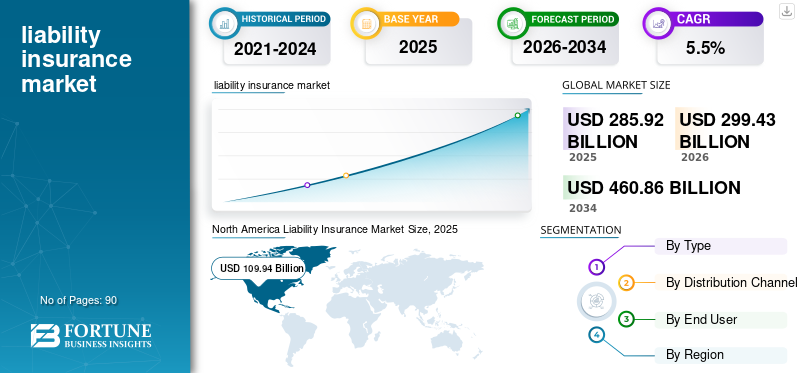
Download Free sample to learn more about this report.
LIABILITY INSURANCE MARKET KEY TAKEAWAYS
 Global Market Size & Forecast
- 2025 Market Size: USD 285.92 billion
- 2026 Market Size: USD 299.43 billion
- 2034 Forecast Market Size: USD 460.86 billion
- CAGR: 5.50% (2026–2034)
 Market Share
- North America dominated the market with a 38.45% share in 2025.
- Commercial liability insurance held the largest share by type in 2025.
- Broker segment dominated the market by distribution channel in 2025.
 Key Regional Highlights
North America
North America valued at USD 109.91 billion in 2025, driven by advanced risk management and rising cyber liability claims.
Europe
Europe reached USD 85.23 billion in 2025, supported by strict regulations and strong corporate compliance.
Asia Pacific
Asia Pacific valued at USD 65.80 billion in 2025, fueled by industrialization and growing business insurance demand.
U.S.
The market is estimated to reach USD 84.20 billion in 2025.
Japan
Market growth is supported by increasing corporate risk awareness and expanding demand for commercial liability insurance.
Read More

MARKET DYNAMICS
Market Drivers
Rising Litigation Rates to Drive the Growth of the Liability Insurance Market
As legal environments become more complex, businesses and individuals are facing a growing number of lawsuits related to negligence, product defects, and professional errors. The increase in litigation is due to greater awareness among consumers about their rights and the expanding scope of liability laws in many regions. This surge in legal claims puts considerable financial strain on businesses, as the costs associated with legal defense, settlements, and damages can be substantial. To mitigate these risks, more companies are turning to liability insurance to protect themselves from potential lawsuits. For instance,
- According to the Norton Rose Fulbright 2025 Annual Litigation Trends Survey, nearly half of corporate counsel expect the number of lawsuits and regulatory investigations affecting their organizations to rise in the near future.
Market Restraints
Legal and Regulatory Barriers to Restrict Market Growth
In many regions, insurers are required to adhere to stringent regulations concerning pricing, claims handling, and policy terms, which can increase operational costs and reduce market flexibility. Additionally, frequent changes in liability laws, such as evolving data protection regulations or new safety standards, create uncertainty for both insurers and businesses. These changes can lead to higher premiums and more complex coverage requirements, making it harder for businesses, especially SMEs, to afford necessary insurance.
Furthermore, insurers may face difficulties in maintaining profitability while complying with regional regulatory frameworks, limiting their ability to innovate or expand into new markets. Such regulatory constraints often slow down the liability insurance market growth and hinder the ability of insurers to meet the dynamic needs of their clients.
Market Opportunities
Rising Integration of Technology and AI to Create Major Opportunities in the Coming Years
AI and machine learning are transforming how insurers assess risk, underwrite policies, and process claims. By leveraging AI algorithms, insurers can more accurately predict and price risks, leading to more competitive premiums and better-tailored policies for businesses. Additionally, AI-powered chatbots and virtual assistants are improving customer service by providing 24/7 support, quick claim reporting, and faster resolution of inquiries. For instance,
- In June 2024, Lemonade Insurance integrated AI and machine learning into its operations, allowing for faster policy underwriting and claims processing. The company uses an AI-driven claims chatbot, “Maya,” which can handle claims in a matter of seconds, significantly reducing the time it takes to settle claims compared to traditional methods.
Furthermore, the use of AI also enables faster processing of claims, enhancing the overall customer experience by reducing wait times and improving accuracy in settlement decisions. Insurers can use AI to automate routine administrative tasks, which lowers operational costs and improves profitability. As technology continues to evolve, the integration of AI in the liability insurance sector presents a huge opportunity for insurers to innovate, streamline their operations, and offer smarter, more responsive services to customers, ultimately driving market growth.
Liability Insurance Market Trends
Growing Demand for Cyber and Digital‑Era Liability Coverage to be a Significant Liability Insurance Market Trend
As businesses continue to embrace digital transformation, the risks associated with cyber threats, including data breaches, ransomware attacks, and privacy violations, have escalated. This has led to a surge in demand for cyber liability insurance, which protects organizations from financial losses related to these risks. In particular, industries handling sensitive customer data, such as healthcare, finance, and e-commerce, are seeking more comprehensive coverage.
As data privacy regulations such as the GDPR and CCPA become more stringent, businesses are also required to safeguard their data more rigorously, further driving the need for specialized cyber liability policies. The increasing frequency and sophistication of cyberattacks have pushed both large enterprises and small businesses to invest in cyber insurance as a critical component of their risk management strategies. This growing focus on cyber coverage reflects the broader shift in the liability insurance market, as traditional risks evolve and new, digital-era threats emerge.
SEGMENTATION Analysis
By Type
Rise in Commercial Liability for Protection Against Third-Party Injury Accelerated the Segment’s Growth
Based on type, the market is divided into employer's liability insurance, product liability insurance, commercial liability insurance, professional liability insurance, and others.
Commercial liability insurance captured the largest liability insurance market share in 2025, as it provides broad protection against third-party bodily injury, property damage, and personal injury claims arising from day-to-day business operations. It is considered a foundational cover for companies of all sizes and is often purchased as a mandatory or first-line policy before any specialized liability products. The rise in claims related to premises accidents, contractor activities, and business operations has reinforced its importance for risk management. In many regions, regulatory expectations, contract requirements, and lender covenants also require businesses to maintain adequate commercial liability coverage.
Professional liability insurance is anticipated to grow at the highest CAGR of 8.9% during the forecast period due to rising exposure to errors and omissions across service-oriented sectors such as healthcare, IT, consulting, finance, and legal services. As economies become more knowledge and service-based, a larger share of value creation depends on professional judgment, advice, and design, which increases the risk of alleged negligence or misrepresentation.
By Distribution Channel
Increased Dependency on Brokers by Corporate and Commercial Client Boosted the Segment’s Growth
Based on distributed channel, the market is divided into broker, online platform, insurance agents, direct sales, and others.
Broker captured the largest liability insurance market share in 2025, as most corporate and commercial clients rely heavily on intermediaries to structure complex liability programs. Brokers provide expert advice on coverage limits, wording, exclusions, and global program design, which is critical for managing high-severity and cross-border risks. They also negotiate terms and premiums with multiple insurers, helping clients obtain competitive pricing and tailored solutions. For instance, major global brokers such as Marsh and Aon have expanded their liability advisory services by offering industry-specific solutions for sectors such as construction, healthcare, and manufacturing. For instance, in March 2022, major global brokers, Marsh, introduced advanced analytics tools that help clients evaluate liability exposure and optimize policy structures, which strengthens its role in large enterprise insurance placements.
Online platform is anticipated to grow at the highest CAGR of 9.3% during the forecast period, owing to the rapid digitalization of insurance distribution and increasing preference for self-service channels. Small and medium enterprises, startups, and professionals are increasingly using online portals to compare products, obtain quotes, and purchase liability policies in a quick and transparent manner.
To know how our report can help streamline your business, Speak to Analyst
By End User
Liability Insurance Segment Dominated due to Rising Scale of Business Operations
Based on end user, the market is divided into corporate, government entities, non-profit organization, and others.
The corporate segment held the largest share in 2025 and is anticipated to grow at the highest CAGR of 6.2% during the forecast period due to the rising complexity and scale of business operations. Companies across manufacturing, technology, healthcare, logistics, and financial services face increasing exposure to third-party claims, regulatory penalties, cyber incidents, and professional mistakes. As supply chains expand and businesses operate across multiple jurisdictions, the need for comprehensive liability protection becomes more critical.
Corporates also face rising expectations from regulators, investors, and clients to maintain strong risk management frameworks, making liability insurance a core requirement. Additionally, contractual obligations in projects, partnerships, and vendor agreements often mandate high liability coverage limits. The growing adoption of digital systems and automation creates new risks, further motivating companies to invest in broader and more specialized liability insurance solutions.
Liability Insurance MARKET REGIONAL OUTLOOK
By geography, the market is categorized into Europe, North America, Asia Pacific, South America, and the Middle East & Africa.
North America Liability Insurance Market Size, 2025 (USD Billion)
To get more information on the regional analysis of this market, Download Free sample
North America
The North America held the dominant share in 2025, valued at USD 2.31 billion. The growth is primarily driven by the presence of major insurers, advanced risk management practices, and higher awareness of professional and commercial liability. Additionally, the rise in cyber incidents and product liability claims encourages firms to invest in more specialized and higher-value liability insurance solutions. For Instance,
- In 2024, AT&T faced a major cyber incident that led to a proposed settlement of approximately USD 177 million after customer data was compromised. This high-value case highlighted the growing financial impact of cyber-related liabilities on large corporations and reinforced the need for stronger liability and cyber insurance coverage across North America.
In 2025, the U.S. market is estimated to reach USD 84.20 billion due to the country’s highly litigious environment and strict legal framework, which increases the probability of costly lawsuits for businesses. U.S. companies frequently deal with claims related to workplace injuries, product defects, medical malpractice, and data breaches, which increases demand for strong liability protection.
Download Free sample to learn more about this report.
Europe
The market in Europe is estimated to reach USD 85.23 billion in 2025, securing a strong position. This is due to the region’s well-established regulatory framework and high emphasis on corporate compliance. European businesses operate under strict rules related to data protection, product safety, workplace standards, and environmental responsibility, all of which increase the need for comprehensive liability insurance. Additionally, the strong presence of major insurers and the increasing adoption of risk management practices support the steady expansion of the liability insurance market across Europe.
The region combines mature markets such as the U.K. with high-growth opportunities in the blockchain sector. Backed by these factors, countries including the U.K. are anticipated to record the valuation of USD 17.28 billion, Germany to record USD 13.90 billion, and France to record USD 11.64 billion in 2025.
Asia Pacific
The Asia Pacific region is projected to record the highest growth rate of 8.3% and touch the valuation of USD 65.80 billion in 2025. In the region, India and China are both estimated to reach USD 9.44 billion and USD 18.49 billion, respectively, in 2025. The growth is supported by rapid industrialization and the expansion of the services sector in countries such as China and India. Businesses in the region are facing stricter regulations on workplace safety, product quality, environmental protection, and data privacy, which is increasing the need for liability coverage. Rising foreign investment and the presence of multinational corporations are also pushing local firms to align with global risk management standards, including higher liability limits.
South Africa & Middle East & Africa
South America and the Middle East & Africa regions would witness a moderate growth in this market. The market in 2025 is set to record a valuation of USD 15.70 billion. Growing participation of multinational companies and cross-border projects is also pushing local businesses to align with international risk management and insurance standards. In addition, improving insurance awareness and the expansion of local and regional insurers are gradually supporting the penetration of commercial and professional liability products across South America.
In the Middle East & Africa, the GCC is set to attain the value of USD 3.34 billion in 2025. MEA market growth is supported by ongoing economic diversification efforts, especially in GCC countries that are investing heavily in infrastructure, construction, and large industrial projects, all of which require robust liability coverage. Governments in the region are also gradually strengthening regulations on workplace safety, professional standards, and product quality, which encourages businesses to adopt liability insurance as part of compliance.
COMPETITIVE LANDSCAPE
Key Players
Strategic Collaboration with Insurtech Firms and Data Analytics Providers to Strengthen Fraud Detection
Strategic collaborations and the formation of industry consortia are becoming central to growth in the liability insurance market. Major insurers are increasingly partnering with sector associations in healthcare, construction, manufacturing, and finance to develop specialized liability products that address emerging risks more precisely. Collaboration with insurtech firms and data analytics providers is also accelerating, enabling carriers to enhance underwriting accuracy, strengthen fraud detection, and speed up claims handling through advanced digital tools.
Long List of Liability Insurance Companies Studied:
- Chubb Limited (Switzerland)
- AIG, Inc. (U.S.)
- Beazley plc (U.K.)
- Hiscox, Inc. (U.K.)
- Philadeiphia Insurance Companies (U.S.)
- AXA Group (France)
- Allianz SE (Germany)
- Traveler Companies, Inc. (U.S.)
- Munich RE (Germany)
- Mapfre SA (Spain)
- CNA Financial Corporation (U.S.)
- Progressive Corporation (U.S.)
- Sompo Holdings, Inc. (Japan)
- Intact Financial Corporation (Canada)
- QBE Insurance Group (Australia)
KEY INDUSTRY DEVELOPMENTS:
- In July 2025, Aviva’s Global, Corporate and Specialty (GCS) business introduced its enhanced Freight Liability insurance to the market. This updated product is newly available on Acturis E-Trade and Fast Trade platforms and offers greater flexibility to meet the evolving needs of brokers and clients.
- In April 2025, Chaucer teamed up with Armilla AI to launch a new standalone third-party liability (TPL) insurance product. The collaboration aims to address the growing concerns around mechanical underperformance in AI systems and the legal liabilities that can arise from such failures.
- In April 2025, Cyber risk solutions firm Resilience expanded its capacity to provide cyber risk solutions to large enterprise accounts with revenue of more than USD 10 billion through a partnership with Accredited Insurance Holdings, a global programme manager. The expanded underwriting aims to address clients’ complex cyber risks.
- In November 2024, Aegis Executive Risks, backed by K2 Insurance Services, announced the launch of a new management liability insurance program. It is designed for private entities and their executives, focusing on D&O and related management liability exposures.
- In May 2024, RSA Insurance partnered with Q Underwriting to launch a new bespoke management liability product aimed at private limited companies and LLPs. This partnership will be providing comprehensive cover for directors and officers, and the company itself.
REPORT COVERAGE
The report provides a detailed analysis of the market and focuses on key aspects such as leading companies, types, and leading applications of the product. Besides, the report offers insights into the market trends and highlights key industry developments. In addition to the factors above, the report encompasses several factors that contributed to the growth of the market in recent years.
Request for Customization to gain extensive market insights.
REPORT SCOPE & SEGMENTATION
|
ATTRIBUTE |
DETAILS |
|
Study Period |
2021-2034 |
|
Base Year |
2025 |
|
Forecast Period |
2026-2034 |
|
Historical Period |
2021-2024 |
|
Growth Rate |
CAGR of 5.5% from 2026 to 2034 |
|
Unit |
Value (USD Billion) |
|
Segmentation |
By Type
By Distribution Channel
By End User
By Region North America (By Type, By Distribution Channel, By End User, and By Country)
Europe (By Type, By Distribution Channel, By End User, and By Country)
Asia Pacific (By Type, By Distribution Channel, By End User, and By Country)
Middle East & Africa (By Type, By Distribution Channel, By End User, and By Country)
South America (By Type, By Distribution Channel, By End User, and By Country)
|
|
Companies Profiled in the Report
|
Frequently Asked Questions
The market is projected to reach USD 460.86 billion by 2034.
In 2025, the market was valued at USD 285.92 billion.
The market is projected to grow at a CAGR of 5.5% during the forecast period.
By end user, the corporate segment led the market.
Rising litigation rates are a key factor driving the growth of the market.
Chubb Limited, AIG, Inc., and Beazley plc are the top players in the market.
North America held the highest market share.



- 2021-2034
- 2025
- 2021-2024
- 90
Get 30-60 hrs Free Customization
Expand Regional and Country Coverage, Segments Analysis, Company Profiles, Competitive Benchmarking, and End-user Insights.












-
US +1 833 909 2966 ( Toll Free )
-
Get In Touch With Us