Liquid Filling Machines Market Size, Share & Industry Analysis, By Function Type (Automatic and Semi-Automatic), By Product Type (Glass, Plastics, Tetra Pack & Cardboards, and Others), By Filling Type (Vacuum filling, Volumetric Filling, Weigh Filling, and Others), By Filling Capacity (Upto 50 ml, 51-250 ml, 250-1000 ml, and above 1000 ml), By End Use (Food, Beverages, Pharmaceuticals, and Cosmetics), and Regional Forecast, 2026–2034
 Download Free Sample
Liquid Filling Machines Market Size
 Listen to Audio Version
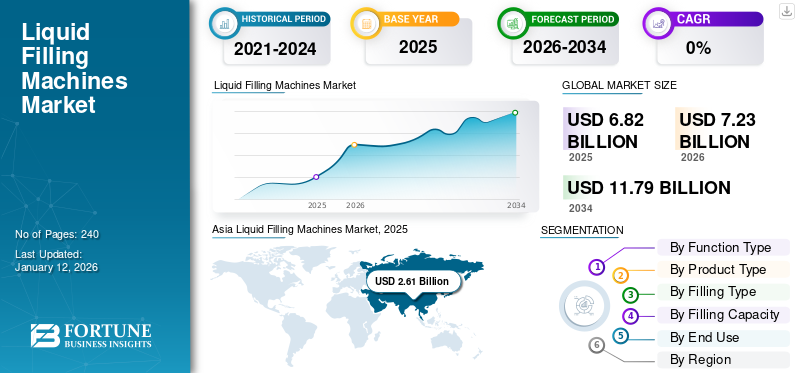
The global liquid filling machines market size was valued at USD 6.82 billion in 2025. The market is projected to grow from USD 7.23 billion in 2026 to USD 11.79 billion by 2034, exhibiting a CAGR of 6.30% during the forecast period. The Asia Pacific dominated global market with a share of 38.20% in 2025.
Liquid filling machines are equipment used across the packaging industry to fill various liquid products, such as water, oil, shampoo, medicine, and beverages into specific packaging and quantities. The machineries are optimally designed to maximize filling speed and accuracy, thereby increasing productivity and minimizing human errors. Liquid filling machines work automatically, either fully automated through IoT and Industry 4.0 or semi-automatically, where an operator controls the filling process manually. They are offered with different filling technologies such as vacuum filling, volumetric filling, weigh filling, overflow filling and others.
Download Free sample to learn more about this report.
Liquid Filling Machines Market Key Takeaways
 Global Market Size & Forecast
- 2025 Market Size: USD 6.82 billion
- 2026 Market Size: USD 7.23 billion
- 2034 Forecast Market Size: USD 11.79 billion
- CAGR: 6.30% from 2026–2034
 Market Share
- Asia Pacific dominated the global market with a share of 38.20% in 2025.
- The automatic liquid filling machines segment is poised to dominate the market with a share of 26.14% in 2026.
- Plastic products have been replaced majorly in every packaging segment with a share of 19.09% in 2026.
 Key Regional Highlights
Asia Pacific
Asia Pacific contributed 38.20% to the global market in 2025, with a valuation of USD 2.61 billion, and is projected to reach USD 2.79 billion in 2026, and is expected to maintain its leading position during the forecast period.
Europe
The Europe market generated USD 2.08 billion in 2025, representing 30.50% of the global market landscape, and is expected to reach USD 2.19 billion in 2026.
North America
North America represented USD 1.39 billion, accounting for 20.30% of the worldwide market in 2025, and is projected to grow to USD 1.47 billion in 2026.
U.S.
The liquid filling machines market is projected to reach USD 0.95 billion by 2026, driven by continued investments in automation and precision filling technologies.
Japan
The market is projected to reach USD 0.50 billion by 2026, supported by steady demand from the food, beverage, and healthcare packaging industries.
Read More

Globally, the demand for liquid filling machines is increasing with growing varieties in the beverages and drink segment. Consumers are spending heavily on cold drinks and beverages that are more high in sugar content and instantly boost dopamine. Furthermore, changing consumer behavior and growing ready-to-eat food culture have bolstered the demand for dairy, sauces, and other liquid food. These machines enhance productivity, accuracy, and precision, ensure hygiene and food safety, decrease human errors, and offer flexibility to fill various products from a single product line.
The COVID-19 pandemic caused a slight decline in the growth of the liquid-filling industry owing to a disturbed supply chain and decrease in the production of beverages and drinks. Additionally, lockdown situations and precautionary measures hampered the product demand. However, the removal of lockdown restrictions post-pandemic has up scaled the demand in the food and beverages sector, significantly supporting the demand for liquid filling machines in the long term.
Liquid Filling Machines Market Trends
Demand for Automated Production Lines and Expansion in Alcoholic Beverage Sales to Bolster Product Demand
Globally the automated production lines installation for beverages and drinks consumption has increased exponentially due to heavy promotions and branding. Growing demand for the varieties in the refreshment industry, such as energy drinks, zero sugar drinks, health drinks, and many more, stimulated the demand for liquid filling machines in the nonalcoholic beverage industry. Additionally, growing demand for alcoholic beverages and beers owing to increasing sales of mid-size beer bottles and canned products in the winery industry has bolstered liquid filling machines market share during the forecast period.
- For instance, in December 2023, Coca-Cola System commissioned a new bottling plant in Senegal. The state-of-the-art facility represents a USD 50 million investment as a part of the process to reshape the Coca-Cola presence in the country.
Download Free sample to learn more about this report.
Liquid Filling Machines Market Growth Factors
Growing Demand for Advanced Precision and Hygiene Solutions to Stimulate Market Growth
Integration of more advanced solutions for liquid filling, ensuring more precise and hygiene, has driven demand across production lines by achieving safer products with minimal productivity loss. Additionally, the filling machines need to have more correct settings to ensure more accurate dosing and filling processes. In volumetric filling, automatic level sensors and level controlling system accurately control liquid levels, avoiding overfilling and under filling in the production lines. These technological advancements in the filling technology are stimulating the demand for liquid filling machines market growth in the long term.
- For instance, in August 2023, Mitsubishi Heavy Industries Machinery Systems, Ltd. commissioned a new aseptic filling system for beverages, featuring dual-level sterilization of the PET bottles to ensure an aseptic environment.
RESTRAINING FACTORS
Challenges in Temperature Control and Impact of Sustainability Packaging Trends May Restrain Market Growth
Liquid filling machines operate at different temperatures for various products ranging from bottled water, window cleaners, jams, pastes, sauces, and other materials. Different materials present unique challenges such as temperature variations in different operating conditions for liquid machine manufacturers. At the same time packaged products are getting deposited in landfills. Thus, emphasis on adopting sustainable packaging has restrained the demand for liquid packaging in the short term. Some of the challenges in liquid filling are the choice of materials for machinery construction or managing the viscosity of the product being filled. Viscosity can vary with temperature changes, complicating accurate filling processes. Keeping the temperature constant can solve the viscosity issues but increases the cost of the machinery. These factors are negatively impacting sales and directly restraining the market.
Liquid Filling Machines Market Segmentation Analysis
By Function Type Analysis
Automatic Segment to Lead Owing to Precise Filling Capabilities
Based on function type, the market is categorized into automatic and semi-automatic.
The automatic liquid filling machines segment is poised to dominate the market with a share of 26.14% in 2026, owing to their high operational accuracy and precise liquid filling in the production lines. Automatic machines are the preferred choice in production as it offers lesser complexity in commissioning and operations compared to semi-automatic filling systems. Automatic machines over time are getting more efficient with lesser consumption of electricity and faster liquid filling this enable faster production and enhanced production capacity for manufacturers.
Semi-automatic machines are growing steadily due to the less cost of installation and productive output in the Micro Small Medium Enterprises (MSME) units.
By Product Type Analysis
Plastic Segment Dominated due to Recycling Initiative
Based on product type, the market is divided into glass, plastic, tetra pack & cardboard, and others (cans).
Globally, plastic products have been replaced majorly in every packaging segment with a share of 19.09% in 2026. In liquid processing and packaging, Polyethylene Terephthalate (PET) and other plastic substitutes are dominating the bottle type segment.
The plastic segment attained the highest market revenue share in 2024, owing to the high demand for beverages that include water, soft drinks, and energy drinks. Ban on single use plastic has expanded its potential that provided a progressive growth to plastic product type segment owing to recycling initiatives and Recycled Polyethylene Terephthalate (rPET) demand.
Glass market share is set to grow steadily owing to high re-usability and low operational cost.
In contrast, tetra packs, cardboard, and other packaging products are showcasing a subtle growth.
By Filling Type Analysis
Growing Demand for Beverages to Dominate Volumetric Filling Segment
Based on filling type, the market is categorized into vacuum filling, volumetric filling, weigh filling, and others (overflow filling).
The volumetric filling segment is attaining the highest market share of 16.74% in 2026 and growth across the liquid filling industry owing to their dominant sales in the beverage filling lines and high efficiency in production lines. They have easy commissioning and attachments made available for different bottle and packaging type. These machines are easy to operate with less workforce and offers more precise filling that bolster the demand for volumetric filling in long term.
Vacuum filling is growing at a steady pace with increasing use in sterilized syrups and cosmetic products packaging.
Weigh filling and other filling systems are forecasted to showcase a subtle growth due to their application-specific operations.
To know how our report can help streamline your business, Speak to Analyst
By Filling Capacity Analysis
51-250 ml Segment to Lead due to High Demand for Cost Effective Refreshment
Based on filling capacity, the market is divided into 50 ml, 51-250 ml, 251-1000 ml, and above 1000 ml.
The 51-250 ml segment is expected to hold the highest share in 2026 with 19.23%, owing to high production costs and shrinkage in the beverage industry. Consumers demand on-the-go drinks that can give a refreshment at an effective cost and minimal consumption of the beverage.
Growing demand for mid-size packaged liquid items of 251-1000ml in the food and beverage segment, due to decreasing consumption, is driving the liquid bottle-filling revenue.
By End Use Analysis
Dominant Beverage Demand Across Consumer to Bolster Liquid Filler End Use
By end-user, the market is classified into food, beverages, cosmetics, and pharmaceuticals.
Beverages segment is set to lead the market. The nonalcoholic segment is set to dominate the market with the highest CAGR and share due to increasing consumer demand for beverages that are loaded with 0% sugar and give instant energy. Post-pandemic introduction of many health drinks and entrant of small and medium enterprises in the beverage industry has boosted the economy and demand for beverage. Thus, to address the growing beverage demand across consumer prominent players are providing manufacturer specific solutions to bolster demand in long term.
The growing trend of sauces and fillings in the food industry has raised the demand for viscous food and sauces, supporting the steady growth of the food segment and bolstering the growth of liquid fillers across the industry.
REGIONAL INSIGHTS
The global liquid filling market is studied across North America, Europe, Asia Pacific, the Middle East & Africa, and Latin America.
Asia Liquid Filling Machines Market, 2025 (USD Billion)
To get more information on the regional analysis of this market, Download Free sample
North America
In 2025, North America represented USD 1.39 billion, accounting for 20.30% of the worldwide market, and is projected to grow to USD 1.47 billion in 2026. North America’s liquid filling machines market is mature and continues to grow steadily, driven by the high adoption of technological advancements and automation across industries. The presence of well-established sectors such as beverages, packaged foods, and consumables in the U.S. and Canada is significantly contributing to the demand for liquid filling machines during the forecast period. Additionally, increasing focus on operational efficiency and precision filling technologies is supporting market expansion. The U.S. market is projected to reach USD 0.95 billion by 2026.
Europe
The Europe market generated USD 2.08 billion in 2025, representing 30.50% of the global market landscape, and is expected to reach USD 2.19 billion in 2026. Europe represents another mature market characterized by a strong emphasis on quality, sustainability, and operational efficiency. Countries such as Germany, the U.K., and Italy serve as major industrial hubs for liquid filling machines. The rising demand for packaged beverages, liquid alcohol, drinks, and packaged liquid food products is fueling market growth across the region. Furthermore, stringent environmental regulations are encouraging the adoption of advanced and eco-friendly filling technologies. The UK market is projected to reach USD 0.15 billion by 2026, while the Germany market is projected to reach USD 0.62 billion by 2026.
Asia Pacific
Asia Pacific contributed 38.20% to the global market in 2025, with a valuation of USD 2.61 billion, and is projected to reach USD 2.79 billion in 2026, and is expected to maintain its leading position during the forecast period. The region held the largest market share in 2024, driven by rapid urbanization and increasing demand for beverages that are low in sugar and provide instant energy. Additionally, the market experienced positive growth during the COVID-19 pandemic due to strong demand for liquid health supplements, food and beverages, and other health-related liquid products. China is anticipated to dominate the regional market owing to its growing population, rapid urbanization initiatives, and a shift toward healthier lifestyles in the post-pandemic period. India, Japan, and South Korea are also key contributors to market growth. The Japan market is projected to reach USD 0.5 billion by 2026, the China market is projected to reach USD 1.11 billion by 2026, and the India market is projected to reach USD 0.41 billion by 2026.
Latin America
The market in Latin America reached USD 0.34 billion in 2025, representing 4.90% of total market revenue, and is projected to reach USD 0.35 billion in 2026. The Latin America liquid filling machines market is witnessing steady yet subtle growth, supported by increasing emphasis on innovation, technological advancements, and modernization of manufacturing processes. The rising adoption of automated and semi-automated liquid filling machines across small and medium enterprises (SMEs) is contributing to market expansion. Additionally, growing demand for packaged beverages and liquid food products is further supporting regional market development.
Middle East & Africa
The Middle East & Africa market was valued at USD 0.42 billion in 2025, capturing 6.10% of global revenue, and is estimated to reach USD 0.43 billion in 2026. The Middle East & Africa liquid bottle-filling market is experiencing notable growth, driven by rising urbanization and increasing tourism activities across the region. Countries such as Saudi Arabia, the UAE, and South Africa are emerging as key markets, contributing to increased investments in liquid filling machine infrastructure. Furthermore, expanding food and beverage industries and growing demand for packaged liquid products are supporting the adoption of advanced filling technologies in the region.
KEY INDUSTRY PLAYERS
Key Firms Emphasize Innovation to Expand their Market Reach
Major players are introducing new state-of-the-art liquid bottle-filling machines for the food and beverages industry. Industry players emphasize innovation by developing new machines that can be user-friendly, environment-friendly, and improve speed and productivity of the operation. These innovative packaging product strategies are increasing the player's revenue and filling machines market size in the long term.
- For instance, in May 2023, Krones AG opened a new R&D excellence center to provide aftermarket support and introduce new technological advancements to its machine product portfolio.
List of Top Liquid Filling Machines Companies:
- Adelphi Group of Companies (U.K.)
- ATS Corporation (Canada)
- GEA Group Aktiengesellschaft (Germany)
- JBT Corporation (U.S.)
- KHS GmbH (Germany)
- Krones AG (Germany)
- ProMach Inc (U.S.)
- Tetra Laval S.A. (Switzerland)
- Syntegon (Bosch) (Germany)
- Mitsubishi Heavy Industries Ltd. (Japan)
KEY INDUSTRY DEVELOPMENTS:
- March 2024: KHS GmbH introduced new Plasmax, a coating technology, which manufactures tech-advanced filler machines. The benefits associated with this technology include higher output, better production efficiency, low energy consumption, flexibility, low maintenance cost, and extended durability. It has a filling capacity of around 48,000 PET bottles per hour.
- February 2024: Ampack, a subsidiary of Syntegon Technology GmbH, introduced a new FBL filling machine for PP, HDPE, and PET bottles. It is used to fill products such as dairy products, soups, and milk and plant-based drinks. This machine can fill bottles between 50 ml and 1,500 ml efficiently, with a production capacity of 36,000 bottles per hour.
- October 2023: GEA Group Aktiengesellschaft launched the new GEA Visitron filler for the beverage industry. It has a production speed of 10,000 containers per hour and can fill various containers such as glass, PET, and aluminum cans. It features durability, easy of use, and low energy consumption.
- October 2023: GEA Group Aktiengesellschaft opened a new manufacturing facility in Parma, Italy. The main aim of opening the manufacturing facility was to increase the production capacity of filling equipment, processing equipment, and packaging equipment by 50 percent. This facility spans 4,000 square meters, enhancing efficiency and technology in filling systems.
- December 2022: TechniBlend, a subsidiary of ProMach Inc., launched the new ProFill V volumetric can filler with a filling capacity ranging from 100 to 600 cans per minute. This versatile machine is designed for use in the food and beverages sector, offering accuracy and high speed operations.
REPORT COVERAGE
The report provides a detailed analysis of the market and focuses on key aspects such as leading companies, product/service types, and leading applications of the product. Besides, the report offers insights into the market trends market insights and highlights key industry developments. In addition to the factors above, the report encompasses several factors that contributed to the growth of the market in recent years.
Request for Customization to gain extensive market insights.
Report Scope & Segmentation
|
ATTRIBUTE |
DETAILS |
|
Study Period |
2021-2034 |
|
Base Year |
2025 |
|
Forecast Period |
2026-2034 |
|
Historical Period |
2021-2024 |
|
Growth Rate |
CAGR of 6.30% from 2026 to 2034 |
|
Unit |
Value (USD Billion) |
|
Segmentation |
By Function Type, Product Type, Filling Type, Filling Capacity, End Use, and Region |
|
Segmentation |
By Function Type
By Product Type
By Filling Type
By Filling Capacity
By End Use
By Region
|
Frequently Asked Questions
Fortune Business Insights Inc. says that the market is projected to reach USD 11.79 billion by 2034.
In 2025, the market was valued at USD 6.82 billion.
The market is projected to grow at a CAGR of 6.30% during the forecast period.
By filling type, volumetric filling segment is leading in terms of market share.
Growing demand for calibrated and hygienic filling is a key factor driving market growth.
Adelphi Group of Companies, ATS Corporation, Coesia S.p.A., Avantis Systems Ltd., GEA Group Aktiengesellschaft, JBT Corporation, KHS GmbHKrones AG, Tetra Laval S.A., Syntegon (Bosch), Cozolli Machine, Marchesini Group, Fuji Machinery, Mitsubishi Heavy Industries Ltd. are top players in the market.
Asia Pacific held the maximum market share in 2025.
The beverage end-use segment is expected to grow at the highest CAGR during the forecast period.



- 2021-2034
- 2025
- 2021-2024
- 240
Get 30-60 hrs Free Customization
Expand Regional and Country Coverage, Segments Analysis, Company Profiles, Competitive Benchmarking, and End-user Insights.







Related Reports
-
US +1 833 909 2966 ( Toll Free )
-
Get In Touch With Us