Low GWP Refrigerants Market Size, Share & Industry Analysis, By Type (Fluorocarbons, Inorganic Refrigerants, and Hydrocarbons), By Application (Residential Air Conditioning, Commercial Refrigeration, Industrial Refrigeration, Automotive Air Conditioning, and Others), and Regional Forecast, 2026-2034
 Download Free Sample
Low GWP Refrigerants Market Size and Future Outlook
 Listen to Audio Version
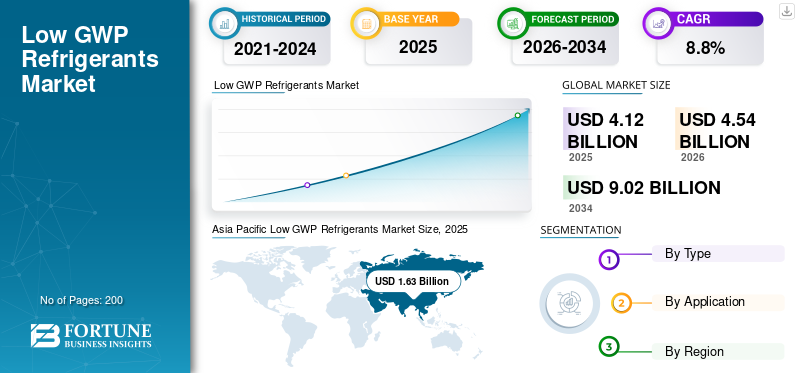
The Low GWP refrigerants market size was valued at USD 4.12 billion in 2025. The market is projected to grow from USD 4.54 billion in 2026 to USD 9.02 billion by 2034, exhibiting a CAGR of 8.8% during the forecast period. Asia Pacific dominated the low gwp refrigerants market with a market share of 39.56% in 2025.
Low GWP refrigerants are refrigerant gases that blends with a global warming potential, materially lower than that of conventional high-GWP HFCs. Commercial demand for fluorocarbons (HFOs, HFO/HFC blends, and selected lower-GWP HFCs), hydrocarbons (propane (R-290), isobutane (R-600a), and propylene (R-1270)), and inorganic refrigerants (carbon dioxide (R-744), ammonia (R-717), water, and air-based systems) is increasing. These refrigerants are supplied for residential air conditioning, commercial refrigeration, industrial refrigeration, automotive air conditioning, chillers, heat pumps, transport refrigeration, and other HVACR applications.
The market growth is driven by the global HFC phase-down under the Kigali Amendment, the U.S. AIM Act technology-transition framework and the EU F-gas Regulation 2024/573, rising air-conditioning penetration, growth in cold-chain infrastructure, supermarket conversions to CO2 and propane systems, and OEM movement toward HFO/HFC blends in stationary and automotive air conditioning. This growth is further supported by the deployment of heat pumps, food retail modernization, improvements in the design of natural refrigerant systems, and increased demand for refrigerant recovery, reclamation, and compliant servicing.
Furthermore, the market comprises several major players, including Honeywell International Inc., The Chemours Company, Arkema S.A., Daikin Industries, Ltd., and Linde plc. Low-GWP chemistry platforms, blend development, refrigerant safety classification, equipment compatibility, regulatory compliance, supply availability, cylinder distribution, reclamation networks, and OEM qualification shapes these companies' competitive positioning in the global market.
Download Free sample to learn more about this report.
LOW GWP REFRIGERANTS MARKET TRENDS
Regulatory Phase-Down, HFO/HFC Blends, and Natural Refrigerant Adoption Are Significant Market Trends
The product demand is increasingly driven by the need to replace high-GWP refrigerants without compromising equipment performance, safety, energy efficiency, servicing practicality, or lifecycle emissions. HVACR OEMs, supermarket chains, automotive manufacturers, cold-storage operators, and heat-pump suppliers are placing preferring lower direct emissions, smaller refrigerant charges, equipment-specific safety design, and refrigerants that comply with evolving GWP limits. This is strengthening the commercial role of HFOs, HFO/HFC blends, R-32, CO2, ammonia, propane, and isobutane across new equipment and retrofit applications.
Additionally, regulation and portfolio strategies are increasingly centered on application-specific refrigerant selection. Residential and light commercial air conditioning is moving toward lower-GWP fluorocarbon blends and R-32, whereas food retail is looking for CO2 transcritical systems, propane cabinets, and HFO/HFC blends. Moreover, the industrial refrigeration continues to rely on ammonia and CO2 systems and automotive air conditioning increasingly uses HFO-1234yf. As HFC quota controls, product bans, and servicing restrictions become more formalized, refrigerant suppliers are highlighting low-GWP formulations, reclaim programs, and product stewardship to retain OEM and aftermarket customers.
- For instance, HFO-based refrigerants, R-32, R-454B, CO2 transcritical systems, low-charge ammonia systems, propane self-contained cabinets, and HFO-1234yf automotive refrigerants are strengthening commercial demand for low-GWP refrigerants.
MARKET DYNAMICS
MARKET DRIVERS
Download Free sample to learn more about this report.
HFC Phase-Down, HVACR Equipment Transition, and Cooling Demand Are Driving Market Growth
Air conditioning and refrigeration remain the largest demand centers as refrigerants are required for equipment first-fill, servicing, repair, and replacement across buildings, vehicles, food retail, cold storage, healthcare, logistics, and industrial cooling. Regulatory momentum is accelerating the replacement of high-GWP refrigerants. For instance, the U.S. AIM Act directs a phasedown of HFC production and consumption and includes technology-transition rules for specific refrigeration, air-conditioning, and heat-pump subsectors. Additionally, the EU F-gas Regulation 2024/573 tightens the HFC phase-down and introduces additional restrictions across products and equipment. These policy signals are pushing OEMs and end users toward HFOs, HFO/HFC blends, CO2, ammonia, and hydrocarbons.
Additionally, the demand for structural cooling is increasing. Global air-conditioner demand remains higher, particularly in China, India, Southeast Asia, North America, Japan, Europe, Latin America, and the Middle East. Commercial refrigeration and cold-chain expansion are also increasing the need for compliant refrigerants in supermarkets, convenience stores, food processing, transport refrigeration, pharmaceuticals, and warehousing. As customers seek regulatory compliance, energy performance, lower direct emissions, and long-term availability, low-GWP refrigerants are becoming a practical route to future-proofing HVACR investments. These factors collectively drive low GWP refrigerants market growth.
- For instance, lower-GWP fluorocarbon blends for air conditioning, CO2 systems for food retail, ammonia/CO2 systems for industrial refrigeration, and propane cabinets for self-contained commercial refrigeration are increasingly used as they help reduce direct climate impact while maintaining application-specific cooling performance.
MARKET RESTRAINTS
Safety Classification, Equipment Redesign, Higher Refrigerant Cost, and Servicing Constraints Can Restrict Market Expansion
Although low-GWP refrigerants are commercially important, the market remains sensitive to equipment redesign costs, safety requirements, refrigerant price premiums, cylinder logistics, service technician availability, and local building code constraints. Many low-GWP alternatives involve trade-offs.
For examples, hydrocarbons are highly efficient but flammable whereas ammonia is efficient & well-established but toxic which requires trained industrial handling. Similarly, CO2 requires a higher-pressure system design and several HFO/HFC blends require equipment-specific compatibility and safety assessments. These all above factors can increase adoption cost compared with legacy refrigerants in price-sensitive markets.
Supply and qualification complexity are also restraining market expansion. OEMs must validate compressors, heat exchangers, lubricants, seals, sensors, controls, and installation procedures before switching refrigerants. Aftermarket adoption depends on technician training, labeling, recovery cylinders, reclaim availability, and avoidance of cross-contamination. Uncertainty around future environmental scrutiny of some fluorinated chemistries, including broader PFAS-related policy debates in certain regions, may also influence purchasing decisions. These factors can slow conversion in smaller installers, developing regions, and applications with long equipment replacement cycles.
MARKET OPPORTUNITIES
Heat Pumps, Food Retail Conversion, Automotive HFO Use, and Refrigerant Reclamation are Creating Lucrative Growth Opportunities
Key market opportunities are emerging from heat-pump deployment, building decarbonization, supermarket retrofits, commercial cold-chain modernization, and the shift of automotive air conditioning toward HFO-1234yf. Suppliers that can support OEM qualification, application engineering, safe handling, and reliable distribution are positioned to benefit as equipment manufacturers standardize new refrigerant platforms. Demand is also expected to expand for R-454B, R-32, R-1234yf, R-1234ze, CO2, ammonia, and propane as regional regulations and building-sector decarbonization policies create stronger incentives for low-GWP cooling and heating systems.
Additional opportunities also exist in refrigerant recovery, reclamation, lifecycle refrigerant management, and lower-charge system design. As raw high-GWP HFC availability becomes less under quota systems, reclaimed refrigerants and compliant substitutes become more valuable for servicing existing equipment. Food retail, industrial refrigeration, pharmaceuticals, logistics, and data-center cooling are higher-value areas where validated performance, energy efficiency, reliability, and service support can justify premium refrigerant solutions. Asia Pacific cooling demand, the U.S. AIM Act transition timing, European F-gas rules, and natural refrigerant adoption in commercial refrigeration are expected to support wider adoption over the forecast period.
MARKET CHALLENGES
Application-Specific Trade-offs, Code Readiness, Technician Training, and Illegal Trade Risks Can Hamper Market Growth
Producers and downstream buyers must balance GWP reduction with energy efficiency, flammability, toxicity, pressure, cost, availability, system charge size, serviceability, and lifecycle climate performance. A refrigerant that works well in one application may be difficult to apply in another due to operating temperature, ambient climate, pressure level, safety class, equipment location, occupancy rules, or maintenance requirements. For example, CO2 works well in many food retail and industrial systems but can face efficiency challenges in hot climates without appropriate system design. Additionally, hydrocarbons also require charge-limit management and safety controls.
Regional infrastructure gaps remain a challenge as technician training, recovery and reclamation networks, safety standards, code enforcement, and compliant cylinder logistics are uneven across regions. Product adoption also depends on customer requalification, OEM warranty terms, spare-parts availability, and installer familiarity. Illegal or mislabeled refrigerant trade can further undermine pricing, safety, and regulatory compliance. These factors can slow substitution even when long-term fundamentals remain favorable, especially in fragmented service sectors and regions where equipment owners are highly cost-sensitive.
Segmentation Analysis
By Type
Fluorocarbons Segment Dominates Due to Broad Use in Air Conditioning, Automotive AC, Chillers, and Commercial Refrigeration
Based on type, the market is segmented into fluorocarbons, inorganic refrigerants, and hydrocarbons.
The fluorocarbons segment accounted for the largest low GWP refrigerants market share in 2025. The segment's growth is driven by HFOs, HFO/HFC blends, and selected lower-GWP HFCs used in residential, commercial, and automotive air conditioning, chillers, heat pumps, and supermarket refrigeration. These products carry higher average selling prices than natural refrigerants and benefit from strong OEM qualification activity. Furthermore, the segment held a 79.2% share in 2025.
The inorganic refrigerants segment is expected to grow significantly, driven by the use of CO2 in transcritical food retail systems, ammonia in industrial refrigeration, ammonia/CO2 cascade systems, and lower-charge industrial designs. The segment is projected to grow at a CAGR of 8.7% during the study period, supported by food retail conversion, cold-chain expansion, and stronger demand for non-fluorinated alternatives.
By Application
To know how our report can help streamline your business, Speak to Analyst
Residential Air Conditioning Segment Dominates Due to Extensive Use of Low-GWP Refrigerants in Room AC and Heat Pump Systems
By application, the market is categorized into residential air conditioning, commercial refrigeration, industrial refrigeration, automotive air conditioning, and others.
The residential air conditioning segment accounted for the largest share in 2025. The segment's growth is driven by the large global installed base of room air conditioners, demand for new equipment in warm-climate markets, replacement of R-410A systems, and greater use of R-32 and lower-GWP HFO/HFC blends in new residential cooling and heat-pump equipment. Furthermore, the segment held a 26.5% share in 2025.
The commercial refrigeration segment is also expected to grow favorably over the projected period. The segment's demand is driven by supermarkets, convenience stores, food retail, cold rooms, display cabinets, transport refrigeration, and cold-chain logistics adopting CO2, propane, ammonia/CO2 systems, and HFO/HFC blends. The segment is expected to grow at around an 8.7% CAGR over the forecast period.
Low GWP Refrigerants Market Regional Outlook
By geography, the market is categorized into North America, Europe, Asia Pacific, Latin America, and the Middle East & Africa.
Asia Pacific
Asia Pacific Low GWP Refrigerants Market Size, 2025 (USD Billion)
To get more information on the regional analysis of this market, Download Free sample
Asia Pacific held the dominant share in 2025, valued at approximately USD 1.63 billion, and is expected to maintain its leading share in 2026, valued at around USD 1.81 billion. The region benefits from its large air-conditioning demand base, refrigerant manufacturing capacity, heat-pump and RAC manufacturing scale, electronics and data-center cooling demand, food cold-chain expansion, and the central role of China, India, Japan, and South Korea in HVACR production and consumption. China remains the largest market, while India, Japan, South Korea, and the broader Asia Pacific region continue to support demand, driven by rising cooling penetration, urbanization, commercial refrigeration, and growing use of lower-GWP refrigerants under Kigali-aligned transition schedules.
China Low GWP Refrigerants Market
In 2026, the China market is estimated to reach USD 0.88 billion. China's market growth is supported by its large room air-conditioning production base, growing commercial refrigeration demand, domestic refrigerant manufacturing scale, vehicle production, and a gradual shift toward R-32, HFO/HFC blends, CO2, and hydrocarbons in selected applications.
To know how our report can help streamline your business, Speak to Analyst
India Low GWP Refrigerants Market
The India market in 2026 is estimated at around USD 0.25 billion, representing approximately 5.5% of global market revenue.
Japan Low GWP Refrigerants Market
Japan market is projected to reach approximately USD 0.26 billion in 2026, accounting for about 5.7% of global sales.
North America
North America is also a significant contributor to the market, and reached at USD 0.82 billion in 2025. The market's growth is driven by the U.S. AIM Act technology-transition framework, commercial refrigeration conversion, strong supermarket and cold-chain demand, automotive HFO-1234yf use, residential AC replacement cycles, heat-pump adoption, and strong aftermarket refrigerant servicing activity. Application intensity remains strong in the U.S., supported by equipment replacement, aftermarket demand, reclaim programs, and higher value HFO/HFC blend adoption.
U.S. Low GWP Refrigerants Market
In 2026, the U.S. market is estimated to reach USD 0.78 billion. The U.S. dominates regional consumption due to its large HVACR installed base, broad residential and commercial AC market, supermarket and food-service refrigeration demand, automotive AC demand, and the transition toward lower-GWP refrigerants in several new equipment categories.
Europe
Europe is expected to experience steady growth in the coming years. During the forecast period, the European region is projected to grow at approximately 9.2%, reaching a valuation of USD 0.89 billion in 2025. The market's growth is supported by the EU F-gas Regulation 2024/573, mature demand for heat pumps and commercial refrigeration, strong adoption of CO2 transcritical systems, ammonia-based industrial refrigeration, and increased use of HFO/HFC blends in compliant equipment. The region benefits from technical know-how, strong regulatory pressure, and greater willingness among industrial and food retail buyers to qualify lower-GWP refrigerants.
U.K. Low GWP Refrigerants Market
The U.K. market in 2026 is estimated at around USD 0.15 billion, representing approximately 3.3% of global market revenue.
Germany Low GWP Refrigerants Market
Germany’s market is projected to reach approximately USD 0.27 billion in 2026, accounting for about 3.3% of global sales.
Latin America
Latin America is experiencing steady growth. The Latin America market in 2025 was at USD 0.43 billion in valuation. The demand is concentrated in commercial refrigeration, food retail, cold-chain logistics, residential AC, automotive AC, and industrial refrigeration, with Brazil and Mexico representing the most important country markets. Hydrocarbon cabinets, CO2 food retail systems, and lower-GWP fluorocarbon blends continue to support regional adoption, while warm climates and rising packaged-food distribution strengthen long-term demand.
Brazil Low GWP Refrigerants Market
Brazil’s market reached approximately USD 0.22 billion in 2026, equivalent to around 4.8% of global sales
Middle East & Africa
The Middle East & Africa region is gradually expanding, supported by GCC-led cooling intensity, commercial building activity, district cooling, food logistics, supermarket refrigeration, industrial refrigeration, and rising interest in more efficient low-GWP cooling systems. GCC countries have the strongest regional demand due to high ambient temperatures and high AC loads, while South Africa and the broader African market support demand from food cold chain, mining, retail, healthcare, and industrial refrigeration applications.
GCC Low GWP Refrigerants Market
GCC is expected to reach USD 0.19 billion by 2026, accounting for approximately 4.2% of global revenues.
COMPETITIVE LANDSCAPE
Key Industry Players
Focus on Expanding Low-GWP Refrigerant Platforms and Blend Portfolios by Key Players Strengthens Market Competition
The market includes a mix of global fluorochemical producers, natural refrigerant suppliers, industrial gas companies, refrigerant distributors, reclamation providers, and HVACR technology companies that supply products for air conditioning, commercial refrigeration, industrial refrigeration, automotive air conditioning, heat pumps, chillers, transport refrigeration, and aftermarket servicing. Competition is shaped by intellectual property on HFO and HFC/HFO blends, access to fluorochemical feedstocks, production scale, regulatory approvals, OEM qualification, safety-class expertise, cylinder logistics, technical support, and the ability to provide region-specific refrigerant solutions.
Leading companies differentiate through HFO-1234yf and HFO-1234ze platforms, R-454B and R-513A blends, R-32 positioning, CO2 and ammonia supply, refrigerant recovery and reclamation programs, training support, and strong relationships with HVACR OEMs, automotive manufacturers, supermarkets, cold-chain operators, and service contractors. Some key market players include Honeywell International Inc., The Chemours Company, Arkema S.A., Daikin Industries, Ltd., and Linde plc.
LIST OF KEY LOW GWP REFRIGERANTS COMPANIES PROFILED
- Honeywell International Inc. (U.S.)
- The Chemours Company (U.S.)
- Arkema S.A. (France)
- Daikin Industries, Ltd. (Japan)
- AGC Inc. (Japan)
- Orbia Fluor & Energy Materials (U.S.)
- Linde plc (U.K.)
- Danfoss (Denmark)
- Hitachi Air Conditioning North America LLC (U.S.)
- BASF (Germany)
KEY INDUSTRY DEVELOPMENTS
- May 2025: Arkema strengthened its lower-GWP Forane refrigerant range through a commercial arrangement with Honeywell covering HFO blends for HVACR applications, signaling broader global supply access and stronger competitive positioning in next-generation refrigerants.
- September 2024: Orbia Fluor & Energy Materials launched Klea Edge and a new low-GWP alternative to R-1234yf for the EU and U.K. automotive aftermarket, signaling portfolio expansion in lower-GWP mobile air-conditioning refrigerants and aftermarket retrofit solutions.
- September 2024: Chemours developed a low-GWP retrofit approach for vehicles using legacy R-134a mobile air-conditioning refrigerant with Opteon YF/R-1234yf, signaling an aftermarket pathway to reduce emissions from older vehicle fleets while supporting HFC phase-down goals.
- July 2024: Danfoss released three new compressors for natural and low-GWP refrigerants, including CO₂-based and low-GWP heat-pump applications, signaling stronger component readiness for OEMs shifting toward low-emission comfort and industrial heating/cooling systems.
- July 2022: Chemours announced an Opteon capacity expansion at its Ingleside site near Corpus Christi, Texas, through a USD 80 million capital project and debottlenecking program, signaling improved supply security for low-GWP HFO refrigerants ahead of rising regulatory-driven demand.
- July 2022: Honeywell and Navin Fluorine inaugurated a hydrofluoroolefin manufacturing plant at Dahej, Gujarat, for Honeywell’s Solstice zd production, signaling regional HFO supply expansion and stronger support for low-GWP chiller and cooling applications in Asia.
- July 2021: Daikin expanded its patent non-assertion pledge for equipment using the low-GWP HFC-32/R-32 refrigerant by adding 123 new patents and making approximately 300 patents freely accessible, signaling broader industry adoption of R-32 in air conditioning, heat pumps, chillers, and other HVACR equipment.
REPORT COVERAGE
The global market analysis provides an in-depth study of market size & forecast by all the market segments included in the report. It includes details on market dynamics and trends expected to drive the market during the forecast period. It offers information on technological advancements, new product launches, key industry developments, and partnerships, mergers & acquisitions. The market research report also includes a detailed competitive landscape, providing market share and profiles of key players.
Request for Customization to gain extensive market insights.
Report Scope & Segmentation
| ATTRIBUTE | DETAILS |
| Study Period | 2021-2034 |
| Base Year | 2025 |
| Estimated Year | 2026 |
| Forecast Period | 2026-2034 |
| Historical Period | 2021-2024 |
| Growth Rate | CAGR of 8.8% from 2026 to 2034 |
| Unit | Value (USD Billion) Volume (Kiloton) |
| Segmentation | By Type, Application, and Region |
| By Type |
|
| By Application |
|
| By Region |
|
Frequently Asked Questions
Fortune Business Insights estimates that the global market size was USD 4.12 billion in 2025 and is projected to reach USD 9.02 billion by 2034.
Recording a CAGR of 8.8%, the market is slated to exhibit steady growth during the forecast period of 2026-2034.
The residential air conditioning application segment is leading in the market.
Asia Pacific held the highest share in the market.
Honeywell International Inc., The Chemours Company, Arkema S.A., Daikin Industries, Ltd., and Linde plc are some of the prominent players in the market.
The key factor driving market growth are stricter HFC phase-down regulations and the shift toward low-emission refrigerants across HVAC, refrigeration, and automotive air-conditioning systems.
The rising cooling demand, growing use of energy-efficient HVACR systems, wider adoption of HFOs, CO₂, ammonia, and hydrocarbons, and increasing OEM conversion to low-GWP technologies are expected to favor product adoption.



- 2021-2034
- 2025
- 2021-2024
- 200
Get 30-60 hrs Free Customization
Expand Regional and Country Coverage, Segments Analysis, Company Profiles, Competitive Benchmarking, and End-user Insights.


















-
US +1 833 909 2966 ( Toll Free )
-
Get In Touch With Us