Luxury Furniture Market Size, Share & Industry Analysis, By Raw Material (Wood, Metal, Plastic, and Others), By End-user (Residential and Commercial), By Distribution Channel (Online and Offline), and Regional Forecast, 2026-2034
 Download Free Sample
(Offer valid till 15th Oct 2026)

KEY MARKET INSIGHTS
 Listen to Audio Version
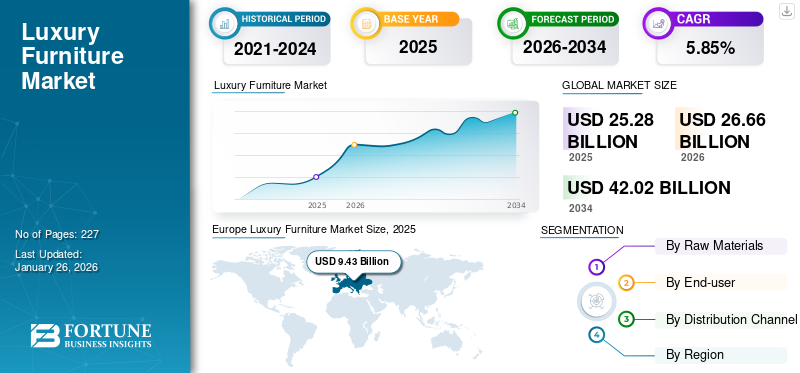
The global luxury furniture market size was valued at USD 25.28 billion in 2025. The market is projected to grow from USD 26.66 billion in 2026 to USD 42.02 billion by 2034, exhibiting a CAGR of 5.85% during the forecast period. Europe dominated the luxury furniture market with a market share of 37.31% in 2025.
Luxury furniture pieces are made from high-quality materials and come in a variety of designs. Some of the most popular materials used to make these products include metal, glass, wood, and others. The industry is primarily driven by the overall consumer spending and other factors such as household debt levels, per-capita income, and consumer expectations. The ever-increasing disposable income, improvement in living standards, and the growing demand for furniture are contributing to the luxury furniture market growth. Furthermore, the rising trend of home renovation and decoration among the urban population has fueled the industry progress.
Selecting the right furniture for schools, homes, offices, and hotels plays a vital role in improving an individual's mental and physical health. Using high-quality materials, such as wood and leather, in the final product not only enhances the aesthetic appeal of furniture pieces but also makes them more durable. The rising use of designer furniture for residential purposes has further expanded the luxury furniture market share.
The COVID-19 pandemic negatively affected the global market. This was due to the implementation of lockdown and other restrictions in 2020, resulting in the complete closure of international and domestic borders. Restrictions were also imposed on the imports and exports of goods and raw materials. In addition, lack of workers' availability forced manufacturers to close the production of luxury furniture products. These factors impeded the global furniture industry progress.
Download Free sample to learn more about this report.
GLOBAL LUXURY FURNITURE MARKET SNAPSHOT
Market Size & Forecast:
- 2025 Market Size: USD 25.28 billion
- 2026 Market Size: USD 26.66 billion
- 2033 Forecast Market Size: USD 42.02 billion
- CAGR: 5.85% from 2026–2034
Market Share:
- Europe led the luxury furniture market with a 37.31% share in 2025, driven by strong innovation in design and material technology, the presence of established luxury brands, and growing investments in high-end residential and commercial interior décor.
- By raw material, wood remains the dominant material choice, attributed to its durability, aesthetic appeal, and premium finish. Rising export and import activity in wooden furniture, particularly among countries like China, Vietnam, Poland, and Germany, supports market strength.
- By end user, residential applications held the majority share in 2024, bolstered by rapid urbanization, increasing disposable income, and the popularity of multifunctional and eco-friendly luxury furnishings.
- Offline retail dominated the distribution channels due to consumers’ preference for physical inspection, customization, and in-store experience, although online sales are rapidly growing due to expanding e-commerce and social media marketing.
Key Country Highlights:
- Germany & Italy: Home to globally renowned luxury furniture brands and high consumer demand for premium craftsmanship; export hubs for wooden and custom designer furniture.
- France & UK: Strong demand driven by luxury hospitality projects and high-income households seeking bespoke interior designs.
- United States: Growth supported by premium home renovation trends, the rise of multifunctional luxury pieces, and expanding online luxury retail presence.
- India: Booming real estate and rising middle-class demand for luxury interiors drive growth; high sales volume in 2023 marked by USD 42 billion in residential property transactions.
- China: Urbanization, disposable income growth, and demand for designer furniture with cultural fusion aesthetics fuel expansion.
- Japan: Preference for minimalist and space-efficient luxury furniture; strong demand in compact urban apartments and hospitality.
- UAE & Saudi Arabia: Rapid construction of luxury villas, hotels, and malls boosts demand for high-end interior furnishings; halal-certified materials gaining interest.
- Brazil: Expanding upper-middle-class supports rising demand for luxury home décor; growing domestic production and imports from Europe aid supply.
- South Africa: Increased urban housing development and lifestyle modernization support slow but steady growth in luxury furniture consumption.
Luxury Furniture Market Trends
Rising Home Décor Projects to Drive Market Development
The increase in consumer demand for aesthetically appealing and eco-friendly luxury products to decorate homes, offices, hotels, and restaurants with exclusive furniture, wooden flooring, and other items has fueled the luxury furniture industry trends. In addition, population migration from rural to urban areas and increased consumer expenditure on high-quality décor products have created several business opportunities for the industry. There is a notable rise in awareness of international brands and trends in developing countries, and since the purchasing power of individuals in these economies has grown, they are splurging on luxurious furniture pieces. These are some of the significant factors spurring the market progress.
Some of the reputed industry players, such as Kimball International, Inc., Herman Miller, Inc. (Knoll Inc), DURESTA, Cassina S.p.A, and others, are aware of the rising younger population and their ever-changing buying pattern with respect to luxury products. This scenario has prompted manufacturers to constantly update their existing lineup of luxury furniture. Moreover, continuous innovation by companies in the production, design, and material used for making unique furniture pieces for home décor may further augment the industry development. The popularity of multifunctional furniture is rising among customers due to its high level of comfort. Manufacturers are also introducing aggressive marketing campaigns to promote their products on social media platforms, such as Instagram, Facebook, and YouTube to increase their consumer reach in less time and cost-effectively. These strategies are predicted to favor the global market outlook.
- Europe witnessed luxury furniture market growth from USD 8.58 billion in 2023 to USD 8.98 billion in 2024.
Download Free sample to learn more about this report.
Luxury Furniture Market Growth Factors
Rapid Growth of the Real Estate Sector to Contribute to the Luxury Furniture Market Growth
The real estate sector has recently experienced substantial growth due to the increased demand for office and residential spaces. The growing need for office space, conducive corporate environment, and urban and semi-urban accommodation have complemented the expansion of the real estate sector. Furthermore, the growing construction of residential and commercial buildings will drive the market progress. According to the India Brand Equity Foundation (IBEF), the Indian real estate sector is anticipated to reach USD 1 trillion in market size by 2030 from USD 200 billion in 2021, accounting for 13% of the country's GDP by 2025. According to The Canadian Real Estate Association (CREA), national home sales are projected to climb to 525,498 units in 2025.
Furthermore, the high demand for luxury property has boosted the adoption of luxury interior furnishings in areas, such as bedrooms, offices, and kitchens. This factor is also expected to boost the sales of luxury furniture.
Rise in Online Retailing in the Furniture Industry to Drive Market Development
Major innovations in various technologies, such as the availability of high-speed internet networks and growing adoption of smart devices are bolstering the development of the global e-retail industry. These advances can make it easier for customers to purchase furniture through online channels. Furthermore, to meet the rising demand for online shopping globally, many companies have launched their own online stores to sell furniture.
For instance, Nilkamal Pvt. Ltd. has launched an online shopping portal featuring an exclusive range of @Home furniture, home furnishings, and upholstery. The availability of various product options and price comparisons on online shopping sites have increased the customer preference for online shopping. Online shopping is also becoming more popular as consumers can read reviews from previous buyers, compare different stores & products, and check product prices from different sellers. These factors may favor the usage of online shopping platforms to buy luxury furniture.
RESTRAINING FACTORS
Availability of Counterfeit Products to Restrain Market Growth
The easy availability of various technologies to make exact imitations of luxury furniture can greatly hinder their overall quality, design, and finishing. This can adversely affect a manufacturer’s revenue margin, and discourage them to make heavy investments in conducting in-depth research & development. While counterfeit production is popular across the world, it is most common in developing countries with strong but low-cost manufacturing capacities, including many nations in Eastern Europe, Asia, and Latin America. Counterfeiting also includes placing the trademark or logo of a well-known brand on a product, but the product is not manufactured or authorized by that brand. The rising sale of counterfeit products has eroded the brand image of manufacturers, leading to loss of customer confidence. The growing preference for online platforms for selling and buying goods has led to a rapid rise in the global supply of counterfeit items, thereby adversely affecting the market trend.
Luxury Furniture Market Segmentation Analysis
By Raw Material Analysis
To know how our report can help streamline your business, Speak to Analyst
High Durability and Aesthetic Design Offered by Wooden Materials to Support Market Expansion
The wood segment is projected to dominate the market with a share of 60.92% in 2026. Based on raw material, the market is divided into wood, metal, plastic, and others. The wood segment is expected to hold a dominant market share owing to its adaptability and finishing. Wood is the most popular material due to its high aesthetic value, monetary value, and durability. Rapid expansion of the residential sector driven by economic growth, population, smart cities, and Foreign Direct Investment (FDI) are factors accelerating the demand for wooden furniture. A steady increase in the need for modern and customizable furniture to help customers lead a comfortable lifestyle will further drive the market growth.
- The wood segment is expected to hold a 61.7% share in 2024.
There is a notable rise in the export and import of wood to construct furniture and flooring, further fueling the segment progress. According to the Observatory of Economic Complexity (OEC), in 2020, the top importers of wooden furniture were the U.S., Germany, France, the U.K., and Japan. On the other hand, the top exporters of furniture and wood in 2020 were China, Vietnam, Poland, Italy, and Germany. This scenario may boost the global market.
By End-user Analysis
Robust Increase in Home Décor Projects to Fuel Market Growth
The residential segment is expected to lead the market, contributing 55.03% globally in 2026. Based on end-user, the market is divided into residential and commercial. The residential segment is predicted to hold a significant market share owing to the high production of home décor and furnishing products. Rapid urbanization, rising disposable income, increasing focus on aesthetics, and extensive adoption of urban lifestyle are fueling the sales of luxury furniture. The shifting consumer trends toward innovative and decorative furniture products will further boost the industry value. The strong demand for eco-friendly and multifunctional luxury furniture in both the developed and developing economies might further support the market growth.
The commercial segment mainly includes office furniture, hospitality furniture, school furniture, and others. The product demand is rising significantly across the commercial sector due to the growing construction of offices and commercial complexes.
By Distribution Channel Analysis
Growing Demand for Personalized Shopping Experience to Augment Preference for Offline Sales Channels
The Offline segment will account for 81.02% market share in 2026. Based on distribution channel, the market is divided into online and offline. The offline segment is predicted to capture a sizable market share as it offers customers a personalized experience and allows them to check a product’s quality through physical inspection. Factors, such as growing workforce, increasing urbanization, and disposable income, are driving the growth of offline distribution channels. These retailers are also available across the globe and are becoming an important sales channel for manufacturers. Nowadays, consumers are looking for customized furniture products for residential and commercial purposes, owing to which they mainly prefer offline sales channels for purchasing goods.
However, online sales channels are also likely to grow significantly during the forecast period due to a strong rise in e-commerce platforms. Many manufacturers are launching their own e-commerce platforms to cater to the growing demand for these services. For instance, in April 2021, Herman Miller launched its new e-commerce store. Furthermore, the launch will help increase the customer base in less time and increase product sales for the company.
REGIONAL INSIGHTS
Europe Luxury Furniture Market Size, 2025 (USD Billion)
To get more information on the regional analysis of this market, Download Free sample
North America
North America recorded a market size of USD 7.74 billion in 2025, capturing 30.63% of the global market share, and is projected to reach USD 8.19 billion in 2026. In terms of region, the market is analyzed across North America, Europe, Asia Pacific, South America, and the Middle East & Africa (MEA). The Europe region is anticipated to capture a sizable market share during the forecast period. Many companies across Europe are involved in constant innovation and upgrading the technologies used in the production of luxury furniture. This has spurred product sales in the region. In Europe, the U.K. market is projected to reach USD 1.87 billion by 2026, while the Germany market is projected to reach USD 2.13 billion by 2026.
- In Europe, the wood segment is estimated to hold a 60.92% market share in 2025.
Asia Pacific
The Asia Pacific market generated USD 5.61 billion in 2025, representing 22.18% of the global market landscape, and is expected to reach USD 5.96 billion in 2026. The Asia Pacific region is also expected to showcase substantial growth during the forecast timeframe. The demand for the construction of residential and commercial properties is increasing exponentially owing to a notable rise in disposable income, urbanization, and employment in the APAC region. According to the India Brand Equity Foundation (IBEF), in FY 2023, India’s residential property observed an all-time high sales of USD 42 billion, marking a robust 48% year-on-year increase. Furthermore, the sales volumes displayed strong development, with a 36% rise to 379,095 units sold. The Japan market is projected to reach USD 1.39 billion by 2026, the China market is projected to reach USD 2.48 billion by 2026, and the India market is projected to reach USD 0.85 billion by 2026. Increased innovation coupled with high consumer preference for designer luxury furniture will continue to foster market progress.
North America is projected to grow with a significant CAGR owing to a rise in investment in the residential sector and employment opportunities in the region, which will further boost product demand. Furthermore, consumers in the region are more inclined toward luxury furniture as it provides comfort, functionality, and style to their homes and offices. The U.S. market is projected to reach USD 6.88 billion by 2026.
Europe
In 2025, Europe represented USD 9.43 billion, accounting for 37.31% of the worldwide market, and is projected to grow to USD 9.91 billion in 2026.
Middle East & Africa
Middle East & Africa accounted for USD 0.97 billion in 2025, representing 3.84% of the global market share, and is projected to reach USD 1 billion in 2026.
South America
In 2025, the South America market stood at USD 1.53 billion, representing 6.05% of global demand, and is projected to grow to USD 1.6 billion in 2026.
To know how our report can help streamline your business, Speak to Analyst
List of Key Companies in Luxury Furniture Market
Reputed organizations in this market are adopting several competitive strategies including product innovation and new product launches to gain a competitive edge over their rivals. Recent years have witnessed an appreciable rise in the demand for innovative products. As a result, key players in the market are focusing on developing products with advanced features.
LIST OF KEY COMPANIES PROFILED IN THE REPORT
- SCAVOLINI S.P.A. (Italy)
- Cassina S.p.A (Italy)
- Kimball International, Inc. (U.S.)
- Brown Jordan International (U.S.)
- Herman Miller, Inc. (Knoll Inc) (U.S.)
- Vivono (India)
- Boca do Lobo (U.K.)
- DURESTA (U.K.)
- Haworth, Inc. (Italy)
- MUEBLES PICO SA (Spain)
KEY INDUSTRY DEVELOPMENTS
- In December 2022, Kogan.com took over the management of Brosa, one of Australia's largest online retailers of luxury furniture. The deal is anticipated to revive the operations of the popular furniture brand, with the support of the Kogan Group.
- In October 2022, Linly Designs acquired the luxury furniture brand Marge Carson, which manufactures high-end residential furniture. The acquisition is expected to enhance operational efficiencies and product offerings.
- In November 2021, Haworth Inc. completed the acquisition of Interni, specializing in furniture and interior design. The acquisition will help increase product design and quality.
- In July 2020, Haworth Inc. announced the acquisition of Luxury Living Group, which manufactures luxury furniture. The acquisition will help strengthen the company's product portfolio and financials.
- In March 2020, Olivia’s, a part of the Motto Group, acquired Houseology, which manufactures stylish furniture. The acquisition will help increase customers and suppliers for a smooth company transition.
REPORT COVERAGE
The research report gives a comprehensive analysis of the market and highlights critical aspects such as prominent companies, competitive landscape, raw materials, end-users, and distribution channels. Besides this, the report provides insights into the market trends and highlights significant industry developments. In addition to the aspects mentioned earlier, the report encompasses several factors contributing to the market growth.
Request for Customization to gain extensive market insights.
Report Scope & Segmentation
|
ATTRIBUTE |
DETAILS |
|
Study Period |
2021-2034 |
|
Base Year |
2025 |
|
Estimated Year |
2026 |
|
Forecast Period |
2026-2034 |
|
Historical Period |
2021-2024 |
|
Growth Rate |
CAGR of 5.85% from 2026 to 2034 |
|
Unit |
Value (USD Billion) |
|
Segmentation |
By Raw Material
By End-user
By Distribution Channel
By Region
|
Frequently Asked Questions
Fortune Business Insights says that the global market size was USD 25.28 billion in 2025 and is anticipated to reach USD 42.02 billion by 2034.
In 2025, the global market value stood at USD 25.28 billion.
Exhibiting a CAGR of 5.85%, the global market will exhibit steady growth over the forecast period.
By end-user, the residential segment is expected to dominate the market throughout the forecast timeframe of 2026-2034.
Rapid growth of the real estate sector will be driving the sales of luxury furniture products during the analysis period of 2025-2032.
SCAVOLINI S.P.A. (Italy), Cassina S.p.A (Italy), and Kimball International, Inc. (U.S.) are the leading companies worldwide.
Europe dominated the global market in 2025.



- 2021-2034
- 2025
- 2021-2024
- 227
-
(Offer valid till 15th Oct 2026)
Get 30-60 hrs Free Customization
Expand Regional and Country Coverage, Segments Analysis, Company Profiles, Competitive Benchmarking, and End-user Insights.



















Related Reports
-
US +1 833 909 2966 ( Toll Free )
-
Get In Touch With Us