Luxury Watch Market Size, Share & Industry Analysis, By Type (Mechanical and Electronic), By Band Type (Strap-Based and Chain-Based), By Distribution Channel (Offline Stores and Online Channels), and Regional Forecast, 2026-2034
 Download Free Sample
(Offer valid till 15th Oct 2026)

Luxury Watch Market Size and Future Outlook
 Listen to Audio Version
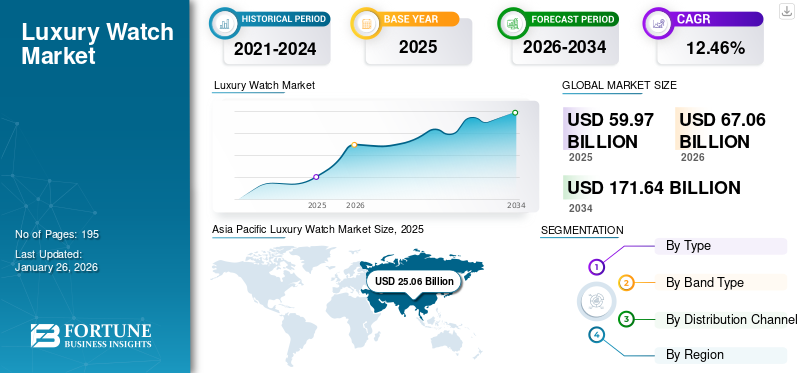
The global luxury watch market size was valued at USD 57.83 billion in 2025. The market is projected to grow from USD 62.35 billion in 2026 to USD 119.48 billion by 2034, exhibiting a CAGR of 8.47% during the forecast period. Europe dominated the luxury watch market with a market share of 27.49% in 2025.
Luxury watches are crafted with exceptional craftsmanship, high-quality materials, and engineered designs that complement an individual’s personal style and enhance their professional image at special events. The increasing number of high-net-worth individuals who consider spending on luxury watches and jewelry as part of their wealth investment is driving demand for such products. In addition, evolving consumer preferences for smaller-case high-end watches, vintage-inspired designs, and alternative materials are favoring global market expansion.
Key companies in the global market include Rolex Org, The Swatch Group Ltd., Financière Richemont SA, Patek Philippe SA, and Audemars Piguet. These players are shaping the l industry by offering high-end, design-driven products across global markets.
Download Free sample to learn more about this report.
LUXURY WATCH MARKET Key Takeaways
 Global Market Size & Forecast
- 2025 Market Size: USD 57.83 billion
- 2026 Market Size: USD 62.35 billion
- 2034 Forecast Market Size: USD 119.48 billion
- CAGR: 8.47% from 2026–2034
 Market Share
- Europe dominated the luxury watch market with a market share of 27.49% in 2025.
- The mechanical segment accounted for the leading global luxury watch market share of 71.87% in 2025.
- The chain-based segment exhibited a leading global market share of 60.20% in 2025.
 Key Regional Highlights
Europe
The regional market reached USD 15.90 billion in 2025 and is projected to grow to USD 17.79 billion in 2026, supported by a strong watchmaking heritage, established luxury brands, and a loyal collector base.
Asia Pacific
The Asia Pacific region held the second-largest global market share of 43.34% and a market size of USD 25.06 billion in 2025. The region is projected to grow at the fastest rate of 9.71% from 2026 to 2034.
North America
North America held the maintain its leading position of 19.31% in 2025, and the market size is estimated to reach USD 12.99 billion by 2026.
U.S.
The U.S. market size reached USD 7.99 billion in 2025, accounting for around 13.82% of the global market sales.
Japan
The Japanese market stood at around USD 2.01 billion in 2025, accounting for roughly 3.48% of global product revenues.
Read More

LUXURY WATCH MARKET TRENDS
Growing Trend of Watches with Timeless Guilloché Dial and Elegant Numeral Designs to Augment Market Growth
The growing trend of luxury watches combining timeless guilloché dials and elegant numeral designs is boosting global sales of such products. In addition, the increasing number of consumers seeking traditional-style products with scratch-resistant ceramic designs, lightweight materials, and anti-magnetic components is a driving factor in worldwide product sales. Furthermore, rising demand for products that support interchangeable straps and exhibit natural dial colors, including black, silver, and blue, is favoring global luxury watch market growth.
MARKET DYNAMICS
MARKET DRIVERS
Download Free sample to learn more about this report.
Manufacturers Expanding Product Ranges to Fuel Market Growth
Manufacturers consistently focus on expanding their portfolio of luxury items to meet evolving consumer preferences for fashion goods across all age groups and market segments. They carefully choose materials, design elements, watch shapes, colors, and sizes to produce craftsmanship products meeting consumer expectations. Manufacturers’ consistent launches of new products and evolving consumer luxury fashion trends are driving the global market's growth.
MARKET RESTRAINTS
Increasing Consumers' Accessibility to Counterfeit Products to Restrain Market Growth
Luxury watch brands, such as Rolex, LVMH, and Tissot, have become powerful status symbols of wealth. These branded products are sold at high prices and considered high-end items that showcase a luxury lifestyle. However, the growing number of unorganized manufacturers selling second-copy or counterfeit watches bearing the premier brand logo is negatively impacting the reputation of these luxury product brands, thereby restraining global market growth.
MARKET OPPORTUNITIES
Rising Demand for Limited Editions Paired with Interest in Sustainable Luxury to Provide Significant Growth Opportunities
The rising demand for limited-edition products with personalized features, including sustainably made dials, case materials, strap types, and engraving, is creating new market growth opportunities. In addition, consistent brand efforts to demonstrate their products' environmental stewardship, ethical sourcing, and transparent manufacturing across their value chain, with items that fulfill certification standards, are favoring global market expansion.
MARKET CHALLENGES
Soaring Gold and Precious Metal Prices to Challenge Key Players' Business Expansion
The soaring gold and precious metal prices are significantly leading manufacturers to raise product retail prices, compress margins, and reduce gold model production. The rising prices of gold and other precious metals are posing challenges for key players in generating the required business profitability. In addition, increasing U.S. tariffs on Swiss watch imports is squeezing manufacturers' and authorized dealers' profit margins, posing a challenge to global industry growth.
Segmentation Analysis
By Type
Mechanical Watches Complex Structure and Innovative Finishes Boosted Mechanical Segmental Growth
By type, the market is bifurcated into mechanical and electronic. The mechanical segment is accounted for the leading global luxury watches market share of 71.87% in 2025. Its leading share is attributed to mechanical watches' complex structures, hand assembly, and finishing, which allow consumers to value these products for their heritage, technical artistry, and appeal. In addition, advancements in the development of mechanical watches with features such as chronographs, tourbillons, perpetual calendars, and minute repeaters, which showcase historical milestones and craftsmanship narratives, are favoring the segment’s growth.
To know how our report can help streamline your business, Speak to Analyst
The electronic segment is projected to grow at the fastest rate of 9.34% from 2026 to 2034. The growing number of first-time buyers seeking electronic watches for their value, convenience, precision, ease of use, and aesthetics is mainly driving the segment’s growth.
By Band Type
High Perceived Quality and Premium Price of Chain-based Watches Led Segmental Dominance
Based on band type, the market is bifurcated into strap-based and chain-based. The chain-based segment exhibited a leading global market share of 60.20% in 2025. Chain-based luxury watches feature metal bracelets made from stainless steel, gold, platinum, titanium, or a mix of precious metals. The bracelet is an integrated and permanent part of the watch’s design. The chain-based luxury watch segment held the largest market share in 2025, primarily because these watches are priced significantly higher due to the use of precious and high-value metals.
The strap-based segment is projected to grow at the fastest rate of 9.04% from 2026 to 2034. Strap-based luxury watches feature non-metal bands, such as leather, rubber, fabric, or textile straps, which can be replaced or customized. The strap-based segment is expected to grow at a higher CAGR due to its greater flexibility, accessibility, and lifestyle appeal.
By Distribution Channel
Offline Stores Segment Led the Market due to Greater Consumer Flexibility for In-Store Evaluation of Various Product Attributes
Based on distribution channel, the market is bifurcated into online channels and offline stores. The offline stores segment exhibited a leading global luxury watch market share of 81.41% in 2025. The segment’s leading share is attributed to greater consumer flexibility for in-store evaluation of various product attributes, including fit, weight, finishing quality, and wrist presence. In addition, consistent specialty retailers’ provision of immersive experiences, heritage displays, and customer services that reinforce their luxury positioning is positively contributing to the segment’s growth.
The online channels segment is projected to grow at a CAGR of 9.36% from 2026 to 2034. The growing number of online platforms enabling users to compare product prices, discover product attributes, and understand availability is generating considerable product sales through online channels, driving the segment’s growth.
Luxury Watch Market Regional Outlook
By region, the market is categorized into North America, Europe, Asia Pacific, South America, and the Middle East & Africa.
North America
Europe Luxury Watch Market Size, 2025 (USD Billion)
To get more information on the regional analysis of this market, Download Free sample
The North America region is anticipated to maintain its leading position of 19.31% in 2025 and is expected to maintain its leading position during the forecast period (2026-2034). The North American market size is estimated to reach USD 12.99 billion by 2026. A mature pre-owned luxury retail ecosystem and a significant number of high-net-worth individuals spending on luxury goods are mainly driving product sales across the region. In addition, the evolving trend of luxury fashion and the increasing product replacement rate, along with the need to meet unique consumer needs, are favoring the region’s market growth.
U.S Luxury Watch Market
The U.S. market size reached USD 7.99 billion in 2025. The market accounted for around 13.82% of the global market sales in 2025. The increasing number of individuals seeking to purchase luxury goods as part of their long-term investment is driving growth in the market.
Europe
The region is expected to maintain its leading global market position during the forecast period (2026-2034). The market in Europe reached USD 15.90 billion in 2025, representing 26.51% of total market revenue, and is projected to reach USD 17.79 billion in 2026. The market exhibits a deep-rooted watchmaking heritage, strong brand loyalty, and a large base of collectors & repeat buyers. The expanding network of specialty goods retailers offering ultra-luxury-priced products is accelerating market growth.
U.K Luxury Watch Market
The U.K. market in 2025 stood at USD 5.19 billion, representing approximately 8.97% of global product revenues.
Germany Luxury Watch Market
Germany’s market reached approximately USD 3.92 billion in 2025, equivalent to around 6.78% of global product sales.
Asia Pacific
The Asia Pacific region’s market is projected to grow at the fastest rate of 9.71% from 2026 to 2034. The region held the second-largest global market share of 26.51% and a market size of USD 25.06 billion in 2025. High demand for mechanical watches, rising disposable income, and evolving online shopping trends are the aspects favoring market growth in the Asia Pacific. In addition, consistent manufacturers’ introduction of innovative craftsmanship-based products is driving the product consumption across the region. For Instance, in December 2025, Tiffany & Co., a U.S.-based luxury brand, introduced its watch product line at its Mumbai boutique in India.
Japan Luxury Watch Market
The Japanese market in 2025 stood at around USD 2.01 billion, accounting for roughly 3.48% of global product revenues. The increasing number of international travelers spending on the product at travel retailing shops is driving product sales across Japan.
China Luxury Watch Market
China’s market is projected to be one of the largest worldwide, with revenues standing at around USD 7.93 billion in 2025, representing roughly 13.71% of global product sales.
India Luxury Watch Market
The Indian market in 2025 stood at around USD 0.77 billion, accounting for roughly 1.33% of global market revenues.
South America and the Middle East & Africa
The markets in South America and the Middle East & Africa are expected to grow at a moderate rate from 2026 to 2034. In 2025, South America represented USD 1.57 billion, accounting for 2.62% of the worldwide market, and is projected to grow to USD 1.64 billion in 2026.In 2025, South America represented USD 1.57 billion, accounting for 2.62% of the worldwide market, and is projected to grow to USD 1.64 billion in 2026. The expanding network of authorized dealers and luxury boutiques offering minimalist design-based luxury watches is driving growth in the market. The significant demand for luxury goods with designs that fulfill the cultural and aesthetic needs of high-net-worth individuals across South Africa, Saudi Arabia, and the UAE is positively contributing to market development across the Middle East and Africa. In the Middle East & African market, Saudi Arabia reached a market valuation of USD 1.10 billion in 2025. The Middle East & Africa region captured 9.78% of the global market in 2025, generating USD 5.87 billion in revenue, and is projected to reach USD 6.57 billion in 2026.
UAE Luxury Watch Market
The UAE market is projected to reach approximately USD 2.76 billion by 2025, accounting for roughly 4.77% of the global market revenues.
COMPETITIVE LANDSCAPE
Key Industry Players
Extensive Focus on New Product Development and Global Distribution to Help Key Players Maintain Market Position
The key players operating in the global market are Rolex Org, The Swatch Group Ltd., Financière Richemont SA, Patek Philippe SA, and Audemars Piguet. These players consistently focus on broadening their product portfolios across multiple price tiers and design attributes, tailored to regional consumer markets. In addition, they broaden their retail network portfolio of brand stores as part of their international business development activities.
LIST OF KEY LUXURY WATCH COMPANIES PROFILED
- Rolex Org (Switzerland)
- The Swatch Group Ltd. (Switzerland)
- Financière Richemont SA (Switzerland)
- Patek Philippe SA (Switzerland)
- Audemars Piguet (Switzerland)
- Seiko Watch Corporation (Japan)
- Breitling S.A. (Switzerland)
- LVMH Moet Hennessy Louis Vuitton SE (France)
- Richard Mille (Switzerland)
- Bell & Ross (France)
KEY INDUSTRY DEVELOPMENTS
- November 2025: LVMH acquired a minority stake in La Joux-Perret to strengthen its product development and industrial capabilities for its TAG Heuer, Hublot, and Zenith brands. This initiative enable company increase its in-house technical differentiation and reduce dependency on third-party movement suppliers.
- August 2025: Casio Computer Co. launched the Edifice EFK-100 Series of luxury mechanical watches in the Indian market. The high-adrenaline world of motorsports inspires the designs of the products.
- March 2025: Rolex advanced its flagship retail strategy with plans to open its largest Western boutique on Old Bond Street in London, signaling a strategic emphasis on flagship stores and controlled sales environments.
- March 2025: Citizen announced the launch of its modern luxury watch collections, “Series8” and “Attesa,” which exhibit a balance of design and technology in the U.S.
- October 2024: LVMH signed a 10-year global sponsorship agreement with Formula 1, effective from 2025, covering TAG Heuer and other LVMH brands. This initiative significantly strengthens TAG Heuer’s motorsport positioning and provides a high-visibility platform to drive brand heat, younger consumer engagement, and global exposure.
- September 2024: Rolex expanded its manufacturing capacity, opening a new production facility in Switzerland to further support long-term demand growth and reduce supply bottlenecks.
- January 2024: LVMH expanded LVMH Watch Week as a global showcase platform for Bulgari, Hublot, TAG Heuer, Zenith, Daniel Roth, and Gérald Genta. The company used the event to introduce major product launches, limited editions, and high-complication pieces, while strengthening relationships with retailers, collectors, and media.
REPORT COVERAGE
The global luxury watch market analysis provides an in-depth study of market insights, size, and forecast by distribution channel, and all other watch segments included in the report. In addition, the report on the market outlooks, market dynamics, and market trends is expected to drive the market in the forecast period. The report on the market includes information on technological advancements, new product launches, key industry developments, and details on partnerships, mergers, and acquisitions. The market research report also encompasses a detailed competitive landscape with information on the market share and profiles of key operating players.
Request for Customization to gain extensive market insights.
Report Scope & Segmentation
| ATTRIBUTE | DETAILS |
| Study Period | 2021-2034 |
| Base Year | 2025 |
| Estimated Year | 2026 |
| Forecast Period | 2026-2034 |
| Historical Period | 2021-2024 |
| Growth Rate | CAGR of 8.47% from 2026 to 2034 |
| Unit | Value (USD Billion) |
| Segmentation | By Type, Band Type, Distribution Channel, and Region |
| By Type |
|
| By Band Type |
|
| By Distribution Channel |
|
| By Geography |
|
Frequently Asked Questions
Fortune Business Insights says that the global market value stood at USD 57.83 billion in 2025 and is projected to reach USD 119.48 billion by 2034.
In 2025, the market value stood at USD 24.16 billion.
The global market is forecasted to grow at a CAGR of 8.47% during 2026-2034.
By type, the mechanical segment held the leading global market share.
The growing number of manufacturers expanding their product ranges is a key factor driving product demand.
Rolex Org, The Swatch Group Ltd., Financiere Richemont SA, Patek Philippe SA, and Audemars Piguet are among the prominent players in the market.
Europe dominated the market in 2025.
The rising demand for limited editions, paired with interest in sustainable luxury, is creating new market growth opportunities.



- 2021-2034
- 2025
- 2021-2024
- 272
-
(Offer valid till 15th Oct 2026)
Get 30-60 hrs Free Customization
Expand Regional and Country Coverage, Segments Analysis, Company Profiles, Competitive Benchmarking, and End-user Insights.


















-
US +1 833 909 2966 ( Toll Free )
-
Get In Touch With Us