Lysosomal Storage Disorder Drugs Market Size, Share & Industry Analysis, By Therapy Type (Enzyme Replacement Therapy (ERT), Substrate Reduction Therapy (SRT), and Others), By Product (Fabrazyme, Cerezyme, Myozyme/Lumizyme, Nexviazyme, Cerdelga, Aldurazyme, Vimizim, Naglazyme, and Others), By Disease Indication (Gaucher Disease, Fabry Disease, Pompe Disease, MPS I, MPS II, MPS IVA, MPS VI, MPS VII, and Others), By Route of Administration (Intravenous (IV), Intracerebroventricular (ICV), Oral, and Others), By End User (Hospitals, Specialty Clinics, and Others), and Regional Forecast, 2026-2034
 Download Free Sample
Lysosomal Storage Disorder Drugs Market Size and Future Outlook
 Listen to Audio Version
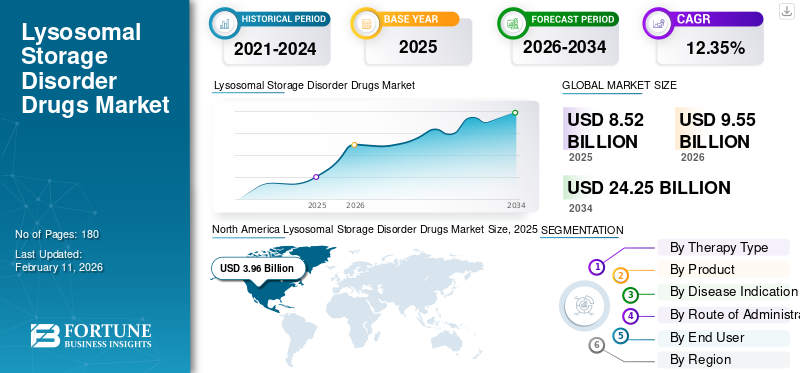
The global lysosomal storage disorder drugs market size was valued at USD 8.52 billion in 2025. The market is projected to grow from USD 9.55 billion in 2026 to USD 24.25 billion by 2034, exhibiting a CAGR of 12.35% during the forecast period. North America dominated the global lysosomal storage disorder drugs market with a market share of 46.48% in 2025.
Lysosomal storage disorders are rare genetic disorders that cause a buildup of toxic substances in cells. Individuals suffering from LSDs often do not have certain enzymes or a substance that helps the enzyme to work. Increasing awareness, improved diagnostic techniques, and advancements in enzyme replacement therapies are driving the demand for lysosomal storage disorder drugs. Furthermore, the market growth is fueled by rising prevalence rates, ongoing research, and expanding approval of novel therapies.
- In March 2025, CANbridge Pharmaceuticals Inc. announced successful clearance of pre-approval and pre-marketing GMP compliance inspections for velaglucerase-beta for injection by the Center of Food and Drug Inspection (CFDI) of China's National Medical Products Administration.
Furthermore, many key industry players, such as Sanofi and Pfizer Inc., are continuously enhancing their product offerings for LSD to boost their market positions.
Download Free sample to learn more about this report.
Lysosomal Storage Disorder Drugs Market Key Takeways
 Market Size & Forecast
- 2025 Market Size: USD 8.52 billion
- 2026 Market Size: USD 9.55 billion
- 2034 Forecast Market Size: USD 24.25 billion
- CAGR: 12.35% from 2026–2034
 Market Share
- North America dominated the lysosomal storage disorder drugs market with a 46.48% share in 2025.
- The enzyme replacement therapy (ERT) segment held the largest market share of 75.4% in 2025.
- The Fabrazyme segment accounted for a 16.3% share of the global market in 2025.
 Key Regional Highlights
North America
North America maintained its leading position in 2025, with the market valued at USD 3.96 billion.
Europe
Europe was valued at USD 2.55 billion in 2025 and is projected to expand at a 11.97% CAGR during the forecast period.
Asia Pacific
Asia Pacific reached USD 1.57 billion in 2025, supported by rising treatment demand and increasing biosimilar launches.
U.S.
U.S. The U.S. lysosomal storage disorder drugs market was valued at approximately USD 3.68 billion in 2025, leading regional growth.
Japan
Japan The Japan market was valued at USD 0.31 billion in 2025, representing approximately 3.6% of global market revenue.
Read More

LYSOSOMAL STORAGE DISORDER DRUGS MARKET TRENDS
Development of Gene Therapy for the Lysosomal Storage Disorders is a Key Trend
The development of gene therapy for Lysosomal Storage Disorders (LSDs) is a significant emerging trend in the field of rare disease treatment. Advances in viral vector technology and improved delivery methods have enhanced the safety and efficacy of gene therapies for conditions such as Gaucher disease, Fabry disease, and Pompe disease. Also, this approach offers functional copies of defective genes directly into patients' cells, potentially providing a one-time, curative solution. Moreover, many key players are focused on offering gene therapy products with regulatory approval to boost the market growth.
- For instance, in February 2025, Ultragenyx Pharmaceutical Inc. announced that the U.S. Food and Drug Administration accepted the Biologics License Application (BLA) for accelerated approval of UX111 (ABO-102), an AAV gene therapy, for patients with Sanfilippo syndrome type A (MPS IIIA).
Download Free sample to learn more about this report.
MARKET DYNAMICS
MARKET DRIVERS
Rising Prevalence of LSDs to Drive Market Growth
The rising prevalence of lysosomal storage disorders, such as Gaucher disease, Fabry disease, and Pompe disease, is a significant driver of the market. As the increasing awareness and diagnostic techniques improve, more patients are correctly identified with these rare genetic conditions. Thus, this heightened demand for specialized treatments for untapped diseases propels overall industry growth and innovation in this niche healthcare segment.
- For instance, according to data published by Orphanet, the prevalence of Niemann-Pick disease type C (NPDC) ranges from 1 in 45,000 to 1 in 286,000 live births worldwide.
MARKET RESTRAINTS
High Development and Treatment Costs to Restrict Market Growth
High development and treatment costs serve as a significant restraint on the lysosomal storage disorder drugs market growth, as both ERTs and gene therapies involve complex biologic manufacturing, cold-chain logistics, and specialized administration, leading to very high unit prices. These access barriers can delay treatment initiation, limit the number of eligible patients treated in certain regions, and create uncertainty for manufacturers when planning capacity and product launches.
- For instance, in January 2024, Orchard Therapeutics announced an agreement with the Beneluxa consortium to enable reimbursed access to Libmeldy (MLD gene therapy), noting this was important for “sustainable access” and that earlier negotiations had ended without reaching an arrangement, thus highlighting how reimbursement hurdles can restrict access to high-cost advanced therapies.
MARKET OPPORTUNITIES
Rising Awareness Programs for Rare Diseases to Boost Market Growth
Awareness programs for rare diseases, including Lysosomal Storage Disorders (LSDs), to boost the diagnosis and treatment of these diseases. These programs are organized to educate the public and healthcare professionals about these conditions. Increased awareness leads to earlier diagnosis, improved patient management, and greater demand for specialized treatments, thereby expanding the LSD drugs market.
For instance, in April 2025, International Pompe Day runs a global awareness campaign on pompeday.com, including a virtual “Run, Walk, or Roll” event to raise awareness of Pompe disease and the importance of early diagnosis and treatment.
MARKET CHALLENGES
Pricing and Reimbursement Barriers to Challenge Market Growth
The high costs of LSD therapies create difficulties in securing favorable insurance coverage and reimbursement agreements. This can hinder patient access to essential treatments, especially in regions with strict healthcare budgets. Additionally, limited insurance coverage and stringent payer scrutiny elevate therapy costs, leading to delays or restrictions in coverage.
Segmentation Analysis
By Therapy Type
Clinical Studies for Enzyme Replacement Therapy (ERT) Propelled Segment Growth
Based on the therapy type, the market is categorized into enzyme replacement therapy (ERT),
substrate reduction therapy (SRT), and others.
The enzyme replacement therapy (ERT) segment held a 75.4% market share in 2025. It directly addresses the enzyme deficiencies characteristic of the segment and offers targeted, effective treatment options with proven efficacy to drive segment growth. Also, key players are focused on clinical studies and publications to boost the lysosomal storage disorder drugs market share.
- In December 2025, Denali Therapeutics Inc. announced the publication of results from its open-label Phase 1/2 clinical trial for next-generation enzyme replacement therapy (ERT), tividenofusp alfa (DNL310), for Hunter syndrome (mucopolysaccharidosis type II, or MPS II) in the January 1, 2026 edition of The New England Journal of Medicine.
The substrate reduction therapy (SRT) segment is expected to grow at a CAGR of 19.29% over the forecast period.
To know how our report can help streamline your business, Speak to Analyst
By Product
Regulatory Approvals for Fabrazyme Boosted Segment Growth
Based on the product, the market is segmented into Fabrazyme, Cerezyme, Myozyme/Lumizyme, Nexviazyme, Cerdelga, Aldurazyme, Vimizim, Naglazyme, and others.
In 2025, the Fabrazyme segment dominated the global market, accounting for a 16.3% share. The segment's growth is driven by increasing regulatory approvals for the use of these drugs in the treatment of lysosomal storage disorders.
- For instance, in August 2025, after Agalzyme's approval in Argentina, Laboratorio Biosidus announced the launch of Agalzyme, a biosimilar to Sanofi’s Fabrazyme for the treatment of Fabry disease.
The Cerezyme segment is projected to grow at a CAGR of 7.66% over the forecast period.
By Disease Indication
Rising Prevalence and Launch of New Drugs Boosted Pompe Disease Segment’s Growth
Based on disease indication, the market is segmented into Gaucher Disease, Fabry Disease, Pompe Disease, MPS I, MPS II, MPS IVA, MPS VI, MPS VII, and Others.
The Pompe disease segment held a 24.4% market share in 2025. The segment's dominant share is driven by the rising prevalence of the disease and the increasing approvals and launches of drugs for its treatment.
- For instance, in August 2021, Sanofi announced that the U.S. Food and Drug Administration (FDA) had approved Nexviazyme for the treatment of patients aged 1 year and older with late-onset Pompe disease.
The Gaucher Disease segment is projected to grow at a 10.32% CAGR over the forecast period.
By Route of Administration
Approval for New Intravenous (IV) Drugs Bolstered Segment Growth
Based on route of administration, the market is segmented into intravenous (IV), intracerebroventricular (ICV), oral, and others.
The intravenous (IV) segment held a 74.1% market share in 2025. The growth of the segment is driven by the administration of biologic enzyme replacement therapies (ERTs) intravenously, and is given as repeat infusions over long durations.
- For instance, in February 2023, Chiesi Farmaceutici S.p.A. announced that the U.S. Food and Drug Administration (FDA) had approved Lamzede, IV injections for the treatment of non-central nervous system manifestations of alpha-mannosidosis (AM) in adult and pediatric patients.
The oral segment is projected to grow at a CAGR of 10.92% over the forecast period.
By End User
Increasing demand for Clinical Genetic Disease Indication to Boost Segment’s Growth
Based on the end user, the market is segmented into hospitals, specialty clinics, and others.
The hospital sector accounted for 59.1% of the market. The segment's dominant share is attributed to rising demand. Brineura (cerliponase alfa) and Lenmeldy (atidarsagene autotemcel) are often delivered through designated treatment centers (i.e., specialized hospital/ATMP centers). These centers hold the capability of cell collection/conditioning and inpatient management.
The specialty clinics segment is projected to grow at a CAGR of 16.10% over the forecast period.
Lysosomal Storage Disorder Drugs Market Regional Outlook
By geography, the market is categorized into Europe, North America, Asia Pacific, Latin America, and the Middle East & Africa.
North America
North America Lysosomal Storage Disorder Drugs Market Size, 2025 (USD Billion)
To get more information on the regional analysis of this market, Download Free sample
North America held the dominant share in 2024 at USD 3.53 billion and maintained its leading position in 2025 at USD 3.96 billion. The market in North America is expected to grow due to advanced research and development facilities and robust healthcare infrastructure for the treatment of rare diseases.
U.S. Lysosomal Storage Disorder Drugs Market
Given North America’s substantial contribution and the U.S. dominance in the region, the U.S. market is estimated at around USD 3.68 billion in 2025, accounting for roughly 43.2% of global lysosomal storage disorder drug sales.
Europe
Europe is projected to grow at 11.97% over the coming years, the second-highest among all regions, and was valued at USD 2.55 billion in 2025. The region’s market growth is driven by the rising prevalence of Pompe and Gaucher diseases and the presence of key market players with advanced product offerings.
U.K. Lysosomal Storage Disorder Drugs Market
The U.K. market in 2025 was valued at USD 0.49 billion, representing approximately 5.75% of global lysosomal storage disorder drugs revenues.
Germany Lysosomal Storage Disorder Drugs Market
Germany’s market was valued at USD 0.55 billion in 2025, accounting for around 6.4% of global lysosomal storage disorder drugs sales.
Asia Pacific
Asia Pacific was valued at USD 1.57 billion in 2025 and ranked third in the market. In the region, India and China were valued at USD 0.13 billion and USD 0.37 billion, respectively, in 2025, driven by increasing demand for adequate treatment for these diseases and the launch of biosimilars to boost market growth.
Japan Lysosomal Storage Disorder Drugs Market
The Japan market in 2025 was valued at USD 0.31 billion, accounting for roughly 3.6% of global Lysosomal Storage Disorder Drugs revenues.
China Lysosomal Storage Disorder Drugs Market
China’s market is projected to be one of the largest worldwide, and was valued at USD 0.37 billion in 2025, representing roughly 4.4% of global lysosomal storage disorder drug sales.
India Lysosomal Storage Disorder Drugs Market
The India market in 2025 was valued at USD 0.13 billion, accounting for roughly 1.5% of global lysosomal storage disorder drugs revenues.
Latin America and Middle East & Africa
The Latin America and the Middle East & Africa regions are expected to witness moderate growth in this market space during the forecast period. The Latin America market was valued at USD 0.39 billion in 2025. The region's growing focus on adequate disease diagnosis and treatment by government bodies to driving its growth. In the Middle East & Africa, the GCC was valued at USD 0.11 billion in 2025.
COMPETITIVE LANDSCAPE
Key Industry Players
Emphasis on Key Players to Offer Adequate Facility Management Services for Healthcare Systems
The global lysosomal storage disorder drugs market is highly concentrated, dominated by a few rare-disease specialists and strong relationships with metabolic centers. Sanofi and Takeda Pharmaceutical Company Limited held prominent positions in the market due to their extensive portfolios and global access programs.
On the other hand, Pfizer Inc. and AstraZeneca also add value through rare-disease commercialization and key assets. Moreover, BioMarin Pharmaceutical Inc. focuses on pediatric-onset LSDs, and Amicus and Chiesi are expanding in ultra-rare enzyme deficiencies, while Kyowa Kirin Co., Ltd. is strengthening its position with advanced therapies and targeted commercialization.
- For instance, in January 2024, Kyowa Kirin Co., Ltd. acquired Orchard Therapeutics to enhance its efforts to develop treatments for severe genetic and other serious diseases with limited or no existing options.
LIST OF KEY LYSOSOMAL STORAGE DISORDER DRUG COMPANIES PROFILED
- Sanofi (France)
- Takeda Pharmaceutical Company Limited (Japan)
- Pfizer Inc. (U.S.)
- BioMarin Pharmaceutical Inc. (U.S.)
- Amicus Therapeutics, Inc. (U.S.)
- AstraZeneca PLC (U.K.)
- Chiesi Farmaceutici S.p.A. (Italy)
- Johnson & Johnson Services Inc. (U.S.)
- Kyowa Kirin Co., Ltd. (Japan)
- Zevra Therapeutics, Inc. (U.S.)
KEY INDUSTRY DEVELOPMENTS
- July 2025: Zevra Therapeutics announced its participation in the National Niemann-Pick Disease Foundation Conference to present oral and poster presentations on MIPLYFFA (arimoclomol).
- July 2024: BioMarin Pharmaceutical received FDA approval for its supplemental Biologics License Application (sBLA) for BRINEURA for neuronal ceroid lipofuscinosis type 2 (CLN2 disease),
- September 2023: Amicus Therapeutics announced that the FDA approved Pombiliti combined with Opfolda (miglustat) 65 mg capsules for adults with late-onset Pompe disease (LOPD).
- August 2022: Sanofi announced the U.S. Food and Drug Administration (FDA) had approved Xenpozyme for treating non-CNS symptoms of acid sphingomyelinase deficiency (ASMD) in both adults and children.
- June 2022: Sanofi secured European Commission approval for Xenpozyme as the first enzyme replacement therapy for non-CNS manifestations of Acid Sphingomyelinase Deficiency (ASMD) in pediatric and adult patients.
REPORT COVERAGE
Request for Customization to gain extensive market insights.
Report Scope & Segmentation
|
ATTRIBUTE |
DETAILS |
|
Study Period |
2021-2034 |
|
Base Year |
2025 |
|
Estimated Year |
2026 |
|
Forecast Period |
2026-2034 |
|
Historical Period |
2021-2024 |
|
Growth Rate |
CAGR of 12.35% from 2026 to 2034 |
|
Unit |
Value (USD Billion) |
|
Segmentation |
By Therapy Type, Product, Disease Indication, Route of Administration, End User, and Region |
|
By Therapy Type |
· Enzyme Replacement Therapy (ERT) · Substrate Reduction Therapy (SRT) · Others |
|
By Product |
· Fabrazyme · Cerezyme · Myozyme/Lumizyme · Nexviazyme · Cerdelga · Aldurazyme · Vimizim · Naglazyme · Others |
|
By Disease Indication |
· Gaucher Disease · Fabry Disease · Pompe Disease · MPS I · MPS II · MPS IVA · MPS VI · MPS VII · Others |
|
By Route of Administration |
· Intravenous (IV) · Intracerebroventricular (ICV) · Oral · Others
|
|
By End User |
· Hospitals · Specialty Clinics · Others |
|
By Region |
· North America (By Therapy Type, Product, Disease Indication, Route of Administration, End User, and Country) o U.S. o Canada · Europe (By Therapy Type, Product, Disease Indication, Route of Administration, End User, and Country/Sub-region) o Germany o U.K. o France o Spain o Italy o Scandinavia o Rest of Europe · Asia Pacific (By Therapy Type, Product, Disease Indication, Route of Administration, End User, and Country/Sub-region) o China o Japan o India o Australia o Southeast Asia o Rest of Asia Pacific · Latin America (By Therapy Type, Product, Disease Indication, Route of Administration, End User, and Country/Sub-region) o Brazil o Mexico o Rest of Latin America · Middle East & Africa (By Therapy Type, Product, Disease Indication, Route of Administration, End User, and Country/Sub-region) o GCC o South Africa o Rest of Middle East & Africa |
Frequently Asked Questions
According to Fortune Business Insights, the global market value stood at USD 8.52 billion in 2025 and is projected to reach USD 24.25 billion by 2034.
In 2025, the market value stood at USD 3.96 billion.
The market is expected to grow at a CAGR of 12.35% over the forecast period of 2026-2034.
By therapy type, the enzyme replacement therapy (ERT) segment led the market.
The rising prevalence of rare diseases and awareness programs to improve patient outcomes are driving market expansion.
Sanofi, Pfizer Inc., and Amicus Therapeutics, Inc. are the major players in the global market.
North America dominated the market in 2025.



- 2021-2034
- 2025
- 2021-2024
- 180
Get 30-60 hrs Free Customization
Expand Regional and Country Coverage, Segments Analysis, Company Profiles, Competitive Benchmarking, and End-user Insights.













.webp)






Related Reports
-
US +1 833 909 2966 ( Toll Free )
-
Get In Touch With Us