Mattress Fabric Market Size, Share & Industry Analysis, By Type (Woven Fabric and Knitted Fabric), By End-user (Household and Commercial), By Distribution Channel (Online and Offline), and Regional Forecast, 2026-2034
 Download Free Sample
(Offer valid till 15th Oct 2026)

KEY MARKET INSIGHTS
 Listen to Audio Version
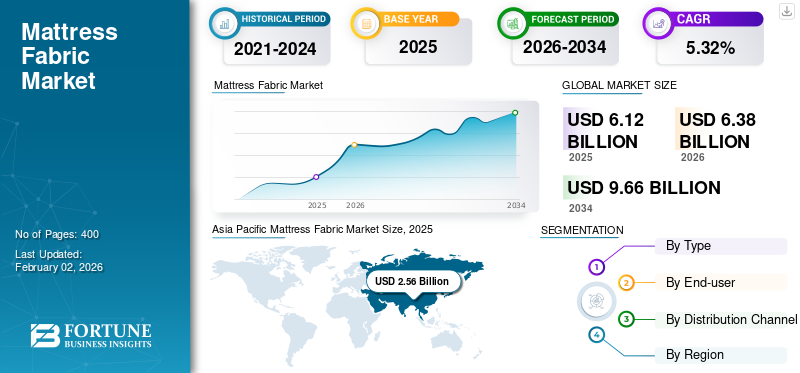
The global mattress fabric market size was valued at USD 6.12 billion in 2025. The market is projected to grow from USD 6.38 billion in 2026 to USD 9.66 billion by 2034, exhibiting a CAGR of 5.32% during the forecast period. Asia Pacific dominated the mattress fabric market with a market share of 41.88% in 2025.
Prominent companies such as Culp, Inc., Hangzhou Xiaoshan Rongli Clothing Co., Ltd, and Changxing Yongxin Textile & Dyeing Co., Ltd., are increasingly leveraging data analytics tools to gain actionable insights into customer preferences, purchasing behavior, and market trends. These data-driven tools can assist companies in optimizing product assortments, further leading to market growth.
Mattress fabrics include materials used to encase and protect the inner components of a mattress. The increasing consumer awareness and demand for eco-friendly textile products, made from organic cotton, bamboo, and wool, is increasing the global market share. At a macro level, the increasing demand for mattresses accelerates fabric sales globally. In this respect, the rising popularity of king-size mattresses positively influences fabric sales. Mattresses available in queen sizes are also becoming increasingly popular across countries due to their versatility to fit various bedroom sizes, directly influencing mattress fabric sales.
Download Free sample to learn more about this report.
Mattress Fabric Market Key Takeaways
 Global Market Size & Forecast
- 2025 Market Size: USD 6.12 billion
- 2026 Market Size: USD 6.38 billion
- 2034 Forecast Market Size: USD 9.66 billion
- CAGR: 5.32% from 2026-2034
 Market Share
- Asia Pacific dominated the mattress fabric market with a 41.88% share in 2025.
- The knitted fabric segment is projected to account for a 65.83% share in 2026.
- The household segment is expected to hold a 68.03% share in 2026.
 Key Regional Highlights
North America
North America accounted for USD 1.82 billion in 2025 and is projected to reach USD 1.90 billion in 2026.
Asia Pacific
Asia Pacific reached USD 2.56 billion in 2025 and is expected to grow to USD 2.69 billion in 2026.
Europe
Europe generated USD 1.17 billion in 2025 and is projected to reach USD 1.21 billion in 2026.
U.S.
The market is expected to reach USD 1.55 billion in 2026.
Japan
The market is expected to reach USD 0.36 billion in 2026.
Read More

Market Dynamics
Market Drivers
Increasing Residential and Commercial Construction Globally to Boost Market Growth
The increasing demand for modern housing, growing consumer spending on purchasing homes, along with the surging government schemes to construct houses, make home purchase procedures easier, driving the market growth. Furthermore, many individuals are migrating to urban areas, increasing demand for mattress fabrics for their apartments and condos. For instance, according to the United Nations Population Fund (UNFPA), more than half of the global population lives in towns and cities. By 2030, this is projected to rise by 5 billion.
Growing Consumer Awareness Regarding Better Sleep Globally to Drive Market Growth
The growing consumer awareness regarding better sleep benefits, such as improving physical and mental health, enhancing focus and memory, reducing stress, increasing productivity, and boosting immunity, drives the global market growth. Furthermore, getting better sleep is the key element in athletic recovery. During sleep, the body produces growth hormones, which help enhance motor skills, reaction time, muscular power, and endurance to boost athletic performance. Thus, the increasing consumer awareness regarding health & wellness and better sleep globally increases the mattress fabric market growth.
Download Free sample to learn more about this report.
Market Restraints
Fluctuations in Raw Material Prices to Restrain Market Growth
The changing prices of mattress fabric raw materials such as cotton, wool, polyester, bamboo, and blends, owing to unfavorable climate conditions, economic disruption, changes in taxation policy, and high advertisement costs, are the factors that enhance the cost of the raw material and restrict the product demand. Moreover, the rising political discrepancies have resulted in a decline in the number of manufacturers at a global level. The deteriorating international political environment and unstable political situation are the factors that adversely impact the sustainable growth of mattress fabrics.
Market Opportunities
Growing Technology Advancement in Mattress Fabric to Boost Market Growth
The increasing technological advancements in cooling, comfort, and hygiene attract a large consumer base. Adopting advanced technology, such as gel infusions and breathable fabrics, helps improve temperature regulation during sleep. This infusion removes heat, keeps the mattress cool, and improves sleep quality. Furthermore, the adoption of 3D printing in mattress fabric is significantly increasing as it offers various benefits, such as enhanced customization in sizes, including queen, king, and others, improved comfort, and design flexibility. In addition, 3D printing is also used to produce functional shapes and integrate various materials for personalized comfort and support, further boosting the market growth.
Market Challenges
Disturbances in Supply Chain Operations to Challenge Market Growth
The frequently changing international and national regulatory framework for the supply chain network due to diversified factors such as technological advancement, evolving global trade dynamics, transportation issues, and natural disasters affects the supply chain of materials and goods. In addition, the sudden changes in climate change globally impact trade routes, enhancing waiting time and causing disruptions throughout the supply chain process, thus challenging the market growth.
Mattress Fabric Market Trends
High Penetration of E-commerce to Expand Market Growth
The consumer inclination toward online sales channels is increasing due to diversified factors such as growing internet penetration, the convenience of e-commerce shopping, personalized experience, wider product selection, and safer online payment options. The improved logistics, reliable shipping, and return policies have made online shopping more comfortable and reliable. Furthermore, the increasing adoption of technology such as artificial intelligence (AI), augmented reality (AR), and virtual reality (VR) in e-commerce platforms enhances customer satisfaction and loyalty toward online shopping, which further enhances product sales.
Impact of Tariff
Tariffs elevated the cost of importing fabric materials and mattresses, resulting in a decline in Asian mattress fabric exports in the U.S. and European markets. Several mattress brands increased their product prices to support their business revenues from the mattress product category. Major exporters in the Asian geography are India and China. For instance, according to the World Bank data, the volume of worldwide trade businesses is predicted to fall by 0.2% in the first half of 2025. The decline is mainly visible in North America, as the export volume of the region decreased by 12.6%.
Segmentation Analysis
By Type
Rising Demand for Softer and Smoother Material to Fuel Knitted Fabric Segment Growth
Based on type, the market is divided into woven fabric and knitted fabric.
The knitted fabric segment is expected to dominate the global market throughout the forecast period, with a share of 65.83% in 2026. Knitted fabrics contain a softer and smoother surface, which further enhances the overall comfort of the mattress and provides a more enjoyable sleeping experience. In addition, this fabric is less prone to tearing and fraying owing to its interlocking loop structure. This durability feature helps extend the lifecycle of the mattress cover.
Woven fabric is expected to be the fastest-growing segment of the market. Woven fabric provides a diversified range of designs from plain and easy to complex textures and patterns, making it suitable for several mattress styles and aesthetics. Furthermore, this fabric can be customized in terms of colors, size, thickness, and weave pattern as per individual needs, owing to the significant growth in its usage in mattress fabric.
To know how our report can help streamline your business, Speak to Analyst
By End-user
Increasing Policy Support and Infrastructure Development Favor Household Segment Growth
Based on the end-user, the market is divided into household and commercial.
In 2026, the household segment is projected to lead the market with a 68.03% share. The growing residential sector, owing to increasing population, rising urbanization, surging income level, improving economic conditions, and government regulation & policies, supports residential and infrastructure development, which drives the segment growth.
Commercial is predicted to be the fastest-growing segment in the market. The increasing bedding products from the commercial sector, including hotels, resorts, hospitals, and hostels, boosts segmental growth. Furthermore, the rapidly evolving hospitality industry, due to increasing consumer spending on travel and tourism, is expected to accelerate demand for mattresses in the foreseeable future.
By Distribution Channel
Availability of Different Brands Fueled Offline Segment Growth
Based on the distribution channels, the market is divided into online and offline.
The offline segment is anticipated to hold a dominant market share of 78.21% in 2026. Offline stores usually cover a large area and display various brands under one roof. In addition, they are situated near residential areas for convenience and accessibility. The increasing working population, urbanization, and disposable incomes drive the offline segment’s growth.
The online stores segment is projected to hold the fastest-growing share during the forecast period. The increasing adoption of technology such as artificial intelligence (AI), augmented reality (AR), and virtual reality (VR) in e-commerce platforms and sales channels enhances customer satisfaction, shopping experience, and loyalty toward online shopping, which further boosts the segment growth.
Mattress Fabric Market Regional Outlook
By region, the market is segmented into North America, Europe, Asia Pacific, South America, and the Middle East & Africa.
Asia Pacific
Asia Pacific Mattress Fabric Market Size, 2025 (USD Billion)
To get more information on the regional analysis of this market, Download Free sample
Asia Pacific contributed 41.88% to the global market in 2025, with a valuation of USD 2.56 billion, and is projected to reach USD 2.69 billion in 2026. Asia Pacific leads the global market. It is also the fastest-growing region. The increasing population in countries such as China, India, and Indonesia makes it a dominant region owing to escalating mattress demand from the residential sector. According to Worldometer, the Indian population is growing by approximately 0.89% annually. Furthermore, the increasing construction of the residential sector and the rising trend of using new and various types of mattresses in the region further drive the product demand. The Japan market is expected to reach USD 0.36 billion by 2026, the China market is expected to reach USD 0.95 billion by 2026, and the India market is expected to reach USD 0.59 billion by 2026.
North America
In 2025, North America represented USD 1.82 billion, accounting for 29.71% of the worldwide market, and is projected to grow to USD 1.9 billion in 2026. North America is the second-largest region in the market. The region is the most prominent owing to surging housing and commercial construction and increasing government support for improving infrastructure. According to the U.S. Bureau of Labor Statistics, average annual consumer expenditure for housing increased by 4.7% in 2023, following a 7.4% increase in 2022. The U.S. market is expected to reach USD 1.55 billion by 2026.
In the U.S., a sizable number of individuals have sleep problems, which increases the demand for mattresses that improve sleep quality, along with sleeping surfaces. For instance, according to the American Sleep Apnea Association, a U.S.-based non-profit organization, approximately 50-70 million individuals across the country suffer from sleep disorders, and nearly 84 million individuals do not get the appropriate amount of sleep needed to protect their health.
Europe
The Europe market generated USD 1.17 billion in 2025, representing 19.16% of the global market landscape, and is expected to reach USD 1.21 billion in 2026. Europe is the third-largest region in the market. The European market is also driven by the growing travel & tourism industry in the region. A growing number of tourist attractions and increasing tourist spending result in an increasing supply of hospitality facilities that, in turn, increases the need for mattresses in the guest rooms. The UK market is expected to reach USD 0.15 billion by 2026, while the Germany market is expected to reach USD 0.24 billion by 2026.
South America and Middle East & Africa
The Middle East & Africa market was valued at USD 0.18 billion in 2025, capturing 3.01% of global revenue, and is estimated to reach USD 0.19 billion in 2026. The South America region captured 6.25% of the global market in 2025, generating USD 0.38 billion in revenue, and is projected to reach USD 0.39 billion in 2026. South America and Middle East & Africa are also expected to achieve significant growth in the near future. Increasing tourist arrivals, especially in countries such as Brazil, Argentina, and Peru, boosts the demand for high-quality bedding products as motels and hotels seek to offer comfortable and luxurious experiences for their guests. According to the Brazilian-American Chamber of Commerce, Inc., in 2024, international tourist arrivals in Brazil were 6.65 million, an increase of 12.6% compared with 2023. On the other hand, increasing population, the growing working population, and rising consumer spending on housing are the factors that drive the market growth. In addition, the UAE Labor Force Participation Rate rose to 77.5% in December 2023 compared to 77.2% in the previous year.
Competitive Landscape
Key Market Players
Expanding Partnerships and Collaborations to Propel Market Growth
Key players have been constantly collaborating with other mattress brands and textile product manufacturers in the fabrics industry to reach new audiences and tap into niche markets. Therefore, partnerships with local textile brands to co-design intricate knitted and woven mattress fabric collections will likely surge brand exposure, thereby increasing product sales.
List of Key Mattress Fabric Companies Profiled
- Culp, Inc. (U.S.)
- Ferzan Mensucat San. Tic. Ltd. Şti. (Turkey)
- BOWI-STYL Sp. z o.o. (Poland)
- Global Textile Alliance, Inc. (U.S.)
- Chemitex (Belgium)
- National Exports Industries (India)
- Hangzhou Dongya Textile Co., Ltd. (China)
- Alok Packaging Pvt. Ltd. (India)
- Changxing Yongxin Textile & Dyeing Co., Ltd. (China)
- Hangzhou Xiaoshan Rongli Clothing Co., Ltd (China)
Key Industry Developments
- May 2025 – BOWI-STYL Sp. z o.o., announced the implementation of high-strength wrap knit fabric production, which features hydrophobic, antibacterial, and recyclable properties, regarding mattress production. The company aimed to strengthen its competitiveness in the European market, particularly within the bedding and furniture industry.
- April 2025 – Culp, Inc. announced the strategic transformation of its business model to further position itself in terms of growth and flexibility. The company aimed to combine its two business operations, Culp Upholstery Fabrics and Culp Home Fashions, into a single business operation.
- November 2024 - Udhna Textile Weaving Mills, an Indian textile manufacturing company, launched new designs for mattress fabric products. Through this product launch, the company aims to expand its product portfolio regarding these fabrics.
- April 2024 - Precision Textiles, a U.S.-based textile company, launched a new collection of non-woven mattress fabric products. With the launch of this collection, the company focuses on enhancing its product portfolio and improving its global footprint.
- August 2020 – Global Textile Alliance, Inc. focused on undertaking the local production process of fabric manufacturing to attain sustainability in its business operation. It undertakes vertical integration in its production operation and sources raw materials from local stakeholders across the U.S. and Canada to reduce the company’s carbon footprint in the long run.
REPORT COVERAGE
The market research report provides a comprehensive analysis, focusing on key elements such as major companies, regional and market segmentation, regional analysis, competitive dynamics, types, end-users, and distribution channels. Additionally, it offers insights into market trends and highlights significant developments within the industry. Beyond the market report, it also examines various factors that have contributed to the global mattress market growth in recent years. A free sample can be shared, outlining the report's coverage.
Request for Customization to gain extensive market insights.
Report Scope & Segmentation
|
ATTRIBUTE |
DETAILS |
|
Study Period |
2021-2034 |
|
Base Year |
2025 |
|
Estimated Year |
2026 |
|
Forecast Period |
2026-2034 |
|
Historical Period |
2021-2024 |
|
Growth Rate |
CAGR of 5.32% from 2026 to 2034 |
|
Unit |
Value (USD Billion) |
|
Segmentation |
By Type
By End-user
By Distribution Channel
By Region
|
Frequently Asked Questions
Fortune Business Insights says that the global market size stood at USD 6.38 billion in 2026 and is anticipated to record a valuation of USD 9.66 billion by 2034.
Fortune Business Insights says that the global market value stood at USD 6.12 billion in 2025.
The global market will exhibit a CAGR of 5.32% during the forecast period of 2026-2034.
By type, the knitted segment is predicted to dominate the market during the forecast period of 2026-2034.
The increasing residential and commercial construction globally is a key factor driving the global market.
Culp, Inc., Hangzhou Xiaoshan Rongli Clothing Co., Ltd, and Changxing Yongxin Textile & Dyeing Co., Ltd. are some of the leading players globally.
Asia Pacific holds the highest market share.



- 2021-2034
- 2025
- 2021-2024
- 400
-
(Offer valid till 15th Oct 2026)
Get 30-60 hrs Free Customization
Expand Regional and Country Coverage, Segments Analysis, Company Profiles, Competitive Benchmarking, and End-user Insights.



















Related Reports
-
US +1 833 909 2966 ( Toll Free )
-
Get In Touch With Us