Machine Identity Management Market Size, Share & Industry Analysis, By Offering (Software and Services), By Deployment Mode (Cloud and On-Premises), By Enterprise Type (Large Enterprises and Small and Medium Enterprises), By End-user Industry (BFSI, IT and Telecommunications, Healthcare and Life Sciences, Manufacturing, Government and Defense, Retail and E-commerce, Energy and Utilities, and Others), and Regional Forecast, 2026–2034
 Download Free Sample
MACHINE IDENTITY MANAGEMENT MARKET SIZE AND FUTURE OUTLOOK
 Listen to Audio Version
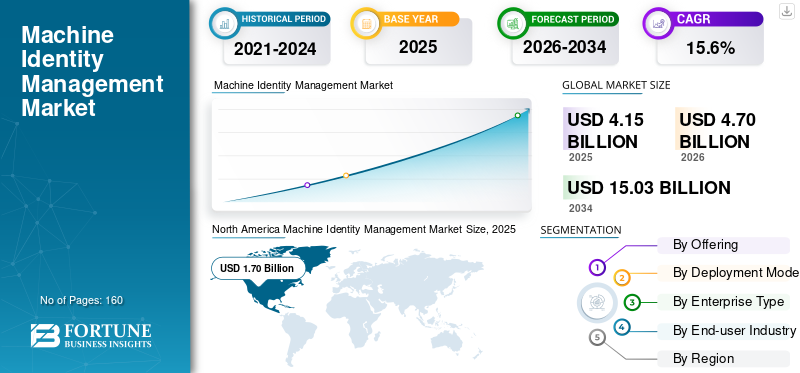
The machine identity management market size was valued at USD 4.15 billion in 2025. The market is projected to grow from USD 4.70 billion in 2026 to USD 15.03 billion by 2034, exhibiting a CAGR of 15.6% during the forecast period. North America dominated the machine identity management market with a market share of 40.96% in 2025.
Machine identity management refers to the software and services organizations use to secure and govern API identities and digital identities of servers, applications, containers, cloud workloads, connected devices, and other non-human entities. The market includes certificate lifecycle management (CLM), public key infrastructure, cryptographic key and secrets management, workload identity security, device identity management, code-signing security, and cryptographic asset discovery. Machine identity lifecycle management also covers the issuance, renewal, rotation, validation, and revocation of certificates and credentials. Associated services include implementation, integration, migration, managed PKI, maintenance, technical support, and security optimization.
Market growth is supported by the expanding use of cloud workloads, APIs, microservices, connected devices, and automated application environments that require mutual TLS (mTLS) and secure machine-to-machine authentication. Organizations are also strengthening certificate governance, cryptographic visibility, and identity-based access controls to reduce outages, unauthorized access, and operational security gaps. CyberArk Software Ltd., DigiCert, Inc., Keyfactor, Inc., Sectigo Limited, and AppViewX, Inc. are the top players in the market.
Download Free sample to learn more about this report.
Machine Identity Management Market Key Takeaways
 Global Market Size & Forecast
- 2025 Market Size: USD 4.15 Billion
- 2026 Market Size: USD 4.70 Billion
- 2034 Forecast Market Size: USD 15.03 Billion
- CAGR: 15.6% from 2026-2034
 Market Share
- North America dominated the global market with a strong revenue share of 40.96% in 2025.
- Germany accounted for roughly 6.5% of the global market, driven by GDPR-led PKI modernization.
- China held a notable 10.5% share of the global market, driven by rapid digital payments expansion.
 Key Regional Highlights
North America
North America held the largest regional share at 40.96% in 2025, driven by widespread zero trust adoption.
Europe
Europe is anticipated to record the second-highest CAGR, driven by GDPR and widespread PKI modernization.
Asia-Pacific
Asia-Pacific is expected to grow at the highest CAGR, driven by digital payments and smart manufacturing expansion.
U.S.
The U.S. accounted for roughly 34.3% of global sales in 2025, supported by strong cybersecurity investment.
Japan
Japan accounted for roughly 4.8% of global revenues in 2025, supported by rising enterprise cybersecurity spending.
Read More

MACHINE IDENTITY MANAGEMENT MARKET TRENDS
Growing Shift Toward Automated Certificate Management is a Pivotal Market Trend
Automated certificate management is becoming an important trend in the market as enterprises are managing rapidly increasing number of digital certificates across complex IT environments. Organizations are adopting centralized platforms to discover certificates, monitor expiration dates, enforce security policies, and automate renewal processes. These features help security teams reduce certificate-related outages, remove manual tracking errors, and maintain consistent protection across applications, server identities, cloud systems, and connected devices. As digital operations expand and certificate management becomes more difficult, automated solutions are expected to gain wider adoption and strengthen service-to-service authentication and machine-to-machine communications.
- In May 2025, Sectigo joined the Pax8 Marketplace to provide its cloud-based certificate lifecycle management solution, enabling managed service providers to discover, manage, and automate customer certificates through a unified dashboard.
MARKET DYNAMICS
MARKET DRIVERS
Download Free sample to learn more about this report.
Rapid Expansion of Non-Human Identities Across Enterprises is Driving the Market Growth
Organizations are deploying AI agents, service accounts, software bots, orchestration tools, and automated processes across daily business operations. Each non-human entity requires its own credentials, permissions, and access path, creating a large identity environment that traditional access controls cannot manage effectively. Unclear ownership, excessive privileges, dormant accounts, and unmanaged credentials can expose sensitive systems to unauthorized activity. Machine identity management platforms help enterprises identify these accounts, assign accountability, integrate privileged access management (PAM), enforce least-privilege access, and remove unnecessary permissions. The growing number and complexity of non-human identities are therefore driving demand for dedicated governance and security solutions.
- According to the Cloud Security Alliance, organizations have an average of 45 non-human identities for every human identity.
This growing imbalance is making dedicated machine identity governance essential for controlling access risks across enterprise environments.
|
Rank |
Market Drivers |
Overall Impact Rank |
CAGR Contribution (2026-2034) |
Impact 2026-2028 |
Impact 2029-2031 |
Impact 2032-2034 |
|
1 |
Rapid expansion of non-human identities across AI agents, microservices, APIs, containers, Kubernetes environments, and automated workloads requiring secure authentication |
High |
+4.10% |
High |
High |
High |
|
2 |
Growing software supply chain security requirements for code signing, application integrity, and trusted software releases |
High |
+3.30% |
High |
High |
High |
|
3 |
Increasing reliance on managed PKI and machine identity services due to limited in-house cryptographic expertise |
High |
+2.80% |
Medium |
High |
High |
|
4 |
Rising demand for device attestation, secure boot, and trusted communication across industrial and connected equipment |
Medium |
+2.50% |
Medium |
High |
High |
|
5 |
Expanding use of digital signatures and trusted electronic transactions across regulated business processes |
Medium |
+2.10% |
Medium |
Medium |
High |
|
6 |
Others (edge computing, 5G network functions, hardware-backed credentials, and DevSecOps policy enforcement) |
Low |
+1.60% |
Low |
Medium |
Medium |
|
Total Positive Growth Contribution |
+16.40% |
MARKET RESTRAINTS
Integration Complexity Across Fragmented IT and Security Environments Restrains Market Growth
The machine identity management market growth can be hindered by integration complexity across fragmented IT and security environments. Enterprises often operate multiple certificate authorities, legacy public key infrastructure, cloud platforms, applications, APIs, containers, service accounts, secrets-management tools, and identity systems that use different credential formats and authentication policies. Connecting a centralized machine identity platform with existing PKI, identity and access management, privileged access management, key management systems, DevOps pipelines, and security monitoring tools can require extensive discovery, configuration, and process redesign. Certificate replacement, credential rotation, or policy migration may also disrupt applications and service-to-service authentication when dependencies are not fully mapped. These challenges increase implementation costs, extend deployment timelines, weaken data security during migration, and require specialized cryptographic expertise.
|
Rank |
Market Restraints |
Overall Impact Rank |
Negative CAGR Contribution (2026-2034) |
Impact 2026-2028 |
Impact 2029-2031 |
Impact 2032-2034 |
|
1 |
Complex integration across legacy PKI, IAM, secrets-management, DevOps, and fragmented multi-cloud security environments |
High |
-0.28% |
High |
High |
Medium |
|
2 |
Risk of application disruption during certificate replacement, credential rotation, or PKI migration |
High |
-0.22% |
High |
Medium |
Medium |
|
3 |
Shortage of professionals with expertise in PKI operations, cryptographic governance, and machine identity security |
Medium |
-0.18% |
Medium |
Medium |
Low |
|
4 |
Others (inconsistent security policies, vendor interoperability limitations, unclear accountability, and delayed budget approvals) |
Low |
-0.12% |
Medium |
Low |
Low |
|
Total Negative Growth Impact |
-0.80% |
MARKET OPPORTUNITIES
Transition Towards Post-Quantum Cryptography is Creating New Growth Avenues
The transition toward post-quantum cryptography presents a significant opportunity for market providers. Enterprises must identify certificates, encryption keys, algorithms, and machine credentials that could become vulnerable to future quantum-based attacks. However, many organizations lack a complete view of where cryptographic assets are located or which applications depend on them. Platforms offering automated cryptographic discovery, cryptographic identity management, risk assessment, policy enforcement, and certificate replacement can support a controlled migration without interrupting critical systems. Vendors that integrate crypto-agility and quantum-resistant capabilities into existing identity platforms can address emerging security requirements across financial services, government, healthcare, telecommunications, and other encryption-dependent industries.
- In August 2024, the U.S. National Institute of Standards and Technology finalized three post-quantum cryptography standards and encouraged organizations to begin migrating their systems.
This transition will create sustained demand for platforms that can inventory, govern, and modernize enterprise cryptographic environments.
SEGMENTATION ANALYSIS
By Offering
Software Accounted for Largest Share Owing to Rising Demand for Centralized Machine Identity Governance Across Enterprises
Based on offering, the market is divided into software and services.
In 2025, software held largest market share as it enables centralized discovery, authentication, policy enforcement, credential rotation, certificate governance, and access control across applications, workloads, devices, and automated systems. Its strong position is supported by enterprises seeking unified visibility and consistent protection across increasingly distributed machine identity environments.
Services are expected to record the highest CAGR of 17.4% over the forecast period due to rising demand for security assessment, enterprise PKI modernization, deployment planning, managed operations, regulatory compliance support, and technical advisory. The need to redesign identity architectures, address cryptographic gaps, and maintain machine credentials across complex enterprise environments is increasing reliance on specialized service providers.
By Deployment Mode
Cloud Leads As Enterprises Seek Flexible Management of Virtual Machine Identities
Based on deployment mode, the market is segmented into cloud and on-premises.
In 2025, cloud took the largest share due to its scalability, faster deployment, centralized visibility, automatic updates, and easier integration with distributed applications and workloads. It is also projected to grow as enterprises increasingly adopt cloud-native systems that require continuous discovery, authentication, and governance of workload and virtual machine identities.
The on-premises segment is projected to grow at a CAGR of 12.7% during the forecast period. On-premises solutions remain relevant for organizations that require direct control over cryptographic assets, internal certificate authorities, and sensitive security infrastructure. Continued demand from highly regulated industries and enterprises managing critical security operations supports segment growth. However, higher deployment costs, complex maintenance, and limited flexibility may restrict adoption among organizations seeking simplified and rapidly scalable identity management environments.
By Enterprise Type
Large Enterprises Held the Highest Position Due to Extensive Machine Ecosystems and Strict Governance Requirements
Based on enterprise type, the market is bifurcated into large enterprises and small and medium enterprises.
In 2025, large enterprises took the leading position as they operate on vast numbers of applications, servers, devices, service accounts, and automated workloads across multiple business units. Their stringent audit requirements, larger security budgets, and need for centralized policy control further support the adoption of comprehensive machine identity management platforms.
Small and medium enterprises are projected to record the highest CAGR of 17.1% during the forecast period due to the increasing availability of simplified, subscription-based, and managed machine identity solutions. Growing cyber risk awareness and the need to secure digital certificates, application credentials, and connected systems without maintaining large internal security teams are further supporting the adoption in these enterprises.
By End-user Industry
To know how our report can help streamline your business, Speak to Analyst
BFSI Held the Highest Share to the Critical Need to Protect High-Value Digital Transactions and Financial Systems
Based on end-user industry, the market is segmented into BFSI, IT and telecommunications, healthcare and life sciences, manufacturing, government and defense, retail and e-commerce, energy and utilities, and others.
In 2025, BFSI held the largest share of 23.7% as banks, insurers, and payment providers rely on certificates, encryption keys, hardware security modules, and application credentials to secure transactions and financial systems. Strict regulatory oversight, uninterrupted service requirements, and the high cost of compromised machine credentials further support adoption.
IT and telecommunications are projected to record the highest CAGR of 18.6% during the forecast period due to the rapid expansion of virtual networks, 5G infrastructure, data centers, APIs, and software-defined services.
Healthcare, manufacturing, government, retail, and energy organizations are also adopting these solutions to secure medical devices, industrial equipment, public systems, digital commerce platforms, and operational technology.
Machine Identity Management Market Regional Outlook
By geography, the market is categorized into North America, South America, Asia Pacific, Europe, and the Middle East & Africa.
North America
North America Machine Identity Management Market Size, 2025 (USD Billion)
To get more information on the regional analysis of this market, Download Free sample
North America dominates with largest machine identity management market share due to widespread zero trust adoption, strong cybersecurity investment, and the presence of established identity security vendors. Enterprises and public agencies across the region are strengthening authentication controls for applications, devices, service accounts, and automated infrastructure. Ongoing PKI modernization and greater attention to certificate-related outages further support sustained demand for machine identity platforms.
To know how our report can help streamline your business, Speak to Analyst
U.S. Machine Identity Management Market
The U.S. market was valued at around USD 1.43 billion in 2025, accounting for roughly 34.3% of global sales.
Asia Pacific
Asia Pacific is expected to grow at the highest CAGR during the forecast period due to rapid expansion of digital payments, smart manufacturing, connected infrastructure, and large-scale application ecosystems. Enterprises across China, India, Japan, South Korea, and Southeast Asia are securing growing volumes of device identities, software credentials, and cryptographic assets. Rising cybersecurity regulations, expanding data center capacity, and greater deployment of industrial IoT systems are further accelerating regional demand.
Japan Machine Identity Management Market
The Japanese market was valued at around USD 0.19 billion in 2025, accounting for roughly 4.8% of global revenues.
China Machine Identity Management Market
China’s market is projected to be one of the largest globally, with 2025 revenues valued at USD 0.43 billion, roughly 10.5% of global sales.
India Machine Identity Management Market
The Indian market was valued at USD 0.15 billion in 2025, accounting for roughly 3.7% of global revenues.
Europe
Europe is anticipated to record the second-highest CAGR due to stringent cybersecurity requirements, the General Data Protection Regulation (GDPR), widespread PKI modernization, and growing demand for trusted digital communications. Enterprises across banking, automotive, industrial, and public sectors are improving control over certificates, encryption keys, and workload identities. The expansion of digital trust services, connected production systems, and cross-border online transactions is further encouraging organizations to adopt structured machine identity governance platforms.
U.K. Machine Identity Management Market
The U.K. market was valued at approximately USD 0.21 billion in 2025, accounting for roughly 5.3% of global revenues.
Germany Machine Identity Management Market
Germany’s market reached USD 0.27 billion in 2025, equivalent to around 6.5% of global sales.
Middle East & Africa
Middle East and Africa is witnessing a steady growth due to expanding digital infrastructure, rising cybersecurity awareness, and continued investment in smart government and cloud services. Organizations across the GCC, South Africa, Turkey, and Israel are strengthening protection for application credentials, connected devices, and automated systems. The growth of digital banking, energy networks, telecom platforms, and public-sector modernization is also supporting regional demand.
GCC Machine Identity Management Market
The GCC market reached USD 0.06 billion in 2025, accounting for roughly 1.4% of global revenues.
South America
South America is experiencing gradual market growth as businesses modernize payment systems, online services, and enterprise applications. Organizations across Brazil, Argentina, Chile, and other regional economies are improving control over digital certificates, software keys, and service credentials. The expansion of e-commerce, fintech platforms, and managed security service providers (MSSPs) is further encouraging enterprises to adopt machine identity management solutions.
Brazil Machine Identity Management Market
The Brazilian market was valued at USD 0.07 billion in 2025, accounting for roughly 1.7% of global revenues.
COMPETITIVE LANDSCAPE
Key Industry Players
Key Players are Expanding Their Machine Identity Capabilities to Strengthen Market Positioning
Key players are focusing on platform innovation, portfolio expansion, and strategic partnerships to address the growing complexity of machine identity environments.
CyberArk Software Ltd., DigiCert, Inc., Keyfactor, Inc., Sectigo Limited, and AppViewX, Inc. are strengthening their market positions through certificate lifecycle automation, PKI modernization, secrets protection, cryptographic discovery, and workload identity security. These companies are also expanding integrations across cloud, DevOps, and enterprise security ecosystems.
Entrust Corporation, Thales S.A., GMO GlobalSign Holdings K.K., International Business Machines Corporation, and BeyondTrust Corporation are enhancing their presence through digital trust services, privileged access security, managed PKI, hardware-based protection, and broader identity security offerings.
LIST OF KEY MACHINE IDENTITY MANAGEMENT COMPANIES PROFILED
- CyberArk Software Ltd. (U.S.)
- DigiCert, Inc. (U.S.)
- Keyfactor, Inc. (U.S.)
- Sectigo Limited (U.S.)
- AppViewX, Inc. (U.S.)
- Entrust Corporation (U.S.)
- Thales S.A. (France)
- GMO GlobalSign Holdings K.K. (Japan)
- International Business Machines Corporation (U.S.)
- BeyondTrust Corporation (U.S.)
KEY INDUSTRY DEVELOPMENTS
- March 2026: International Business Machines Corporation introduced IBM Guardium capabilities for monitoring non-human identities used by AI agents, service accounts, and automated processes. The solution maps machine interactions with sensitive data and helps organizations identify unusual access behavior.
- November 2025: Keyfactor, Inc. introduced a PKI-based identity capability for securing agentic AI systems. The solution provides cryptographic identities for autonomous agents and supports stronger authentication across enterprise environments.
- November 2025: AppViewX, Inc. joined the F5 Application Delivery and Security Platform Partner Program. The collaboration combines application delivery with automated certificate lifecycle management across hybrid and multi-cloud environments.
- October 2025: CyberArk Software Ltd. expanded its Machine Identity Security portfolio with advanced discovery and contextual intelligence capabilities. The enhancements help enterprises locate, assess, and secure machine identities across distributed infrastructure.
- August 2025: BeyondTrust Corporation added Secrets Insights to its Identity Security Insights solution. The capability improves visibility into exposed secrets and security risks associated with non-human identities.
- January 2025: Entrust Corporation launched PKI Hub, an integrated virtual appliance for managing and automating cryptographic assets. The solution supports scalable deployment across cloud and on-premises environments.
- January 2025: Entrust Streamlines PKI, Certificate Lifecycle Management, and Automation With PKI Hub. The company introduced PKI Hub to simplify the deployment and management of enterprise public key infrastructure.
REPORT COVERAGE
The machine identity management market report provides a comprehensive assessment of market size, forecasts, and key segments. It evaluates market dynamics, emerging trends, technological advancements, and the growing adoption of certificate lifecycle management, enterprise PKI modernization, cryptographic identity management, secrets management, workload identity security, and automated credential governance. The report analyzes major industry developments, including product launches, partnerships, mergers, acquisitions, platform integrations, and strategic initiatives undertaken by leading market participants. It also presents the competitive landscape, market share analysis, regional outlook, and detailed profiles of prominent companies operating in the global machine identity management market.
Request for Customization to gain extensive market insights.
REPORT SCOPE & SEGMENTATION
| ATTRIBUTE | DETAILS |
| Study Period | 2021-2034 |
| Base Year | 2025 |
| Estimated Year | 2026 |
| Forecast Period | 2026-2034 |
| Historical Period | 2021-2024 |
| Growth Rate | CAGR of 15.6% from 2026 to 2034 |
| Unit | Value (USD Billion) |
| Segmentation | By Offering, By Deployment Mode, By Enterprise Type, By End-user Industry, and By Region |
| By Offering |
|
| By Deployment Mode |
|
| By Enterprise Type |
|
| By End-user Industry |
|
| By Region |
|
Frequently Asked Questions
Fortune Business Insights says that the global market value stood at USD 4.15 billion in 2025 and is projected to reach USD 15.03 billion by 2034.
In 2025, the North America market value stood at USD 1.70 billion.
The market is anticipated to grow at a CAGR of 15.6% over the forecast period.
By end-use industry, the BFSI segment led the market.
The rapid growth of non-human identities, increasing certificate volumes, and rising demand for secure authentication are driving the market.
CyberArk Software Ltd., DigiCert, Inc., Keyfactor, Inc., Sectigo Limited, and AppViewX, Inc. are among the top players in the market.
North America held the largest market share in 2025.
The adoption is supported by centralized visibility, automated credential management, stronger authentication, and reduced risk of certificate-related outages.



- 2021-2034
- 2025
- 2021-2024
- 160
Get 30-60 hrs Free Customization
Expand Regional and Country Coverage, Segments Analysis, Company Profiles, Competitive Benchmarking, and End-user Insights.




















Related Reports
-
US +1 833 909 2966 ( Toll Free )
-
Get In Touch With Us