Magnesium Silicate Market Size, Share & Industry Analysis, By Type (Natural Magnesium Silicate, Synthetic Magnesium Silicate, and Others), By End-Use Industry (Plastics & Polymer, Paints and Coatings, Paper & Pulp, Ceramics, and Others), and Regional Forecast, 2026-2034
 Download Free Sample
Magnesium Silicate Market Size and Future Outlook
 Listen to Audio Version
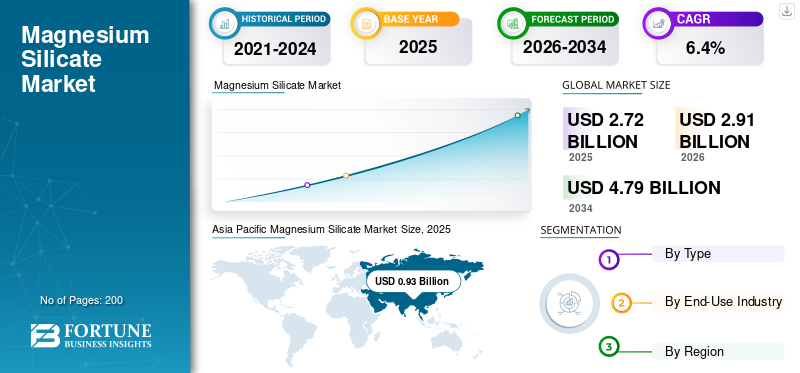
The global magnesium silicate market size was valued at USD 2.72 billion in 2025. The market is projected to grow from USD 2.91 billion in 2026 to USD 4.79 billion by 2034, growing at a CAGR of 6.4% during the forecast period. Asia Pacific dominated the magnesium silicate market with a market share of 34.19% in 2025
Magnesium silicate (MgSiO₃) market products are mineral-based materials used across a range of industrial applications, including plastics and polymers, paints and coatings, paper and pulp, ceramics, cosmetics and personal care, and other specialty manufacturing processes. The market includes natural MgSiO₃ and synthetic MgSiO₃ designed to improve reinforcement, thermal stability, surface finish, absorption performance, and also used as an anti-caking agent in end-use formulations. The market is increasingly influenced by demand for multifunctional, high-performance, and cost-effective mineral additives that support product durability, texture control, lightweight formulation, and stable processing behavior. Growing preference for efficient filler materials, improved functional performance, and application-specific mineral solutions is driving the market growth.
Furthermore, the market is led by several key players, including Imerys, Magris Talc, IMI Fabi SpA, Sibelco, and Merck KGaA. Their competitive position is supported by broad mineral product portfolios, strong processing capabilities, reliable raw material access, application-focused product development, and close engagement with industrial customers across various end-use sectors.
Download Free sample to learn more about this report.
Magnesium Silicate Market Key Takeaways
 Global Market Size & Forecast
- 2025 Market Size: USD 2.72 billion
- 2026 Market Size: USD 2.91 billion
- 2034 Forecast Market Size: USD 4.79 billion
- CAGR: 6.4% from 2026–2034
 Market Share
- Asia Pacific dominated the magnesium silicate market with a 34.19% share in 2025.
- The synthetic magnesium silicate segment is projected to grow at a 7.1% CAGR during the forecast period.
- The paints and coatings segment is expected to expand at a 6.7% CAGR over the forecast period.
 Key Regional Highlights
Asia Pacific
Asia Pacific led the market with USD 0.93 billion in 2025.
Europe
Europe is projected to reach USD 0.71 billion in 2026.
North America
remained a significant market, supported by strong demand from plastics, paints, paper, and industrial applications.
U.S
The market is estimated at USD 0.57 billion in 2026.
Japan
The market is projected to reach USD 0.15 billion in 2026.
Read More

MAGNESIUM SILICATE MARKET TRENDS
Rising Demand for Functional Mineral Additives in Industrial Formulations to Surge Market Growth
One of the key trends in the market is the growing shift from basic filler use toward more functional mineral performance in industrial formulations. End users are increasingly looking for materials that can do more than provide volume, with a stronger focus on thermal stability, reinforcement, absorption control, surface finish improvement, and better processing behavior. As a result, suppliers are developing magnesium silicate products with more application-specific performance for plastics and polymers, paints and coatings, paper and pulp, ceramics, and related industrial uses. At the same time, the market is moving toward higher-value and performance-driven applications where consistency, formulation efficiency, and end-product quality are becoming more important.
- According to the Bureau of Indian Standards, MgSiO₃ is a key extender used in the paint industry, supporting the trend toward rising use of functional mineral additives in industrial formulations.
MARKET DYNAMICS
MARKET DRIVERS
Download Free sample to learn more about this report.
Growing Demand from Plastics and Polymers is Supporting Market Growth
The primary driver of the magnesium silicate market growth is the rising demand from plastics and polymers applications, where the material is used to improve formulation performance, processing behavior, and end-product quality. Manufacturers are increasingly using MgSiO₃ as a functional mineral additive to support reinforcement, absorption control, surface smoothness, and stability in polymer formulations. This is particularly important in applications that require consistent texture, improved durability, and efficient production performance. An additional layer of support comes from the growing preference for cost-effective and multifunctional mineral materials that can enhance both product quality and manufacturing efficiency.
- According to the U.S. Geological Survey (USGS), plastics are among the major end-use markets for talc, reflecting the material’s established role in plastics and polymer applications.
MARKET RESTRAINTS
Performance Variation Across Different Types and End-Use Requirements Restricts Broader Market Adoption
A key restraint in the market is the variation in material performance across different types, purities, and end-use requirements. Since MgSiO₃ is used in plastics and polymers, paints and coatings, paper and pulp, ceramics, and other industrial applications, buyers often need specific particle size, absorption behavior, brightness, and reinforcement characteristics for their formulations. This makes product selection and formulation matching more demanding for manufacturers and end users. The challenge becomes more significant when customers require both cost efficiency and consistent performance in large-volume production. In many cases, additional testing, formulation adjustment, and quality checks are needed before the material can be used successfully in a specific application.
- According to ASTM’s Standard Specification for MgSiO₃ Pigment (Talc), MgSiO₃ pigments are classified and specified by different physical requirements, indicating that grade and property differences matter in industrial use.
MARKET OPPORTUNITIES
Rising Demand for Paints and Coatings are Creating Market Opportunities
One of the key opportunities in the market is the rising demand for paints and coatings applications. Magnesium silicate is increasingly valued in coating formulations for its role in improving texture, matting effect, surface smoothness, and formulation stability. As manufacturers continue to develop coatings with better finish quality, processing efficiency, and application performance, the use of functional mineral additives is becoming more important. Another area of opportunity comes from the growing need for cost-effective and performance-enhancing materials in industrial coating systems. End users are increasingly looking for additives that can support consistent quality while also improving formulation control and end-product appearance. As a result, MgSiO₃ is gaining wider attention in paints and coatings formulations where durability, finish quality, and efficient processing are important.
- According to ASTM, natural hydrous MgSiO₃ can be processed to what is commercially known as paint pigment quality, reflecting its established use in coatings formulations.
MARKET CHALLENGES
Raw Material Quality Variability and Supply Consistency Challenge Market Growth
The market faces a key challenge due to variations in raw material quality and the difficulty of maintaining a consistent supply across industrial applications. Since MgSiO₃ is used in performance-sensitive products such as plastics and polymers, paints and coatings, paper and pulp, and ceramics, changes in purity, particle characteristics, and mineral composition can affect formulation behavior and final product quality. This creates added pressure for both suppliers and end users to maintain reliable material consistency. The challenge becomes more significant when manufacturers require stable quality at competitive pricing and in large commercial volumes. In many cases, producers need tighter quality control, additional processing, and stronger supply management to meet customer expectations across different applications.
- According to IMA Europe, talc ores differ by the type and proportion of associated minerals present, indicating that MgSiO₃ raw materials can vary in quality and consistency across sources.
Segmentation Analysis
By Type
Broad Availability and Wide Industrial Use Support Dominance of Natural Magnesium Silicate Segment
Based on type, the market is segmented into natural magnesium silicate, synthetic magnesium silicate, and others.
The natural magnesium silicate segment holds the largest market share due to its broad availability, cost advantage, and widespread use across industrial applications. Natural MgSiO₃ is widely preferred in plastics and polymers, paints and coatings, paper and pulp, ceramics, and other manufacturing processes where reliable filler performance, absorption control, and processing efficiency are important. Its established use in large-volume applications makes it more commercially attractive than higher-cost specialty alternatives.
- According to the U.S. Geological Survey (USGS), U.S. talc is used in plastics as a functional filler providing rigidity, reflecting the broad industrial role of natural MgSiO₃ in large-volume applications.
The synthetic magnesium silicate segment is expected to grow at a CAGR of 7.1% over the forecast period.
By End-Use Industry
To know how our report can help streamline your business, Speak to Analyst
Role as a Reinforcing and Performance-Enhancing Filler Led to Plastics and Polymers Segmental Dominance
In terms of end-use industry, the market is categorized into plastics & polymer, paints and coatings, paper & pulp, ceramics, and others.
The plastics and polymers segment held the largest magnesium silicate market share in 2025, supported by its broad use as a functional mineral additive in polymer formulations. MgSiO₃ is widely used in this segment to improve stiffness, dimensional stability, surface finish, processability, and cost efficiency in plastic products. Its role as a reinforcing and performance-enhancing filler makes it valuable in applications where manufacturers seek a balance between material strength, weight control, and production efficiency.
- According to the U.S. Geological Survey (USGS), plastics are a major end-use market for talc, where it functions as a filler that provides rigidity, reflecting the leading role of plastics and polymers in MgSiO₃ consumption.
The paints and coatings segment is expected to grow at a CAGR of 6.7% over the forecast period.
Magnesium Silicate Market Regional Outlook
By geography, the market is categorized into North America, Europe, Asia Pacific, Latin America, and the Middle East & Africa.
Asia Pacific
Asia Pacific Magnesium Silicate Market Size, 2025 (USD Billion)
To get more information on the regional analysis of this market, Download Free sample
In 2024, Asia Pacific accounted for the largest share of the magnesium silicate industry, valued at USD 0.85 billion, and continued to lead in 2025, valued at USD 0.93 billion. The region benefits from its strong industrial base, large-scale plastics and polymers production, expanding paints and coatings demand, and well-established mineral processing and manufacturing activities across China, India, Japan, South Korea, and Southeast Asia. MgSiO₃ is widely used across plastics and polymers, paints and coatings, paper and pulp, and ceramics applications, all of which see high consumption across the region’s growing industrial sectors.
China Magnesium Silicate Market
By 2026, the Chinese market is projected to reach USD 0.37 billion. China remains the region’s largest demand center, supported by its strong plastics and polymers industry, broad industrial manufacturing base, and extensive use of MgSiO₃ in paints and coatings, paper and pulp, ceramics, and other mineral-based applications. Growth is reinforced by large-scale production activity, rising demand for performance-enhancing fillers, and continued expansion in downstream industrial processing.
To know how our report can help streamline your business, Speak to Analyst
India Magnesium Silicate Market
The Indian market is estimated at around USD 0.16 billion in 2026, accounting for roughly 16.3% of regional revenues.
Japan Magnesium Silicate Market
The Japanese market is estimated to be around USD 0.15 billion in 2026, accounting for roughly 15.3% of the regional revenues.
Europe
Europe is expected to experience significant market growth over the coming years. Throughout the forecast period, the region is expected to expand at a steady rate, attaining a market valuation of USD 0.71 billion by 2026. Europe is projected to witness stable growth during this period, supported by strong demand from plastics and polymers, paints and coatings, paper and pulp, and ceramics applications. The region also benefits from its established industrial base, advanced manufacturing capabilities, and increasing preference for functional mineral additives that improve product performance, processing efficiency, and formulation quality.
U.K. Magnesium Silicate Market
The U.K. market is estimated at around USD 0.10 billion in 2026, accounting for roughly 13.5% of regional revenues.
Germany Magnesium Silicate Market
Germany’s market is estimated at around USD 0.19 billion in 2026, accounting for roughly 26.1% of regional revenues.
North America
North America continues to be a well-established and attractive market for MgSiO₃, supported by strong demand from plastics and polymers, paints and coatings, paper and pulp, and other performance-focused industrial applications. The region benefits from its advanced manufacturing base, stable industrial demand, and widespread use of functional mineral fillers in formulations that require improved rigidity, surface finish, absorption control, and processing efficiency. Its mature industrial structure and steady downstream consumption continue to support the importance of North America in the market.
U.S. Magnesium Silicate Market
Given North America’s significant contribution and the U.S. dominance in the region, the U.S. market is estimated at around USD 0.57 billion in 2026, accounting for roughly 84.9% of regional sales.
Latin America and Middle East & Africa
Latin America and the Middle East & Africa are relatively smaller in absolute size, yet continue to present growth prospects for the market. Growth in Latin America is supported by expanding plastics and polymers production, rising paints and coatings demand, and increasing use of mineral additives in paper and pulp, ceramics, and other industrial applications. The region is also benefiting from gradual industrial development and broader adoption of cost-effective functional fillers in manufacturing processes. The Middle East & Africa are also showing steady potential, supported by growing construction-linked industrial activity, expanding manufacturing operations, and increasing use of mineral-based additives in coatings, ceramics, and specialty industrial products. Rising industrial diversification and improving downstream processing activity are further supporting market opportunities across both regions.
Brazil Magnesium Silicate Market
The Brazilian market is estimated at USD 0.13 billion in 2026, accounting for approximately 44.2% of regional revenues.
COMPETITIVE LANDSCAPE
Key Industry Players
Performance, Supply Consistency, and Application Expertise Are Core Competitive Differentiators
The market is moderately fragmented, and companies in the MgSiO₃ market are witnessing growth in the market. Competitive advantage depends on the ability to offer consistent mineral quality, dependable supply, technical support, and product grades tailored to specific end-use requirements. Companies that can help customers improve formulation performance, processing efficiency, and cost control are better positioned to strengthen their market presence.
Major participants such as Imerys, Magris Talc, IMI Fabi SpA, Sibelco, and Merck KGaA benefit from strong mineral processing capabilities, broad product portfolios, and global supply networks serving plastics and polymers, paints and coatings, paper and pulp, ceramics, and other industrial applications. As competition continues to evolve, the market is increasingly favoring suppliers that combine reliable raw material access, consistent product performance, and application-specific support rather than competing only on volume.
LIST OF KEY MAGNESIUM SILICATE COMPANIES PROFILED IN REPORT
- Imerys (France)
- Magris Talc (U.S.)
- IMI Fabi SpA (Italy)
- Sibelco (Belgium)
- Merck KGaA (Germany)
- ANAND TALC. (India)
- Vasundhara Micro Mineral Infinite Pvt Ltd. (India)
- Airotech Minerals (India)
- Par Drugs and Chemical Limited (India)
- Nanoshel LLC (India)
KEY INDUSTRY DEVELOPMENTS
- May 2025: IMI Fabi SpA completed the acquisition of Elementis Talc, bringing Elementis’ industrial talc business, employees, sites, and assets under IMI Fabi and expanding its global talc platform.
- January 2025: Imerys reported that its North American talc entities achieved the required claimant approval threshold for their Plan of Reorganization, a major development affecting its talc business structure in North America.
REPORT COVERAGE
The global magnesium silicate market analysis provides an in-depth study of market size & forecast by all the market segments included in the report. It includes details on market dynamics and trends expected to drive the market during the forecast period. It offers information on new product launches, key industry developments, and partnerships, mergers & acquisitions. The market research report also encompasses a detailed competitive landscape with information on the market shares and profiles of key players.
Request for Customization to gain extensive market insights.
Report Scope & Segmentation
| ATTRIBUTE | DETAILS |
| Study Period | 2021-2034 |
| Base Year | 2025 |
| Estimated Year | 2026 |
| Forecast Period | 2026-2034 |
| Historical Period | 2021-2024 |
| Growth Rate | CAGR of 6.4% from 2026-2034 |
| Unit | Value (USD Billion), Volume (Kiloton) |
| Segmentation | By Type, End-Use Industry, and Region |
| By Type |
|
| By End-Use Industry |
|
| By Region |
|
Frequently Asked Questions
Fortune Business Insights says that the global market size was valued at USD 2.72 billion in 2025 and is projected to reach USD 4.79 billion by 2034.
Recording a CAGR of 6.4%, the market is slated to exhibit steady growth during the forecast period of 2026-2034.
The plastics & polymer end-use industry segment is leading the market.
Asia Pacific held the highest market share in 2025.
Rising demand for plastics and polymer formulations is accelerating the adoption of magnesium silicate.



- 2021-2034
- 2025
- 2021-2024
- 200
Get 30-60 hrs Free Customization
Expand Regional and Country Coverage, Segments Analysis, Company Profiles, Competitive Benchmarking, and End-user Insights.


















Related Reports
-
US +1 833 909 2966 ( Toll Free )
-
Get In Touch With Us