Molecular Diagnostics Market Size, Share, Trends and Industry Analysis By Product Type (Instruments, Reagents & Consumables), By Application (Infectious Disease, Blood Screening, Histology & Oncology), By Technique (Amplification, Hybridization & Sequencing Techniques), End User (Hospitals, Clinical & Pathology Labs), and Regional Forecast 2026-2034
 Download Free Sample
Molecular Diagnostics Market Size & Share
 Listen to Audio Version
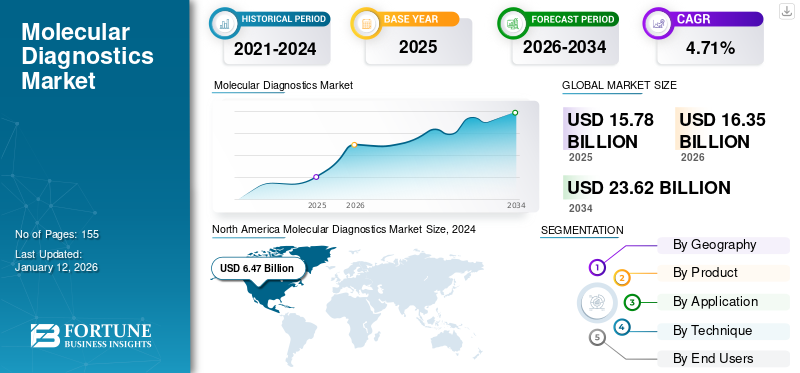
The molecular diagnostics market size was valued at USD 15.78 billion in 2025 and is projected to grow from USD 16.35 Billion in 2026 to USD 23.62 billion by 2034, exhibiting a CAGR of 4.71% during 2026-2034. North America dominated the global market with a share of 42.39% in 2025.
Molecular diagnostics has moved from a specialist laboratory capability to a core component of modern clinical decision-making. That shift is being reinforced by advances in genomics, automation, and precision medicine, alongside broader efforts by healthcare systems to improve diagnostic accuracy and reduce the time between disease detection and treatment selection. According to the U.S. Food and Drug Administration (FDA), molecular diagnostic technologies continue to expand across oncology, infectious diseases, inherited disorders, and companion diagnostics through new device clearances and approvals, while organizations such as the World Health Organization (WHO) increasingly recognize molecular testing as an essential element of disease surveillance and outbreak response.
The market outlook remains favorable as healthcare providers modernize laboratory infrastructure and integrate genomic information into routine care pathways. Demand is supported by the growing prevalence of cancer, infectious diseases, and rare genetic conditions, as well as continued investment in precision medicine initiatives by governments, academic medical centers, and healthcare organizations. Manufacturers are accelerating innovation through automation, multiplex testing, digital workflow integration, and next-generation sequencing platforms designed to improve laboratory efficiency and clinical utility.
During the last decade, molecular diagnostics has emerged as a superior methodology. It has achieved the goal of faster disease diagnosis with minimal complexities. The demand for these procedures is higher, particularly for diagnosing infectious diseases.
The growing prevalence of infectious diseases in developing and developed nations is boosting the demand for molecular diagnosis. Major viral and bacterial outbreaks in the Middle East and Africa forced all governments and research institutions across the globe to adopt molecular diagnostic techniques to inhibit microbial outbreaks. In terms of techniques, the amplification techniques segment is projected to hold a considerable share in the global market. The consumables and reagent segments are also expected to hold a considerable share in this market.
Download Free sample to learn more about this report.
Molecular Diagnostics Market Key Takeaways
 Market Size & Forecast
- 2025 Market Size: USD 15.78 billion
- 2026 Market Size: USD 16.35 billion
- 2034 Forecast Market Size: USD 23.62 billion
- CAGR: 4.71% from 2026–2034
 Market Share
- North America dominated the molecular diagnostics market with a 42.39% share in 2025.
- Infectious disease applications accounted for a 60.0% market share in 2024.
- Amplification techniques held a considerable share due to rapid and accurate diagnostic capabilities.
 Key Regional Highlights
North America
North America was valued at USD 6.69 billion in 2025 and is projected to reach USD 6.94 billion in 2026, supported by strong collaboration between academic institutions and research hospitals.
Europe
Europe is projected to reach USD 1.12 billion in 2026, driven by increasing adoption of advanced molecular diagnostic platforms and favorable regulatory support.
Asia Pacific
Asia Pacific is projected to reach USD 1.12 billion in 2026, supported by improving healthcare infrastructure and rising investments in research and development.
U.S.
The U.S. market is projected to reach USD 6.62 billion in 2026, owing to the high utilization of molecular diagnostics for improving diagnostic accuracy.
Japan
The Japanese market is projected to reach USD 1.12 billion in 2026, driven by growing awareness of early disease detection and expanding diagnostic capabilities.
Read More

Key Market Dynamics
Market Drivers
Infectious Diseases are expected to drive the molecular diagnostics market growth.
Managing microbial outbreaks and infections across the globe is a big challenge faced by all governments worldwide. A huge amount of resource engagement in terms of technology, expertise, and finance serves as a favorable environment for the initiation of research projects, particularly for infectious diseases, and is boosting the market for molecular diagnostics. The Infectious diseases application segment accounted for a market share of 60.0% in 2024. Moreover, a rise in awareness programs initiated by global organizations such as the World Health Organization (WHO), the World Bank, and others for infectious diseases is expected to encourage the talent pool to step forward to achieve higher utilization of such diagnostic technologies.
Growing reliance on precision medicine is reshaping how diseases are diagnosed and managed, placing molecular diagnostics at the center of clinical decision-making. Healthcare providers increasingly require tests capable of identifying genetic alterations, infectious pathogens, and treatment-responsive biomarkers with greater speed and analytical accuracy than conventional diagnostic methods. This demand is supported by expanding cancer incidence, the continuing burden of infectious diseases, and wider adoption of personalized therapeutic approaches.
Government-backed genomic initiatives are further accelerating adoption. Programs such as the U.S. National Institutes of Health's All of Us Research Program and the United Kingdom's genomic medicine initiatives illustrate sustained public investment in integrating genomic data into routine healthcare. At the regulatory level, the U.S. Food and Drug Administration continues authorizing innovative molecular diagnostic devices and companion diagnostics that support targeted therapies across multiple disease areas.
Technological progress also strengthens market expansion. Automated sample preparation, multiplex polymerase chain reaction (PCR), digital PCR, next-generation sequencing (NGS), and cloud-enabled laboratory informatics have improved workflow efficiency while reducing turnaround times and manual errors. These advances enable laboratories to process larger testing volumes without compromising analytical performance.
The pharmaceutical industry's growing emphasis on biomarker-driven drug development further reinforces demand. Companion diagnostics have become increasingly important in oncology and rare disease treatment, where molecular testing helps identify patients most likely to benefit from specific therapies. Together, these scientific, regulatory, and clinical developments continue to strengthen the long-term role of molecular diagnostics within modern healthcare systems.
Market Restraints
Scientific progress has expanded the capabilities of molecular diagnostics, yet commercialization and routine clinical adoption remain constrained by operational, regulatory, and economic challenges. High capital expenditure for instrumentation, laboratory automation, and specialized infrastructure continues to limit implementation, particularly among smaller hospitals and laboratories operating under restricted healthcare budgets. Ongoing costs associated with reagents, quality assurance, maintenance, and workforce training further increase the total cost of ownership throughout the technology lifecycle.
Regulatory compliance presents another significant barrier. Manufacturers must generate comprehensive analytical and clinical performance data to satisfy requirements established by agencies such as the U.S. Food and Drug Administration and regulatory authorities operating under the European Union's In Vitro Diagnostic Regulation (IVDR). These validation processes are essential for patient safety but frequently extend development timelines, increase development costs, and delay market entry for innovative diagnostic solutions.
Reimbursement policies also influence purchasing decisions. Coverage criteria, coding practices, and payment levels differ considerably across healthcare systems, creating uncertainty regarding return on investment for healthcare providers. Even when molecular tests demonstrate strong clinical value, inconsistent reimbursement can slow widespread implementation and discourage laboratories from expanding testing menus.
Workforce availability remains an additional constraint. Advanced molecular testing requires experienced laboratory scientists, molecular pathologists, bioinformaticians, and quality specialists capable of interpreting increasingly complex genomic data. Many healthcare systems continue reporting shortages of these professionals, limiting testing capacity despite growing clinical demand. Collectively, these financial, regulatory, and operational pressures continue to moderate adoption, particularly in resource-constrained regions where healthcare modernization remains an ongoing priority.
Download Free sample to learn more about this report.
Market Trends
Clinical laboratories are moving beyond standalone molecular assays toward integrated diagnostic ecosystems that combine automation, genomic analysis, digital pathology, and advanced informatics within a single workflow. This transition reflects a broader shift toward precision healthcare, where clinicians increasingly rely on comprehensive molecular information to guide diagnosis, treatment selection, and disease monitoring. Rather than focusing solely on analytical sensitivity, healthcare providers are prioritizing platforms that improve laboratory efficiency while delivering clinically actionable insights.
Automation remains one of the defining trends shaping the industry. Manufacturers continue introducing systems that integrate nucleic acid extraction, amplification, detection, and data interpretation into streamlined workflows, reducing manual intervention and minimizing variability between laboratories. At the same time, advances in multiplex polymerase chain reaction (PCR), next-generation sequencing (NGS), and digital PCR are expanding the range of diseases that can be assessed from a single patient specimen.
Another notable development is the growing role of companion diagnostics in precision oncology. As pharmaceutical companies develop targeted therapies for genetically defined patient populations, molecular diagnostics has become increasingly important for identifying treatment eligibility. The U.S. Food and Drug Administration continues approving companion diagnostic assays alongside novel therapeutics, illustrating the close alignment between diagnostic innovation and drug development.
Artificial intelligence and cloud-enabled bioinformatics are also gaining traction for data interpretation, quality management, and laboratory workflow optimization. Although implementation remains subject to regulatory oversight and cybersecurity requirements, these technologies are expected to enhance scalability, improve consistency across testing environments, and support broader clinical adoption of molecular diagnostics as genomic medicine becomes increasingly integrated into routine patient care.
Market Opportunities
Expanding access to precision medicine presents one of the strongest long-term opportunities for the molecular diagnostics market. Healthcare systems are increasingly incorporating genomic information into routine clinical practice, creating sustained demand for technologies that deliver rapid, accurate, and clinically meaningful molecular insights. National genomic medicine initiatives, coupled with investments in laboratory modernization, continue to broaden the adoption of advanced molecular testing across both developed and emerging healthcare markets.
Companion diagnostics represent another significant avenue for growth. As biopharmaceutical companies advance targeted therapies, the need for validated molecular assays that identify appropriate patient populations is expected to increase. The U.S. Food and Drug Administration has continued approving companion diagnostic tests alongside precision medicines, illustrating the expanding integration of diagnostics with therapeutic development. This trend creates opportunities for diagnostic manufacturers to establish long-term collaborations with pharmaceutical companies throughout the drug development lifecycle.
Decentralized and near-patient molecular testing is also gaining momentum. Advances in instrument miniaturization, cartridge-based technologies, and automated sample processing are enabling high-quality molecular analysis outside traditional centralized laboratories. These innovations have the potential to improve access to timely diagnostics in community hospitals, outpatient clinics, and resource-limited settings while supporting faster clinical decision-making.
Market Segmentation Insights
By Product Type
Instruments
Instruments form the technological foundation of molecular diagnostics by enabling nucleic acid extraction, amplification, detection, sequencing, and data analysis within standardized laboratory workflows. Demand for advanced molecular diagnostic instruments continues to rise as hospitals and reference laboratories expand testing capacity to support oncology, infectious disease surveillance, inherited disease screening, and precision medicine programs. Rather than purchasing standalone equipment, healthcare organizations increasingly favor integrated systems capable of automating multiple laboratory processes while reducing turnaround time and improving reproducibility.
Adoption patterns are shifting toward high-throughput platforms that combine automation, software integration, and quality management into unified laboratory ecosystems. Large healthcare networks often prioritize scalable systems that accommodate increasing test volumes without requiring proportional workforce expansion, while smaller laboratories are adopting compact platforms designed for decentralized testing. Manufacturers continue differentiating their portfolios by improving analytical sensitivity, workflow flexibility, and interoperability with laboratory information systems.
Reagents & Consumables
Reagents and consumables represent the largest recurring revenue category because every molecular diagnostic test depends upon specialized assay kits, enzymes, primers, probes, extraction reagents, controls, and quality assurance materials. Unlike capital equipment purchases, consumable demand grows directly with testing volume, making this segment less sensitive to procurement cycles and more closely aligned with routine laboratory operations.
Healthcare providers increasingly prioritize reagent consistency, analytical performance, regulatory validation, and compatibility with existing laboratory platforms when selecting suppliers. Reliable supply chains have become a strategic purchasing criterion following recent disruptions that highlighted the importance of uninterrupted access to essential laboratory materials. Manufacturers continue investing in standardized reagent formulations, longer shelf life, simplified workflows, and multiplex assay development to improve laboratory efficiency while reducing operational complexity.
By Application
To know how our report can help streamline your business, Speak to Analyst
Based on applications, the global molecular diagnostic market segments include infectious diseases, blood screening, histology, oncology, etc.
Infectious Disease
Infectious diseases held an estimated 63% of the market share in 2026. The global molecular diagnostic market includes reagents and consumables based on the product type. In terms of techniques, the global molecular diagnostic market is categorized as amplification techniques, hybridization techniques, sequencing techniques, and others.
Infectious disease remains the largest application segment for molecular diagnostics because rapid and accurate pathogen identification is essential for effective clinical management and public health surveillance. Molecular assays enable healthcare providers to detect bacterial, viral, fungal, and parasitic infections with greater sensitivity and specificity than many conventional diagnostic methods, allowing earlier intervention and more targeted treatment strategies. Hospitals, reference laboratories, and public health agencies continue expanding molecular testing capabilities to strengthen outbreak preparedness and antimicrobial stewardship programs.
The global market includes various end users, including clinical and pathology labs, hospitals, and others (physicians’ offices, clinics, emergency centers, long-term and urgent care centers, etc.). Lucrative reimbursement strategies offered by the government for the implementation of molecular diagnostics signify considerable growth in the execution of these diagnostic systems in clinical and pathology labs and hospitals.
Blood Screening
Blood screening continues to represent a strategically important application because transfusion safety depends on highly accurate detection of blood-borne pathogens before clinical use. Molecular diagnostic technologies complement conventional serological testing by identifying viral nucleic acids during early stages of infection, reducing diagnostic window periods and enhancing blood safety. Blood collection organizations and transfusion centers increasingly rely on nucleic acid testing to strengthen quality assurance and maintain compliance with evolving regulatory requirements.
Histology & Oncology
Histology and oncology have become one of the fastest-evolving application areas as precision medicine increasingly depends on molecular characterization of tumors rather than histological assessment alone. Molecular diagnostics supports the identification of clinically actionable genetic alterations, enabling oncologists to select targeted therapies, monitor disease progression, and evaluate treatment response with greater precision. The growing availability of biomarker-driven therapies continues to strengthen the clinical importance of comprehensive molecular testing throughout the cancer care pathway.
By Technique
Amplification
Amplification technologies continue to hold the leading position within the molecular diagnostics market because they deliver rapid, highly sensitive, and reproducible detection of nucleic acids across a broad spectrum of clinical applications. Polymerase chain reaction (PCR), digital PCR, and isothermal amplification methods have become integral to diagnosing infectious diseases, detecting genetic mutations, monitoring treatment response, and supporting precision oncology. Their proven clinical performance, broad regulatory acceptance, and compatibility with automated laboratory workflows have reinforced widespread adoption across hospitals, reference laboratories, and public health institutions.
Customer purchasing behavior increasingly reflects a preference for platforms that combine high analytical performance with operational simplicity. Laboratories seek amplification systems capable of reducing turnaround times while maintaining consistent accuracy across growing testing volumes. Automated sample preparation, integrated quality control, and multiplex testing capabilities are becoming standard purchasing criteria as healthcare providers aim to improve efficiency without increasing laboratory complexity.
Hybridization & Sequencing Techniques
Hybridization and sequencing technologies are gaining strategic importance as healthcare systems expand precision medicine and comprehensive genomic profiling. While amplification techniques remain the primary method for routine diagnostics, sequencing-based approaches provide deeper molecular characterization by identifying genetic variants, structural alterations, and complex biomarker profiles that support personalized treatment decisions. This capability has made sequencing increasingly valuable across oncology, inherited disorders, pharmacogenomics, and rare disease diagnosis.
Healthcare organizations are progressively investing in next-generation sequencing platforms that combine higher throughput, declining per-sample costs, and improved analytical accuracy with advanced bioinformatics. Hybridization techniques, including fluorescence in situ hybridization (FISH), continue to play an important role in validating chromosomal abnormalities, gene amplifications, and genomic rearrangements, particularly within cancer diagnostics. Rather than competing directly, sequencing and hybridization increasingly complement amplification technologies within integrated diagnostic workflows.
By End User
Hospitals
Hospitals account for a substantial share of molecular diagnostics adoption because they require rapid, reliable diagnostic information across emergency medicine, oncology, infectious diseases, transplantation, and critical care. Investment in integrated laboratory infrastructure continues to increase as healthcare providers seek to shorten diagnostic timelines, improve treatment selection, and strengthen patient outcomes. Large hospital networks increasingly deploy automated molecular testing platforms that integrate seamlessly with electronic health records and laboratory information systems, enabling faster clinical decision-making and more efficient resource utilization.
Customer preferences are shifting toward comprehensive diagnostic platforms capable of supporting multiple clinical specialties from a single laboratory environment. Future growth is expected to be supported by continued expansion of precision medicine programs, digital healthcare integration, and hospital modernization initiatives that prioritize advanced molecular testing as a core component of high-quality patient care.
Clinical & Pathology Laboratories
Clinical and pathology laboratories remain indispensable to the molecular diagnostics ecosystem by providing specialized testing services for hospitals, physician practices, public health agencies, and pharmaceutical research organizations. These laboratories continue expanding their molecular capabilities as test complexity increases and demand grows for comprehensive genomic analysis, infectious disease surveillance, and precision oncology services. High sample volumes encourage ongoing investment in automation, advanced bioinformatics, and standardized quality management systems that improve efficiency while maintaining analytical consistency.
Technology evolution is enabling laboratories to process increasingly sophisticated molecular assays with greater speed and accuracy. Customer demand favors flexible platforms that accommodate diverse testing menus while supporting regulatory compliance and scalable operations. Looking ahead, continued advances in laboratory automation, digital pathology, artificial intelligence-assisted interpretation, and genomic medicine are expected to strengthen the strategic role of clinical and pathology laboratories, positioning them as central contributors to future innovation and value creation within the molecular diagnostics market.
Regional Insights
North America Molecular Diagnostics Market Analysis
Reinforcement Strategies of Government Institutions for Molecular Diagnostics Reflected as Higher Growth of the Market in North America
North America Molecular Diagnostics Market Size, 2025 (USD Billion)
To get more information on the regional analysis of this market, Download Free sample
North America dominated the molecular diagnostics market with a valuation of USD 6.69 billion in 2025, increasing to USD 6.94 billion in 2026. Market leadership is driven by strong collaboration between large academic institutions and research hospitals, which accelerates innovation and clinical adoption. In addition, high utilization of molecular diagnostics to improve diagnostic accuracy and clinical efficiency continues to support market expansion. The U.S. market is projected to reach USD 6.62 billion by 2026.
North America represents the most mature regional market, supported by advanced healthcare infrastructure, extensive genomic research, and widespread adoption of precision medicine. Continuous investment in laboratory automation, companion diagnostics, and molecular testing strengthens clinical utilization across multiple disease areas. Strong collaboration between healthcare providers, biotechnology companies, and research institutions is expected to sustain innovation, reinforce commercialization, and support continued regional leadership.
United States Molecular Diagnostics Market
The United States leads the regional market through its well-established molecular testing infrastructure, strong biomedical research ecosystem, and ongoing regulatory approvals from the U.S. Food and Drug Administration. Healthcare organizations continue expanding genomic testing and precision oncology programs while investing in laboratory modernization. Continued innovation, pharmaceutical collaboration, and increasing integration of molecular diagnostics into routine clinical care are expected to strengthen future market expansion.
Europe Molecular Diagnostics Market Analysis
Europe represents a significant share of the global molecular diagnostics market, supported by the growing emphasis on large hospital research networks and clinical microbiology laboratories. Increasing interactions between academic institutions and hospital research organizations are facilitating broader adoption of advanced molecular diagnostic platforms. Favorable regulatory support for diagnostic innovation further strengthens regional growth. The UK market is projected to reach USD 0.49 billion by 2026, while the German market is projected to reach USD 1.12 billion by 2026.
Europe maintains a mature molecular diagnostics market supported by universal healthcare systems, advanced clinical laboratories, and sustained investment in precision medicine. Regulatory harmonization under the European Union's In Vitro Diagnostic Regulation continues to shape product development and laboratory practices. Growing adoption of genomic technologies, personalized medicine, and digital laboratory solutions positions the region for stable long-term expansion and continued technological advancement.
Germany Molecular Diagnostics Market
Germany remains one of Europe's strongest molecular diagnostics markets because of its advanced healthcare infrastructure, internationally recognized biomedical research institutions, and commitment to laboratory innovation. Hospitals and specialized diagnostic laboratories continue investing in automation, genomic technologies, and precision medicine. Strong industrial capabilities and continued collaboration between academia and industry are expected to support sustained technological progress and market development.
United Kingdom Molecular Diagnostics Market
The United Kingdom continues expanding molecular diagnostics through national genomic medicine initiatives, laboratory modernization, and precision healthcare programs. Healthcare providers increasingly incorporate genomic testing into clinical pathways for oncology, rare diseases, and inherited disorders. Continued investment in research, digital health infrastructure, and advanced laboratory technologies is expected to strengthen diagnostic capabilities and encourage long-term market growth.
Asia-Pacific Molecular Diagnostics Market Analysis
Although the molecular diagnostics market in Asia Pacific is still at a developing stage, the region is expected to witness substantial growth during the forecast period. Rapidly improving healthcare infrastructure, increasing investments in research and development, and rising awareness of early disease detection are key growth enablers. Expanding diagnostic capabilities in emerging economies are expected to unlock significant market potential. The Japan market is projected to reach USD 1.12 billion by 2026, the China market is projected to reach USD 1.12 billion by 2026, and the India market is projected to reach USD 0.28 billion by 2026.
Asia-Pacific is emerging as the fastest-expanding regional market, driven by healthcare modernization, biotechnology investment, and increasing adoption of genomic medicine. Governments continue strengthening laboratory infrastructure while expanding access to advanced molecular testing across major healthcare systems. Growing clinical demand, improving healthcare expenditure, and domestic innovation are expected to accelerate technology adoption and reinforce long-term regional growth prospects.
Japan Molecular Diagnostics Market
Japan continues advancing molecular diagnostics through strong investment in healthcare innovation, precision medicine, and biomedical research. Healthcare institutions increasingly deploy automated molecular testing platforms to improve diagnostic quality and clinical efficiency. Continued technological development, aging population demographics, and expanding genomic medicine initiatives are expected to support sustained demand for advanced molecular diagnostic solutions across the country's healthcare system.
China Molecular Diagnostics Market
China continues to strengthen its molecular diagnostics industry through healthcare reforms, biotechnology investment, and expanding domestic manufacturing capabilities. Clinical laboratories increasingly adopt advanced genomic technologies to improve disease detection and personalized healthcare. Government support for innovation, laboratory modernization, and precision medicine is expected to accelerate commercial development while enhancing China's contribution to the global molecular diagnostics industry.
Latin America Molecular Diagnostics Market Analysis
The molecular diagnostics market in Latin America is in an early growth phase, supported by gradual improvements in laboratory infrastructure and increasing adoption of advanced diagnostic technologies. Rising government initiatives to strengthen healthcare systems and growing demand for accurate infectious disease testing are expected to support steady market expansion.
Latin America continues to improve molecular diagnostics through healthcare infrastructure expansion, increasing laboratory modernization, and greater awareness of precision medicine. Hospitals and diagnostic laboratories are progressively adopting advanced molecular testing technologies to strengthen infectious disease surveillance and oncology services. Continued healthcare investment, public health initiatives, and technology transfer are expected to support gradual regional market development.
Middle East & Africa Molecular Diagnostics Market Analysis
The Middle East & Africa molecular diagnostics market is witnessing moderate growth, driven by increasing healthcare investments and expanding access to diagnostic services. Growing focus on improving clinical laboratory capabilities and rising prevalence of infectious and chronic diseases are expected to support market development, particularly in urban healthcare centers.
The Middle East and Africa continue expanding molecular diagnostics through healthcare modernization, laboratory capacity building, and increased investment in specialized diagnostic services. Governments are strengthening disease surveillance and improving access to advanced testing technologies. Continued infrastructure development, workforce training, and precision medicine initiatives are expected to gradually enhance regional adoption and future market opportunities.
Molecular Diagnostics Industry Competitive Landscape
QIAGEN, F. Hoffmann-La Roche Ltd., Danaher Corporation, and Abbott Laboratories are expected to Hold Considerable shares in the Global Market
Giant organizations such as QIAGEN, F. Hoffmann-La Roche Ltd., Danaher Corporation, and Abbott Laboratories are expected to lead the global market during the forecast period. Optimal research & development strategies, robust supply chain network, increasing investments in research & development, and cost management are projected to serve as huge opportunities for the aforementioned market players to lead this market during the forecast period. Moreover, higher potential for intense penetration of advanced diagnostics in the Asia Pacific market may offer a significant share for the companies in terms of revenue in the global molecular diagnostics market.
Competition within the molecular diagnostics industry is defined less by the breadth of individual test menus than by the ability to deliver integrated diagnostic ecosystems that combine instruments, reagents, software, bioinformatics, and clinical support. Global leaders continue investing heavily in research and development to expand precision medicine applications while strengthening laboratory automation, workflow efficiency, and regulatory compliance. Innovation remains the principal competitive differentiator as healthcare providers increasingly prioritize comprehensive solutions over standalone diagnostic products.
F. Hoffmann-La Roche, Thermo Fisher Scientific, Danaher Corporation (through Cepheid and Beckman Coulter), Abbott Laboratories, QIAGEN, Illumina, Bio-Rad Laboratories, and Hologic maintain strong global positions through broad product portfolios, established distribution networks, and extensive regulatory expertise. These companies continue introducing new molecular assays, sequencing technologies, companion diagnostics, and automated laboratory platforms to strengthen customer retention and expand clinical applications.
Emerging biotechnology companies increasingly compete by focusing on specialized molecular technologies, decentralized testing platforms, artificial intelligence-assisted data interpretation, and novel biomarker discovery. Rather than competing across every application, many differentiate through expertise in niche disease areas or innovative genomic technologies that address unmet clinical needs.
Strategic partnerships remain central to competitive positioning. Diagnostic manufacturers frequently collaborate with pharmaceutical companies to co-develop companion diagnostics supporting targeted therapies, while research partnerships with academic medical centers accelerate biomarker validation and clinical evidence generation. Selective acquisitions continue enabling companies to strengthen technology portfolios, expand geographic reach, and accelerate commercialization of innovative diagnostic platforms.
Regional competitors are also expanding their presence by investing in localized manufacturing, regulatory capabilities, and customer support infrastructure to address country-specific healthcare requirements. Looking ahead, organizations that successfully integrate automation, advanced genomics, digital pathology, cloud-enabled informatics, and interoperable laboratory solutions will be best positioned to strengthen competitive advantage. The ability to combine scientific innovation with operational scalability and regulatory excellence will remain the defining characteristic of market leadership in molecular diagnostics.
Top Molecular Diagnostic Market Players
- bioMérieux SA.
- BD
- Danaher Corporation
- Grifols, S.A.
- Hologic Inc.
- Novartis AG
- QIAGEN
- Siemens Healthcare GmbH
- F. Hoffmann-La Roche Ltd.
- Other players
KEY INDUSTRY DEVELOPMENTS:
- January 2026: QIAGEN N.V. announced its 2026 strategic priorities, outlining planned launches in sample preparation, syndromic testing, digital PCR, and clinical bioinformatics. The strategy is intended to expand the company's installed instrument base, strengthen recurring consumables revenue, and accelerate adoption of precision diagnostics across clinical laboratories.
- September 2025: Illumina, Inc. expanded its precision oncology portfolio by making the TruSight™ Oncology Comprehensive assay more broadly available for companion diagnostic development with biopharmaceutical partners. The initiative is designed to support biomarker-driven drug development and increase access to comprehensive genomic profiling in oncology.
- July 2025: Thermo Fisher Scientific Inc. completed the acquisition of a sterile fill-finish and packaging facility from Sanofi in New Jersey. While the acquisition primarily expands pharmaceutical manufacturing capacity, it also strengthens Thermo Fisher's integrated life sciences and diagnostics ecosystem that supports molecular diagnostics and precision medicine for customers.
- May 2025: F. Hoffmann-La Roche Ltd. received U.S. FDA approval for the VENTANA® MET (SP44) RxDx Assay, the first companion diagnostic approved to identify patients with MET protein-overexpressing non-small cell lung cancer who may benefit from EMRELIS™ (telisotuzumab vedotin). The approval expands Roche's precision oncology diagnostics portfolio and strengthens its companion diagnostics capabilities.
- May 2025: GeneDx Holdings Corp. announced its agreement to acquire Fabric Genomics, combining GeneDx's genomic testing capabilities with Fabric's artificial intelligence-enabled genomic interpretation platform. The acquisition is intended to enhance variant interpretation, improve clinical decision support, and accelerate the delivery of precision genomic diagnostics.
Report Coverage
The science of medical diagnostics is witnessing remarkable achievements in terms of new diagnostic domains and philosophies. The popularity of molecular diagnostics is continuously increasing in life sciences due to its extensive applications, promising solutions, and methodologies for disease diagnosis on a molecular level.
The molecular diagnostics market report provides both qualitative and quantitative insights on molecular diagnostics industry trends and detailed analysis of market size & growth rate for all possible segments in the market. The market is segmented into product type, application, technique, and end user. Based on product type, the global market is categorized into instruments and reagents & consumables.
Based on applications, the market is segmented into infectious disease, blood screening, histology, oncology, and others. Based on techniques, this market is segmented into amplification techniques, hybridization techniques, sequencing techniques, and others. Various end users covered in the report are clinical and pathology laboratories, hospitals, and others. Geographically, the market is segmented into five major regions, which are North America, Europe, Asia Pacific, Latin America, and the Middle East & Africa. These regions are further categorized into countries.
Along with this, the report analysis includes market dynamics and a competitive landscape. Various key insights provided in the report are Porter’s five forces analysis, recent advancements in molecular diagnostics, key mergers & acquisitions, and others.
Request for Customization to gain extensive market insights.
Report Scope & Segmentation
|
ATTRIBUTE |
DETAILS |
|
Study Period |
2021-2034 |
|
Base Year |
2025 |
|
Estimated Year |
2026 |
|
Forecast Period |
2026-2034 |
|
Historical Period |
2021-2024 |
|
Unit |
Value (USD Billion) |
|
Growth Rate |
CAGR of 4.71% from 2026 to 2034 |
|
By Product Type |
|
|
By Application |
|
|
By Technique |
|
|
By End User |
|
|
By Geography |
|
Frequently Asked Questions
According to Fortune Business Insights, the global molecular diagnostics market is expected to grow from USD 16.35 Billion in 2026 to USD 23.62 Billion by 2034.
Fortune Business Insights has estimated the value of the molecular diagnostic market at USD 23.62 billion in 2034.
The molecular diagnostic market is projected to grow at a CAGR of 4.71% during the forecast period.
North America dominated the global molecular diagnostics market with a share of 42.42% in 2025, driven by advanced healthcare infrastructure and high adoption of innovative diagnostic technologies.
Artificial intelligence is enhancing molecular diagnostics by improving data analysis accuracy, enabling real-time decision-making, and facilitating the development of advanced diagnostic platforms.
Leading companies in the molecular diagnostics market include Roche, Abbott, bioMérieux, Qiagen, Danaher (Cepheid), Thermo Fisher Scientific, and Hologic. These firms are known for innovations in PCR, NGS, and rapid diagnostic platforms, driving growth and technological advancement in the sector.
Emerging trends include the integration of AI and machine learning, the rise of liquid biopsy techniques, advancements in CRISPR-based diagnostics, and the development of portable diagnostic devices.



- 2021-2034
- 2025
- 2021-2024
- 155
Get 30-60 hrs Free Customization
Expand Regional and Country Coverage, Segments Analysis, Company Profiles, Competitive Benchmarking, and End-user Insights.













.webp)






Related Reports
-
US +1 833 909 2966 ( Toll Free )
-
Get In Touch With Us