Mailer Packaging Market Size, Share & Industry Analysis by Material (Plastic, Paper, Aluminum Foil, and Others), By Product Type (Cushioned Mailers and Non-cushioned Mailers), By Insulation (Insulated and Non-insulated), By End Use (E-commerce, Shipping & Logistics, Manufacturing & Warehousing, and Others), and Regional Forecast, 2026-2034
 Download Free Sample
(Offer valid till 15th Oct 2026)

KEY MARKET INSIGHTS
 Listen to Audio Version
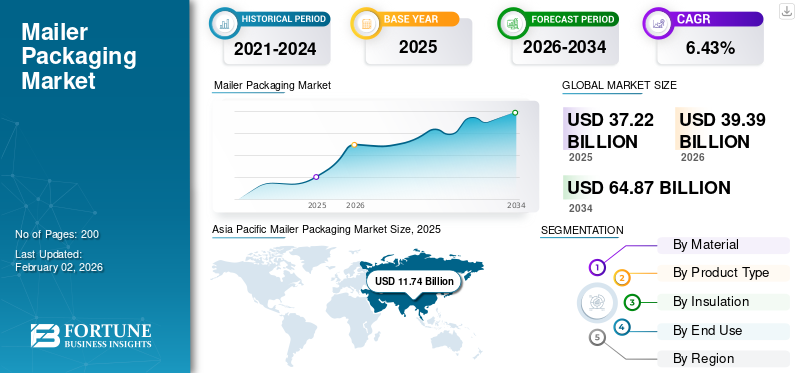
The global mailer packaging market size was valued at USD 37.22 billion in 2025 and is projected to grow from USD 39.39 billion in 2026 to USD 64.87 billion by 2034, exhibiting a CAGR of 6.43% during the forecast period. Asia Pacific dominated the mailer packaging market with a market share of 31.53% in 2025.
Mailer packaging pertains to lightweight, flexible, and robust packaging materials intended to safeguard products throughout shipping, handling, and delivery. These materials are extensively utilized in the e-commerce, retail, and logistics industries to transport small to medium-sized products securely and economically. The increasing usage of mailers in the e-commerce and retail sectors drives the global market growth.
The market encompasses several key players, Sealed Air, Mondi, and Pregis Corporation, at the forefront. Broad portfolio with innovative product launches and strong steps aimed at expanding geographical presence have bolstered the dominance of these players in the global market.
Download Free sample to learn more about this report.
Mailer Packaging Market Key Takeaways
 Market Size & Forecast
- 2025 Market Size: USD 37.22 billion
- 2026 Market Size: USD 39.39 billion
- 2034 Forecast Market Size: USD 64.87 billion
- CAGR: 6.43% from 2026–2034
 Market Share
- Asia Pacific dominated the mailer packaging market with a 31.53% share in 2025.
- The paper segment is expected to grow at a CAGR of 6.13% during the forecast period.
- The cushioned mailers segment is projected to dominate the market with a 49.71% share in 2026 and grow at a CAGR of 6.69%.
 Key Regional Highlights
Asia Pacific
Reached USD 11.74 billion in 2025 and USD 12.54 billion in 2026, driven by e-commerce growth and sustainable packaging demand.
Europe
Expected to grow steadily due to eco-friendly packaging adoption and sustainability regulations.
North America
Growth is supported by rising parcel volumes and advanced packaging technologies.
U.S
Reached USD 7.81 billion in 2026, driven by e-commerce expansion and shipping demand.
Japan
Projected to reach USD 2.37 billion by 2026, supported by packaging innovation and sustainability efforts.
Read More

MARKET DYNAMICS
MARKET DRIVERS
Expansion of Online Retail and Direct-to-Consumer (D2C) Brands to Drive the Market Growth
The main factor driving the global mailer packaging market is the swift growth of the e-commerce and direct-to-consumer (D2C) sectors. Online retail leaders and up-and-coming D2C companies depend significantly on sturdy, lightweight, and economical mailers to safeguard products during transportation. The increasing consumer inclination toward home delivery and cross-border online shopping has amplified the need for adaptable mailer packaging, including padded mailers, bubble mailers, and poly mailers. Additionally, mailers provide branding benefits through customizable printing and eco-friendly materials, making them a popular selection for retailers seeking to improve brand visibility while staying cost effective, driving the global mailer packaging market growth.
MARKET RESTRAINTS
Environmental Concerns and Recycling Limitations May Hamper Market Growth
Even with robust demand, the market is hindered by growing environmental concerns surrounding plastic-based mailers and difficulties in recycling composite materials. Several mailers utilize layered materials that merge paper, plastic, and adhesives, which makes recycling challenging. Legislative measures promoting sustainable packaging and imposing limitations on single use plastics are prompting manufacturers to move toward environmentally friendly alternatives. However, this shift often leads to increased production costs and poses scalability challenges, especially for small and medium-sized businesses. These sustainability demands, along with escalating raw material costs, might impede short-term market growth.
MARKET OPPORTUNITIES
Increasing Demand for Eco-Friendly and Biodegradable Mailers to Creates Lucrative Growth Opportunities
A significant opportunity exists due to the rising consumer and corporate preference for environmentally friendly mailer packaging options. Manufacturers are increasingly focusing their investments on recyclable, compostable, and biodegradable materials such as kraft paper, molded fiber, and plant-derived bioplastics. Brands aiming to reach carbon neutrality and fulfill corporate sustainability targets are incorporating eco-friendly packaging solutions as a way to differentiate themselves in the market. Furthermore, advancements in water-based coatings and mono-material mailers that are entirely recyclable are creating new avenues for market growth, particularly in developed regions such as North America and Europe.
MAILER PACKAGING MARKET TRENDS
Shift toward Smart, Customizable, and Circular Packaging Booms as a Market Trend
Emerging trends in the mailer packaging industry involve the adoption of smart and tailored packaging along with a transition to a circular economy framework. Businesses are utilizing QR codes, NFC tags, and digital printing to improve tracking, marketing interaction, and personalization. Customized mailers bolster brand visibility, particularly among e-commerce companies looking for unique unboxing experiences. At the same time, the movement toward circular packaging alternatives featuring recycled materials, closed-loop collection systems, and single-material designs is transforming product development. Collaborations between packaging manufacturers, logistics companies, and recyclers are creating an ecosystem aimed at minimizing waste and enhancing material recovery.
MARKET CHALLENGES
Balancing Cost, Performance, and Sustainability is a Major Challenge to Market Expansion
One of the primary challenges before the market players is finding the right equilibrium between sustainability, cost-effectiveness, and protective capabilities. As consumers increasingly seek eco-friendly products, many sustainable materials tend to be more expensive and may lack the same level of protective strength as conventional plastic mailers. Furthermore, logistical issues such as reducing weight without sacrificing durability and ensuring compatibility with automated fulfilment systems contribute to the complexity. Balancing packaging performance with compliance to environmental regulatory pressure and financial limitations continues to be a significant challenge for the industry.
Download Free sample to learn more about this report.
Segmentation Analysis
By Material
Remarkable Benefits Offered by Plastic Material to Propel Segment Growth
In terms of material, the market is categorized into plastic, paper, aluminum foil, and others.
The plastic segment is projected to dominate the market with a share of 50.50% in 2026. In 2025, the segment dominates with a 50.19% share. Plastic mailers are highly durable, resistant to tearing, offer protection against punctures, and has water resistance features, making them perfect for shipping delicate or oddly shaped products. Their sturdy design guarantees that items stay secure during long-distance transport and frequent handling, which helps reduce product damage and related return expenses. This feature notably lowers shipping and transit costs, particularly for e-commerce deliveries where the weight of packages directly affects courier charges. Additionally, lightweight mailers enhance efficiency in warehouse and distribution operations, leading to quicker order processing and decreased labor expenses.
The paper segment is expected to grow at a CAGR of 6.13% over the forecast period.
By Product Type
Noteworthy Characteristics of Non-Cushioned Mailers to Boost the Segment’s Growth
In terms of product type, the market is categorized into cushioned mailers and non-cushioned mailers.
The non-cushioned segment led the global mailer packaging market share in 2024.The non-cushioned segment led the global mailer packaging market share in 2024. In 2025, the segment dominates with a 50.49% share. Non-cushioned mailers are streamlined, foldable, and stackable, which facilitates easy storage in both warehouses and fulfilment centers. This feature enhances operational efficiency since they occupy less space compared to bulky padded mailers and can be rapidly utilized during busy shipping times. Typically, non-cushioned mailers come with self-sealing adhesive strips, which removes the necessity for extra tape or intricate closures. This allows for quick preparation for shipping. Furthermore, they can be conveniently printed or branded, enabling businesses to develop custom packaging solutions that improve the unboxing experience without substantially raising costs.
The cushioned mailers segment is expected to grow at a CAGR of 6.69% over the forecast period. The cushioned segment is projected to dominate the market with a share of 49.71% in 2026.
By Insulation
Potential Benefits of Non-Insulated Mailers to Propel the Segment’s Growth
In terms of insulation, the market is categorized into insulated and non-insulated.
The non-insulated segment is projected to dominate the market with a share of 52.68% in 2026. In 2025, the segment dominates with a 52.93% share. The segment of non-insulated mailers is experiencing growth owing to its cost-effectiveness, ease of operation, sustainability, and versatility. Although insulated or cushioned mailers are vital for goods that are temperature-sensitive or fragile, non-insulated mailers are becoming increasingly preferred for high-volume shipments of standard products, positioning them as a significant contributor to the growth of the market. This characteristic renders them especially appealing to businesses that seek to scale efficiently while keeping error rates low.
The insulated segment is expected to grow at a CAGR of 6.83% over the forecast period.
By End Use
Escalating Demand from the E-commerce Sector to Propel Segmental Growth
Based on end use, the market is segmented into e-commerce, shipping & logistics, manufacturing & warehousing, and others.
To know how our report can help streamline your business, Speak to Analyst
e-commerce segment is projected to dominate the market with a share of 43.39% in 2026. Furthermore, the segment holds a 43.39% share in 2025. The swift expansion of e-commerce platforms and direct-to-consumer (D2C) brands is the main catalyst for the increasing demand for mailer packaging. Companies such as Amazon, Alibaba, Flipkart, Shopify-based brands, and local online retailers necessitate high-volume, dependable, and economical packaging solutions to guarantee that products arrive at customers' doorsteps securely. This rise in parcel deliveries, especially for electronics, cosmetics, and small consumer items, significantly enhances the preference for mailers instead of conventional boxes or envelopes.
In addition, the shipping & logistics segment is projected to grow at a CAGR of 6.25% during the study period.
Mailer Packaging Market Regional Outlook
By geography, the market has been studied across Europe, North America, Asia Pacific, Latin America, and the Middle East & Africa.
Asia Pacific
Asia Pacific Mailer Packaging Market Size, 2025 (USD Billion) To get more information on the regional analysis of this market, Download Free sample
Asia Pacific maintained a strong presence in the global market, reaching USD 11.74 billion in 2025, accounting for 31.53% share, and is expected to reach USD 12.54 billion in 2026. The regional growth is driven by significant e-commerce expansion in China, India, Japan, and Southeast Asia. The emergence of online platforms such as Alibaba, Flipkart, and Shoppe has led to a substantial increase in parcel demand, thereby boosting the consumption of mailers. There exists considerable potential for innovative, cost-effective, sustainable packaging solutions, such as locally sourced kraft paper mailers and starch-based films. The governments in India, Japan, and South Korea are enacting packaging sustainability initiatives that have the potential to catalyze market transformation.
The Japan market is projected to reach USD 2.37 billion by 2026, the China market is projected to reach USD 4.11 billion by 2026, and the India market is projected to reach USD 3.4 billion by 2026.
North America
Other regions, such as North America and Europe, are anticipated to witness notable growth in the coming years. During the forecast period, the North America region is projected to record a growth rate of 6.36%, which is the second highest amongst all the regions, and reach the valuation of USD 9.15 billion in 2025. North America, especially the U.S., continues to be a prominent market owing to the prevalence of e-commerce leaders such as Amazon, Walmart, and D2C brands utilizing Shopify. The well-established online retail framework in the region, coupled with a significant volume of parcels, is fueling strong demand for padded and poly mailers. Increased consumer awareness and commitments to sustainability from corporations create avenues for compostable and curbside-recyclable mailers, driving North America market expansion. Firms that are investing in bio-based materials or paper mailers that comply with circular economy principles are securing a competitive advantage.
In 2026, the U.S. market has reached USD 7.81 billion.
Europe
The Europe region captured 20.02% of the global market in 2025, generating USD 7.45 billion in revenue, and is projected to reach USD 7.86 billion in 2026 and secure the position of the third-largest region in the market. The mailer packaging market in Europe is propelled by the robust legislative framework supporting sustainable packaging and the growing consumer inclination toward environmentally friendly delivery alternatives. The European Union's Packaging and Packaging Waste Regulation (PPWR) is hastening the transition to paper-based mailers and mono-material solutions.
The UK market is projected to reach USD 1.44 billion by 2026, while the Germany market is projected to reach USD 1.71 billion by 2026.
France are expected to record the valuation of USD 1.18 billion respectively in 2025.
Latin and Middle East & Africa
In 2025, Latin America represented USD 5.18 billion, accounting for 13.92% of the worldwide market, and is projected to grow to USD 5.44 billion in 2026. The mailer packaging industry in these regions is experiencing growth with the increasing penetration of the internet and the expansion of digital retail in Brazil, Mexico, and Chile. Additionally, governments are starting to advocate for policies aimed at reducing packaging waste, thereby creating opportunities for the establishment of regional sustainable manufacturing hubs and driving market growth.
The Middle East & Africa market accounted for USD 3.7 billion in 2025, representing 9.94% of the global industry, and is expected to reach USD 3.87 billion in 2026. The development of logistics networks mainly fuels the growth in the region, with other factors being the online retail sector (particularly in the UAE, Saudi Arabia, and South Africa), and the emergence of digital marketplaces. The rise in disposable incomes and the widespread use of smartphones are contributing to an increase in parcel shipments.
COMPETITIVE LANDSCAPE
Key Industry Players
Key Companies’ Wide Range of Product Offerings, Coupled with a Strong Distribution Network, Supported their Leading Position
The global mailer packaging industry shows a semi-concentrated structure with numerous small- to mid-size companies actively operating across the globe. These players are actively involved in product innovation, strategic partnerships, and geographic expansion.
Sealed Air, Mondi, and Pregis Corporation are some of the dominating players in the market. A comprehensive range of unit-dose packaging products, global presence through a strong distribution network, and partnerships with academic and research institutes are a few characteristics of these players that support their dominance.
Apart from this, other prominent players in the market include Smurfit Kappa, DS Smith, ProAmpac, and others. These companies are undertaking various strategic initiatives, such as investments in R&D and partnerships with pharmaceutical companies to enhance their market presence.
LIST OF KEY MAILER PACKAGING COMPANIES PROFILED
- Sealed Air (U.S.)
- Mondi (U.K.)
- Pregis Corporation (U.S.)
- Smurfit Kappa (Ireland)
- DS Smith (U.K.)
- ProAmpac (U.S.)
- Tipa Ltd. (Israel)
- Crown Packaging Corp. (U.S.)
- Intertape Polymer Group Inc. (U.S.)
- 3M (U.S.)
- Novolex (U.S.)
- Georgia-Pacific LLC (U.S.)
- Storopack Hans Reichenecker GmbH (Germany)
- Uline (U.S.)
- Primary Packaging Inc. (U.S.)
- BASF SE (Germany)
KEY INDUSTRY DEVELOPMENTS
- September 2025: PAC Worldwide, a prominent name in protective packaging and now a division of ProAmpac, showcased its newest e-commerce packaging innovations at Pack Expo Las Vegas. Featured products include a new Bubble Roll made from post-consumer recycled materials and the introduction of a fixed release liner for PAC’s wicketed paper mailer. These advancements highlight PAC’s dedication to providing more sustainable, high-performance options for the current e-commerce and retail sectors.
- October 2024: PAC Worldwide Corporation introduced the newest innovation: mailers created from 100% recycled materials available in both 100% post-consumer resin (PCR) certified under the Recycled Claim Standard (RCS) and 100% post-industrial recycled (PIR) variants. The new Polyjacket product would be showcased at PACK EXPO in Chicago. The mailers aim to reinforce the environmental objectives of brands that prioritize sustainability. This certification functions as an independent validation for stakeholders who might be worried about corporate "greenwashing."
- May 2024: Pregis, a worldwide leader in advanced flexible and protective packaging solutions, introduced the Pregis EverTec Automated Mailer, which is specifically designed to work in harmony with the Pregis Sharp MaxPro series of automated bagging machines, renowned for enhancing productivity, throughput, and efficiency while lowering shipping costs. Constructed from specialized kraft paper, the new EverTec Automated Mailer is sturdy enough to guarantee that products can be transported securely and effectively through the parcel delivery system. The mailers come in three standard sizes and can be tailored with 1-color printing, offering a customizable packaging solution driven by paper.
- March 2024: 3M introduced a new padded mailer material designed for shipping and packaging across various industries. Dubbed 3M Padded Automatable Curbside Recyclable (PACR) Mailer Material, this innovative material is said to be the first to integrate padding and paper into a recyclable format, providing companies with an automated packaging solution. When utilized with compatible machines, this material can increase packaging speeds by as much as three times compared to manual processes.
- July 2022: Sealed Air, known for creating the famous BUBBLE WRAP cushioning, introduced Paper Bubble Mailer, a new bubble wrap brand, which is recyclable in curbside bins given its fiber-based padded nature. This product complements SEE’s existing range of paper mailers, which includes Sealed Air brand return-ready mailers, SEALED AIR brand padded mailers, and Sealed Air brand rigid mailers.
REPORT COVERAGE
Request for Customization to gain extensive market insights.
Report Scope & Segmentation
| ATTRIBUTE | DETAILS |
| Study Period | 2021-2034 |
| Base Year | 2025 |
| Estimated Year | 2026 |
| Forecast Period | 2026-2034 |
| Historical Period | 2021-2024 |
| Growth Rate | CAGR of 6.43% from 2026-2034 |
| Unit | Value (USD Billion) |
| Segmentation |
By Material · Plastic · Paper · Aluminum Foil · Others By Product Type · Cushioned Mailers · Non-cushioned Mailers By Insulation · Insulated · Non-insulated · E-commerce · Shipping & Logistics · Manufacturing & Warehousing · Others By Geography · North America (By Material, Product Type, Insulation, End Use, and Country) o U.S. o Canada · Europe (By Material, Product Type, Insulation, End Use, and Country/Sub-region) o Germany o U.K. o France o Spain o Italy o Russia o Poland o Romania o Rest of Europe · Asia Pacific (By Material, Product Type, Insulation, End Use, and Country/Sub-region) o China o Japan o India o Australia o Southeast Asia o Rest of Asia Pacific · Latin America (By Material, Product Type, Insulation, End Use, and Country/Sub-region) o Brazil o Mexico o Argentina o Rest of Latin America · Middle East & Africa (By Material, Product Type, Insulation, End Use, and Country/Sub-region) o Saudi Arabia o UAE o Oman o South Africa o Rest of the Middle East & Africa |
Frequently Asked Questions
Fortune Business Insights says that the global market value stood at USD 37.22 billion in 2025 and is projected to reach USD 64.87 billion by 2034.
In 2025, the Asia Pacific market value stood at USD 11.74 billion.
The market is expected to exhibit a CAGR of 6.43% during the forecast period of 2026-2034.
In 2026, the non-cushioned mailers segment led the market by product type.
The key factors driving the market growth is the expansion of online retail and direct-to-consumer (D2C) brands.
Sealed Air, Mondi, Pregis Corporation, Smurfit Kappa, DS Smith, and ProAmpac are some of the prominent players in the market.
Asia Pacific dominated the market in 2025.
Surging demand from the e-commerce industry is one of the factors that is expected to favor the product adoption.



- 2021-2034
- 2025
- 2021-2024
- 200
-
(Offer valid till 15th Oct 2026)
Get 30-60 hrs Free Customization
Expand Regional and Country Coverage, Segments Analysis, Company Profiles, Competitive Benchmarking, and End-user Insights.











Related Reports
-
US +1 833 909 2966 ( Toll Free )
-
Get In Touch With Us