Malaysia Culinary Coconut Milk Market Size, Share & COVID-19 Impact Analysis, By Product Type (Coconut Milk, Coconut Milk Powder, Coconut Cream, and Coconut Cream Powder), By Form (Liquid and Powder), By Distribution Channel (Supermarkets/Hypermarkets, Convenience Stores, Grocery Stores, and Online Retails), and Country Forecast, 2025–2032
 Download Free Sample
(Offer valid till 30th Sep 2026)

KEY MARKET INSIGHTS
 Listen to Audio Version
The Malaysia culinary coconut milk market size was valued at USD 81.28 million in 2024. The market is projected to grow from USD 88.35 million in 2025 to USD 151.12 million by 2032, exhibiting a CAGR of 7.97% during the forecast period.
Coconut is one of the major crops with a significant role in the Malaysian agriculture-based economy. According to the Food and Agriculture Organization data, the area under coconut cultivation has increased over the last five years. The increase in coconut cultivation is mainly attributed to the increasing demand for coconut-based products in Malaysia and the global market. One such prominent product consumed is coconut milk and cream, widely incorporated in household food preparations and by processed foods companies. Furthermore, consumers are leaning toward vegetarianism and organic foods due to their perceived benefits, which is anticipated to contribute to the Malaysia culinary coconut milk market growth during the forecast period.
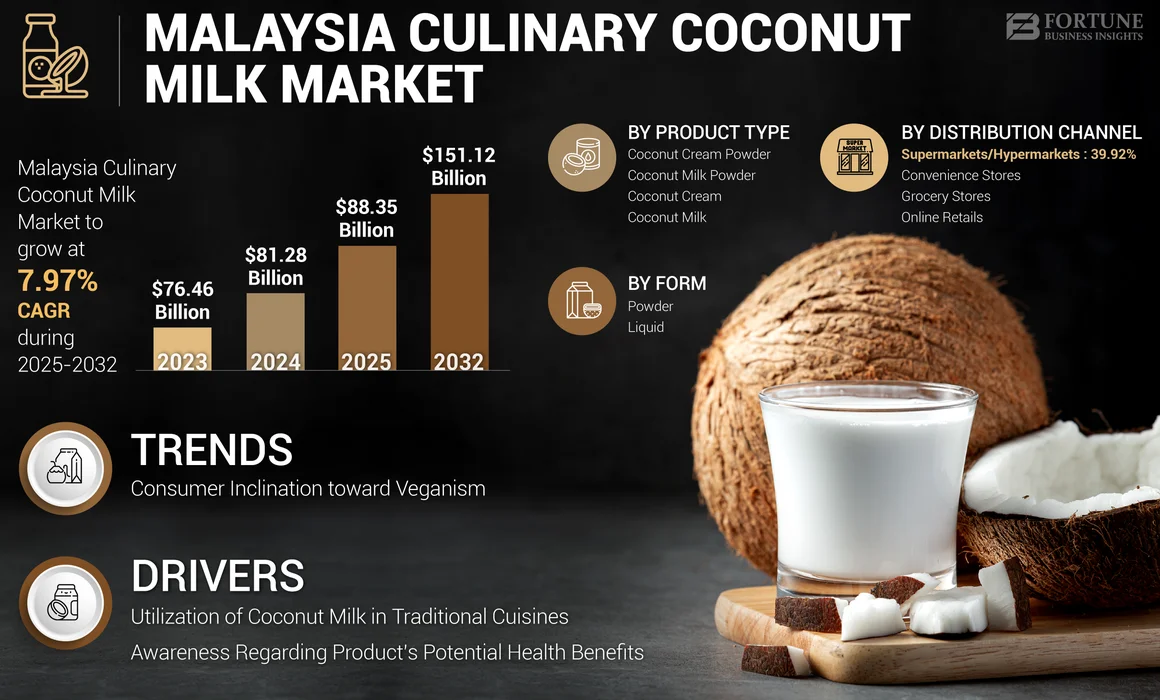
Malaysia Culinary Coconut Milk Market Key Takeaways
Market Size & Forecast:
- 2024 Market Size: USD 81.28 million
- 2025 Market Size: USD 88.35 million
- 2032 Forecast Market Size: USD 151.12 million
- CAGR: 7.97% from 2025–2032
Market Share:
- Coconut cream powder was the leading segment in 2022 due to its wide utilization in home cooking and industrial processed food companies.
- The powder segment dominates the market owing to its ease of use, longer shelf life, and cost-effective nature, making it preferred among manufacturers and individual consumers.
Key Country Highlights:
- Malaysia: Rising coconut cultivation, growing consumer inclination toward veganism, and increasing demand from the HORECA sector are key drivers of market growth.
- The country's diverse culinary culture, increasing lactose intolerance, and rapid adaptation of plant-based milk by foodservice brands like Dunkin’ contribute to strong domestic demand.
COVID-19 IMPACT
Disruptions in Logistics and Transportation amid COVID-19 Led to Market Growth
The COVID-19 pandemic had a challenging impact on the Malaysian economy and trade. The outbreak led to industries and consumers adjusting to the new normal and thriving on the change going on in the marketplace. Restrictions on public movement and the shortage of workforce were some of the major concerns as they created demand and supply gaps. However, the demand for dairy-free foods, such as ice creams, milk, and creams, surged during the later months of the outbreak in the country. Some manufacturers reported an increase in their sales revenue as demand for coconut-based products rose. For instance, S&P Industries Sdn., in its 2020 annual reports, mentions that its revenue increased by 29.8% compared to 2019.
LATEST TRENDS
Download Free sample to learn more about this report.
Proliferating Consumer Inclination toward Veganism to Aid Growth Trends
Malaysia is renowned for its consumers' desire for delicious dishes, but as the world shifts toward health consciousness trends, so do consumers' eating habits in the country. In recent years, consumers in Malaysia have increased their uptake of plant-based foods. As modern dietary trends create demand for plant-based foods, it paves opportunities for the culinary coconut milk sector to grow further in the country. The changing consumer preferences toward vegetarian and healthy diets are supported by the rising disposable income of the middle-class, enabling them to opt for plant-based alternatives such as coconut and almond milk over conventional milk. Moreover, the Malaysia culinary coconut milk market share is expected to expand in the forthcoming years in the global market.
Factors such as rising incidences of animal cruelty and food-induced allergies have augmented the transition. Along with this, the lactose-intolerant population is switching to plant-based milk. Furthermore, the growing awareness about high sustainability of vegan lifestyle motivates consumers to adopt vegan trends, anticipating to fuel the market growth of culinary coconut milk.
DRIVING FACTORS
Increasing Utilization of Coconut Milk in Traditional Cuisines to Drive Market Growth
Coconut is a highly versatile fruit with its flesh and water suitable for consumption and processing into other products. This results in abundant raw material resource availability for the manufacturers and consumers access to various coconut-based food products. Traditional Malaysian dishes represent a multi-ethnic cultural diversity from Malay, Indian, and Chinese cuisines. These dishes comprise culinary coconut milk as a prominent ingredient. Culinary coconut milk is used in cooking as a thickening and emulsifying agent due to the presence of phospholipids in the milk, which helps create stability in food.
Furthermore, low-calorie coconut milk products with high nutrients are in high demand from the HORECA sector. Coconut cream and milk powder are widely used in various recipes, owing to their mild sweet taste. The expanding quick-service restaurants in the country are also among the factors driving the Malaysia culinary coconut milk market growth.
Growing Awareness Regarding Product’s Potential Health Benefits to Augment Market Growth
Coconut and its derived products are considered a functional food that provides essential nutrients and other benefits, leading to its consumption becoming mainstream in the country. Coconuts are rich in antioxidants, fiber, and vitamins apart from imparting texture and flavor to the food products. Thus, increased awareness among consumers about its health and nutritional benefits has been reflected by the surged demand for coconut milk. As it is rich in Medium-Chain Saturated Fatty Acids (MCFAs), it helps in increasing insulin sensitivity, thereby keeping blood sugar and blood pressure levels in check.
According to the Journal of Chemical and Pharmaceutical Research of 2015, Malaysian coconut milk (Pati Satan) possesses high protein content and lower fats than other tropical countries' coconut milk. Thus, this factor is leading to increased utilization in culinary applications.
RESTRAINING FACTORS
Availability of Substitutes/Alternatives to Hinder Market Growth
The abundant availability of substitute plant-based milk, such as oat milk, rice milk, soy milk, hemp milk, and others, comprising similar nutritional and functional properties as coconut milk, is expected to restrain the market growth. Along with this, the fortification of plant-based milk such as oats and rice is relatively more prevalent than coconut milk, which has shifted consumer’s interests toward these alternatives. Moreover, culinary coconut milk contains high fat, calories, and fewer proteins than its counterparts. Also, oat milk is considered more sustainable while almond milk is rich in calcium, sodium, and potassium, making other plant-based milk a better option.
SEGMENTATION
By Product Type Analysis
Owing to Wide Applications, Cream Powder to Hold Higher Share in the Market
Based on product type, the market is segmented into coconut milk, coconut milk powder, coconut cream, and coconut cream powder.
Out of these, coconut cream powder was the leading segment in 2022 due to its wide utilization in home cooking and industrial processed food companies. In households, coconut cream powder is used in dishes that require coconut milk while food processors and manufacturers use it majorly in bakery and confectionery items and the HORECA sector. Further, certain consumers consider cream powder better for cooking purposes. Its growing demand amongst industrial customers to develop functional food and beverages will augment the segment growth.
The coconut milk and coconut milk powder segments are observing substantial traction, owing to their ease of incorporation in food preparations, unlike coconut cream powder, which has to be mixed with water to make milk. In addition, manufacturers are introducing organic variants of the milk, which may contribute to the segment’s growth.
By Form Analysis
Ease in the Utilization of Powder Form to Propel the Segment Growth
By form, the market is divided into powder and liquid.
Powder segment to hold dominant market share, owing to ease of utilization offered by powdered products, reduced storage and transportation costs, and shelf-stable attributes, which drives manufacturers and individual consumers' demand. The demand for powder form is also anticipated to increase in the coming years as it is more cost-effective and shelf-stable than standard coconut milk.
By Distribution Channel Analysis
To know how our report can help streamline your business, Speak to Analyst
Easy Accessibility in Grocery Stores Led to the Emergence of it to be the Leading Channel
Based on distribution channel, the market is segmented into supermarkets/hypermarkets, convenience stores, grocery stores, and online retailers.
Grocery stores segment is expected to account for the major share based on distribution channels. Modern grocery stores hold nearly 45% of the sales revenue and are the most preferred retail channel for purchasing essential household items. Traditional grocery stores are aggressively competing with mass merchandisers. These grocery retailers appeal to tech-savvy customers by offering online platforms and mobile applications for ease in ordering and delivery processes.
Supermarkets/hypermarkets segment is the second most popular retail channel for purchasing as the urban and semi-urban population generally prefer these outlets due to their numerous product offerings all under a roof. These supermarkets often give discounts on bulk purchasing and coupons, which draw consumers toward them. In addition, the expanding supermarket chains and networks pave new growth opportunities.
REGIONAL INSIGHTS
Malaysia being a multi-ethnic country, hosts people from around the world. With middle-class consumers comprising majority of the population, it is mainly responsible for driving the major food trends in the country. The culinary application of coconut milk has always been present in Malaysia; however, its popularity has spiked in recent years as consumers' preferences change toward plant-based products. The foodservice industry is also rapidly adapting to the gradual switch toward alternative milk to satisfy consumer demands. For instance, in April 2021, Dunkin Brands, a prominent fast-food restaurant company in Malaysia, announced its addition of coconut milk as a dairy alternative across all its restaurants for customized beverages.
The market is also driven by the rising incidences of lactose intolerance in Malaysia. This has led consumers to replace conventional milk with plant-based milk in their regular diet. Moreover, the growing understanding of consumers and their appreciation of the unique role of culinary coconut milk in maintaining a balanced lifestyle also contribute to its increase in sales. In addition, the rising consumer expenditure on household products due to their growing income and focus on nutrition and health has prompted its rising consumption.
KEY INDUSTRY PLAYERS
New Product Developments by the Players to Fuel Market Growth
The growing consumer's demand for hassle-free and convenient culinary ingredients has influenced prominent manufacturers in the country to come up with new products. The market is moderately consolidated, with a few major culinary coconut milk players constituting half of the market share. Companies, such as S&P Industries Sdn. Bhd., Santanmas Food Industries (M) Sdn Bhd, Santanku Sdn Bhd., and others, are the leaders focusing on expanding their product offerings to meet rising consumers demand for safe and organic products.
LIST OF KEY COMPANIES PROFILED:
- S&P Industries Sdn. Bhd. (Malaysia)
- Santanmas Food Industries (M) Sdn Bhd (Malaysia)
- Linaco Manufacturing (M) Sdn. Bhd. (Malaysia)
- Tropical Produce Sdn Bhd (Malaysia)
- J. Mitra Sdn Bhd. (Malaysia)
- Eramas Group (Malaysia)
- M&S Food Industries Sdn Bhd (Malaysia)
- Kara Marketing Sdn Bhd (Malaysia)
- Gogoco Holding Sdn Bhd (Malaysia)
- Denis Group Holding S.A. (Switzerland)
INDUSTRY DEVELOPMENTS:
- May 2022 – M&S Coconut, a Malaysian culinary coconut milk and cream brand, launched new coconut cream products. These products are available in different packaging sizes.
- August 2021 – Nespresso Malaysia announced its partnership with Crème De La Crème, an artisanal local ice cream parlor to launch coffee and coconut infused ice cream.
- August 2020 – Century Pacific Food signed a long-term agreement with Linaco Group to extend its presence in Malaysia and other Asian, Middle Eastern, and European Countries This partnership will increase both the companies’ production capabilities of coconut products.
- October 2019 – Ayam Brand introduced a new variant called Coconut Milk Super Light that has 75% less fat compared to raw coconut milk, uncompromising the aroma and taste of the product.
- 2019 - Universal Food Public Company Limited, a Malaysian company, launched a range of coconut milk in tetrapak packaging with twist cap. It is available in 200 ml and 1 liter packs.
REPORT COVERAGE
The Malaysia culinary coconut milk market research report provides quantitative and qualitative insights. It also offers a detailed analysis of Malaysia market share, market size, and growth rate for all possible segments in the market. Along with this, the report provides an elaborative analysis of the market dynamics and competitive landscape. Various key insights presented in the report are an overview of related markets, research methodology, recent industry developments such as mergers & acquisitions, regulatory scenario in critical countries, and key industry trends.
REPORT SCOPE & SEGMENTATION
|
ATTRIBUTE |
DETAILS |
|
Study Period |
2019-2032 |
|
Base Year |
2024 |
|
Estimated Year |
2025 |
|
Forecast Period |
2025-2032 |
|
Historical Period |
2019-2023 |
|
Growth Rate |
CAGR of 7.97% from 2025 to 2032 |
|
Unit |
Value (USD million) |
|
By Product Type |
|
|
By Form |
|
|
By Distribution Channel (B2C) |
|
Frequently Asked Questions
Fortune Business Insights says that the market was valued at USD 81.28 million in 2024.
The market is estimated to grow at a CAGR of 7.97% during the forecast period (2025-2032).
Coconut cream powder is expected to be the leading segment among product types in the market during the forecast period.
Growing utilization of coconut milk in traditional cuisines drives the market growth.
S&P Industries Sdn. Bhd., Santanmas Food Industries (M) Sdn Bhd, and Santanku Sdn Bhd. are a few of the key players in the market.
Powder form is expected to hold the highest market share.
The grocery stores segment is expected to grow the fastest during the forecast period.
The rising inclination of consumers toward veganism is an ongoing trend in the country.



- 2019-2032
- 2024
- 2019-2023
- 100
-
(Offer valid till 30th Sep 2026)
Get 30-60 hrs Free Customization
Expand Regional and Country Coverage, Segments Analysis, Company Profiles, Competitive Benchmarking, and End-user Insights.




















-
US +1 833 909 2966 ( Toll Free )
-
Get In Touch With Us