Management System Certification Market Size, Share & Industry Analysis, By Type (System Certification and Product Certification), By Service Type (Certification and Verification and Training and Business Assurance), By Certification Standard (ISO 9001, ISO 14001, ISO 45001, ISO/IEC 27001, ISO 50001, ISO 22000, ISO 22301, and Others), By Application (Urban, River, Coastal, Transportation, Utility & Critical Infrastructure, and Others), and Regional Forecast, 2026-2034
 Download Free Sample
KEY MARKET INSIGHTS
 Listen to Audio Version
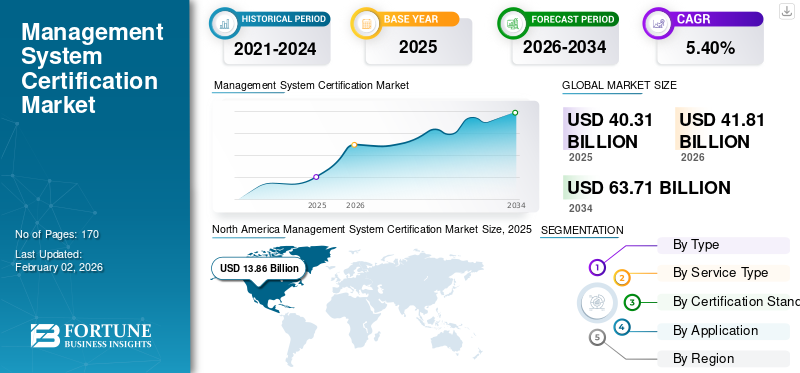
The global management system certification market size was valued at USD 40.31 billion in 2025 and is projected to grow from USD 41.81 billion in 2026 to USD 63.71 billion by 2034, exhibiting a CAGR of 5.40% during the forecast period. North America dominated the global market with a share of 34.40% in 2025.
The management system certification is a professional recognition of accordance of the management practices of an organization with the globally accepted standards, including the requirements of ISO 9001 for quality and ISO 14001 for environmental management. It shows that the organization has been dedicated in enhancing operational effectiveness, risk management, consumer satisfaction, and flexibility.
The major growth drivers in this market are the growing regulatory demands, digitalization of industries and technologies such as AI and cloud computing, growing demand for sustainability and ESG certifications, and industry-specific certification in healthcare, manufacturing, and IT. These drivers are increasing the growth of the market across the world with more emphasis on transparency, compliance, and operational excellence.
The leading firms in the industry are Applus+, BSI Group, Bureau Veritas SA, DEKRA SE, DNV AS, and Eurofins Scientific.
Download Free sample to learn more about this report.
Management System Certification Market Key Takeaways
 Global Market Size & Forecast
- 2025 Market Size: USD 40.31 billion
- 2026 Market Size: USD 41.81 billion
- 2034 Forecast Market Size: USD 63.71 billion
- CAGR: 5.40% (2026–2034)
 Market Share
- North America dominated the market with a 34.40% share in 2025.
- The system certification segment is projected to lead the market with a 13.39% share in 2026.
- The ISO 9001 segment is expected to dominate the market, accounting for 7.15% of the global market in 2026.
 Key Regional Highlights
Asia Pacific
Asia Pacific held USD 9.35 billion in 2025 and is projected to reach USD 9.58 billion in 2026.
North America
North America generated USD 13.86 billion in 2025 and is projected to reach USD 14.53 billion in 2026.
Europe
Europe accounted for USD 12.29 billion in 2025 and is expected to grow to USD 12.76 billion in 2026.
U.S.
U.S. market is projected to reach USD 11.23 billion by 2026.
Japan
Japan market is projected to witness steady growth during the forecast period.
Read More

MARKET DYNAMICS
Market Drivers
Regulatory and Customer Compliance Demands Rise Drives Market Growth
The increase in the number of regulatory checks and the changing customer demands are key drivers of the growth of the management system certification industry. Companies in every field are seeking accredited third-party certifications to ensure compliance with the complicated legal systems, international standards, and purchasing criteria. Such certifications assist the companies to build trust, improve transparency, and demonstrate credibility in terms of governance, quality and risk management practices. Also, another factor that boosts adoption is the fact that customers and business partners prefer to collaborate with certified parties. With the increasing strictness of compliance norms in the global context, the need to employ certification services acquires additional strength, and compliance assurance becomes one of the key factors of market competitiveness and development.
Market Restraints
Fragmented Standards and Auditor Shortages Hinder Growth
The management system certification market is characterized by significant limitations due to the lack of unified regional standards and the increasing number of specialized certifications. This results in confusion as well as differences in compliance requirements across the areas, posing a challenge to global operations by organizations. In addition, the number of certified and accredited auditors is also low, which makes it take a longer period to be approved. These are obstacles to scaling certification programs, and smaller firms will not seek accreditation. As a result, the companies are faced with increased operational costs and a slower pace in attaining internationally accredited certifications for their management systems.
Market Opportunities
Demand for Cybersecurity and Sustainability Certifications to Generate Growth Opportunities
The rapid shift to a digital world, along with an increase in regulation, is fueling the demand for data security, sustainability, and ESG-based certification. Organizations are seeking trusted assurance partners to ensure compliance, assess and respond to risk, and to increase supply chain accountability. This creates significantly new avenues for growth and diversification for certification bodies to diversify portfolios, develop integrated solutions, and embed service offerings such as audits, training, and digital compliance tools. There will always be opportunities for certification bodies to expand into new, more complex areas such as carbon footprint verification, data privacy management, and greater supply chain resilience in pursuit of the social goals of sustainability and governance within complex industry systems.
MANAGEMENT SYSTEM CERTIFICATION MARKET TRENDS
Digitalization and Integrated Management Systems Emerges as a Major Trend
The market for management system certification is experiencing a significant transition to digitalization and the integration of various management systems. Organizations are increasingly utilizing automated audit workflows, digital documentation, and cloud-based verification systems for greater accuracy, transparency, and efficiency. Process automation allows for increased real-time compliance monitoring, reduces human error, and a way to minimize audit cycles. Organizations are also implementing integrated management systems that bring together various quality, environment and safety standards into a single management framework, supporting business in optimizing resources, in addition to maintaining ongoing compliance. The increasing reliance on digital tools will create changes in the certification landscape and ultimately create more agile compliance structure, too.
Download Free sample to learn more about this report.
SEGMENTATION ANALYSIS
By Type
High Preference for Consistency and Easier Regulatory Acceptance Boosts System Certification Segment Growth
Based on the type, the market is segmented into system certification and product certification.
The system certification segment held the largest revenue share of USD 22.71 billion in the overall global market in the year 2024. The System Certification segment is anticipated to hold a dominant market share of 13.39% in 2026. The segment’s growth is attributable to organizations’ preference for end-to-end certification that validates integrated management systems across operations. Large enterprises and regulated industries favor system-level accreditation for consistency, supplier confidence, and easier regulatory acceptance.
Product certification segment has the maximum CAGR of 5.5% in the global industry. The segment is growing because market and regulators are paying more attention to product safety, performance, and compliance in different various sectors. Growing consumer awareness and stricter import-export rules are motivating manufacturers to get systems and certain products certified.
To know how our report can help streamline your business, Speak to Analyst
By Service Type
Certification & Verification Segment Dominates Market Owing to Its Vital Role for Supply-Chain Transparency
Based on service type, the market is divided into certification & verification and training & business assurance.
In 2026, the certification & verification segment is projected to lead the market with a 15.28% share. It earns the most revenue because it ensures that products and processes meet accepted standards helping companies gain the primary market access and build trust. Third-party verification plays a key role in keeping supply chains transparent, assuring investors, and meeting procurement rules.
Training & business assurance has the maximum CAGR of 5.8%. The segment’s growth is attributable to organizations’ investment in capability-building for implementing standards effectively and sustaining continuous improvement. Vendors who offer bundle training, skill gap checks can earn more steady income and build stronger client connections.
By Certification Standard
Broad Applicability Across Industries Augments the ISO 9001 Segment Growth
Based on the certification standard, the market is divided into ISO 9001, ISO 14001, ISO 45001, ISO/IEC 27001, ISO 50001, ISO 22000, ISO 22301, and others.
The ISO 9001 segment is projected to dominate the market with a share of 7.15% in 2026. The segment’s growth is attributable to its broad applicability across industries and long-standing role as the baseline quality management standard for global trade and operations. Its widespread adoption by manufacturers and service providers cements demand for audits, recertifications, and consultancy around quality systems.
ISO/IEC 27001 represent the largest CAGR at 6.5% in the global market. The segment’s growth is attributable to rising cyber threats and strict data protection laws that push organizations to adopt formal information security management systems. Demand is particularly strong among tech, financial, and service firms that handle sensitive customer or intellectual-property data.
By Application
Reliance On Standardized Processes Augments the Manufacturing Segment Growth
Based on the application, the market is divided into urban, river, coastal, transportation, utility & critical infrastructure, and others.
The manufacturing segment is expected to lead the market, contributing 7.13% globally in 2026. The segment’s growth is attributable to its reliance on standardized processes, regulatory compliance, and global supply-chain requirements that favor certified partners. Large-scale manufacturers invest heavily in multiple certifications to secure contracts and market access.
ICT represent the largest CAGR at 6.3% in the global market. The segment’s growth is attributable to increasing digital transformation initiatives, expanding cloud service adoption, and growing cybersecurity needs that encourage certification uptake. Software, managed-service providers, and telecom firms increasingly pursue standards to demonstrate reliability, security, and service continuity.
MANAGEMENT SYSTEM CERTIFICATION MARKET REGIONAL OUTLOOK
Geographically the market is segmented into North America, Europe, Asia Pacific, South America and Middle East & Africa.
North America
North America Management System Certification Market Size, 2025 (USD Billion)
To get more information on the regional analysis of this market, Download Free sample
North America is currently leading the global industry. The North America market was valued at USD 13.86 billion in 2025, capturing 34.40% of global revenue, and is estimated to reach USD 14.53 billion in 2026. The region’s growth is attributable to mature regulatory frameworks, high corporate governance standards, and large-scale adoption of third-party certification across industries. Corporate demand for risk mitigation, ESG reporting, and supply-chain assurance keeps service providers busy with audits and advisory work.
The U.S. is at the forefront of the North American market, with expected revenue of USD 11.23 billion in 2026. This growth is attributable to increasing regulatory compliance requirements, a strong emphasis on quality assurance, and the expansion of key industries such as IT, healthcare, and manufacturing.
Europe
In 2025, Europe held 30.50% of the global market, reaching a valuation of USD 12.29 billion, and is projected to grow to USD 12.76 billion in 2026. The region’s is attributable to strict regulations, a strong focus on sustainability, and increasing consumer awareness of product quality and corporate accountability. The U.K., Germany, and Italy are some of the leading contributors to the growth in the market, with the required revenue stake of USD 2.19 billion, USD 2.88 billion in 2026 and USD 1.57 billion respectively by 2025.
Asia Pacific
The market in Asia Pacific reached USD 9.35 billion in 2025, representing 23.20% of total market revenue, and is projected to reach USD 9.58 billion in 2026. The region’s market size is expected to be valued at USD 9.35 billion in 2025. The growth is attributable to industrialization, export-oriented manufacturing, and rising regulatory alignment with global standards. Emerging economies are investing in certification to access global markets, improve competitiveness, and meet multinational customers’ requirements.
India and China are major contributors to the management system certification market growth with an expected revenue share of USD 1.93 billion, and USD 3.88 billion respectively by 2026.
South America and Middle East & Africa
In 2025, the Middle East & Africa market stood at USD 2.14 billion, representing 5.30% of global demand, and is projected to grow to USD 2.18 billion in 2026.
South America recorded a market size of USD 2.68 billion in 2025, capturing 6.60% of the global market share, and is projected to reach USD 2.76 billion in 2026.
The growth of these regions is attributable to increasing regulatory standards, a focus on quality assurance, and digital innovation. GCC countries are predicted to have a market share of USD 1.10 billion by 2025.
COMPETITIVE LANDSCAPE
Key Industry Players
Leading Companies Focus On Partnerships and Acquisitions to Lead the Industry
The leading companies in the industry include Applus+, BSI Group, Bureau Veritas SA, DEKRA SE, DNV AS, and Eurofins Scientific. These companies focus on strategic growth through acquisitions, partnerships, and geographic expansion. These companies are also expanding their service offerings to include new areas such as ESG (Environmental, Social, and Governance) and technology-driven certifications to keep up with growing demand for regulatory compliance and risk management across industries including manufacturing, healthcare, and IT.
LIST OF KEY MANAGEMENT SYSTEM CERTIFICATION COMPANIES PROFILED
- Applus+ (Spain)
- BSI Group (U.K.)
- Bureau Veritas SA (France)
- DEKRA SE (Germany)
- DNV AS (Norway)
- Eurofins Scientific (Luxembourg)
- Intertek Group plc (U.K.)
- Kiwa Group (Netherlands)
- Lloyd’s Register Group Limited (U.K.)
- Perry Johnson Registrars, Inc. (U.S.)
- Rina S.p.A. (Italy)
- SGS SA (Switzerland)
- TÜV Rheinland AG (Germany)
- TÜV SÜD AG (Germany)
- UL LLC (U.S.)
KEY INDUSTRY DEVELOPMENTS
- September 2025- BSI released seven international standards designed to modernize and harmonize Prerequisite Programmes (PRPs) under ISO 22000, the international benchmark for food safety management systems. The update includes two newly published ISO standards and five fully revised standards, marking the most comprehensive revision of the ISO 22002 series to date.
- May 2025- SGS, the world's leading testing, inspection, and certification company, gained ISO 17025 accreditation to offer extractables and leachables (E&L) testing through its Mississauga laboratory.
- January 2025- Eurofins Healthcare Assurance started a new Good Manufacturing Practice (GMP) certification program for dietary and food supplements. The program is designed to improve compliance, safety, and quality in supply chains.
- February 2024- TÜV Rheinland Group, a global independent testing, inspection, and certification organization, partnered with U.S.-based global authority on color, Pantone, to provide color performance for real-world applications.
- January 2024: A first-in-kind AI management system designed to enable the safe, secure and responsible use of Artificial Intelligence (AI) across society has been launched by BSI, following research showing 61% wanted global guidelines for the technology. The international standard (BS ISO/IEC 42001) is intended to assist organizations in responsibly using AI, addressing considerations such as non-transparent automatic decision-making, the utilization of machine learning instead of human-coded logic for system design, and continuous learning.
REPORT COVERAGE
The global report provides a detailed analysis of the market and focuses on key aspects such as prominent companies, deployment modes, types, and end users of the product. Besides this, it offers insights into the management system certification market trends and highlights key industry developments and market share analysis for key companies. In addition to the aforementioned factors, the report encompasses several factors that have contributed to the growth of the market over recent years.
Request for Customization to gain extensive market insights.
Report Scope & Segmentation
|
ATTRIBUTE |
DETAILS |
|
Study Period |
2021-2034 |
|
Base Year |
2025 |
|
Estimated Year |
2026 |
|
Forecast Period |
2026-2034 |
|
Growth Rate |
CAGR of 5.40% from 2026-2034 |
|
Historical Period |
2021-2024 |
|
Unit |
Value (USD Billion) |
|
Segmentation |
By Type, Service Type, Certification Standard, Application , and Region |
|
By Type |
· System Certification · Product Certification |
|
By Service Type |
· Certification and Verification · Training and Business Assurance |
|
By Certification Standard |
· ISO 9001 · ISO 14001 · ISO 45001 · ISO/IEC 27001 · ISO 50001 · ISO 22000 · ISO 22301 · Others |
|
By Application |
· Urban · River · Coastal · Transportation · Utility & Critical Infrastructure · Others |
|
By Region |
· North America (By Type, Service Type, Certification Standard, Application and Country/Sub-region) o U.S. (By Type) o Canada (By Type) o Mexico (By Type) · Europe (By Type, Service Type, Certification Standard, Application and Country/Sub-region) o U.K. (By Type) o Germany (By Type) o France (By Type) o Italy (By Type) o Rest of Europe · Asia Pacific (By Type, Service Type, Certification Standard, Application and Country/Sub-region) o China (By Type) o Japan (By Type) o India (By Type) o South Korea (By Type) o Rest of Asia Pacific · South America (By Type, Service Type, Certification Standard, Application and Country/Sub-region) o Argentina (By Type) o Brazil (By Type) o Rest of South America · Middle East & Africa (By Type, Service Type, Certification Standard, Application and Country/Sub-region) o GCC (By Type) o South Africa (By Type) o Rest of the Middle East & Africa |
Frequently Asked Questions
Fortune Business Insights says that the global market stood at USD 41.81 billion in 2026 and is projected to reach USD 63.71 billion by 2034.
The market is expected to exhibit steady growth at a CAGR of 5.40% during the forecast period.
Regulatory and customer compliance demands is speeding up the market growth.
Applus+, BSI Group, Bureau Veritas SA, DEKRA SE, DNV AS, and Eurofins Scientific are some of the top players in the market.
North America dominated the global market with a share of 34.40% in 2025.
North America was valued at USD 13.86 billion in 2025.



- 2021-2034
- 2025
- 2021-2024
- 170
Get 30-60 hrs Free Customization
Expand Regional and Country Coverage, Segments Analysis, Company Profiles, Competitive Benchmarking, and End-user Insights.











-
US +1 833 909 2966 ( Toll Free )
-
Get In Touch With Us