Maritime Satellite Communication Market Size, Share, Russi-Ukraine War & Industry Analysis, By Type (Very Small Aperture Terminal (VSAT) (Broadband), Mobile Satellite Service (MSS), and Hybrid/Multi-band Packages), By Component (Hardware, Software, and Service), By Service (Connectivity Services, Tracking & Monitoring/IoT, Safety & Regulatory Services, and Value-Added & Managed Services), By Application (Fleet Operations & Ship Management, Navigation, Safety & Regulatory, Crew Welfare & Infotainment, & Others, By End User, and Regional Forecast, 2026-2034
 Download Free Sample
Maritime Satellite Communication Market Size and Future Outlook
 Listen to Audio Version
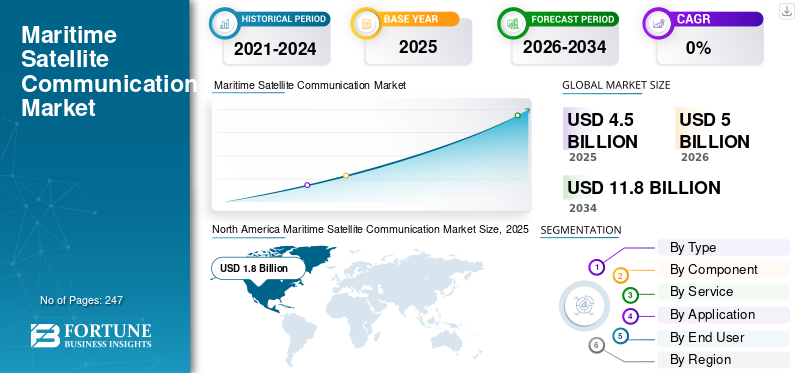
The global maritime satellite communication market size was valued at USD 4.5 billion in 2025 and is projected to grow from USD 5.0 billion in 2026 to USD 11.8 billion by 2034, exhibiting a CAGR of 11.42% during the forecast period. North America dominated the global maritime satellite communication market with a market share of 40% in 2025.
Maritime satellite communication offers voice, data, and video links amongst ships, offshore assets, and shore using GEO, MEO, and LEO satellites. It covers connectivity services, safety and GMDSS links, tracking/IoT, and value-added services such as cyber security, crew welfare Wi-Fi, and remote maintenance. Systems are used on merchant ships, cruise vessels, fishing fleets, offshore rigs, and naval/coast-guard platforms for navigation, operations, compliance, and welfare.
Key players include Inmarsat/Viasat, Iridium, SES, Intelsat, Starlink, OneWeb, KVH, Marlink, and Speedcast, focusing on multi-orbit networks, higher throughput, bundled digital services, and managed connectivity to support fleet digitalization and resilient global coverage.
Download Free sample to learn more about this report.
Maritime Satellite Communication Market Key Takeaways
 Market Size & Forecast
- 2025 Market Size: USD 4.5 Billion
- 2026 Market Size: USD 5.0 Billion
- 2034 Forecast Market Size: USD 11.8 Billion
- CAGR: 11.42% from 2026–2034
 Market Share
- North America dominated the global maritime satellite communication market with a market share of 40% in 2025.
- The hybrid/multi-band packages segment is projected to register the fastest growth, with a CAGR of 11.64% during the forecast period.
- The software segment is expected to witness the highest growth rate, expanding at a CAGR of 11.87% through 2034.
 Key Regional Highlights
North America
North America held the dominant maritime satellite communication market share in 2024 valuing at USD 1.6 Billion and also took the leading share in 2025 with USD 1.8 Billion.
Asia Pacific
Asia Pacific is projected to be the fastest-growing region, registering a CAGR of 12.16% during the forecast period, driven by expanding seaborne trade and maritime digitalization.
Europe
Europe is anticipated to witness notable market growth in the coming years, and the market is estimated to reach USD 1.0 Billion in 2026 & increasing focus on crew welfare and connectivity solutions.
U.S.
In the U.S., demand is driven by the development of IoT devices, the military's requirement for secure communication, and the necessity for high-speed internet. In 2026, the U.S. market is estimated to reach USD 1.2 Billion.
Japan
The market is benefiting from ongoing investments in maritime communication infrastructure and Backed by these factors, Japan is anticipated to record a valuation of USD 0.2 Billion in 2026.
Read More

MARKET DYNAMICS
MARKET DRIVERS
Rise in Adoption of Very Small Aperture Terminal (VSAT) is a Market Driver
One of the main factors propelling the maritime satellite communication industry is the increasing use of Very Small Aperture Terminal (VSAT) technology. For vessels, VSAT provides high speed internet connectivity that supports IoT-based monitoring systems, video conferencing, and enables real time data transmission. The increased capacity for communication improves personnel welfare, safety, and operational effectiveness. Furthermore, due to their dependability and global coverage, VSAT solutions are becoming more and more popular as marine businesses update their fleets. The technology's function in enhancing navigation, remote repair, and shipping logistics management is further strengthened by its capacity to optimize bandwidth utilization and interact with cloud-based platforms.
MARKET RESTRAINTS
Cybersecurity Threats is Anticipated to Impact Market Growth
The market for maritime satellite communication is severely restricted by cybersecurity risks. Phishing, ransomware, spyware, and distributed denial-of-service (DDoS) assaults are among the increasingly complex cyberattacks that target satellite communication networks, posing a threat to vital shipboard communication and data breaches. These flaws expose data integrity and operational safety, requiring expensive expenditures in cutting-edge cybersecurity solutions. Some maritime operators are discouraged from modernizing maritime communications infrastructure due to the difficulty and expensive cost of putting strong protection mechanisms in place, which restricts the wider adoption of technology. As a result, ongoing cyber threats pose serious obstacles to market expansion by raising operational risks and regulatory
MARKET OPPORTUNITIES
Growing Focus on Digitalization and Autonomous Vessels Present Market Opportunities
The market for maritime satellite communication presents considerable prospects due to the rise of autonomous vessels and the quickening pace of digitalization. The need for fast, dependable connectivity at sea is growing due to the increased reliance on real-time data for navigation, cargo tracking, and predictive maintenance. Furthermore, increased coverage and better communication quality are made possible by the combination of 5G technology with sophisticated satellite systems, such as multi frequency (Ka Band, Ku Band) antennas and gyro-stabilized terminals. Service providers can take advantage of the need for scalable, data-driven communication solutions as international maritime trade grows and regulatory attention to environmental monitoring and safety increases, driving long-term market growth.
MARITIME SATELLITE COMMUNICATION MARKET TRENDS
Growing Use of High-Throughput Satellites (HTS) is a Latest Market Trend
The increasing use of High-Throughput Satellites (HTS) is a major technological development in the maritime satellite communication sector. By focusing signals on specific regions utilizing spot beam technology, HTS technology improves spectral efficiency and provides significantly more bandwidth. Owing to this, even in remote oceanic areas, maritime operators may access more data-intensive services such as cloud computing, improved navigation, and video streaming. Additionally, HTS provides affordable internet services with reduced latency, which is essential for operational optimization and real-time decision-making on board ships. The transition to next-generation maritime connectivity solutions is being accelerated by this trend.
MARKET CHALLENGES
Regulatory and Compliance Framework is a Market Challenge
The maritime satellite communication market growth is hindered by major regulatory and compliance issues. For satellite service providers, particularly those operating in international waters, a complex environment is created by many and changing national legislation. Issues with spectrum allocation and cross-border compliance make operations more challenging and cause service launch delays. Continuous system and process upgrades are also necessary due to differing standards for data privacy, security, and environmental effect. For market participants seeking to preserve global connectivity and seamless communication while adhering to numerous regulatory frameworks, these regulatory obstacles provide a significant barrier since they complicate the integration of new technology and raise costs.
Impact of Russia-Ukraine War
The Russia-Ukraine war has significantly impacted the maritime satellite communications market, highlighting the critical role of satellite connectivity in modern warfare. The conflict emphasized liabilities in traditional naval communications and accelerated demand for resilient, secure satellite communication systems to support unmanned drones, real-time monitoring, and command and control functions. Disruptions in Black Sea maritime routes caused supply chain challenges and increased interest in alternative communication and navigation technologies.
Download Free sample to learn more about this report.
Segmentation Analysis
By Type
Rise in Digitalization Is Powering Very Small Aperture Terminal (VSAT) (Broadband) Segment Growth
On the basis of type, the market is classified into Very Small Aperture Terminal (VSAT) (Broadband), Mobile Satellite Services (MSS), and hybrid/multi-band packages.
The Very Small Aperture Terminal (VSAT) (Broadband) segment accounted for the significant market share in 2025. Rising data demands from route optimization, real time performance monitoring, crew welfare, and cloud-based applications at sea are driving the VSAT segment's rise.
Hybrid/multi-band Packages segment is expected to grow at a highest CAGR of 11.64% over the forecast period.
By Component
Increasing Demand for Reliable and Advanced Hardware Component Drive Sustained Growth In Hardware Segment
In terms of component, the market is categorized into hardware, software, and service.
The hardware segment captured the largest share of the market in 2025. The growing need for dependable and sophisticated antennas, modems, and stabilization systems all necessary for continuous marine communication is driving the hardware market's rapid expansion.
The software segment is expected to grow at a highest CAGR of 11.87% over the forecast period.
To know how our report can help streamline your business, Speak to Analyst
By Service
Rising Bandwidth Consumption is Anticipated to Boost Connectivity Services Segment Growth
Based on service, the market is segmented into connectivity services, tracking & monitoring/IoT, safety & regulatory services, and value-added & managed services.
The connectivity services segment held the dominating position in 2025. The segmental growth is due to the vital requirement for dependable, fast, and continuous global communication to support operational efficiency, safety, regulatory compliance, and crew welfare.
The segment of tracking & monitoring/IoT is set to flourish and is growing at a highest CAGR of 12.18% growth across the forecast period.
By Application
Operational Optimization and Compliance Fuel Fleet Operations & Ship Management Demand
Based on application, the market is segmented into fleet operations & ship management, navigation, safety & regulatory, crew welfare & infotainment, remote maintenance & diagnostics, offshore operations & field support, defense & naval C4ISR at sea, and fishing & small vessel operations.
The fleet operations & ship management segment held the dominating position in 2025. The growth in this application segment is owing to tighter emissions, reporting, and safety requirements that depend on real-time data flows between ship and shore.
The segment of remote maintenance & diagnostics will witness a highest growth rate of 12.24% growth across the forecast period.
By End User
Trade Growth and Fleet Modernization Drive Merchant/Commercial Shipping Segment Growth
Based on end user, the market is segmented into merchant/commercial shipping, passenger & leisure, offshore energy, fishing fleets, government & defense, and others.
The merchant/commercial shipping segment held the dominating position in 2025. The growth in the merchant segment is driven by expanding global trade, larger and more digital fleets, and the need to control OPEX through data-led decisions.
The segment of defense & government will witness a highest growth rate of 12.10% growth across the forecast period.
Maritime Satellite Communication Market Regional Outlook
By region, the market is categorized into Europe, North America, Asia Pacific, and Rest of the World.
North America Maritime Satellite Communication Market Size, 2025 (USD Billion)
To get more information on the regional analysis of this market, Download Free sample
North America
North America held the dominant maritime satellite communication market share in 2024 valuing at USD 1.6 Billion and also took the leading share in 2025 with USD 1.8 Billion. The market for maritime satellite communication in North America is expanding significantly due to a number of factors, including increased maritime traffic, rising demand for high-speed connectivity, sophisticated naval operations, and the quick uptake of new technologies such as high-throughput satellites (HTS) and LEO. In the U.S., the demand is driven by the development of IoT devices, the military's requirement for secure communication, and the necessity for high-speed internet. In 2026, the U.S. market is estimated to reach USD 1.2 Billion.
Europe and Asia Pacific
Europe and Asia Pacific are anticipated to witness a notable market growth in the coming years. During the forecast period, Asia Pacific Maritime Satellite Communications market is projected to record 12.16% CAGR during the forecast period, which is the highest amongst all the regions. Asia Pacific region is the fastest-growing during the study period. Increasing seaborne trade, a stronger emphasis on maritime security and safety, digital transformation, and the creation of new technologies such as high speed satellite broadband and low-Earth orbit (LEO) constellations are the main drivers of this expansion. Backed by these factors, countries including China anticipate to record the valuation of USD 0.4 Billion, Japan to record USD 0.2 Billion, and India to record USD 0.4 Billion in 2026. After Asia Pacific, the market in Europe is estimated to reach USD 1.0 Billion in 2026. The significant shipping sector in the area, the need for improved worker welfare drive the market in Europe. In the region, U.K. and Germany both are estimated to reach USD 0.3 Billion and 0.3 Billion each in 2026.
Rest of the World
Over the forecast period, the rest of the world segment including the Middle East & Africa and Latin America regions would witness a moderate growth in this marketspace. The Middle East & Africa market in 2026 is set to record USD 0.4 Billion as its valuation. Latin America is set to attain the value of USD 0.3 Billion 2026.
COMPETITIVE LANDSCAPE
Key Market Players
Rise in Mergers and Acquisitions, Product Development Define Market Landscape
The market is led by key players such as Inmarsat Global Limited, Iridium Communications Inc., Leonardo S.p.A., Thuraya Telecommunications Company, and ViaSat Inc., who drive innovation in broadband and narrowband services. The recent merger of SES S.A. with Intelsat has created a multi-orbit satellite operator, enhancing global coverage and bandwidth capabilities. SpaceX’s Starlink introduces high-speed connectivity options, cost efficiency compelling traditional providers to adopt multi orbit and hybrid solutions. Furthermore, market leaders focus on cybersecurity, managed services, and expanding regional presence, notably in Asia Pacific, to capitalize on growing maritime trade and autonomous vessel applications.
LIST OF KEY MARITIME SATELLITE COMMUNICATIONS COMPANIES PROFILED:
- Inmarsat (U.K.)
- Marlink (France)
- Speedcast (U.S.)
- KVH Industries (U.S.)
- SES (Luxembourg)
- Intelsat (Luxembourg)
- Viasat (U.S.)
- Iridium Communications (U.S.)
- SpaceX (U.S.)
- OneWeb (U.K.)
KEY INDUSTRY DEVELOPMENTS:
- April 2025: Intelsat was awarded a contract by the U.S. Space Force to supply the U.S. Defense Department (DoD) with commercial satellite communications capacity, equipment, and services for worldwide maritime coverage.
- April 2025: A new multi-year connectivity service agreement between SES and De Boer Marine, a provider of marine connectivity solutions, will allow ship operators to enhance their digital capabilities and vessel operations.
- February 2025: Maersk and Inmarsat Maritime, a Viasat company, agreed to improve Inmarsat satellite communications capabilities throughout Maersk's fleet of about 340 container ships worldwide.
- February 2025: Marlink will modernize the Alpha Adriatic fleet's hybrid network with state-of-the-art cyber security measures. The solution offers Alpha Adriatic included high bandwidth and low latency communications over Sealink NextGen to facilitate fleet operations and improved cyber security to reflect stricter regulations for vessel operators.
- February 2024: P&O Maritime Logistics has awarded Speedcast, a multi-year contract to oversee communications on 59 support vessels that operate in 12 countries and on three continents.
REPORT COVERAGE
The global market analysis provides an in-depth study of market size & forecast by all the market segments included in the report. It includes details on the market dynamics and market trends expected to drive the market in the forecast period. It offers information on the technological advancements, new product launches, key maritime satellite communication industry developments, and details on partnerships, mergers & acquisitions. The market research report also encompasses detailed competitive landscape with information on the market share and profiles of key operating players.
Request for Customization to gain extensive market insights.
Report Scope & Segmentation
| ATTRIBUTE | DETAILS |
| Study Period | 2021-2034 |
| Base Year | 2025 |
| Forecast Period | 2026-2034 |
| Historical Period | 2021-2024 |
| Growth Rate | CAGR of 11.42% from 2026-2034 |
| Unit | Value (USD Billion) |
| Segmentation | By Type, Component, Service, Application, End User, and Region |
| By Type |
|
| By Component |
|
| By Service |
|
| By Application |
|
| By End User |
|
| By Region |
|
Frequently Asked Questions
Fortune Business Insights says that the global market value stood at USD 4.5 Billion in 2025 and is projected to reach USD 11.8 Billion by 2034.
In 2024, the market value stood at USD 1.8 Billion.
The market is expected to exhibit a CAGR of 11.42% during the forecast period.
The Very Small Aperture Terminal (VSAT) (Broadband) segment dominated the market by type.
The rise in the adoption of Very Small Aperture Terminal (VSAT) is the key factor driving the demand for the market.
Inmarsat (U.K.), Marlink (France), SES (Luxembourg), Intelsat (Luxembourg), and Space X (U.S.) are some of the major players in the market.
North America dominated the market share in 2025.



- 2021-2034
- 2025
- 2021-2024
- 247
Get 30-60 hrs Free Customization
Expand Regional and Country Coverage, Segments Analysis, Company Profiles, Competitive Benchmarking, and End-user Insights.




















-
US +1 833 909 2966 ( Toll Free )
-
Get In Touch With Us