Vehicle-to-Grid (V2G) Market Size, Share & Industry Analysis, By Service (Time Shifting, Frequency Response & Reserve, Distribution Services, Emergency Backup, and Arbitrage), By Application (Commercial, Individual, and Both), By Charger (DC, AC, and Both), and Regional Forecast, 2026–2034
 Download Free Sample
 Vehicle-to-Grid (V2G) Market Size and Future Outlook
 Listen to Audio Version
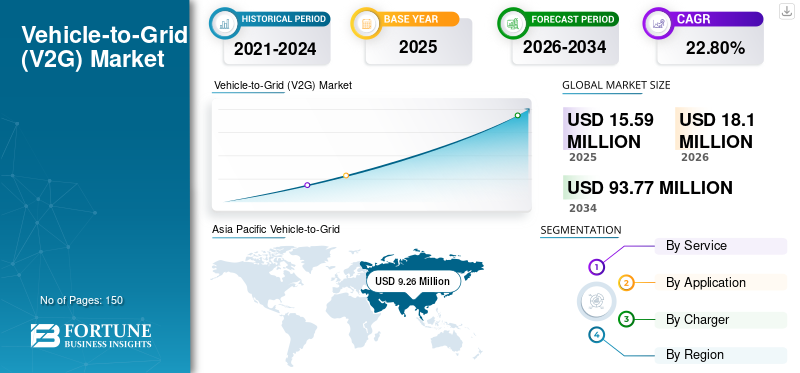
The global vehicle-to-grid (V2G) market size was valued at USD 15.59 million in 2025. The market is projected to grow from USD 18.10 million in 2026 to USD 93.77 million by 2034, exhibiting a CAGR of 22.80% during the forecast period. The Vehicle-to-Grid Market in the U.S. is projected to grow significantly, reaching an estimated value of USD 12.11 Million by 2032
Vehicle-to-Grid (V2G) technology enables an electric vehicle to supply stored energy back to the grid. By implementing this technology, batteries in electric vehicles can serve as a means of power storage and supply power whenever required. This technology utilizes bidirectional charging stations to supply and extract electricity to and from electric vehicles based on necessity. The stored energy can be used to power residential, commercial, and industrial buildings.
In vehicle-to-grid (V2G) technology, the charging stations must be equipped with software capable of communicating with the central power grid to understand the supply-demand balance and provide power at any given time. It can make power distribution more efficient by easing the strain on the system. Expanded storage capacities within the V2G system can pave the way for storing energy generated from renewable energy sources. Moreover, this technology will aid in cost stability by balancing supply and demand dynamics.
Leading players are accelerating V2G adoption through pilot projects, strategic alliances, and grid-integration trials. Automakers such as Nissan and Hyundai are embedding bidirectional charging in EV portfolios, while utilities such as EDF and Enel are testing large-scale deployment models. Charging infrastructure providers, including Nuvve and Virta, are driving commercialization by refining software platforms and enabling real-time grid communication.
Download Free sample to learn more about this report.
MARKET DYNAMICS
MARKET DRIVERS:
Rise in Adoptions of Electric Vehicles Drive the Market Growth.
The rapid acceleration in the adoption of electric vehicles, including plug-in hybrid electric vehicles (PHEVs) and fuel cell electric vehicles (FCEVs) is significantly transforming the landscape of electric mobility, impacting the requirement for electricity network capacity and smart grid technology. With EVs being one of the most recognized green transportation noticed by society and the government, the sale of electric vehicles is expected to boom during the forecast period. This, in turn, will drive the demand for grid V2G technology to maintain the grid capacity and prevent power shortages.
· In 2024, China accounted for nearly 60% of global new electric vehicle (EV) registrations, with around 12.87 million new energy vehicles (NEVs) sold, marking a 35.5% increase from 2023. This also meant that over 40% of China’s total domestic car sales were electric, reflecting a continued surge in EV adoption.
MARKET RESTRAINTS:
Limited V2G-Compatible Vehicles and Non-Standardized Chargers May Restrict Market Growth
The vehicle-to-grid (V2G) market growth is significantly restrained by the absence of universal standards for EV chargers and bidirectional charging protocols. Fragmented infrastructure limits interoperability across regions, creating barriers to mass adoption. Additionally, the limited number of V2G-compatible vehicles available today narrows the consumer base, reducing scalability and slowing integration into mainstream energy and transportation ecosystems. Standardization and broader OEM adoption remain critical to overcoming these challenges.
- In January 2022, Honda supplied 50 V2G-enabled electric vehicles for a trial aimed at developing V2G technology. This initiative will create a demand for the technology and drive market growth during the forecast period.
MARKET OPPORTUNITIES:
Efficient Power Distribution and Expanded Storage Capacity to Propel Market Growth
The V2G market presents strong opportunities as efficient power distribution enables utilities to manage peak demand and reduce grid congestion. Expanded storage capacity through EV batteries enhances renewable energy integration, ensuring reliable supply and minimizing wastage. These advantages translate into cost optimization for both consumers and providers while supporting sustainability goals, positioning V2G as a pivotal enabler in the transition toward smarter, cleaner, and more resilient energy ecosystems.
- In June 2025, MyWheels’ announced the integration of 500 bidirectional Renault EVs, which demonstrates how fleets can act as distributed storage assets by using idle battery capacity to smooth out peaks in electricity demand. This reinforces efficient power distribution, enhances renewable grid resiliency, and offers potential revenue streams for both fleet operators and local utilities.
Vehicle-to-Grid (V2G) MARKET TRENDS:
Integration with Renewable Energy and Grid Services to Bolster Market Growth
There is a growing trend of coupling V2G systems with renewable energy sources and grid service functions. Electric vehicles are increasingly serving as energy buffers; storing surplus solar or wind power during periods of low demand, and feeding it back at peak times. This enhances grid flexibility, supports decarbonization goals, and opens new revenue models via ancillary services and demand response.
- In April 2025, China launched pilot projects in nine major cities (Beijing, Shanghai, Shenzhen, etc.) to integrate EVs with V2G tech under its renewable energy framework. These vehicles will store excess energy generation (e.g. from wind/solar) and discharge it back into the grid during peak hours, helping to balance supply without additional fossil-fuel generation.
MARKET CHALLENGES:
Accelerated Battery Degradation Due to V2G Operations Pose Challenge to Market Growth
It is considered that the use of vehicle batteries for grid support can lead to accelerated degradation of the battery, which may limit the lifetime and overall value of the vehicle. According to the research conducted by the University of Warwick, if the daily drive cycle consumes between 21% and 38% state of charge, then discharging 40%–80% of the batteries state of charge to the grid minimizes capacity fade by approximately 6% and power fade by 3% over a period of three months. The smart-grid formulation can reduce EV battery pack capacity fade by up to 9.1% and power fade by 12.1%.
Download Free sample to learn more about this report.
Vehicle-to-Grid (V2G) Market Segmentation Analysis
By Service Analysis
Economic Incentives for EV Owners Boosted Time Shifting Segment Growth
Based on service, the market is classified into time shifting, frequency response & reserve, distribution services, emergency backup, and arbitrage.
The time-shifting segment is expected to hold a considerable share of 55.25% in 2026. Time shifting allows energy stored in electric vehicle (EV) batteries to be used during peak demand periods when electricity prices are typically higher. By shifting charging and discharging activities to off-peak hours, EV owners can take advantage of lower electricity rates, benefiting both the grid and consumers.
- In February 2024, Nissan launched Nissan Energy Share in Japan, enabling intelligent bidirectional charging for EVs. Targeted at businesses, government entities, and fleet managers, the initiative allows optimized energy use, grid support, and cost savings, effectively turning EVs into virtual power plants and boosting the V2G segment’s growth.
By Application Analysis
Financial Incentives Boosted the Individual Segment Growth
Based on application, the market is bifurcated into commercial, individual, and both.
The individual segment is projected to dominate the global market share of 55.25% in 2026. Individuals can benefit financially by participating in V2G programs, selling excess energy stored in their EV batteries back to the grid during peak demand periods when electricity prices are higher. This allows them to earn revenue or reduce their electricity bills.
- In June 2023, Renault’s Renault 5 EV introduced a bidirectional charger, paired with Mobilize Powerbox and V2G services. This setup enables drivers to sell surplus electricity back to the grid, reduce energy costs, and supports growth in the V2G segment.
By Charger Analysis
To know how our report can help streamline your business, Speak to Analyst
Advancements in Technology to Boost the DC Segment Growth
Based on charger, the market is categorized into DC, AC, and both.
The DC segment is forecasted to capture a share of 66.30% in 2026. Ongoing advancements in DC charging technology, including improvements in efficiency, reliability, and interoperability, are driving the adoption of DC chargers in the V2G market. These advancements make DC chargers more attractive for both individual consumers and commercial operators.
- In October 2023, Fermata Energy’s FE-20 20 kW bidirectional charger, powered by Heliox and optimized with AI software. This charger allows commercial EV users to sell stored energy or offset peak demand, enhancing efficiency and cost savings.
REGIONAL INSIGHTS
By region, the market is analyzed across North America, Europe, Asia Pacific, and the rest of the world.
Asia Pacific Vehicle-to-Grid (V2G) Market Size, 2025 (USD Million)
To get more information on the regional analysis of this market, Download Free sample
Asia Pacific
Asia Pacific recorded a market size of USD 9.26 million in 2025, capturing 59.39% of the global market share, and is projected to reach USD 11.72 million in 2026, driven by the rapid adoption of electric vehicles and increasing government support for clean energy infrastructure. Countries such as China, Japan, and South Korea are investing heavily in smart grid modernization and bidirectional charging systems to optimize energy use and stabilize electricity supply. Rising EV penetration, favorable policies, and technological advancements are collectively accelerating V2G implementation and strengthening the region’s market dominance. The Japan market is projected to reach USD 10 billion by 2026.
- In November 2023, India’s Central Electricity Authority proposed standards to enhance battery interoperability and enable V2G integration, allowing EVs to feed electricity back into the grid. The CEA also recommended including reactive power compensation in technical regulations, supporting the growth of the V2G market in the Asia Pacific region.
Europe
The European market accounted for USD 5.85 million in 2025, representing 37.51% of the global industry, and is expected to reach USD 5.82 million in 2026. Europe accounted for a significant share of the global vehicle-to-grid (V2G) market in 2024, supported by rapid grid modernization, stringent emission targets, and a strong shift toward renewable energy sources. Countries such as the U.K., Germany, and the Netherlands are leading pilot projects integrating EV batteries as distributed energy resources to enhance grid stability and flexibility. The region’s robust regulatory support and well-established EV ecosystem are further propelling V2G adoption. The UK market is projected to reach USD 1.82 billion by 2026, while the Germany market is projected to reach USD 1.14 billion by 2026.
North America
In 2025, North America generated USD 0.48 million, contributing 3.11% to global market revenue, and is projected to grow to USD 0.56 million in 2026. North America captured a substantial portion of the V2G market in 2024, driven by the expanding electric vehicle fleet and increasing investments in charging infrastructure. The U.S. and Canada are witnessing growing interest in bidirectional charging technologies to manage electricity demand and support grid resilience. Strategic collaborations between automakers, utilities, and technology firms are accelerating large-scale V2G trials, strengthening the region’s position in the global market. The U.S. market is projected to reach USD 0.56 billion by 2026.
Rest of The World
The rest of the world is anticipated to expand at the fastest CAGR owing to the increasing demand for EVs, resulting in an increasing demand for electricity. Maintaining grid stability is crucial for countries in these regions, which pushes the adoption of vehicle-to-grid technology and boosting market demand.
COMPETITIVE LANDSCAPE
KEY INDUSTRY PLAYERS
Companies are Collaborating and Forming Partnerships to Achieve Competitive Advantage
The Vehicle-to-Grid (V2G) market is evolving through a combination of global OEM initiatives, charging infrastructure advancements, and utility collaborations. Industry leaders are investing in bidirectional charging technologies, advanced energy management software, and fleet-level integration to strengthen their foothold. Their market leadership is further reinforced by strong product pipelines, diversified partnerships, and increasing involvement in large-scale demonstration projects.
Nissan Motor Corporation, Hyundai Motor Company, and Renault Group are among the dominant players actively shaping this landscape. Nissan’s early adoption of bidirectional charging with the LEAF, Hyundai’s integration of V2G-ready systems into EV platforms, and Renault’s Mobilize Powerbox solution highlight strategies to expand beyond vehicle sales into energy management services. Their leadership is supported by continuous R&D investments, collaborations with utilities, and government-backed pilot programs.
Other notable participants include BMW Group, Ford Motor Company, Tata Motors, and Toyota Motor Corporation. These companies are leveraging regional partnerships, grid-interactive pilots, and infrastructure alliances to scale adoption across key markets in Europe, North America, and Asia Pacific.
- For instance, in September 2025, BMW Group and E.ON introduced Germany's first customer solution enabling electric cars to actively participate in the energy market. This innovative offer allows private customers to use their electric vehicles as mobile energy storage units, providing grid services and earning financial incentives. Participants can receive annual bonuses, enabling them to drive as much as 14,000 kilometres a year at no cost. The initiative aims to promote the integration of renewable energy sources and enhance grid stability through bidirectional charging technology.
LIST OF TOP VEHICLE-TO-GRID (V2G) COMPANIES:
- Nuvve Holding Corp. (U.S.)
- E.ON U.K. plc (U.K.)
- ABB Ltd. (Switzerland)
- Honda Motor Co., Ltd. (Japan)
- Enel Spa (Italy)
- The Mobility House GmbH (Germany)
- Mitsubishi Electric Corporation (Japan)
- Virta Global (Finland)
- Ovo Energy (U.K.)
- Flexitricity (Scotland)
KEY INDUSTRY DEVELOPMENTS:
- In July 2024, Nissan Thailand has partnered with several organizations, including the Faculty of Engineering at Chulalongkorn University, the Electricity Generating Authority of Thailand (EGAT), and Haupcar Company Limited, to launch a Vehicle to Grid project. The Nissan LEAF, which supports bi-directional charging, will be used not only for transportation but also to aid in research on sustainable energy management for the future.
- In May 2024, Tata Power Delhi Distribution Limited signed an MOU with India Smart Grid Forum (ISGF) to deploy a Vehicle-to-Grid (V2G) technology demonstration project in North Delhi. The memorandum of understanding (MoU) was signed on May 15, 2024, marking a significant step in electric vehicles (EVs) with the power grid to enhance grid stability and EV utility.
- October 2023 – PUNGGOL was selected to host Singapore’s most extensive vehicle-to-grid (V2G) testbed. A consortium spearheaded by SMRT Corporation's business division, Strides, secured a grant to conduct technology trials in the area. The planning for the testbed commenced in November 2023.
- September 2023 - BMW Group, Ford Motor Company, and American Honda Motor Co. collaborated on a technology and services platform called ChargeScape. This partnership aims to facilitate the integration of electric vehicles with the power grid. The joint venture enables the management of energy consumption for the extensive deployment of EVs by linking electric utilities, automakers, and EV drivers through controlled EV charging and energy-sharing services. ChargeScape is scheduled to commence operations in early 2024 after getting regulatory approval.
- December 2022 – Toyota announced that it will set up a pilot plant in the U.S. to persuade V2G technology. This project will be conducted in partnership with the Texas electric transmission and distribution group Oncor. Toyota aims to increase its position in the electric vehicle market with the adoption of the latest advanced technologies.
REPORT COVERAGE
The report provides a detailed analysis of this market and focuses on key aspects such as leading companies, product/service types, and leading applications of the product. Besides, the report offers insights into the market trends and highlights key industry developments. In addition to the factors above, the report encompasses several factors that contributed to the growth of the market in recent years.
Request for Customization to gain extensive market insights.
Report Scope & Segmentation
|
ATTRIBUTE |
DETAILS |
|
|
Study Period |
2021-2034 |
|
|
Base Year |
2025 |
|
|
Estimated Year |
2026 |
|
|
Forecast Period |
2026-2034 |
|
|
Historical Period |
2021-2024 |
|
|
Unit |
Value (USD Million) |
|
|
Growth Rate |
CAGR of 22.80% from 2026 to 2034 |
|
|
Segmentation |
By Service
|
|
|
By Application
|
||
|
By Charger
|
||
|
By Region
|
||
Frequently Asked Questions
As per a study by Fortune Business Insights, the market size stood at USD 15.59 million in 2025.
The market is likely to grow at a CAGR of 22.80% over the forecast period.
The time shifting segment led the market.
The Asia Pacific market size stood at USD 9.26 million in 2025.
Rising adoption of electric vehicles, in conjunction with technological advancements, drive the growth of the market.
Some of the top players in the market are Nuvve, The Mobility House and Virta.
The Asia Pacific region dominated the market in 2025.
The concerns associated with battery degradation may hamper the market growth in future.



- 2021-2034
- 2025
- 2021-2024
- 150
Get 30-60 hrs Free Customization
Expand Regional and Country Coverage, Segments Analysis, Company Profiles, Competitive Benchmarking, and End-user Insights.




















Related Reports
-
US +1 833 909 2966 ( Toll Free )
-
Get In Touch With Us