Fatty Alcohol Market Size, Share & Industry Analysis, By Product (C6-C10, C11-C14, and C15-C22), By Application (Soaps & Detergents, Personal Care, Lubricants, Amines, and Others) and Regional Forecast, 2026-2034
 Download Free Sample
Fatty Alcohols Market Size and Industry Overview
 Listen to Audio Version
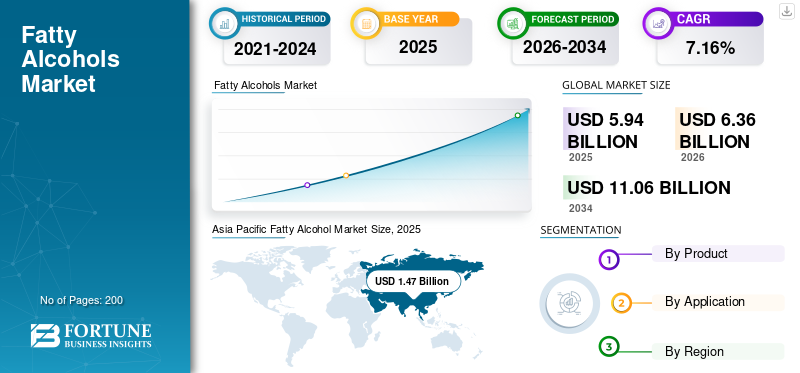
The global fatty alcohol market size was valued at USD 5.94 billion in 2025. The market is projected to grow from USD 6.36 billion in 2026 to USD 11.06 billion by 2034, exhibiting a CAGR of 7.16% during the forecast period. Asia Pacific dominated the fatty alcohol market with a market share of 28.94% in 2025. Moreover, the U.S. fatty alcohol market is projected to reach USD 1.20 billion by 2027, supported by demand in personal care products, detergents, and surfactants.
Fatty alcohols are straight-chain and high molecular weight primary alcohols. These are natural and petrochemical based waxy solids or oily liquids. These alcohols are exhibiting high demand from the personal care industry due to the increasing importance of personal hygiene and sanitation, amidst the coronavirus crisis. The surging demand for sustainable and biodegradable cosmetic products is further set to support the growth of the market. The rising disposable income and increasing expenditure by consumers on cosmetic products is another factor driving the market growth. Factors such as supply chain disruptions and volatile raw material prices, on the other hand, would weaken the market growth.
Download Free sample to learn more about this report.
Fatty Alcohol Market Key Takeaways
 Global Market Size & Forecast
- 2025 Market Size: USD 5.94 billion
- 2026 Market Size: USD 6.36 billion
- 2034 Forecast Market Size: USD 11.06 billion
- CAGR: 7.16% from 2026–2034
 Market Share
- Asia Pacific dominated the fatty alcohols market with a 28.94% share in 2025.
- The C11–C14 segment led the market due to its extensive use in soaps and detergents.
- The soaps & detergents segment dominated the market owing to increasing demand for surfactants and personal hygiene products.
 Key Regional Highlights
Asia Pacific
The market reached USD 1.47 billion in 2025, driven by strong demand from the personal care, cosmetics, and surfactant industries.
North America
The market is expected to witness steady growth, supported by increasing demand for biodegradable lubricants, detergents, and personal care products.
Europe
The market is projected to expand steadily due to rising consumer preference for liquid soaps, sustainable ingredients, and personal care products.
U.S.
The market is projected to reach USD 1.20 billion by 2027, driven by growing demand from personal care products, detergents, and surfactants.
Japan
The market is expected to witness steady growth, supported by increasing demand for bio-based chemicals and premium personal care products.
Read More

FATTY ALCOHOL MARKET TRENDS
Rising Demand for Bio-based Products is a Prominent Trend
Globally, concerns regarding the negative effects of petroleum-based products have stimulated the demand for sustainable products. The increasing consumer preference towards bio-based products has driven manufacturers to use eco-friendly ingredients. These alcohols derived from bio-based oleochemicals are less toxic and are recyclable, as compared to their conventional substitutes. These alcohols have a high demand from personal care and pharmaceutical industries due to the minimum number of side effects associated with them.
- Asia Pacific witnessed a growth from USD 1.39 Billion in 2025 to USD 1.47 Billion in 2026.
Download Free sample to learn more about this report.
Wilmar International, for instance, offers WILFAROL 1698, an alcohol derived from palm oil and palm kernel oil. Similarly, another key player named KLK OLEO offers a series of fatty alcohols derived from vegetable oils under the name PALMEROL. Moreover, restrictions imposed by regulatory bodies such as REACH on the environmental effects related to the use of petroleum-based products is set to drive the market growth.
FATTY ALCOHOL MARKET GROWTH FACTORS
Increasing Demand for Surfactants to Propel Market Growth
The demand for surfactants such as soaps and detergents is rising exponentially. Surfactants based on fatty alcohols serve various purposes in agriculture, paper & pulp, and cosmetic industries. They are used as solubilizing and emulsifying agents, as well as wetting and cleaning agents. Owing to these properties, fatty alcohols are expected to experience high demand. Additionally, the increasing demand for personal care products such as liquid soaps and hand sanitizers in an attempt to stop the spread of the COVID-19 is expected to boost the market growth.
RESTRAINING FACTORS
Fluctuating Prices of Raw Materials to Hamper Growth
Fatty alcohols are manufactured from raw materials such as tallow, palm oil, rapeseed oil, and others. Various countries in Asia Pacific such as Indonesia and Malaysia are major producers of these raw materials. Other regions including North America and Europe are dependent on the Asian countries to source their raw materials. Hence, fluctuations in the cost of raw materials are dependent on the trade scenarios in these regions. Additionally, newly imposed restrictions on the import of refined palm oil in India will further act as an obstruction in the growth of the market.
FATTY ALCOHOL MARKET SEGMENTATION ANALYSIS
By Product Analysis
To know how our report can help streamline your business, Speak to Analyst
C11-C14 Segment Dominated the Market in 2019 Backed by Usage in Soaps & Detergents Industry
On the basis of product segmentation, the market is fragmented into C6-C10, C11-C14, and C15-C22. The C11-C14 segment held the dominant share of the market in 2019. This growth is attributed to its extensive usage in the soaps and detergents industry.
The C15-C22 segment is projected to showcase high growth owing to its surging demand from the personal care industry. Rising disposable income is resulting in the increasing demand for cosmetics products such as shampoos, lotions, vanishing creams, lipsticks, and shaving creams, thereby raising the demand for C15-C22 alcohols.
By Application Analysis
Soaps & Detergents Segment to Generate Highest Revenue
In terms of application, the market is segmented into soaps & detergents, personal care, lubricants, amines, and others. The soaps & detergents segment is expected to generate a dominant share in the market during the forecast period. Improvements in the standard of living in developing economies and the increasing attention towards personal hygiene are anticipated to drive the growth of this segment. Furthermore, the rising demand for domestic & industrial cleaners to maintain a hygienic environment is expected to boost the segment.
The personal care segment is projected to be the second-largest segment during the forecast period. Personal care products such as shampoos, lotions, and essential oils are exhibiting high demand from Asia Pacific due to the rising expenditure capacity of consumers.
REGIONAL FATTY ALCOHOL MARKET ANALYSIS
Asia Pacific Fatty Alcohol Market Size, 2025 (USD billion)
To get more information on the regional analysis of this market, Download Free sample
Asia Pacific
The market size in Asia Pacific stood at USD 1.47 billion in 2025. It is the major contributor to the market growth owing to the escalating demand from personal care & cosmetics and surfactant industries. An exponential growth of population, coupled with the surging disposable incomes in India, China, and South Korea would support the market growth. In addition to this, China being the hub for major soaps and detergent manufacturers is showcasing a rise in consumption.
- In China, the c6-c10 segment is estimated to hold a 17% market share in 2019.
North America
In North America, the market growth is associated with the rising demand for surfactants. Additionally, a spike in the demand for sanitizers and home cleaning products in this region due to the COVID-19 outbreak would spur consumption.
Europe
The market in Europe is characterized by the surging demand from the personal care industry. Furthermore, the increasing consumer preference for liquid soaps is boosting the market growth. According to Eurostat, in 2018, around 12.6 million tons of soaps & detergents were manufactured in the European Union, out of which 81% accounted for detergents and washing preparations and 19% for soap and organic surface-active products.
Latin America and the Middle East & Africa
In Latin America and the Middle East & Africa, the high demand from multiple lubricant manufacturing companies is estimated to boost growth.
To know how our report can help streamline your business, Speak to Analyst
KEY INDUSTRY PLAYERS
Key Players Focus on Expansion & Acquisition Strategies to Strengthen Their Positions
The global fatty alcohol market is fragmented. Key players are investing in research and development activities to create new formulations for various applications. These companies are also implementing expansion and acquisition strategies to increase their presence in the market. Many manufacturers are establishing new plants in developing countries to serve the growing markets and upcoming opportunities.
LIST OF KEY COMPANIES PROFILED IN FATTY ALCOHOL MARKET:
- Godrej Industries (India)
- Berg + Schmidt (Germany)
- Wilmar International Ltd (Singapore)
- KLK OLEO (Malaysia)
- SABIC (Saudi Arabia)
- P&G Chemicals (U.S.)
- Musim Mas (Singapore)
- VVF L.L.C. (India)
- Sasol (South Africa)
- Emery Oleochemicals (Malaysia)
- Royal Dutch Shell (Netherlands)
- Univar Solutions Inc. (U.S.)
- BASF SE (Germany)
- Other Players
KEY INDUSTRY DEVELOPMENTS:
- March 2018- Musim Mas expanded its fatty alcohol production capabilities by opening a new facility in Batam with a production capacity of 150 KT per annum.
- June 2017- Royal Dutch Shell is set to expand the production capacity of mid-cut and low-cut alcohols at its Geismar, U.S. facility. This expansion will help the company to meet the growing demand for surfactant and plasticizer alcohol from consumers.
REPORT COVERAGE
The fatty alcohol market research report provides a detailed analysis of the market and focuses on key aspects such as leading companies, product types, and leading applications of the product. Besides this, it offers insights into the market trends and highlights key industry developments. In addition to the aforementioned factors, the report encompasses several factors that have contributed to the growth of the advanced market over recent years.
Request for Customization to gain extensive market insights.
Report Scope & Segmentation
|
ATTRIBUTE |
DETAILS |
|
Study Period |
2021-2034 |
|
Base Year |
2025 |
|
Forecast Period |
2026-2034 |
|
Historical Period |
2021-2024 |
|
Unit |
Value (USD Million) and Volume (KT) |
|
By Product |
|
|
By Application |
|
|
By Geography |
|
Frequently Asked Questions
Fortune Business Insights says that the global market size was USD 5.94 billion in 2025 and is projected to reach USD 11.06 billion by 2034.
In 2025, the Asia Pacific market value stood at USD 1.47 billion.
Registering a CAGR of 7.16%, the market will exhibit steady growth in the forecast period (2026-2034).
The C11-C15 segment is expected to lead this market during the forecast period.
The increasing demand from the surfactant industry is a major factor driving the growth of the market.
Wilmar International, KLK OLEO, and SABIC are major players in the market.
Asia Pacific dominated the market in terms of share in 2025.
A shift towards bio-based personal care products expected to drive product adoption.



- 2021-2034
- 2025
- 2021-2024
- 200
Get 30-60 hrs Free Customization
Expand Regional and Country Coverage, Segments Analysis, Company Profiles, Competitive Benchmarking, and End-user Insights.


















Related Reports
-
US +1 833 909 2966 ( Toll Free )
-
Get In Touch With Us