Face Wash Market Size, Share & Industry Analysis, By Product Type (Gel-Based, Foam-Based, Cream-Based, and Others), By Skin Type (Oily Skin, Combination Skin, Dry Skin, and Others), By Ingredient Type (Synthetic/Conventional, Natural & Herbal, and Organic/Clean-Label), By End-User (Women, Men, and Unisex), and Regional Forecast, 2026-2034
 Download Free Sample
(Offer valid till 30th Sep 2026)

Face Wash Market Size and Future Outlook
 Listen to Audio Version
The global face wash market size was valued at USD 32.00 billion in 2025. The market is projected to grow from USD 33.40 billion in 2026 to USD 50.87 billion by 2034, exhibiting a CAGR of 5.40% during the forecast period. North America dominated the face wash market with a market share of 36.53% in 2025.
The market expansion for face wash is mainly driven by increasing consumer awareness for skincare, growing concerns associated with skin problems caused by pollution, rising spending on skincare products, and practice of daily face washing. Rapid urbanization and growing income levels are boosting the demand for premium, natural, and dermatologically tested skincare organic products including facewash. Besides that, the introduction of new products, including those specially designed for acne-prone, aging, and sensitive skin, is being a great factor in the development of the market. Furthermore, social media, beauty influencers, and e-commerce platforms are making the product more visible and accessible. Meanwhile, men’s grooming and clean, label trends are continuously opening growth prospects for facewash manufacturers.
- For instance, according to the U.S. Bureau of Labor Statistics Consumer Expenditure Survey (CE) 2023, total average annual consumer spending on personal care products and services including skincare and related goods increased from USD 646 in 2020 to USD 950 in 2023.
Key market players operating in the market include Procter & Gamble (P&G), L’Oréal, Unilever, Beiersdorf AG, and Johnson & Johnson. One of the biggest primary strategies undertaken by these players to maintain their positions in the market is by consistently coming up with new products, especially by creating innovative formulations that are dermatologically tested, natural, and specific to different skin types. Besides that, they highly engage into brand building and digital advertising. They also utilize social media platforms and collaborate with influencers to strengthen consumer loyalty and broaden their geographic reach.
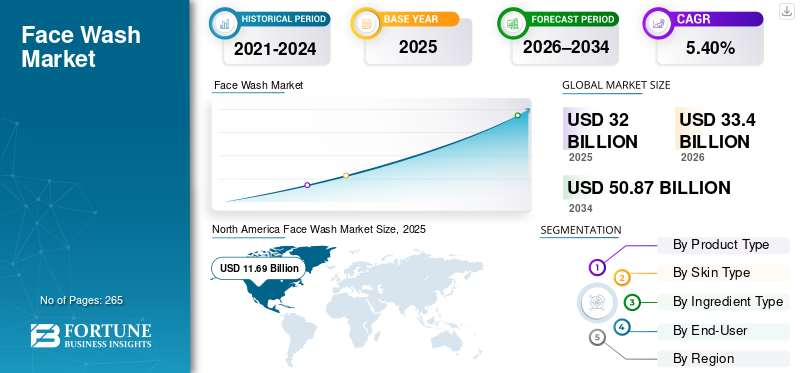
Download Free sample to learn more about this report.
Face Wash Market Key Takeaways
 Global Market Size & Forecast
- 2025 Market Size: USD 32.00 billion
- 2026 Market Size: USD 33.40 billion
- 2034 Forecast Market Size: USD 50.87 billion
- CAGR: 5.40% from 2026–2034
 Market Share
- North America dominated the face wash market with a 36.53% share in 2025.
- Gel-based face wash segment dominated due to strong consumer adoption and oil-control benefits.
- Women segment held the leading market position due to higher usage and purchase frequency.
 Key Regional Highlights
North America
North America reached USD 11.69 billion in 2025, maintaining its leading market position.
Asia Pacific
Asia Pacific accounted for USD 9.26 billion in 2025, supported by rising skincare adoption.
Europe
Europe recorded USD 7.48 billion in 2025, capturing 23.39% of global market share.
U.S.
The U.S. face wash market reached USD 10.21 billion in 2025, representing around 31.90% of global sales.
Japan
Japan’s face wash market reached USD 0.76 billion in 2025, accounting for approximately 2.39% of global revenues.
Read More

FACE WASHS MARKET TRENDS
Rise in Clean-Label and Dermatologist-Backed Products
Consumer awareness of skin health and ingredient safety is on the rise and this, in turn, is driving the demand for dermatologically-tested, free of sulfate, and clean-label facewashes. As consumers are moving towards products that they think are safer and more effective, manufacturers are reformulating their offerings and pointing out clinical validation and transparency. This trend is resulting in premiumization, higher brand trust, and greater usage of specialized facewashes for sensitive and problem, prone skin types.
Download Free sample to learn more about this report.
MARKET DYNAMICS
MARKET DRIVERS
Growing Consumer Awareness Associated with Skincare is Boosting the Market Growth
One of the primary drivers for the market growth of the face wash is the rising awareness among people of the benefits of regular facial cleansing not just for skin health but also to prevent acne, irritation, and pollution damage. The growing consumer education by health authorities, dermatologists, and online content is turning daily practice of face washing into a basic hygiene habit rather than some beauty skincare routines. This shift in perception is widening the market potential, increasing the use of face wash products and hence, creating a continuous demand for such products across demographics and both genders.
MARKET RESTRAINTS
Skin Sensitivity and Risk of Allergic Reactions to Obstruct Market Growth
The increase in skin sensitivity and allergy cases due to the presence of harsh chemicals, fragrances, and preservatives in face wash products is one of the major factors limiting the growth of the market. When consumers’ skin gets irritated or it becomes dry, they lose trust in those products which then leads to them being more careful with their purchases and even change their brand. That way, they are stimulated to buy other safer products but at the same time, the use of typical formulations gets limited.
MARKET OPPORTUNITIES
Expansion of Gender-Neutral and Men’s Skincare to Generate Market Growth Opportunities
More women following the skincare routine and the breaking of the stereotypes around gender, specific grooming are opening up new growth avenues for the face wash market growth. With males getting more aware of their skin conditions such as acne, oil control, and their exposure to pollution, the demand for specialized yet straightforward products are increasing. This transition is prompting skincare brands to come up with new men and unisex face washes, thus extending their market coverage and resulting in additional sales growth.
MARKET CHALLENGES
Brand Differentiation Pressure and Intense Market Competition to Pose a Critical Challenge to Market Development
The global market experiences challenges from intense rivalry from international brands, regional industry stakeholders, and emerging indie labels. As product portfolio has become increasingly similar in terms of formulations and claims, players struggle to distinguish themselves effectively. This in turn results in higher promotion and marketing costs, price competition, and lowered margins, making sustained brand loyalty and profitability more difficult to achieve.
Segmentation Analysis
By Product Type
Broad Consumer Adoption due to Superior Oil Control, Propels Growth of Gel-Based Face Wash
Based on the product type, the market is divided into gel-based, foam-based, cream-based, and others.
The gel-based product segment dominated the market growth on account of its strong suitability for acne-prone and oily skin, which caters to a larger chunk of global consumer base. Gel formulations are recognized to provide effective oil control, deeper cleansing, and a lightweight feel, making them widely adopted across all the demographics and in tropical or humid regions. Thus, broad applicability across various climates and skin types leads to higher usage frequency, wide brand offerings, and solid repeat purchases, driving segmental expansion.
The foam-based segment is anticipated to rise at the second-fastest CAGR of 5.41% over the forecast period.
To know how our report can help streamline your business, Speak to Analyst
By Skin Type
High Acne Prevalence and Frequent Cleansing Needs Boosted Oily Skin Segment Growth
Based on skin type, the market is segmented into oily skin, combination skin, dry skin, and others.
In 2025, oily skin segment dominated the global market. This dominance of the segment was due to the high prevalence of excess oil production and acne-related concerns across adults and younger generations. Individuals with oil skin type usually need frequent facial cleansing to manage clogged pores, breakouts, and shine which results into higher product consumption rate. Moreover, targeted formulations, wide range product availability, and marketing focused on acne prevention and oil control, augments order repetition, resulting in higher revenue generation.
The combination skin segment is projected to grow at the second-fastest CAGR of 5.56% over the forecast period.
By Ingredient Type
Mass-Market Affordability and Wide Availability to Drive Synthetic/Conventional Segment Growth
Based on the ingredient type, the market is segmented into synthetic/conventional, natural & herbal, and organic/clean-label.
The synthetic/conventional segment is anticipated to witness a dominating market share over the forecast period. Their mid-priced product category, solid penetration across mass-markets, and availability across all the platforms including supermarkets & hypermarkets, drug stores, pharmacies, convenience stores, online platforms, and others makes them accessible to broad consumer base. In addition, longer shelf life, economical manufacturing cost, and solid brand presence enable economies of scale and competitive pricing.
The organic/clean-label segment is projected to grow at a CAGR of 6.69% over the forecast period. The demand for organic face washes is likely to multifold in the coming years as consumers have become cautious of what they apply to their skin.
By End-User
Women Segment Takes the Lead Due to Highest Usage and Buying Frequency Amongst Female Population
Based on end-user, the market is segmented into women, men, and unisex.
The women end-user segment dominated the global market. This high market share was driven by higher usage and purchase frequency and a broad spectrum of products catered to the gender as compared to men and unisex categories. Females tend to opt and spend on fashion and personal care products, therefore leading to repeat orders and higher average spending. Moreover, brands constantly launch varieties, styles, textures, and trend-driven collections targeting women end-users, which triggers demand and boost replacement cycles, thus contributing to higher revenue generation by the segment.
In addition, men end-user segment is projected to grow at the fastest CAGR of 6.27% during the forecast period.
Face Wash Market Regional Outlook
By geography, the market is categorized into Europe, North America, Asia Pacific, South America, and the Middle East and Africa.
North America
North America Face Wash Market Size, 2025 (USD Billion)
To get more information on the regional analysis of this market, Download Free sample
North America is projected to record the highest growth rate of 4.53% in the coming years, which is the highest among all regions, reaching a valuation of USD 11.69 billion by 2025. The region holds the dominating face wash market share. High consumer purchasing power, willingness to spend on premium and value-added products, and strong preference for branded, high-quality, and innovative offerings in the region supplemented the regional market growth.
U.S. Face Wash Market
Based on North America’s strong contribution and the U.S. dominates within the region, the U.S. market reached USD 10.21 billion in 2025, accounting for roughly 31.90% of global market sales.
Asia Pacific
Asia Pacific reached USD 9.26 billion in 2025 and secure the position of the second-largest region in the market. In the region, India and China both reached USD 2.87 billion and USD 3.04 billion, respectively in 2025.
Japan Face Wash Market
The Japan market in 2025 was valued at USD 0.76 billion, accounting for roughly 2.39% of global market revenues. Growing consumer preference for quality and innovation, along with strong demand for dermatologically-tested, advanced and premium products drives the country’s market growth.
China Face Wash Market
China’s market in 2025 was valued at USD 3.04 billion revenues, representing roughly 9.49% of global market sales.
India Face Wash Market
The India market in 2025 was valued at USD 2.87 billion, accounting for roughly 8.98% of global market revenues.
Europe
Europe held the third-dominant share in 2025, valuing at USD 7.48 billion with a market share of 23.39% in the global market. The region’s growth is led by strong demand for premium and sustainable products, supported by high consumer awareness associated with skin care routine, evolving lifestyle trends, and a well-established online retail infrastructure.
U.K Face Wash Market
The U.K. market in 2025 reached USD 0.88 billion, representing roughly 2.75% of global market revenues.
Germany Face Wash Market
Germany’s market reached USD 1.32 billion in 2025, equivalent to around 4.13% of global market sales.
South America and Middle East & Africa
The South America and Middle East & Africa regions are expected to witness moderate growth in this market space during the forecast period. The South America market reached USD 2.10 billion in 2025. Rising urbanization, expanding middle-class population, and increasing adoption of affordable and branded products drives market growth of the region. In the Middle East & Africa, the UAE reached USD 0.38 billion in 2025.
South Africa Face Wash Market
The South Africa market reached USD 0.28 billion in 2025, representing roughly 0.87% of global market revenues.
COMPETITIVE LANDSCAPE
Key Industry Players
Innovation, Expansion, and Strategic Differentiation By Key Market Players Drives an Intense Competitive Rivalry
Industry players compete by regularly inventing new products that not only help them satisfy changing consumer tastes but also keep their brands relevant. Companies are expanding their geographical footprint to get to new markets, which on the one hand, has resulted in a larger customer base and higher revenues. To emphasize their distribution channels and increase productivity, companies are entering into strategic partnerships and collaborations.
LIST OF KEY FACE WASH COMPANIES PROFILED
- L’Oréal S.A. (France)
- Unilever PLC (Netherlands)
- The Procter & Gamble Company (U.S.)
- Shiseido Company, Limited (Japan)
- The Estée Lauder Companies Inc. (U.S.)
- Beiersdorf AG (Germany)
- Colgate-Palmolive Company (U.S.)
- Johnson & Johnson (Neutrogena) (U.S.)
- Coty Inc. (Netherlands)
- Godrej Consumer Products Limited (India)
KEY INDUSTRY DEVELOPMENTS
- December 2025: The Estée Lauder Companies Inc. boosts its product offering range by launching new brands in order to increase its market share, reinvent its brand position, and lure broader consumer base. The company is taking minority stakes in beauty brands across key developing countries including India, China, and Mexico with brands such as The Ordinary, as part of its growth strategy to enhance brand exposure.
- June 2025: – Unilever declared that it has signed an agreement to acquire personal care brand Dr. Squatch from growth equity firm Summit Partners for approximately USD 1.5 billion. This acquisition is aimed at strengthening Unilever’s position in premium and clean personal care product
- December 2024: L’Oréal tapped into the flourishing Asian skincare market segment by acquiring a stake in Korean skincare company Gowoonsesang Cosmetics and its brand Dr.G. With this acquisition company diversified its face wash and cleansing formulations.
- June 2024: The Estée Lauder Companies Inc., completed the acquisition of DECIEM Beauty Group, the Canadian-based, vertically integrated, multi-brand company. Through this acquisition, ELC strives to expand its holdings in innovative skincare and direct-to-consumer brand portfolios.
- March 2024: L’Oréal Paris unveiled the new product, RevitaLift Radiant Smoothing Cream Cleanser, facewash integrated with Vitamin C that exfoliates, removes impurities and makeup gently, and help improve skin texture for a smoother, more radiant complexion.
REPORT COVERAGE
Request for Customization to gain extensive market insights.
Report Scope & Segmentation
|
ATTRIBUTE |
DETAILS |
|
Study Period |
2021-2034 |
|
Base Year |
2025 |
|
Estimated Year |
2026 |
|
Forecast Period |
2026-2034 |
|
Historical Period |
2021-2024 |
|
Growth Rate |
CAGR of 5.40% from 2026-2034 |
|
Unit |
Value (USD Billion) |
|
Segmentation |
By Product Type, Skin Type, Ingredient Type, End-User, and Region |
|
By Product Type |
· Gel-based · Foam-based · Cream-based · Others |
|
By Skin Type |
· Oily Skin · Combination Skin · Dry Skin · Others |
|
By Ingredient Type |
· Synthetic / Conventional · Natural & Herbal · Organic / Clean-Label |
|
By End-User |
· Women · Men · Unisex |
|
By Region |
· North America (By Product Type, Skin Type, Ingredient Type, End-User, and Country) o U.S. (By Product Type) o Canada (By Product Type) o Mexico (By Product Type) · Europe (By Product Type, Skin Type, Ingredient Type, End-User, and Country/Sub-region) o Germany (By Product Type) o U.K. (By Product Type) o France (By Product Type) o Spain (By Product Type) o Italy (By Product Type) o Rest of Europe (By Product Type) · Asia Pacific (By Product Type, Skin Type, Ingredient Type, End-User, and Country/Sub-region) o China (By Product Type) o Japan (By Product Type) o India (By Product Type) o Australia (By Product Type) o Rest of Asia Pacific (By Product Type) · South America (By Product Type, Skin Type, Ingredient Type, End-User, and Country/Sub-region) o Brazil (By Product Type) o Argentina (By Product Type) o Rest of South America (By Product Type) · Middle East & Africa (By Product Type, Skin Type, Ingredient Type, End-User, and Country/Sub-region) o South Africa (By Product Type) o UAE (By Product Type) o Rest of Middle East & Africa (By Product Type) |
Frequently Asked Questions
According to Fortune Business Insights, the global market value stood at USD 32.00 billion in 2025 and is projected to reach USD 50.87 billion by 2034.
In 2025, the market value stood at USD 11.69 billion.
The market is expected to exhibit a CAGR of 5.40% during the forecast period.
By product type, the gel-based segment leads the market.
Increasing consumer awareness for skincare, growing concerns associated with skin problems caused by pollution, and rising spending on skincare products are driving market expansion.
Procter & Gamble (P&G), L’Oreal, Unilever, Beiersdorf AG, and Johnson & Johnson are the major players in the global market.
North America dominated the market in 2025.



- 2021-2034
- 2025
- 2021-2024
- 265
-
(Offer valid till 30th Sep 2026)
Get 30-60 hrs Free Customization
Expand Regional and Country Coverage, Segments Analysis, Company Profiles, Competitive Benchmarking, and End-user Insights.



















Related Reports
-
US +1 833 909 2966 ( Toll Free )
-
Get In Touch With Us