Intracranial Pressure Monitoring Devices Market Size, Share & Industry Analysis, By Product Type (Invasive {Intraventricular Catheters (EVD), Intraparenchymal Sensors, and Others} and Non-Invasive {Transcranial Doppler-based Systems, Optic Nerve Sheath Diameter (ONSD) Devices, Tympanic Membrane Displacement (TMD), and Others}), By Application (Traumatic Brain Injury, Intracerebral Hemorrhage, Meningitis & Encephalitis, Subarachnoid Hemorrhage, and Others), By End-user (Hospitals & Trauma Centers, Specialty Clinics, and Others), and Regional Forecast, 2026-2034
 Download Free Sample
Intracranial Pressure Monitors Market Overview
 Listen to Audio Version
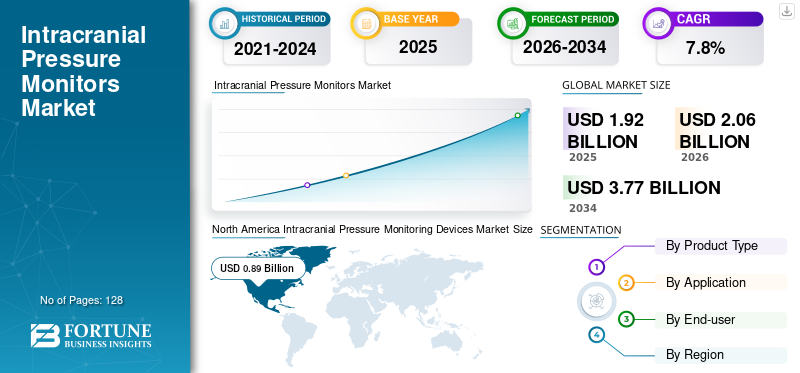
The global intracranial pressure monitoring devices market size was valued at USD 1.92 billion in 2025. The market is projected to grow from USD 2.06 billion in 2026 to USD 3.77 billion by 2034, exhibiting a CAGR of 7.8% during the forecast period. North America dominated the intracranial pressure monitoring devices market with a market share of 46.35% in 2025.
Intracranial pressure (ICP) monitoring devices are tools or instruments used to measure the pressure inside the skull, particularly in the brain tissue and cerebrospinal fluid. These devices are widely used in neurocritical care to monitor patients with traumatic brain injuries, brain tumors, stroke, or intracranial hemorrhage. Market growth is attributed to the increasing prevalence of neurological conditions and improvements in neuromonitoring technologies, which are driving the adoption of intracranial monitoring devices.
Furthermore, Integra LifeSciences, Natus, and RAUMEDIC AG are among the major industry players due to their strong product portfolios and established distribution networks.
Download Free sample to learn more about this report.
INTRACRANIAL PRESSURE MONITORING DEVICES MARKET KEY TAKEAWAYS
 Global Market Size & Forecast
- 2025 Market Size: USD 1.92 billion
- 2026 Market Size: USD 2.06 billion
- 2034 Forecast Market Size: USD 3.77 billion
- CAGR: 7.80% from 2026–2034
 Market Share
- North America dominated the market with a 46.35% share in 2025.
- The Traumatic Brain Injury segment is expected to hold the largest market share of 44.70% in 2026.
- The Hospitals & Trauma Centers segment is expected to dominate the market with a 70.90% share in 2026.
 Key Regional Highlights
North America
The market reached USD 0.89 billion in 2025 and is projected to maintain its leadership through 2026.
Europe
The market is projected to reach USD 0.46 billion in 2026, supported by the presence of leading manufacturers and high adoption of intracranial pressure monitoring technologies.
Asia Pacific
The market is projected to reach USD 0.45 billion in 2026, fueled by a large traumatic brain injury patient population and expanding availability of monitoring devices.
U.S.
The market is projected to reach USD 0.90 billion by 2026.
Japan
The market is projected to witness steady growth by 2026.
Read More

INTRACRANIAL PRESSURE MONITORING DEVICES MARKET TRENDS
Integration of Advanced Sensors and Multimodal Neuromonitoring Systems to Emerge as a Key Trend
Currently, key players are integrating ICP monitoring with multimodal neuromonitoring platforms. Modern ICP monitoring technologies include fiber-optic sensors and microchip catheters that provide continuous, highly accurate measurements. Such integration helps clinicians better understand brain physiology and guide treatment decisions more effectively, driving adoption of ICP monitoring devices in healthcare settings.
- For instance, according to the World Journal of Critical Care Medicine in June 2024, intensive care units (ICUs) now employ advanced multimodal monitoring (MMM) that incorporates key neurophysical principles.
Download Free sample to learn more about this report.
MARKET DYNAMICS
MARKET DRIVERS
Rising Incidence of Traumatic Brain Injuries and Neurological Disorders to Fuel the Market Expansion
Over the past few years, there has been an increasing number of traumatic brain injuries (TBIs), strokes, and neurological conditions worldwide. In severe cases, there is often a need for continuous ICP monitoring to avoid complications such as brain swelling and hemorrhage, which is driving the demand for intracranial pressure monitoring devices. Such a scenario is expected to drive the global intracranial pressure monitoring devices market growth.
- For instance, in February 2025, the University of Utah Health reported that roughly 2.8 million U.S. individuals suffer a traumatic brain injury (TBI) each year, with one in 60 U.S. residents living with a related disability.
MARKET RESTRAINTS
Risks and Complications Associated with Invasive Monitoring to Restrict Market Growth
Despite the clinical benefits, invasive intracranial pressure monitoring devices are associated with certain risks. Procedures such as inserting intraventricular catheters or intraparenchymal sensors require drilling into the skull, which may lead to complications such as infection, bleeding, or catheter misplacement. This is expected to limit their adoption, hampering the market growth over the forecast period.
- For instance, according to the Journal of Neurocritical and Neurohospitalist Care in July 2023, infection is the most common complication associated with invasive intracranial pressure monitoring.
MARKET OPPORTUNITIES
Development of Non-Invasive Intracranial Pressure Monitoring Technologies to Create Significant Opportunities
In recent years, there has been a growing focus on the development of non-invasive ICP monitoring technologies, such as wearable sensors, ultrasound-based monitoring, and optic nerve sheath diameter measurement, as key professionals seek safer and faster diagnostic tools.
- For instance, in April 2025, BIT researchers developed a crack-enhanced MXene-carbon nanotube soft contact lens for non-invasive intracranial pressure monitoring via intraocular pressure, published in ACS Nano.
MARKET CHALLENGES
High Cost and Limited Access to Advanced Neuromonitoring Infrastructure to Challenge Market Expansion
Intracranial pressure monitoring requires specialized equipment, trained neurosurgeons, and dedicated neurocritical care units, which are often limited in low- and middle-income countries. Also, the high cost of disposable sensors, catheters, and monitoring equipment is expected to increase overall treatment costs, hindering market growth.
Segmentation Analysis
By Product Type
Strong Adoption of Invasive Monitoring Devices to Boost the Invasive Segment's Growth
Based on product type, the market is segmented into invasive and non-invasive. The invasive segment is further subdivided into intraventricular catheters (EVD), intraparenchymal sensors, and others. On the other hand, the non-invasive segment is sub-classified into transcranial Doppler-based systems, optic nerve sheath diameter (ONSD) devices, tympanic membrane displacement (TMD), and others.
To know how our report can help streamline your business, Speak to Analyst
The invasive segment accounted for the largest global intracranial pressure monitoring devices market share in 2025. Invasive monitoring methods, such as intraventricular catheters and intraparenchymal sensors, are considered the gold standard for measuring intracranial pressure because they provide highly accurate and continuous measurements. This is expected to contribute to the segment's growth in the forthcoming years.
Additionally, the non-invasive segment is projected to grow at an 8.3% CAGR during the forecast period.
By Application
High Prevalence of Traumatic Brain Injuries to Fuel the Segment's Growth
By application, the market is segmented into traumatic brain injury, intracerebral hemorrhage, meningitis & encephalitis, subarachnoid hemorrhage, and others.
The traumatic brain injury segment accounted for the largest market share in 2025. Over the past few years, the number of traumatic brain injuries has been increasing worldwide, driven by road accidents, falls, and sports injuries, which has increased demand for ICP monitoring devices, fueling the segment's growth. Moreover, the segment is estimated to hold a 44.7% share in 2026.
- For instance, according to the data from The Lancet in 2022, around 50.0 to 60.0 million people worldwide have traumatic brain injuries each year.
Additionally, the intracerebral hemorrhage segment is anticipated to grow at an 8.3% CAGR over the forecast period.
By End-user
Increasing Need for Specialized Neurosurgery Departments to Drive the Hospital & Trauma Centers Segment's Growth
Based on end user, the market is segmented into hospitals & trauma centers, specialty clinics, and others.
In 2025, hospitals & trauma centers dominated the market as end users. These facilities typically have specialized neurosurgery departments, neurocritical care units, and trained professionals required for invasive monitoring procedures, which are contributing to higher penetration of intracranial pressure monitoring devices and the segment's growth. Furthermore, the segment is set to hold a 70.9% share in 2026.
In addition, the specialty clinics segment is projected to grow at an 8.1% CAGR over the forecast period.
Intracranial Pressure Monitoring Devices Market Regional Outlook
Based on region, the market is classified into North America, Europe, Asia Pacific, Latin America, and the Middle East & Africa.
North America
North America Intracranial Pressure Monitoring Devices Market Size, 2025 (USD billion)
To get more information on the regional analysis of this market, Download Free sample
North America accounted for the largest share of revenues in 2024, valued at USD 0.83 billion, and held USD 0.89 billion in 2025. The region's growth is attributed to well-established neurocritical care infrastructure and high healthcare spending, favoring the adoption of intracranial pressure monitoring devices.
U.S Intracranial Pressure Monitoring Devices Market
In 2026, the U.S. is projected to reach USD 0.90 billion, accounting for approximately 43.6% of the global market.
Europe
Europe is projected to record a 6.9% growth rate during the projection period, the second-highest globally, to reach USD 0.46 billion by 2026. The growth is attributed to the presence of prominent manufacturers, including RAUMEDIC AG, Sophysa, and others, which has led to high penetration of ICP monitoring devices in the region.
U.K Intracranial Pressure Monitoring Devices Market
The U.K. market is expected to reach USD 0.07 billion by 2026, accounting for roughly 3.4% of global revenues.
Germany Intracranial Pressure Monitoring Devices Market
Germany's market is projected to reach USD 0.11 billion by 2026, accounting for approximately 5.3% of global revenue.
Asia Pacific
By 2026, the Asia Pacific's intracranial pressure monitoring devices market is expected to reach USD 0.45 billion, ranking third globally. The growth is attributed to the largest patient pool of traumatic brain injuries in the region, which is driving demand for monitoring devices and influencing key players to expand product availability.
Japan Intracranial Pressure Monitoring Devices Market
Japan is forecasted to generate USD 0.10 billion in revenue by 2026, capturing nearly 4.7% of the global market.
China Intracranial Pressure Monitoring Devices Market
China's market is expected to reach approximately USD 0.16 billion by 2026, representing nearly 7.9% of global revenues.
India Intracranial Pressure Monitoring Devices Market
India's intracranial pressure monitoring devices market is expected to reach approximately USD 0.09 billion by 2026, accounting for around 4.2% of global market revenue.
- For instance, according to the data from the European Journal of Cardiovascular Medicine in February 2024, India has the highest rate of traumatic brain injuries (TBIs) in the world.
Latin America and the Middle East & Africa
Both Latin America and the Middle East & Africa are expected to grow moderately, with the Latin America market forecast to reach USD 0.13 billion by 2026. The growth of these regions is mainly driven by rising awareness of neurocritical care monitoring and increased investments in trauma care centers, which are expected to support the adoption of advanced neuromonitoring technologies.
GCC Intracranial Pressure Monitoring Devices Market
By 2026, the GCC market is estimated to reach approximately USD 0.04 billion, representing around 1.8% of global revenues.
COMPETITIVE LANDSCAPE
Key Industry Players
Diversified Portfolios and Established Distribution Networks to Strengthen the Market Position of Key Companies
In 2025, Integra LifeSciences, Natus, and RAUMEDIC AG held the majority of the global market share for intracranial pressure monitoring devices. The growth is mainly due to their strong product portfolios, established distribution networks, and long-term presence in neurosurgical monitoring technologies.
Moreover, other prominent players are focusing on product innovation, regulatory approvals, hospital partnerships, and expansion into emerging markets to strengthen their market positions.
LIST OF KEY INTRACRANIAL PRESSURE MONITORING DEVICES COMPANIES PROFILED
- Integra LifeSciences (U.S.)
- Medtronic (Ireland)
- Natus (U.S.)
- RAUMEDIC AG (Germany)
- Sophysa (France)
- Spiegelberg GmbH & Co. KG (Germany)
- NeuraSignal, Inc. (U.S.)
- Sense Neuro (Sweden)
- Koninklijke Philips N.V. (Netherlands)
- BRANCHPOINT & AURA DEVELOPMENT LLC. (U.S.)
KEY INDUSTRY DEVELOPMENTS
- December 2025: Benchmark partnered with CoMind to develop and manufacture its groundbreaking non-invasive brain-monitoring device using infrared lasers to track real-time cerebral blood flow, intracranial pressure, and autoregulation.
- December 2025: CranioSense landed USD 5.5 million in non-dilutive funding from NIH Blueprint MedTech and DoD's JWMRP to develop and validate its noninvasive intracranial pressure (ICP) monitoring system using near-infrared sensors.
- October 2025: CoMind raised USD 102.5 million to develop a non-invasive bedside brain monitor using Lidar-like technology to measure real-time brain blood flow and other parameters via a forehead adhesive sensor.
- August 2024: Aesculap received FDA Breakthrough Device Designation for the M.scio non-invasive telemetric pressure measurement system, developed with Christoph Miethke GmbH. The implantable sensor enables continuous, long-term monitoring of intracranial pressure in cerebrospinal fluid, improving hydrocephalus management.
- April 2024: Integra LifeSciences relaunched the CereLink ICP Monitoring System in the U.S. market to strengthen its neuromonitoring portfolio.
- April 2024: Integra LifeSciences showcased the CereLink ICP monitoring technology at the AANS Annual Scientific Meeting.
- June 2023: Luciole Medical AG acquired Spiegelberg GmbH & Co. KG, a leading neurosurgery device maker specializing in intracranial pressure (ICP) probes, from SHS Capital.
REPORT COVERAGE
The report provides a comprehensive analysis across all segments, covering market drivers, trends, opportunities, restraints, and challenges shaping the growth of the market. It includes insights on technological advancements, prevalence of neurological disorders, major industry developments, company market share analysis, and in-depth profiles of leading firms.
Request for Customization to gain extensive market insights.
Report Scope & Segmentation
| ATTRIBUTE | DETAILS |
| Study Period | 2021-2034 |
| Base Year | 2025 |
| Estimated Year | 2026 |
| Forecast Period | 2026-2034 |
| Historical Period | 2021-2024 |
| Growth Rate | CAGR of 7.8% from 2026-2034 |
| Unit | Value (USD Billion) |
| Segmentation | By Product Type, Application, End-user, and Region |
| By Product Type |
|
| By Application |
|
| By End-user |
|
| By Region |
|
Frequently Asked Questions
Fortune Business Insights says that the global market value stood at USD 1.92 billion in 2025 and is projected to reach USD 3.77 billion by 2034.
In 2025, the market value stood at USD 0.89 billion.
The market is expected to grow at a CAGR of 7.8% over the forecast period.
The invasive segment led the market in terms of product type.
The key factor driving the market is the rising incidence of neurological disorders and traumatic brain injuries.
Integra LifeSciences, Natus, and RAUMEDIC AG are among the prominent players in the market.
North America dominated the market in 2025.



- 2021-2034
- 2025
- 2021-2024
- 128
Get 30-60 hrs Free Customization
Expand Regional and Country Coverage, Segments Analysis, Company Profiles, Competitive Benchmarking, and End-user Insights.













.webp)






-
US +1 833 909 2966 ( Toll Free )
-
Get In Touch With Us