Fiber Optics Market Size, Share & Industry Analysis, By Fiber Type (Plastic and Glass), By Type (Single-mode and Multimode), By Application (Telecom, Automobile, Medical Equipment, Power Utilities, Aerospace & Defense, Industrial Automation & Control, and Others), and Regional Forecast, 2026–2034
 Download Free Sample
Fiber Optics Market (2026-2034)
 Listen to Audio Version
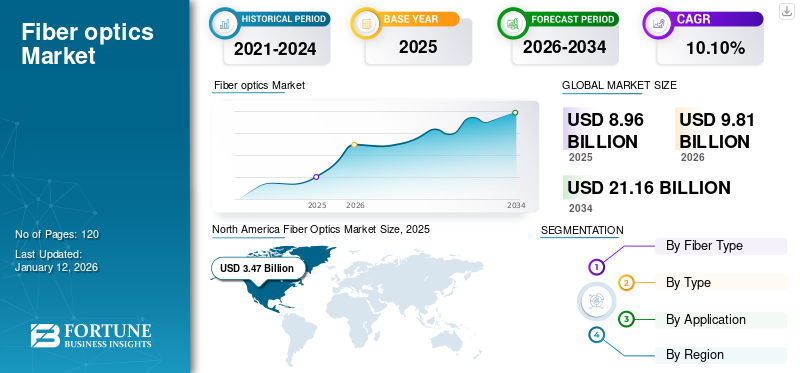
The global fiber optics market size was valued at USD 8.96 billion in 2025 and is projected to grow from USD 9.81 billion in 2026 to USD 21.16 billion by 2034, exhibiting a CAGR of 10.10% during the forecast period. North America dominated the global fiber optics market with a share of 38.70% in 2025. The fiber optics industry growth is driven by expanding high-speed connectivity, data center investments, and next-generation communication infrastructure.
The scenario of the bandwidth people need in their homes has changed, and people have started to look for better options. This enormous shift has pointed to the need for constantly growing the capacity of the network and investing in technologies, including fiber to the home, 5G, and cloud computing, driving demand for networks based on optical fiber technology. According to industry experts, by 2024, there will be around 1.9 billion 5G subscriptions globally, and fiber optics will be crucial in meeting those demands with the ever-growing surge for high-bandwidth data. Also, the expansion of smart city initiatives globally to boost the demand for fiber optic networks, and government initiatives and subsidies towards broadband setups, will accelerate the expansion of fiber optics.
Demand for a stable internet connection has increased from the COVID-19 pandemic as companies have adopted remote working policies, and technology has provided people with a means to stay connected for the safety of their homes. An increase in digital meetings and movie streaming parties required a more stable connection, and due to that, the in-demand video app Zoom witnessed a surge in users from 10 million users to 200 million in a few months. Also, Netflix gained 15 million subscribers during the early months of the COVID-19 crisis.
The global fiber optics market is experiencing sustained expansion as governments, telecommunications operators, and enterprises accelerate investments in high-capacity communication infrastructure. Increasing demand for high-speed internet, cloud computing, and digital transformation initiatives is driving widespread adoption of fiber optics across commercial, industrial, and residential applications. Consequently, the fiber optics market size continues to expand as network operators prioritize scalable and low-latency communication networks capable of supporting rapidly increasing data traffic.
Telecommunications remains the largest application segment, supported by continuous fiber-to-the-home (FTTH), fiber-to-the-premises (FTTP), and fifth-generation (5G) network deployments. Rising investments in hyperscale data centers and edge computing facilities are further strengthening demand for fiber optic connectivity. High bandwidth transmission capabilities and superior signal reliability position optical fiber as the preferred medium for next-generation communication systems.
Technological innovation continues to reshape the competitive landscape. Manufacturers are focusing on advanced cable type development, improved installation efficiency, and enhanced network performance to meet evolving bandwidth requirements. Single-mode fiber remains the preferred solution for long-distance transmission, while multimode products continue to support enterprise networks and data center applications. The adoption of fiber optics is also expanding across industrial automation, aerospace and defense, healthcare, and power utility infrastructure.
North America maintains a significant position in the global market due to its advanced telecommunications infrastructure and ongoing broadband modernization initiatives. Asia Pacific is emerging as the fastest-growing regional market, supported by large-scale infrastructure investments, rapid urbanization, and expanding digital economies. Europe continues to strengthen regional connectivity through public and private broadband deployment programs.
Download Free sample to learn more about this report.
Fiber optics Market Key Takeaways
 Global Market Size & Forecast
- 2025 Market Size: USD 8.96 billion
- 2026 Market Size: USD 9.81 billion
- 2034 Forecast Market Size: USD 21.16 billion
- CAGR: 10.10% from 2026–2034
 Market Share
- North America dominated the global fiber optics market with a share of 38.70% in 2025.
- The multimode segment is projected to generate the maximum share of 51.65% in terms of revenue in 2026.
- The telecom segment is expected to dominate the market with share of 43.73% in 2026.
 Key Regional Highlights
North America
In 2025, North America held 38.70% of the global market share, reaching a valuation of USD 3.47 billion, and is projected to grow to USD 3.74 billion in 2026.
Asia Pacific
Asia Pacific contributed approximately USD 1.99 billion to the global market in 2025, accounting for 22.20% share, and is expected to reach USD 2.23 billion in 2026.
Europe
The market in Europe reached USD 2.13 billion in 2025, representing 23.80% of total market revenue, and is projected to reach USD 2.33 billion in 2026.
U.S.
The U.S. market is projected to reach USD 2.36 billion by 2026, driven by strong investments in broadband infrastructure, hyperscale data centers, and next-generation communication networks.
Japan
The Japan fiber optics market is projected to reach USD 0.41 billion by 2026, supported by the adoption of advanced optical networking technologies and expanding digital infrastructure.
Read More

Market Trends
Surge in Implementation of Fiber-based Medical Imaging and Telemedicine to Increase Adoption of Optical Fiber
The escalating demand for cutting-edge and high-definition imaging technologies in medical sectors, particularly within telemedicine and diagnostic imaging applications, is driving a significant surge in the adoption of fiber optic solutions. Leveraging fiber optic bundles, healthcare enterprises seamlessly transmit intricate visual data captured by endoscopic cameras, confocal microscopes, and other diagnostic imaging equipment to remote locations for real-time analysis. Moreover, the inherent flexibility and robustness of optics make them indispensable for minimally invasive surgical procedures, enabling precise maneuverability of imaging probes within confined anatomical spaces without sacrificing image quality or reliability.
The fiber optics market trends are increasingly shaped by digital infrastructure modernization, cloud computing expansion, and continuous network capacity upgrades. Telecommunications operators are accelerating fiber deployment to support rising bandwidth consumption driven by streaming services, enterprise connectivity, and Internet of Things applications.
Single-mode fiber continues to dominate long-distance communication systems because of its superior transmission efficiency and lower signal attenuation. Meanwhile, multimode solutions remain widely deployed within enterprise campuses and data centers where shorter transmission distances are required.
Furthermore, the incorporation of fiber optic technology into telemedicine platforms revolutionizes remote patient care by facilitating high-definition video conferencing and seamless streaming of medical images across expansive geographic areas. Through fiber optic-enabled telemedicine solutions, healthcare organizations can conduct comprehensive virtual consultations, provide prompt diagnoses, and remotely monitor patient conditions with higher clarity and detail.
Increasing investments in hyperscale data centers are driving demand for high-performance optical connectivity. Cloud service providers continue expanding infrastructure capacity to accommodate artificial intelligence, big data analytics, and edge computing applications, strengthening demand for advanced fiber optic solutions.
Therefore, the above factors are boosting the fiber optics market share.
Download Free sample to learn more about this report.
Market Growth Drivers
Expansion of Data Centers to Augment Fiber Optics Deployments
The exponential growth of digital content and the pervasive adoption of cloud services have catalyzed an unprecedented surge in the establishment and expansion of data centers on a global scale. This proliferation is underpinned by the ongoing generation, storage, and dissemination of vast datasets, necessitating robust infrastructure to accommodate the burgeoning digital ecosystem. As data centers evolve into intricate hubs of computational prowess, the demand for high-speed connectivity has become paramount to facilitate seamless data transfer, access, and processing. This product, with its inherent advantages in terms of data transmission speed, bandwidth, and reliability, has emerged as the quintessential solution to meet the growing demand for interconnectivity within the data giants.
The fiber optics market growth is also driven by increasing demand for high-speed internet, expanding communication networks, and rising global data traffic. Governments and telecommunications providers are investing heavily in broadband infrastructure to support digital transformation initiatives and bridge connectivity gaps across urban and rural regions. These investments continue to strengthen demand for fiber optic deployment worldwide.
The deployment of optics within the data center ecosystem not only future-proofs the infrastructure but also aligns with the industry's trajectory toward higher data rates and lower latency. As data centers continue to be the nerve centers of the digital era, the reliance on high-speed connectivity is not just a technological necessity but a strategic imperative in ensuring the competitiveness and resilience of these vital computational hubs.
Cloud computing and hyperscale data centers are creating substantial demand for fiber optic connectivity. Enterprises require high-bandwidth, low-latency communication systems to support cloud services, artificial intelligence workloads, and large-scale data processing. Optical fiber provides the transmission speed and reliability necessary to accommodate these evolving digital infrastructure requirements.
The adoption of fiber optics is also accelerating across industrial automation, healthcare, aerospace, and power utilities. Modern manufacturing facilities increasingly rely on high-performance communication networks to enable real-time monitoring, automation, and operational efficiency.
Therefore, the above factors are driving the fiber optics market growth.
Market Restraints
Limited Infrastructure Investments and Alternative Technologies to Hamper Market Growth
In emerging economies, the insufficient allocation of financial resources toward building robust telecommunications infrastructure acts as a significant impediment to the widespread adoption of optics. The limited investment in laying the groundwork for fiber optic networks results in a constrained expansion of high-speed internet connectivity. Fiber optic technology demands substantial upfront investments for the deployment of the necessary physical infrastructure, including the installation of cables and associated equipment. Without adequate financial backing, these emerging economies struggle to keep pace with the global shift toward optical fiber, leaving them reliant on less efficient and outdated connectivity solutions.
The fiber optics market faces several constraints despite strong long-term demand. High initial deployment costs remain one of the most significant barriers, particularly in developing regions where large-scale network expansion requires substantial capital investment. Installation expenses associated with trenching, civil engineering, and specialized equipment further increase project complexity.
Furthermore, the competitive landscape, characterized by the presence of wireless technologies, such as satellite networking, has complicated the market dynamics. Wireless technologies, with their flexibility and ease of deployment, present a compelling alternative for providing high-speed internet access. Therefore, the market faces resistance to gaining dominance, especially in regions where the lure of wireless solutions diverts attention and investment away from the more infrastructure-intensive fiber optic networks.
Fiber optic infrastructure also requires skilled technicians for installation, testing, maintenance, and network management. Workforce shortages in specialized technical fields can delay project execution and increase operational costs for network operators. Competition from existing copper-based communication systems presents another challenge in certain markets. Although fiber offers superior bandwidth and reliability, many organizations continue utilizing legacy infrastructure due to replacement costs and budget limitations.
Market Opportunities
The fiber optics market presents significant opportunities as governments, enterprises, and communication service providers continue investing in digital infrastructure. Expanding broadband connectivity initiatives across developing economies are creating substantial demand for fiber optic deployment to support economic development and digital inclusion.
Rapid growth in cloud computing, artificial intelligence, and edge computing infrastructure offers considerable long-term opportunities. Increasing construction of hyperscale data centers requires scalable, high-bandwidth communication systems capable of supporting continuous growth in global data traffic.
Industrial digitalization is generating additional opportunities across manufacturing, energy, transportation, and healthcare sectors. Organizations increasingly deploy fiber optic networks to support industrial automation, smart infrastructure, and mission-critical communication applications requiring high reliability and low latency.
The global transition toward fifth-generation and future sixth-generation mobile communication networks is expected to create sustained demand for fiber backhaul infrastructure. Telecommunications operators will continue expanding fiber connectivity to support increasing mobile data consumption and network densification.
Market Segmentation Analysis
By Fiber Type Analysis
Usage of Glass Fiber Optics for Long Distance and High Speed Communication to Boost Segment Growth
By fiber type, the market is segmented into plastic and glass.
Glass:
The glass segment is expected to dominate the market with a share of 69.67% in 2026 and is estimated to grow with the highest growth rate during the forecast period, as glass has a larger numerical aperture than plastic, allowing more light into the system. Also, glass fiber is used in more extreme temperatures and is able to handle wet and corrosive environments without degrading. Due to high transmissivity and low loss factor, glass optical fiber is mostly used for long-distance and high-speed communication applications.
The segment accounts for the largest fiber optics market share and remains central to overall market growth. Investments in fifth-generation mobile networks, enterprise connectivity, and international broadband expansion continue to strengthen long-term demand for glass optical fiber.
Glass optical fiber dominates the global fiber optics market owing to its superior transmission efficiency, high bandwidth, and long-distance communication capabilities. These fibers form the backbone of modern telecommunications infrastructure, cloud computing facilities, and hyperscale data centers where reliable, high-capacity connectivity is essential.
Demand for fiber optic solutions manufactured from glass continues to increase as communication networks expand globally. Glass fiber supports higher transmission speeds with minimal signal attenuation, making it the preferred cable type for long-haul networks, submarine communication systems, and metropolitan broadband infrastructure. Increasing demand for high-speed internet and digital services further reinforces adoption.
Plastic:
The plastic segment is estimated to grow substantially as plastic optics have a narrower aperture than glass, and they are not able to withstand harsh environments easily. Due to these features, plastic fibers are more preferred for decorative and illumination applications, including backlighting and trim lighting.
Plastic optical fiber represents a growing segment within the fiber optics market due to its flexibility, cost-effectiveness, and ease of installation. These fibers are widely deployed in short-distance communication systems, automotive networks, industrial automation, and consumer electronics, where high-speed transmission over limited distances is sufficient. Their lightweight construction and resistance to electromagnetic interference further enhance operational reliability.
The adoption of fiber optics based on plastic materials is increasing as manufacturers seek economical networking solutions with simplified installation requirements. Plastic fiber is particularly suitable for local area communication networks, vehicle connectivity, and smart building applications. Although transmission distance and bandwidth remain lower than glass alternatives, continuous material innovation is improving performance and expanding commercial applications.
This segment contributes significantly to deployment volumes, particularly in industrial and automotive environments where installation flexibility is a critical purchasing consideration. Ongoing technological advancements are expected to support the gradual expansion of plastic optical fiber across emerging communication applications.
By Type Analysis
Increasing Adoption of Multimode Optical Fiber for Data Center Networks to Aid Segment Growth
By type, the market is segmented into single-mode and multimode.
Multimode:
The multimode segment is projected to generate the maximum share of 51.65% in terms of revenue in 2026 and is expected to register the highest CAGR during the forecast period, as multimode is the cost-effective choice for shorter-reach applications over single-mode. Also, the multimode has a lower power consumption feature, which is important, specifically when considering the cost of powering and cooling a data center.
Multimode fiber is widely utilized for short-distance, high-speed communication within enterprise buildings, campuses, manufacturing facilities, and data centers. Its larger core diameter simplifies equipment alignment and reduces deployment costs for localized networking environments.
Growing investments in enterprise digital transformation and cloud computing infrastructure are increasing the demand for multimodal communication systems. Organizations rely on multimode fiber to support high-speed internal connectivity, server communication, and data transmission across local network environments.
Although transmission distance is lower than single mode fiber, multimode solutions remain essential for cost-effective deployment across enterprise and industrial applications. Continuous improvements in transmission performance are expected to sustain demand throughout the forecast period.
Multimode optics provide considerable cost savings for large data centers, from both a transceiver and power/cooling perspective. Thereby, multimode is the best fiber choice for enterprise and data center applications that have a range between 500 and 600 meters.
Single-mode:
The single-mode segment is estimated to grow steadily over the forecast period. Single-mode optics are costlier to install and control as the laser-based tools generate more heat. The reliance on lasers makes single-mode cables less versatile and more limited in their applications.
Single-mode fiber represents the most technologically advanced segment within the fiber optics market. It is specifically designed for long-distance communication systems requiring high bandwidth, minimal signal loss, and superior transmission performance. Telecommunications operators, cloud service providers, and hyperscale data centers extensively deploy single-mode infrastructure to support rapidly increasing data traffic.
The increasing demand for high-capacity communication networks continues to strengthen the adoption of single-mode fiber. Expansion of broadband infrastructure, international submarine cable systems, and fifth-generation mobile backhaul networks further supports market growth. Continuous technological advancements have also improved installation efficiency and network reliability.
By Application Analysis
To know how our report can help streamline your business, Speak to Analyst
Increasing Usage of Fiber Optics for Medical Practices to Drive the Medical Equipment Segment Growth
By application, the market is segmented into telecom, automobile, medical equipment, power utilities, aerospace & defense, industrial automation & control, and others.
Medical Equipment:
The medical equipment segment is estimated to grow with the highest CAGR during the forecast period, as these products are used in medical settings, are safe for monitoring health, and are stable and biocompatible. Optical medical sensors have been recognized for various applications in medical practice, including cardiovascular exams, ophthalmology, angiology, and dentistry.
Medical equipment represents a steadily expanding application segment within the fiber optics market. Fiber optic technology is widely utilized in endoscopy, minimally invasive surgery, diagnostic imaging, laser delivery systems, and advanced medical instrumentation. Its ability to transmit high-quality optical signals with exceptional precision makes it indispensable for modern healthcare environments.
Growing investment in healthcare infrastructure and increasing adoption of minimally invasive procedures continue to strengthen demand for fiber optic solutions. Hospitals and medical device manufacturers increasingly prioritize reliable communication systems that support accurate diagnostics and patient safety.
The glass fiber, being an inert material, resists many chemicals, so it is suitable for use in in vivo and in-vitro applications. As the surgical rooms have various kinds of tools that produce electromagnetic interference (EMI), the usage of fiber is trustworthy for life-support and mission-critical in this situation, as it is immune to EMI.
Telecom:
The telecom segment is expected to dominate the market with share of 43.73% in 2026, owing to the surge in data traffic from various sources, including e-commerce, internet, multimedia, and computer networks that requires a transmission medium, which is capable of handling higher bandwidth used to manage the huge amount of data, and this is propelling the demand for fiber optic cables in the telecom infrastructure.
Telecommunications represents the largest application segment within the fiber optics market, driven by continuous investment in broadband expansion, fifth-generation mobile networks, and high-capacity communication infrastructure. Network operators increasingly deploy fiber optic solutions to support rising internet traffic, cloud services, and digital communication requirements.
Growing demand for high-speed internet, expanding communication networks, and increasing mobile data consumption continue to strengthen investment across this segment. Fiber infrastructure enables reliable, low-latency connectivity while supporting future network scalability.
Telecom remains the dominant contributor to fiber optics market growth and is expected to retain its leading position over the forecast period.
Automobile:
The automotive industry is increasingly adopting fiber optic technology to support advanced communication systems, autonomous driving platforms, infotainment solutions, and vehicle networking applications. Fiber optics provides high-speed data transmission while reducing electromagnetic interference within increasingly connected vehicles.
Growing integration of advanced driver assistance systems and electric vehicle technologies continues to strengthen demand. As automotive connectivity becomes more sophisticated, fiber optic deployment is expected to expand steadily across next-generation vehicle platforms.
Power Utilities:
Power utility companies increasingly deploy fiber optic networks to support smart grid infrastructure, substation automation, power transmission monitoring, and communication systems. Optical fiber enables secure, high-speed data transmission while providing immunity to electromagnetic interference, making it well-suited for critical utility operations.
The growing modernization of electricity infrastructure and increasing investment in renewable energy integration continue to drive adoption. Utilities require highly reliable communication networks capable of supporting real-time monitoring and operational control across extensive transmission systems.
The segment remains an important contributor to the fiber optics market size as governments and energy providers expand intelligent power infrastructure worldwide.
Aerospace & Defense:
The aerospace and defense sector represents a high-value application area within the fiber optics market. Fiber optic communication systems are extensively utilized in aircraft avionics, military communication networks, surveillance systems, navigation equipment, and defense electronics, where reliability and high bandwidth are essential.
Increasing defense modernization programs and rising investment in advanced aerospace technologies continue to strengthen demand. Fiber optics offers lightweight construction, resistance to electromagnetic interference, and secure high-speed communication capabilities required for mission-critical environments.
Although deployment volumes remain comparatively lower than telecommunications, this segment contributes significantly to the overall market value and technological advancement.
Industrial Automation & Control:
Industrial automation and control applications are experiencing strong adoption of fiber optic technology as manufacturers accelerate digital transformation initiatives. Modern production facilities require high-speed communication networks capable of supporting industrial robotics, machine automation, process monitoring, and real-time operational control.
Increasing implementation of Industry 4.0 technologies and smart manufacturing solutions is strengthening demand for reliable fiber optic connectivity. High bandwidth transmission supports uninterrupted communication between production equipment while improving operational efficiency and system reliability.
This segment is expected to remain one of the fastest-growing application areas, reinforcing long-term fiber optics market growth across manufacturing industries.
Others:
Other application segments include oil and gas, railway infrastructure, marine communication, broadcasting, security systems, education, and scientific research. These industries increasingly utilize fiber optic technology to improve communication performance, operational reliability, and data transmission capacity.
Growing digitalization across multiple sectors continues to expand the adoption of fiber optics beyond traditional telecommunications infrastructure. Emerging applications associated with smart cities, intelligent transportation, and connected infrastructure are creating additional revenue opportunities.
Continuous technological innovation, expanding communication requirements, and increasing investments in digital infrastructure are expected to strengthen demand across these emerging application segments, supporting sustained fiber optics market growth throughout the forecast period.
Regional Insights
The fiber optics market is studied across regions, including North America, South America, Europe, the Middle East & Africa, and the Asia Pacific. These regions are further classified into leading countries.
North America Fiber Optics Market Analysis:
North America Fiber Optics Market Size, 2025 (USD Billion)
To get more information on the regional analysis of this market, Download Free sample
In 2025, North America held 38.70% of the global market share, reaching a valuation of USD 3.47 billion, and is projected to grow to USD 3.74 billion in 2026. The government is taking steps to promote and fund the expansion of fiber infrastructure by recognizing the importance of optical products for economic growth and global competitiveness.
North America maintains a leading position in the fiber optics market, supported by extensive broadband modernization, expanding data centers, and increasing demand for high-speed internet. Telecommunications providers continue investing in advanced communication networks to support cloud computing and fifth-generation deployment. Strong digital infrastructure, favorable investment environments, and continuous technological innovation contribute significantly to regional fiber optics market growth and long-term competitiveness.
United States Fiber Optics Market:
In North America, the U.S. exhibits a larger market share in terms of revenue owing to increasing demand for high-speed internet access. The U.S. market is projected to reach USD 2.36 billion by 2026. The United States dominates the North American fiber optics market through large-scale investment in broadband infrastructure, hyperscale data centers, and communication systems.
Increasing adoption of fiber optics across telecommunications, healthcare, industrial automation, and enterprise networking continues to strengthen market expansion. Growing demand for fiber optic connectivity, cloud computing services, and high bandwidth communication supports sustained fiber optics market growth nationwide.
The government in the U.S. has started some initiatives for expanding its fiber infrastructure that include,
- The Connect America Fund: The Connect America Fund (CAF) is a federal program administered by the Federal Communications Commission (FCC) in 2019 to expand broadband access to underserved areas in the U.S. The CAF has allocated billions of dollars in funding to support the deployment of fiber optic networks in rural and remote regions, helping to bridge the digital divide and ensure that all Americans have access to high-speed internet.
Asia-Pacific Fiber Optics Market Analysis:
Asia Pacific contributed approximately USD 1.99 billion to the global market in 2025, accounting for 22.20% share, and is expected to reach USD 2.23 billion in 2026. Asia Pacific is expected to grow with the highest CAGR during the forecast period as the region is undergoing a technological transformation, Internet of Things (IoT) integration, emphasizing smart cities, and advancements in healthcare systems.
Asia-Pacific represents the fastest-growing fiber optics market, supported by rapid urbanization, expanding communication networks, and increasing investment in digital infrastructure. Countries throughout the region continue strengthening broadband connectivity, cloud computing facilities, and data centers. Strong manufacturing capabilities, rising telecommunications investment, and increasing demand for high-speed internet contribute significantly to fiber optics market growth and regional leadership.
The region is witnessing growth due to the increasing adoption of cutting-edge technologies, including Dense Wavelength Division Multiplexing (DWDM) and Wavelength Division Multiplexing. These technologies improve the data capacity by transmitting multiple light wavelengths over a single fiber. The Japan market is projected to reach USD 0.41 billion by 2026, the China market is projected to reach USD 0.82 billion by 2026, and the India market is projected to reach USD 0.28 billion by 2026.
The increasing use of fiber optics beneath the sea in the region has improved the connectivity between countries. The undersea fiber optic cables deployment demonstrated by the Asia-Africa-Europe 1 (AAE-1) submarine cable system covers around 25,000 kilometers that connects multiple countries across Asia, Europe, and the Middle East & Africa.
Japan Fiber Optics Market:
Japan's fiber optics market benefits from advanced telecommunications infrastructure, high broadband penetration, and continuous technological innovation. The country continues investing in communication systems, industrial automation, healthcare, and cloud computing infrastructure. Growing demand for high-bandwidth connectivity and smart manufacturing solutions supports market expansion while reinforcing Japan's strategic position within the Asia-Pacific fiber optics industry.
China Fiber Optics Market:
China represents one of the world's largest fiber optics markets due to extensive telecommunications investment and strong manufacturing capabilities. Rapid deployment of broadband infrastructure, expanding data centers, and increasing cloud computing adoption continue driving demand. Domestic production capacity, technological advancements, and growing communication network expansion significantly strengthen China's contribution to the global fiber optics market size and competitiveness.
Europe Fiber Optics Market Analysis:
The market in Europe reached USD 2.13 billion in 2025, representing 23.80% of total market revenue, and is projected to reach USD 2.33 billion in 2026. As the adoption of various technologies is increasing and the needs of a connected world are surging, fiber optics has become the ultimate option for commercial and residential users in Europe.
Europe represents a mature fiber optics market driven by digital infrastructure modernization and expanding broadband connectivity initiatives. Governments and private operators continue investing in communication networks to improve high-speed internet access and enterprise connectivity. Rising deployment across industrial automation, telecommunications, and cloud computing infrastructure strengthens regional demand, supporting steady fiber optics market growth throughout major European economies.
Also, ultra-fast internet connections enable working from home, surge the demand for e-commerce, grow the tourism sector, and transform education and healthcare facilities. For local authorities in countries, including France, Germany, and others, high-speed broadband is becoming a center of attraction that is providing momentum to their local economy and enhancing their competitiveness. The UK market is projected to reach USD 0.56 billion by 2026, and the German market is projected to reach USD 0.68 billion by 2026.
Germany Fiber Optics Market:
Germany plays a significant role in the European fiber optics market owing to its strong industrial capabilities and ongoing digital transformation initiatives. Investments in broadband expansion, industrial automation, and communication systems continue to support market development. Growing deployment across manufacturing, automotive, and enterprise sectors strengthens demand for high bandwidth optical networks, contributing substantially to regional fiber optics market share and innovation.
United Kingdom Fiber Optics Market:
The United Kingdom fiber optics market is expanding steadily through increasing investment in nationwide broadband infrastructure and next-generation communication networks. Telecommunications providers continue to accelerate fiber deployment to improve digital connectivity and enterprise services. Growing cloud computing adoption, expanding data centers, and government-backed infrastructure programs support long-term fiber optics market growth while strengthening national digital competitiveness.
Latin America Fiber Optics Market Analysis
In 2025, Latin America generated USD 0.82 billion, contributing 9.10% to global market revenue, and is projected to grow to USD 0.89 billion in 2026. Latin America is experiencing steady fiber optics market growth as governments and telecommunications providers expand broadband connectivity across urban and rural regions. Increasing investment in communication networks, enterprise digitalization, and cloud computing infrastructure supports market development. Growing demand for reliable high-speed internet and improving digital infrastructure continue to create long-term opportunities throughout the regional market.
South America and the Middle East & Africa
South America and the Middle East & Africa are experiencing significant growth as governments in countries, such as the UAE, Brazil, and others, are heavily investing in the expansion and modernization of their telecom infrastructure with a particular focus on optical networks. The Middle East & Africa region captured 6.30% of the global market in 2025, generating USD 0.56 billion in revenue, and is projected to reach USD 0.62 billion in 2026. Leading telecom companies and internet service providers are investing in optical fiber cable networks to meet the growing bandwidth requirements and deliver enhanced services.
The Middle East and Africa fiber optics market is expanding through increasing investment in broadband infrastructure, communication systems, and smart city development. Governments continue strengthening digital connectivity to support economic diversification and cloud computing adoption. Rising telecommunications investment, expanding enterprise networks, and growing demand for fiber optic infrastructure contribute to sustained regional market growth.
Competitive Landscape
Major Players Focus on Adopting Advanced Technologies to Strengthen Market Positions to Enhance Their Presence
Players in the market for fiber optics are leveraging edge computing, AI, IoT, and cloud analytics trends to launch and deploy their latest high-bandwidth fiber optic cables. The implementation of optical fiber cables in data centers has enabled market players to expand their core business capabilities, generate additional revenue, and promote greater reliability and scalability. Key players, such as Heraeus Group, Corning Incorporated, Prysmian Group, CommScope Holding Company, Inc., OFS Fitel, LLC, and Rosendahl Nextrom GmbH, are substantially integrating next-generation faster technologies to provide additional efficiency and reduce carbon footprint.
The global fiber optics market is characterized by intense competition among established cable manufacturers, optical component suppliers, and communication infrastructure providers. Market participants compete through technological innovation, production capacity expansion, strategic acquisitions, and diversified product portfolios. Increasing demand for fiber optic connectivity across telecommunications, cloud computing, data centers, and industrial applications continues to reshape the competitive landscape and encourage sustained investment in advanced manufacturing capabilities.
Leading companies maintain strong market positions through global manufacturing networks and continuous product innovation. These companies focus on developing advanced cable-type solutions capable of delivering higher bandwidth, improved durability, and simplified deployment.
Research and development remain central to competitive strategy. Manufacturers are investing in next-generation single-mode fiber, bend-insensitive optical fiber, ultra-low-loss transmission technologies, and high-density cable designs to support evolving communication systems. Increasing investments in fifth-generation (5G) infrastructure, fiber-to-the-home (FTTH) deployments, and hyperscale data centers are further accelerating product development.
Strategic partnerships, acquisitions, and long-term supply agreements continue to strengthen market positioning. Companies are collaborating with telecommunications operators, cloud service providers, and governments to expand broadband infrastructure and digital connectivity. Geographic expansion into high-growth markets across Asia-Pacific, North America, Latin America, and the Middle East also remains a priority.
Top Fiber Optics Companies Analyzed:
- Heraeus Group (Germany)
- Corning Incorporated (U.S.)
- Prysmian Group (Italy)
- Shin-Etsu Chemical Co, Ltd (Japan)
- Nokia Corporation (Finland)
- Rosendahl Nextrom GmbH (Austria)
- FOLAN (France)
- CommScope Holding Company, Inc. (U.S.)
- PI (Physik Instrumente) L.P. (Germany)
- OFS Fitel, LLC (U.S.)
Latest Fiber Optics Industry Developments:
- January 2024: PI expanded its range of mechanical alignment systems to enhance the support for quality assurance, assembly, and packaging of Silicon Photonics (SiPh) chips. The company also showcased new solutions, such as air-bearing stages and entry-level systems, at Photonics West 2024 to assist global customers in enhancing alignment requirements for optical integrated circuits, fiber optics, and lenses.
- March 2025: Prysmian Group entered a strategic partnership with Relativity Networks to manufacture hollow-core optical fiber, accelerating next-generation optical networking for artificial intelligence (AI) infrastructure and hyperscale data centers, utilizing hollow-core fiber technology to reduce latency and improve high-bandwidth data transmission.
- March 2025: Corning Incorporated launched the GlassWorks AI portfolio for hyperscale data center connectivity, strengthening optical infrastructure for AI-driven cloud computing environments, integrating high-density optical fiber, connectivity hardware, network planning, and deployment solutions.
- April 2025: Nokia expanded Vodafone Idea's optical transport network across India, enhancing nationwide communication networks and broadband capacity, deploying high-capacity optical transport solutions supporting fifth-generation (5G) backhaul and high-speed data transmission.
- August 2025: Amphenol Corporation announced the acquisition of CommScope's Connectivity and Cable Solutions business, expanding its fiber-optic connectivity portfolio and communications infrastructure capabilities, adding fiber-optic interconnect technologies for broadband, enterprise, wireless networks, and AI-driven data centers.
- January 2026: Sumitomo Electric Industries expanded production capacity for optical fiber and fiber optic cable products, addressing increasing global demand from telecommunications operators and hyperscale data centers, strengthening manufacturing capabilities for high-performance single-mode optical fiber and advanced communication network solutions.
REPORT COVERAGE
The fiber optics market report provides a detailed analysis of the market and focuses on key aspects such as leading companies, product types, and leading applications of the product. Besides, the report offers insights into the market trends and highlights the competitive landscape. In addition to the factors above, the report encompasses several factors that contributed to the growth of the market in recent years.
Request for Customization to gain extensive market insights.
Report Scope & Segmentation
|
ATTRIBUTE |
DETAILS |
|
Study Period |
2021-2034 |
|
Base Year |
2025 |
|
Estimated Year |
2026 |
|
Forecast Period |
2026-2034 |
|
Historical Period |
2021-2024 |
|
Growth Rate |
CAGR of 10.10% from 2026 to 2034 |
|
Unit |
Value (USD Billion) |
|
Segmentation |
By Fiber Type
By Type
By Application
By Region
|
Frequently Asked Questions
The market is projected to reach USD 21.16 billion by 2034.
In 2025, the market was valued at USD 8.96 billion.
The market is projected to grow at a CAGR of 10.10% during the forecast period.
The glass segment is expected to lead the market in terms of market share.
The expansion of data centers to augment market growth
Corning Incorporated, Heraeus Group, Prysmian Group, OFS Fitel, LLC, and Nokia Corporation are the top players in the market.
North America held the highest market share.
By application, the medical equipment segment is expected to grow with the highest CAGR during the forecast period.



- 2021-2034
- 2025
- 2021-2024
- 120
Get 30-60 hrs Free Customization
Expand Regional and Country Coverage, Segments Analysis, Company Profiles, Competitive Benchmarking, and End-user Insights.




















Related Reports
-
US +1 833 909 2966 ( Toll Free )
-
Get In Touch With Us