Peracetic Acid Market Size, Share & Industry Analysis, By Application (Disinfectants & Sanitizers, Sterilants, and Others), By End-use Industry (Food & Beverages, Healthcare, Water Treatment, Pulp & Paper, and Others), and Regional Forecast, 2026-2034
 Download Free Sample
PERACETIC ACID MARKET SIZE and FUTURE OUTLOOK
 Listen to Audio Version
The global peracetic acid market size was valued at USD 1.12 billion in 2025 and is projected to grow from USD 1.20 billion in 2026 to USD 2.16 billion by 2034 at a CAGR of 7.6% during the 2026-2034 forecast period. Asia Pacific dominated the peracetic acid market with a market share of 40.17% in 2025.
Peracetic Acid (PAA) is a strong organic peroxide formed from the equilibrium reaction of acetic acid and hydrogen peroxide. It is widely used as a high-efficacy oxidizing biocide and disinfectant due to its broad antimicrobial spectrum, rapid action, and decomposition into environmentally benign byproducts (acetic acid, oxygen, and water). These attributes make PAA particularly valuable in applications spanning water & wastewater treatment, food & beverage sanitation, healthcare disinfection, pulp & paper bleaching, and industrial cleaning processes.
The peracetic acid market is structurally driven by tightening hygiene standards, water reuse and wastewater treatment mandates, chlorine substitution trends, and the need for effective disinfectants under lower contact times and variable organic loads. Key players operating in the market include Solvay SA, Evonik Industries AG, Ecolab Inc., LANXESS AG, FMC Corporation, and Christeyns Group, alongside regional formulators and distributors supplying stabilized PAA blends.
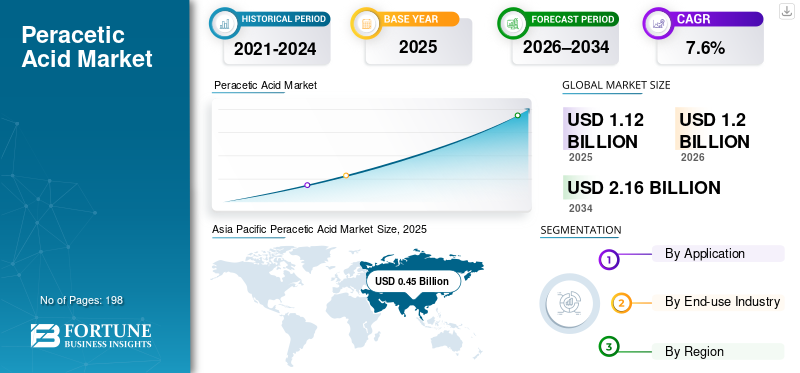
Download Free sample to learn more about this report.
Peracetic Acid Market Key Takeaways
 Market Size & Forecast
- 2025 Market Size: USD 1.12 billion
- 2026 Market Size: USD 1.20 billion
- 2034 Forecast Market Size: USD 2.16 billion
- CAGR: 7.6% from 2026–2034
 Market Share
- Asia Pacific dominated the peracetic acid market with a 40.17% share in 2025.
- The Food & Beverages segment is expected to hold the largest market share during the forecast period.
- The Sterilants segment is projected to grow at a 6.5% CAGR during 2026–2034.
 Key Regional Highlights
Asia Pacific
Rapid industrialization and food processing expansion continue to accelerate demand.
North America
Advanced wastewater treatment and healthcare sanitation sustain steady market growth.
Europe
Environmental regulations and food safety standards continue to support product adoption.
U.S.
Market reached USD 0.26 billion in 2025, accounting for 23.0% of global sales.
Japan
Water treatment upgrades and food export growth steadily increase product demand.
Read More

PERACETIC ACID MARKET TRENDS
Shift from Chlorine-Based Disinfectants to High-Performance Oxidizing Biocides
A defining trend in the market is its growing substitution for chlorine and chlorine dioxide in water treatment, food processing, and industrial sanitation. PAA offers strong efficacy against bacteria, viruses, fungi, and spores without generating halogenated Disinfection Byproducts (DBPs) such as Trihalomethanes (THMs), which are increasingly regulated. This positions PAA as a preferred solution in facilities seeking regulatory compliance alongside operational robustness.
In food and beverage processing, PAA adoption continues to rise due to its effectiveness at low temperatures, tolerance to organic matter, and suitability for Clean-in-Place (CIP) systems. Suppliers such as Ecolab and Solvay actively position stabilized PAA formulations for surface disinfection, equipment sanitation, and aseptic packaging, reflecting how PAA is marketed as a performance-driven hygiene solution rather than a commodity oxidant.
Download Free sample to learn more about this report.
MARKET DYNAMICS
MARKET DRIVERS
Water and Wastewater Treatment Regulations Drive Structural Demand
One of the strongest demand for peracetic acid market growth is municipal and industrial wastewater disinfection. Increasing water reuse requirements, stricter effluent discharge norms, and public sensitivity to chemical residuals are pushing utilities toward non-chlorinated disinfection technologies. PAA’s rapid decomposition and minimal residual toxicity make it particularly attractive for tertiary treatment and reuse applications.
Regulatory frameworks reinforce this driver. In Europe, the Urban Wastewater Treatment Directive (recast proposals under EU Green Deal objectives) and national water quality standards support advanced disinfection technologies. Similarly, in North America, tightening state-level discharge permits and reuse guidelines encourage adoption of alternatives to chlorine, sustaining long-term PAA demand.
MARKET RESTRAINTS
Cost Sensitivity and Handling Complexity Limit Broader Penetration
Despite its technical advantages, peracetic acid faces restraints related to cost and handling. PAA is generally more expensive on a per-unit basis than traditional chlorine disinfectants, particularly in high-volume municipal applications. Price sensitivity can delay adoption in cost-constrained regions or facilities with legacy chlorination infrastructure.
In addition, peracetic acid is a reactive oxidizer that requires careful storage, stabilization, and dosing system design. Safety considerations related to corrosion, material compatibility, and operator training can increase total cost of ownership, especially for smaller end users without established chemical management capabilities.
MARKET OPPORTUNITIES
Growth in Water Reuse, Healthcare Hygiene, and Decentralized Sanitation
A key opportunity for the market lies in expanding water reuse programs, particularly in water-stressed regions. PAA is well suited for reuse schemes as it does not leave persistent toxic residues, aligning with sustainability and circular water objectives.
Healthcare and life-sciences sanitation also represent high-value growth segments. PAA is increasingly used in hospital surface disinfection, medical device sterilization, and pharmaceutical cleanroom sanitation, where efficacy against resistant microorganisms and rapid breakdown are critical. These applications favor higher-margin, formulated PAA products rather than bulk commodity grades.
Decentralized sanitation systems, including packaged wastewater treatment units and industrial onsite disinfection systems, further expand the addressable market, especially in emerging economies and remote industrial operations.
MARKET CHALLENGES
Stability, Logistics, and Application-Specific Optimization to Challenge Market Growth
A recurring challenge in the peracetic acid market is balancing stability with performance. PAA exists in equilibrium with acetic acid and hydrogen peroxide, and maintaining shelf life while ensuring rapid antimicrobial activity requires formulation expertise. This makes product performance highly supplier-dependent and application-specific.
Additionally, logistics constraints including transport regulations for oxidizing substances and temperature sensitivity can complicate supply chains, particularly in regions with limited chemical handling infrastructure. End users often require technical support to optimize dosing, materials compatibility, and safety protocols, increasing the importance of service capability alongside product supply.
TRADE PROTECTIONISM AND GEOPOLITICAL IMPACT
Global chemical supply chain disruptions, energy price volatility, and trade tensions indirectly affect the peracetic acid market through upstream raw materials such as hydrogen peroxide and acetic acid. Tariffs, freight costs, and regional capacity imbalances can influence pricing and availability, particularly in import-dependent regions.
At the same time, localization of water treatment and hygiene chemical supply is gaining importance as governments prioritize resilience in critical infrastructure. This supports regional production investments and partnerships, especially in Asia Pacific and the Middle East.
RESEARCH AND DEVELOPMENT (R&D) TRENDS
R&D efforts in the peracetic acid market focus on formulation stability, controlled reactivity, and application-specific performance optimization. Advances include buffered and stabilized PAA systems that improve shelf life and reduce corrosion while maintaining biocidal efficacy.
Innovation is also visible in blended oxidizing systems combining PAA with hydrogen peroxide or other peroxygen compounds to tailor kill rates and organic load tolerance. In food and healthcare applications, low-odor, low-residue formulations are being developed to improve worker safety and user acceptance.
Digital dosing and monitoring systems integrated with PAA delivery are emerging as complementary innovations, enabling precise control, reduced chemical consumption, and improved compliance reporting.
SEGMENTATION ANALYSIS
By Application
Disinfectants & Sanitizers Dominate Due to Broad-Spectrum Efficacy and Regulatory Acceptance
Based on application, the market is segmented into disinfectants & sanitizers, sterilants, and others.
Among these, the disinfectants & sanitizers segment has the dominant peracetic acid market share. This dominance is driven by the extensive use of peracetic acid in water and wastewater treatment, food & beverage sanitation, industrial surface disinfection, and healthcare hygiene. Peracetic acid’s rapid microbial kill, effectiveness in the presence of organic matter, and decomposition into non-toxic byproducts make it particularly suitable for continuous and high-throughput disinfection processes.
The sterilants segment represents a smaller but higher-value portion of the peracetic acid market. Growth in this segment is driven by demand from healthcare facilities, pharmaceutical manufacturing, and medical device reprocessing, where stringent sterility requirements favor strong oxidizing agents with proven sporicidal activity. The segment is expected to grow at a CAGR of 6.5% during study period.
The others segment includes pulp & paper bleaching, agriculture, cooling water treatment, and specialty industrial oxidation processes. In pulp and paper, peracetic acid is used as an environmentally favorable bleaching and slime control agent, particularly in mills seeking to reduce chlorine-based chemicals. Agricultural and specialty industrial uses remain niche and highly application-dependent, often influenced by local regulations, cost considerations, and availability of alternative chemistries.
By End-use Industry
To know how our report can help streamline your business, Speak to Analyst
Food & Beverages Leads Due to Increasingly Stringent Food Safety Regulations
Based on end-use industry, the market is segmented into food & beverages, healthcare, water treatment, pulp & paper, and others.
The food & beverages segment is expected to hold the major market share during the forecast period. PAA is widely used for clean-in-place (CIP) sanitation, equipment and surface disinfection, packaging sterilization, and produce washing, owing to its efficacy at low temperatures and lack of harmful residues. Growth in this segment is reinforced by increasingly stringent food safety regulations and by the globalization of food supply chains. Export-oriented processors, particularly in meat, poultry, dairy, beverages, and fresh produce, favor peracetic acid to meet international hygiene standards while minimizing chemical residues. Multinational food companies further accelerate adoption by applying standardized sanitation protocols across facilities.
The healthcare segment is expected to register significant growth during the forecast period. Peracetic acid is used in hospital surface disinfection, medical device reprocessing, and pharmaceutical cleanroom sanitation, where high-level antimicrobial performance is required. PAA-based solutions are particularly relevant for low-temperature sterilization of heat-sensitive medical instruments, including endoscopes and surgical tools. Demand is supported by rising healthcare expenditure, increased focus on infection prevention, and stricter sterilization protocols, especially in developed markets and healthcare hubs in emerging regions. The segment is expected to grow at a CAGR of 7.4% during study period.
The water treatment segment is experiencing strong market growth driven by its use in municipal wastewater disinfection, industrial effluent treatment, and water reuse applications. Peracetic acid’s effectiveness against a broad range of microorganisms, combined with its rapid decomposition into environmentally benign byproducts, makes it particularly suitable for applications where residual toxicity and chlorinated disinfection byproducts are regulatory concerns.
The others segment comprises industrial cleaning, cooling water treatment, agriculture, and specialty oxidation processes. These applications are typically niche and highly application-specific, influenced by local regulatory frameworks, cost considerations, and the availability of alternative chemistries.
PERACETIC ACID MARKET REGIONAL OUTLOOK
By region, the market is segmented into North America, Europe, Asia Pacific, Latin America, and the Middle East & Africa.
Asia Pacific
Asia Pacific Peracetic Acid Market Size, 2025 (USD Billion)
To get more information on the regional analysis of this market, Download Free sample
Asia Pacific is the fastest-growing regional market, driven by rapid urbanization, expanding industrial wastewater treatment capacity, and growth in food & beverage processing. China and India are key contributors, although adoption varies based on cost sensitivity and infrastructure maturity.
China Peracetic Acid Market
China’s market is one of the largest globally, with 2025 revenue at USD 0.25 Billion, representing roughly 22.3% of global sales.
To know how our report can help streamline your business, Speak to Analyst
North America
North America represents a mature, high-value market supported by advanced wastewater treatment infrastructure and strong adoption in food processing and healthcare sanitation. Regulatory scrutiny of disinfection byproducts supports continued substitution of chlorine-based systems with PAA.
U.S. Peracetic Acid Market
In 2025, the U.S. represented a USD 0.26 billion market in North America, driven primarily by strong demand from the industrial sector. The U.S. accounts for roughly 23.0% of global market sales.
Europe
Europe’s market is shaped by environmental regulations, water reuse initiatives, and strict food safety standards. Sustainability considerations and DBP regulations reinforce demand for non-halogenated disinfectants across municipal and industrial applications.
Germany Peracetic Acid Market
The Germany market in 2025 was valued at around USD 0.06 billion, representing roughly 5.6% of global market revenues.
U.K. Peracetic Acid Market
The U.K. market in 2025 was valued at around USD 0.05 billion, representing roughly 4.4% of global market revenues.
Latin America
The Latin America market is moderate in size but structurally improving, driven by incremental upgrades in water treatment, food processing hygiene, and industrial sanitation rather than large-scale regulatory mandates. Demand is concentrated in Brazil, Mexico, Chile, and Colombia, where industrial water treatment, food exports, and urban wastewater management are relatively more developed.
Brazil Peracetic Acid Market
Brazil market in 2025 was valued at around USD 0.02 billion, representing roughly 2.0% of global market revenues.
Middle East & Africa
The Middle East & Africa market is highly fragmented and project-driven, with demand concentrated in Gulf Cooperation Council (GCC) countries, South Africa, and select North African markets. Growth dynamics differ sharply between the Middle East and Sub-Saharan Africa, but both are linked to water scarcity, industrial development, and hygiene-critical applications.
GCC Peracetic Acid Market
GCC market in 2025 was valued at around USD 0.01 billion, representing roughly 1.3% of global market revenues.
COMPETITIVE LANDSCAPE
KEY INDUSTRY PLAYERS
Key Players are Adopting an Expansion Strategy to Maintain their Dominance in Market
Major investments are underway in the market as manufacturers respond to rising sustainability expectations and higher performance requirements across end-use industries. Leading producers, such as Solvay SA, Evonik Industries AG, Ecolab Inc., LANXESS AG, FMC Corporation, and Christeyns Group, are directing capital toward process optimization, product quality enhancement, and environmentally aligned manufacturing practices. Innovation efforts are increasingly focused on enhancing purity consistency, reducing the environmental footprint, and developing applications suitable for advanced products.
LIST OF KEY PERACETIC ACID COMPANIES PROFILED IN REPORT
- Solvay SA (Belgium)
- Evonik Industries AG (Germany)
- Ecolab Inc. (U.S.)
- LANXESS AG (Germany)
- FMC Corporation (U.S.)
- Christeyns Group (Belgium)
- Kemira Oyj (Finland)
- Arkema Group (France)
- PeroxyChem (U.S.)
- Aditya Birla Chemicals (India)
KEY INDUSTRY DEVELOPMENTS
- April 2025: Solvay advanced its peroxide and peracetic acid offerings targeted at water treatment and industrial sanitation, reinforcing its positioning around chlorine-free disinfection and reduced environmental impact. The company emphasized alignment with tightening wastewater discharge norms and water reuse initiatives.
- February 2025: Evonik continued the integration and optimization of its peroxygen chemicals portfolio following the PeroxyChem acquisition, with emphasis on peracetic acid solutions for water treatment and biosecurity applications. The company highlighted enhanced formulation capabilities and global supply reliability as part of its active oxygen growth strategy.
- January 2025: Ecolab expanded its peracetic-acid-based disinfectant and sanitizer solutions for food & beverage and healthcare customers, integrating chemical supply with digital monitoring and dosing systems. This reflects the company’s strategy of coupling chemistry with service-led hygiene and compliance solutions.
REPORT COVERAGE
The peracetic acid market report provides a detailed analysis of the market. It focuses on key aspects, such as leading companies, application, and end-use industry. Besides this, it offers insights into the market and current industry trends and highlights key industry developments. In addition to the factors mentioned above, the report also covers several factors contributing to market growth.
Request for Customization to gain extensive market insights.
Report Scope & Segmentation
| ATTRIBUTE | DETAILS |
| Study Period | 2021-2034 |
| Base Year | 2025 |
| Estimated Year | 2026 |
| Forecast Period | 2026-2034 |
| Historical Period | 2021-2024 |
| Unit | Value (USD Billion), Volume (Kiloton) |
| Growth Rate | CAGR of 7.6% from 2026 to 2034 |
| Segmentation | By Application, By End-use Industry, By Region |
| By Application |
|
| By End-use Industry |
|
| By Region |
|
Frequently Asked Questions
Fortune Business Insights says that the global market size was valued at USD 1.12 billion in 2025 and is projected to reach USD 2.16 billion by 2034.
Recording a CAGR of 7.6%, the market is slated to exhibit steady growth during the forecast period of 2026-2034.
The food & beverages segment is expected to lead market during the forecast period.
Asia Pacific held the highest market share in 2025.
Water and wastewater treatment regulations drive structural demand.



- 2021-2034
- 2025
- 2021-2024
- 198
Get 30-60 hrs Free Customization
Expand Regional and Country Coverage, Segments Analysis, Company Profiles, Competitive Benchmarking, and End-user Insights.


















Related Reports
-
US +1 833 909 2966 ( Toll Free )
-
Get In Touch With Us