Personal Protective Equipment (PPE) Market Size, Share & Industry Analysis, By Product (Hand Protection, Eye & Face Protection {Safety Spectacles, Safety Goggles, Welding Shields, Face Shields, & Head Gear}, Hearing Protection {Ear Plugs, Cap Mounted Earmuffs, and Hearing Bands}, Protective Clothing, Respiratory Protection {Air Purifying Respirators (APR) and Supplied Air Respirators}, Protective Footwear, Fall Protection, & Head Protection), By End-use Industry (Manufacturing, Construction, Automotive, Oil & Gas, Healthcare, Food, Chemical, & Transportation), and Regional Forecast, 2026-2034
 Download Free Sample
Personal Protective Equipment (PPE) Market Size Overview 2026-2034
 Listen to Audio Version
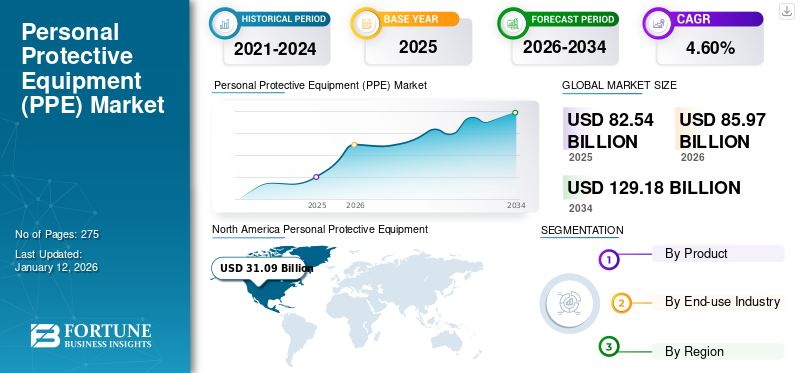
The global personal protective equipment (PPE) market size was valued at USD 82.54 billion in 2025 and is projected to grow from USD 85.97 billion in 2026 to USD 129.18 billion by 2034, exhibiting a CAGR of 4.60% during the forecast period. North America dominated the personal protective equipment market with a market share of 36% in 2025.
Personal protective equipment (PPE) is majorly used to protect the user from safety hazards or workplace health. PPE is a significant source of emergency and recuperation of workers' safety. The growing consideration of workers’ safety in oil & gas, mining, construction, and manufacturing industries will drive market trends. The market includes all safety gear designed to protect users from various workplace hazards. Employers are mostly seeking PPE gear for their personnel, benefiting from saving surplus expenses on employee compensation, medical expenditures, and lost manufacturing time. Strict regulatory mandates from bodies such as the Occupational Safety and Health Administration (OSHA), the National Institute for Occupational Safety and Health (NIOSH), and the American National Standards Institute (ANSI) make it compulsory for workers to ensure the safe usage of equipment in accident-prone areas. This, in turn, is expected to boost the PPE industry size. Companies operating in the market include key players such as 3M, Ansell Ltd., DuPont, Bullard, and MSA Safety, among others.
Download Free sample to learn more about this report.
GLOBAL PERSONAL PROTECTIVE EQUIPMENT (PPE) MARKET TAKEAWAYS
 Market Size & Forecast
- 2025 Market Size: USD 82.54 billion
- 2026 Market Size: USD 85.97 billion
- 2034 Forecast Market Size: USD 129.18 billion
- CAGR: 4.60% from 2026–2034
 Market Share
- North America dominated the personal protective equipment market with a market share of 36% in 2025.
- The hand protection segment is anticipated to hold a dominant market share of 31.16% in 2026.
- The healthcare segment is expected to account for a considerable share of 32.78% in 2026.
 Key Regional Highlights
North America
In terms of revenue, North America accounted for the largest market share in 2024. The rising number of fatal accidents in the workplace and increasing workers’ and manufacturers’ awareness regarding occupational safety measures will drive regional market growth.
Europe
Europe is expected to remain the second-largest regional market, driven by supportive PPE regulations, renewable energy investments, and growing demand from the food & beverage sector.
Asia Pacific
Asia Pacific is projected to witness significant growth due to rapid industrialization, expanding manufacturing activities, and increasing infrastructure development across emerging economies.
U.S.
The market is valued at USD 26.06 billion in 2026, supported by stringent OSHA regulations, strong enforcement of workplace safety standards, and growing investments in healthcare and industrial safety.
Japan
The market is valued at USD 2.95 billion in 2026, driven by increasing industrial safety requirements, technological advancements in manufacturing, and continued focus on worker protection across industries.
Read More

PERSONAL PROTECTIVE EQUIPMENT (PPE) MARKET TRENDS
Utilization of Biodegradable and Recyclable Materials for Manufacturing Safety Gloves Shall Drive Market
Glove manufacturers across the globe are making efforts to make the environment greener, safer, and cleaner. Every year, millions of gloves end up in landfills and causing soil pollution. Companies such as Showa, Globus, and others have introduced biodegradable disposable nitrile gloves, encouraging the development of green products. Glove producers can reduce their energy footprint by designing new machines or modifying existing machines to lower energy consumption. Additionally, companies can offer packaging made from 100% recycled materials for inner dispensers and outer cases made from 100% post-consumer waste.
- North America witnessed a growth from USD 31.09 billion in 2025 to USD 32.68 billion in 2026.
Growing Usage of Eco-Friendly Materials to Propel Market Growth
The ongoing trend of using eco-friendly materials to maintain environmental safety has led to a rise in the industrial head protection market. Companies are sourcing eco-friendly raw materials such as bio-plastics to manufacture safety helmets and leveraging technological advancements to augment product demand. For instance, MSA offers V-Gard GREEN Hard Hat, USDA Certified Bio-based with 95% bio-based content. These helmets are manufactured from a biopolymer named Green High-Density Polyethylene (GHDPE), mainly made from sugarcane-based ethanol. The product offers the benefits of reducing atmospheric CO2 and curbing carbon emissions associated with GHDPE production.
Download Free sample to learn more about this report.
MARKET DYNAMICS
MARKET DRIVERS
Growth in the Construction Industry to Drive Personal Protective Equipment (PPE) Market
According to market analysis, the growing infrastructure and construction projects in the U.S., China, and India present significant opportunities for market expansion. As per OSHA, in 2020, the construction industry accounted for more than 995 out of 4,500 fatalities, primarily resulting from incidents such as collapses, falls, being hit by objects, electrocution, trench and equipment malfunctions such as those involving forklifts and cranes.
Falls are the major reason for the construction sector's rising fatality rates. According to OSHA, construction-related falls result in around 100,000 injuries and nearly 100 to 200 deaths every year. The increasing novel infrastructure projects for residential and commercial building developments shall boost the personal protective equipment (PPE) market growth. Furthermore, construction workers wear protective boots or shoes with puncture-resistant and slip-resistant soles to prevent crushed toes when working around falling objects or heavy equipment. Stringent regulatory policies, norms, and high mortality rates have been established to safeguard workers’ well-being, contributing to market growth.
MARKET RESTRAINTS
Sales of Inexpensive and Low-quality Products to Restrict Market Growth
Insufficient consumer knowledge about workplace dangers, coupled with the availability of substandard, low-grade products, might impede market expansion. Additionally, the risk of counterfeit, low-quality, and alternative products could hinder the industrial safety footwear segment's growth. Furthermore, these items go through stringent quality assessments mandated by regulatory bodies to counteract the challenges posed by the disorganized sector.
MARKET OPPORTUNITIES
Security and Safety Compliance at Workplace to Augment PPE Market Growth
The increasing awareness of workers’ safety and health, along with surging industry fatalities, fosters the market. The market includes protective clothing, earplugs, emergency escape devices, eyewear, footwear, full-body harnesses, goggles, protective gloves, and safety helmets.
The increasing number of fatality rates or hazards in the workplace has forced workers to use personal protective equipment (PPE) to ensure individuals' safety. For instance, according to the International Association of Oil & Gas Producers (IOGP), there was an 8% drop in the fatal accident rate and a reduction in fatalities in the oil & gas industry from 33% in 2017 to 31% in 2019. NIOSH has issued guidelines to reduce the chances of these fatalities by performing hazard evaluations at the well site, educating workers about the risks linked to tank gauging, implementing respiratory protection such as Self-contained Breathing Apparatus (SCBA), and establishing protocols for emergency medical response in case of an incident.
Moreover, OSHA has framed occupational health and safety regulations in the U.S. to promote the proper usage of the product. In addition, various compliance-consulting firms provide recognized certifications and tests for proper product usage to maintain a healthy workplace environment.
MARKET CHALLENGES
Influx of Counterfeit Products to Create Challenges for Market Growth
The influx of counterfeit and substandard PPE has become a critical issue in the global market, especially after the high demand that was caused during the COVID-19 pandemic. These products often resemble certified equipment but fail to meet established safety and performance standards, posing serious risks to end users. Their widespread availability undermines trust, endangers frontline workers, and disrupts supply chains. For businesses and regulatory authorities, ensuring product authenticity has become increasingly more complex, necessitating stricter procurement practices and stronger regulatory compliance. Efforts to combat this challenge include improved traceability measures, supplier audits, and collaboration with global certification bodies to maintain quality control and protect public health and workplace safety across various industries and regions.
TRADE BARRIERS AND PROTECTIONISM
Current Tariff War to Reshape Market Dynamics Across the Globe
U.S. tariffs on imported personal protective equipment are likely to have a significant impact on the global PPE market. By increasing the cost of foreign-made products, these tariffs may drive U.S. buyers to prioritize domestic suppliers or shift sourcing to countries with lower trade barriers. While this could offer short-term gains for U.S. manufacturers, it also risks disrupting global supply chains and reducing export opportunities for international producers. A decline in competition could lead to higher prices and potential supply shortages in the U.S. market. In addition to this, global PPE manufacturers may reassess their production and export strategies, potentially relocating facilities or diversifying their markets to mitigate tariff impacts. Overall, these trade measures could reshape the global PPE industry's structure and dynamics.
SEGMENTATION Analysis
By Product
Hand Protection Segment Captures the Major Share in the Market due to Increasing Workers’ Safety Awareness
Based on product, the market is classified into head protection, hearing protection, eye & face protection, protective clothing, protective footwear, respiratory protection, hand protection, fall protection, and others.
The hand protection segment is anticipated to hold a dominant market share of 31.16% in 2026. The rising awareness regarding workers’ safety in mining, construction, equipment manufacturing, and chemical industries will bolster industrial safety gloves. The growing demand for safety gloves is likely to boost the hand protection segment. Workplace activities involve handling sharp-edge materials such as metal, abrasion, and glass materials, which may augment product adoption. Safety gloves play a crucial role in safeguarding workers from chemical burns and metal cuts. In addition, most safety glove manufacturing companies are forming strategies, including acquisitions, to enhance their product portfolio and boost business expansions.
Demand for respiratory protection is primarily driven by increased awareness and stricter regulations regarding workplace safety in environments with airborne hazards. Industries such as construction, mining, pharmaceuticals, and manufacturing require protection against dust, fumes, and harmful particles, making respiratory equipment essential. The COVID-19 pandemic further emphasized the importance of such protection, particularly in healthcare and public settings. As a result, both regulatory bodies and employers are prioritizing investments in reliable respiratory protective equipment to meet safety standards, minimize health risks, and ensure worker well-being. This ongoing focus continues to support steady growth for the respiratory protection segment across key sectors worldwide.
By End-use Industry
To know how our report can help streamline your business, Speak to Analyst
Manufacturing Segment is Likely to Account for a Major Market Share Due to the Rising Demand for Protective Gloves and Safety Shoes
By end-use industry, the market is divided into manufacturing, construction, automotive, oil & gas, healthcare, chemical, food, transportation, and others.
The manufacturing industry is anticipated to account for a major share during the forecast period, driven by the inherent risks associated with the sector. For instance, in the welding industry, workers must use earmuffs or earplugs to protect themselves against noise. In addition, they must wear protective gloves and safety shoes to protect against electric shocks, heat burns, and fires. In addition, protective respirators are used to save oneself from oxides and fumes. While welding, one must wear a helmet, flame-resistant protective clothing, goggles, and a hand shield to protect against radiation, hot slags, chemical burns, sparks, and flying particles.
Working in the food & beverage sector requires an uncompromising commitment to quality control and safety. Protective clothing is used in the food manufacturing industry to reduce the risk of food product contamination. Workers use a wide array of protective clothing, including overalls, suits, jackets, smocks, sleeves, aprons, and hair covers. DuPont, for instance, recommends protective clothing made from its Tyvek fabric, which prevents contamination from dust particles, bacteria, spores, and parasites carried on regular clothing or the human body.
The healthcare segment is expected to account for a considerable share of 32.78% in 2026, attributed to the increasing incidence of infectious diseases such as COVID-19. Rising awareness regarding self-protection is further supporting segment growth. Health care personnel and frontline workers, who are most exposed to the virus, rely heavily on coveralls, masks, and gloves. The substantial increase in the demand for these products in hospitals and clinics is further augmenting the segment’s growth. The manufacturing segment is expected to hold a 18.5% share in 2024.
Personal Protective Equipment (PPE) Market REGIONAL OUTLOOK
Geographically, the market is studied across North America, Europe, Asia Pacific, Latin America, and the Middle East & Africa.
North America
North America Personal Protective Equipment (PPE) Market Size, 2025 (USD Billion)
To get more information on the regional analysis of this market, Download Free sample
In terms of revenue, North America accounted for the largest market share in 2024. The rising number of fatal accidents in the workplace and increasing workers’ and manufacturers’ awareness regarding occupational safety measures will drive regional market growth.
In the U.S., stringent regulatory frameworks such as OSHA standards, coupled with strong enforcement mechanisms, have significantly boosted demand for advanced personal protective equipment across industries including construction, oil & gas, and healthcare. This proactive regulatory environment ensures consistent investments in safety gear adoption across the country. The U.S. market is valued at USD 26.06 billion by 2026.
According to the U.S. Bureau of Labor Statistics, around 5,250 workers died from work-related injuries in 2019. In addition, the increasing government expenditure in the medical and healthcare sectors will further drive the market during the upcoming years.
- In U.S., the manufacturing segment is estimated to hold a 16.4% market share in 2024.
To know how our report can help streamline your business, Speak to Analyst
Europe
Europe is expected to be the second dominant region in this market due to a rise in government investments in renewable energy sources. Supportive government regulation, such as the EU Directive 2016/425 on personal protective equipment, ensuring quality standards for safety equipment sold in the European market, will fuel the regional market growth. Increasing safety glove demand in the food & beverage industry is expected to drive the regional market growth further. The UK market is valued at USD 5.64 billion by 2026, while the Germany market is valued at USD 7.65 billion by 2026.
Asia Pacific
Asia Pacific is expected to grow significantly during the forecast timeframe. The rising infrastructure spending supported by rapid industrialization, mainly in India, Vietnam, and China, has led to the expansion of manufacturing industries in this region. The construction and building industry may witness an uptrend on account of government policy implementations regarding smart and energy-efficient building technologies. The Japan market is valued at USD 2.95 billion by 2026, the China market is valued at USD 7.63 billion by 2026, and the India market is valued at USD 1.16 billion by 2026.
Latin America and the Middle East & Africa
Latin America and the Middle East & Africa have also witnessed an increase in the number of people affected by the coronavirus. This surge has eventually led to high demand for products in the region. Brazil, with a large number of personal protective equipment manufacturers and technological advancements compared to other Latin American countries, is primarily boosting the regional market. Cities such as Dubai, Sharjah, and Abu Dhabi are known for tourism. The high demand from these regions is expected to boost the market size.
Competitive Landscape
KEY INDUSTRY PLAYERS
Key Players are Focusing on New Product Launches and Compliance to Strengthen their Market Position
The global PPE market is highly competitive, with several players ranging from global giants to regional suppliers. Leading companies such as 3M, Ansell Ltd., DuPont, Bullard, and MSA Safety dominate through strong brand presence, broad product portfolios, and consistent innovation. The market also faces intense price competition from low-cost manufacturers, especially in Asia Pacific. Ongoing demand and evolving safety regulations drive companies to invest in R&D, improve product quality, and expand distribution. The COVID-19 pandemic has further intensified rivalry, attracting new entrants and increasing market fragmentation. To stay competitive, key players are focusing on advanced features, compliance, and value-added services to meet diverse industry needs.
LIST OF KEY Personal Protective Equipment (PPE) Market COMPANIES PROFILED
- 3M (U.S.)
- Ansell Ltd. (Australia)
- Alpha ProTech (Canada)
- DuPont (U.S.)
- Avon Rubber p.l.c. (U.K.)
- Mallcom (India) Limited (India)
- Bullard (U.S.)
- Delta Plus Group (France)
- Supermax Corporation Berhad (Malaysia)
- MSA Safety (U.S.)
- Protective Industrial Products, Inc. (U.S.)
- Kimberly-Clark Worldwide, Inc. (U.S.)
- Uvex Group (Germany)
- COFRA S.r.l. (Italy)
- Lakeland Inc. (U.S.)
KEY INDUSTRY DEVELOPMENTS
- February 2024: Ansell Ltd. introduced a new highly textured glove called MICROFLEX Mega Texture 93-256 to the market. This orange-colored disposable nitrile glove provides a reliable grip and long-lasting protection for industrial workers. It is particularly well-suited for automotive shop employees needing a sturdy glove with tear resistance, high visibility, and excellent gripping capabilities.
- May 2024: Supermax Corporation Berhad completed the acquisition of Supermax Healthcare Canada Inc. By this acquisition, Supermax Healthcare Canada Inc. became a fully-owned subsidiary of Supermax. Such development strategies would help the company enhance its product portfolio in the PPE market.
- March 2023: Ansell opened its Greenfield Manufacturing Plant in India, investing USD 80 million in the plant. The new facility aims to provide the most innovative and highest-quality surgical gloves to healthcare professionals across the country.
- April 2022: Honeywell acquired Norcross Safety Products L.L.C., a manufacturer of PPE, for USD 1.2 billion. This acquisition would provide the company with a platform in the fragmented global business, projected to provide significant growth opportunities. This investment in Norcross allows the company to enter into a highly regulated industrial safety market completely.
- March 2022: 3M, MSA Safety and Dentec Safety Specialists redesigned reusable industrial face masks to better protect healthcare workers and help prevent mask shortages. These elastomeric respirators have gained NIOSH approval, as they are redesigned by either removing the exhalation valve or fitting it with a new filter and valve to trap the virus inside.
- January 2022: MSA Safety Incorporated acquired England-based Bristol Uniforms for USD 60 million. This acquisition would strengthen MSA Safety’s hold in fire service and PPE, expanding the business in the U.K. and key European markets.
REPORT COVERAGE
The research report provides a detailed analysis of the industry and focuses on crucial aspects such as leading companies and products. In addition, it offers insights into market trends and highlights vital industry developments. In addition to the factors mentioned above, the report encompasses various factors that have contributed to the market's growth in recent years. It includes historical data, forecasts revenue growth at global, regional, and country levels, and analyzes the industry's latest market dynamics and opportunities.
Request for Customization to gain extensive market insights.
Report Scope & Segmentation
|
ATTRIBUTE |
DETAILS |
|
Study Period |
2021-2034 |
|
Base Year |
2025 |
|
Estimated Year |
2026 |
|
Forecast Period |
2026-2034 |
|
Historical Period |
2021-2024 |
|
Growth Rate |
CAGR of 4.60% from 2026 to 2034 |
|
Unit |
Value (USD Billion) |
|
Segmentation |
By Product
|
|
By End-use Industry
|
|
|
By Region
|
Frequently Asked Questions
According to Fortune Business Insights, the global market size was USD 82.54 billion in 2025 and is projected to reach USD 129.18 billion by 2034.
In 2025, the market size in North America stood at USD 31.09 billion.
Registering a CAGR of 4.60%, the market will exhibit steady growth during the forecast period (2026-2034).
By end-use industry, the manufacturing segment is expected to lead the market during the forecast period.
Growing usage of eco-friendly materials is the key factor driving market growth.
3M, Ansell Ltd., DuPont, Bullard, and MSA Safety are the major players in the global market.
North America dominated the market in terms of revenue share in 2025.



- 2021-2034
- 2025
- 2021-2024
- 275
Get 30-60 hrs Free Customization
Expand Regional and Country Coverage, Segments Analysis, Company Profiles, Competitive Benchmarking, and End-user Insights.


















Related Reports
-
US +1 833 909 2966 ( Toll Free )
-
Get In Touch With Us