Synthetic Fiber Market Size, Share & Industry Analysis, By Type (Polyester, Nylon, Polypropylene, Acrylics, and Others), By Application (Clothing, Home Furnishing, Automotive, Healthcare, and Others), and Regional Forecast, 2026-2034
 Download Free Sample
KEY MARKET INSIGHTS
 Listen to Audio Version
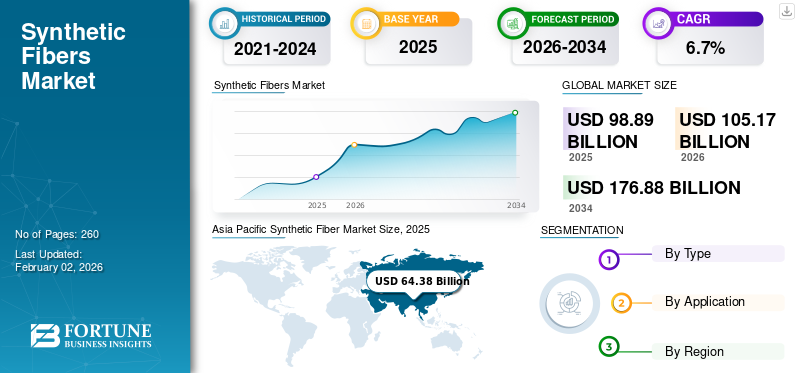
The global synthetic fiber market size was valued at USD 98.89 billion in 2025. The market is expected to grow from USD 105.17 billion in 2026 to USD 176.88 billion by 2034 at a CAGR of 6.7% during the forecast period. Asia Pacific dominated the synthetic fiber market with a market share of 65.10% in 2025.
Synthetic fibers are man-made fibers produced from chemical substances and are used extensively across industries. They are designed to offer high strength, durability, and elasticity. Widely observed in clothing for their ability to maintain shape and resist staining, these fibers are also critical in sectors such as healthcare, for making surgical meshes, and in the automotive industry for upholstery and tire reinforcement. In addition, their use in home furnishings for carpets and curtains is well appreciated for their colorfastness and ease of maintenance. Their versatility and cost-effectiveness make them a popular choice in various applications, from filtration systems to high-strength ropes used in construction and marine environments.
The COVID-19 pandemic negatively impacted the market due to the lockdown, which halted import-export activities globally. The pandemic significantly disrupted the market, reducing industrial demand and leading to production shutdowns. Supply chain interruptions and a downturn in end-use sectors, such as automotive and construction, further strained the market. However, recovery signs emerged as industries adjusted to new operational norms and demand rebounded.
Download Free sample to learn more about this report.
Global Synthetic Fiber Market Takeaways
 Global Market Size & Forecast
- 2025 Market Size: USD 98.89 billion
- 2026 Market Size: USD 105.17 billion
- 2034 Forecast Market Size: USD 176.88 billion
- CAGR: 6.7% from 2026–2034
 Market Share
- Asia Pacific dominated the synthetic fiber market with a 65.10% share in 2025.
- The polyester segment is expected to capture the largest market share of 83.10% in 2026.
- The clothing segment is expected to account for the largest market share of 60.64% in 2026.
 Key Regional Highlights
North America
North America represented 13.10% of the global market in 2025, driven by increasing demand for technical textiles, sportswear, outdoor gear, and home textile applications.
Europe
Europe accounted for 15.60% of the global market in 2025 and is expected to witness significant growth due to expanding construction, automotive, and water treatment industries.
Asia Pacific
Asia Pacific led the global market with a valuation of USD 64.38 billion in 2025 and is projected to reach USD 68.18 billion in 2026, supported by strong textile, automotive, industrial, and infrastructure demand.
U.S.
The U.S. synthetic fiber market is projected to reach USD 9.68 billion by 2026, supported by growing demand across technical textile and industrial applications.
Japan
The Japan synthetic fiber market is projected to reach USD 7.79 billion by 2026, reflecting continued demand from the country's advanced textile manufacturing sector.
Read More

Synthetic Fiber Market Trends
Rapidly Shifting Fashion Trends and the Expansion of E-Commerce to Create New Lucrative Opportunities
The rapidly shifting fashion trends and the expansion of e-commerce have significantly influenced the market. Firstly, they have accelerated the demand for versatile and durable products as consumers seek the latest trends quickly and affordably. Secondly, online shopping platforms have expanded the global reach of fashion brands, increasing the need for products that can withstand long shipping processes. Thirdly, the pace of changing fashion trends has pushed manufacturers to invest in innovative and sustainable products catering to eco-conscious consumers. In addition, e-commerce has facilitated direct-to-consumer sales models, increasing demand for personalized and custom-made synthetic fiber products. These factors have driven research and development in the industry, aiming for higher-quality, more sustainable materials. Asia Pacific witnessed a synthetic fiber market growth from USD 61.61 billion in 2022 to USD 57.39 billion in 2023.
Download Free sample to learn more about this report.
Synthetic Fiber Market Growth Factors
Increasing Demand for Lightweight Automotive Parts to Drive Market Growth
The growing need for the product in the automotive industry propels market expansion. Synthetic fiber components are used in the manufacturing of automotive upholstery and interiors to provide durability and aesthetic appeal. Automotive parts such as seat covers, carpets, and headliners are often made from these fibers due to their strength and resistance to wear and tear. Synthetic fiber-based materials are also used in the production of automotive filters, belts, and hoses for their excellent mechanical properties and heat resistance. The use of the product in automotive parts contributes to lighter vehicle weight, improved fuel efficiency, and reduced environmental impact. High-performance products are employed in the production of safety components such as airbags and seatbelts, enhancing passenger protection in vehicles. Synthetic fiber-reinforced composites are utilized in the manufacturing of lightweight and strong automotive body panels and structural parts. The application of these fibers in automotive parts aligns with the industry's emphasis on sustainability, cost-efficiency, and innovation in material technologies.
RESTRAINING FACTORS
Volatile Raw Material Prices May Impede Market Growth
Volatile raw material prices restrict the growth of the market by increasing production costs and reducing profit margins. Fluctuations in raw material prices can lead to uncertainty in planning and budgeting for product manufacturers. This volatility can also affect the competitiveness of the product compared to natural fibers. In addition, it can make it challenging for product producers to maintain stable pricing for their customers, which can impact market demand. Furthermore, consumers may experience fluctuations in product prices, which can affect demand patterns. Sharp fluctuations in raw material prices may result in price instability and uncertainty for both suppliers and consumers, potentially hindering the synthetic fiber market growth.
Synthetic Fiber Market Segmentation Analysis
By Type Analysis
Polyester Segment Dominated Owing to Its Rising Adoption in the Clothing Industry
Based on type, the market is segmented into polyester, nylon, polypropylene, acrylics, and others.
The polyester segment is expected to hold the largest share of the market, capturing 83.10% in 2026. Polyester is extensively utilized in the clothing industry to create long-lasting and wrinkle-resistant garments. Because of its moisture-wicking properties, it is a preferred option for sportswear and outdoor clothing. Polyester fibers can be combined with natural fibers to produce fabrics that are breathable and easy to maintain. In addition, polyester is used to manufacture different types of clothing, including shirts, dresses, and outerwear.
- The acrylics segment is expected to hold a 2.5% share in 2025.
The nylon segment is set to register significant growth during the forecast period. Due to its durability, strength, and flexibility, nylon is widely used in the market to produce clothing, carpets, and industrial materials. Its application in sportswear, hosiery, and other textiles has made nylon a popular choice in the market. In addition, nylon is utilized in the production of ropes, seatbelts, and tire cords, contributing to its significance in various industries.
Moreover, polypropylene is commonly used in the market for producing ropes, carpets, and geotextiles due to its high tensile strength, chemical resistance, and durability. Its applications range from industrial materials to household textiles, making it a versatile and widely utilized material in the industry.
By Application Analysis
To know how our report can help streamline your business, Speak to Analyst
Clothing Segment Holds Leading Position Due to Changing Fashion Trends
Based on application, the market is classified into clothing, home furnishing, automotive, healthcare, and others.
The clothing segment is expected to hold the largest share of the synthetic fiber market, capturing 60.64% in 2026. The dominance of the segment in the market is due to changing fashion trends, which have led to increased demand for the product in apparel production. This trend has prompted innovative applications of the product in clothing, such as performance wear and athleisure, aligning with evolving fashion demands. Moreover, the clothing-dominated market has facilitated the utilization of the product in sustainable fashion, driving advancements in eco-friendly textiles and apparel. This segment is projected to capture 61% of the market share in 2025.
The home furnishing segment is predicted to witness notable growth in the coming years. These fibers can be used in the production of durable and stain-resistant upholstery fabrics for sofas, chairs, and other furniture. Synthetic fiber-filled pillows and cushions are popular in the home furnishing segment due to their hypoallergenic and easy-to-clean properties. Synthetic fiber rugs and carpets are widely used in home furnishing due to their resilience, stain resistance, and affordability. This segment is expected to record a substantial CAGR of 6.48% durin the forecast period (2024-2032).
Furthermore, these products are widely used in the automotive industry for manufacturing seat upholstery, carpets, and other interior components due to their durability and stain-resistant properties. In addition, synthetic fiber-based composite materials are used in the production of lightweight automotive parts for improved fuel efficiency.
REGIONAL INSIGHTS
Based on region, the market is segmented into North America, Europe, Asia Pacific, Latin America, and the Middle East & Africa.
Asia Pacific Synthetic Fiber Market Size, 2025 (USD Billion)
To get more information on the regional analysis of this market, Download Free sample
Asia Pacific
Asia Pacific dominated the market with a valuation of USD 64.38 billion in 2025 and is projected to reach USD 68.18 billion in 2026. The region occupies the dominant share of the global market and might emerge as the fastest-growing region in the future. The booming textile and apparel industry primarily drives the market in the region. In addition, the increasing demand for automotive and industrial applications further boosts the market growth. The growth of the construction and infrastructure sectors also creates opportunities for synthetic fibers in products such as geotextiles. Furthermore, technological advancements in product production processes contribute to the market's expansion. The growing awareness of sustainable and eco-friendly fibers is also influencing the market dynamics in Asia Pacific. The Japan synthetic fiber market is projected to reach USD 7.79 billion by 2026, the China synthetic fiber market is projected to reach USD 38.26 billion by 2026, and the India synthetic fiber market is projected to reach USD 15.46 billion by 2026.
To know how our report can help streamline your business, Speak to Analyst
North America
The North America market generated USD 12.99 billion in 2025, representing 13.10% of the global market landscape, and is expected to reach USD 13.72 billion in 2026. The demand for technical textiles, such as geotextiles and automotive textiles, drives the market in North America. The use of the product in the production of sports and activewear also contributes to the market's growth. The durability and versatility of these fibers make them suitable for various applications, including outdoor gear and protective clothing. Furthermore, the increasing adoption of the product in the home textile industry also propels market growth in North America. The U.S. synthetic fiber market is projected to reach USD 9.68 billion by 2026.
Europe
Europe contributed 15.60% to the global market in 2025, with a valuation of USD 15.45 billion, and is projected to reach USD 16.69 billion in 2026. Europe is expected to showcase significant growth in the global market during the forecast period. The expansion of the construction sector, especially in Eastern Europe, is boosting the demand for glass. The rising automotive industry, which uses glass extensively, also supports the need for synthetic fibers in Europe. Lastly, advancements in water treatment technologies, where it is used to adjust pH levels, further contribute to the rising demand within the region. The UK synthetic fiber market is projected to reach USD 4.12 billion by 2026, while the Germany synthetic fiber market is projected to reach USD 5.31 billion by 2026.
Rest of the World
Latin America is the fourth largest market likely to reach USD 4.03 billion in 2025. Latin America and the Middle East & Africa markets are projected to grow moderately during the assessment period. The escalating natural synthetic fiber production in countries such as Turkey contributes to the market's expansion in the Middle East & Africa. Economic growth and increasing consumer spending power in Latin American countries further fuel the demand for products, enhancing the market growth. Lastly, environmental regulations promoting cleaner processes and products have led to innovations and adaptations in the industry, supporting sustainable market growth in these regions. Saudi Arabia is projected to grow with a valuation of USD 0.97 billion in 2025.
In 2025, Middle East & Africa held 2.10% of the global market, reaching a valuation of USD 2.04 billion, and is projected to grow to USD 2.21 billion in 2026.
Latin America contributed approximately USD 4.03 billion to the global market in 2025, accounting for 4.10% share, and is expected to reach USD 4.37 billion in 2026.
KEY INDUSTRY PLAYERS
Key Players to Adopt Organic and Inorganic Business Growth Strategies to Maintain Dominance in Market
In terms of the competitive landscape, the market depicts the presence of established and emerging companies. Mitsui Chemicals, DuPont, TORAY INDUSTRIES, INC., Leigh Fibers, Inc., and Indo Rama Synthetics are some of the key players in this market. Global players in the market have heavily invested in developing better technologies to improve product output. Superior operational efficiency and novel technology development are the strategies the market leaders use for their growth. In addition, major players focus on acquisition and expansion activities to increase their market share.
LIST OF TOP SYNTHETIC FIBER COMPANIES:
- Mitsui Chemicals (Japan)
- DuPont (U.S.)
- TORAY INDUSTRIES, INC. (Japan)
- Leigh Fibers, Inc. (U.S.)
- Indo Rama Synthetics (India)
- Toyobo (Japan)
- China Petroleum (Taiwan)
- Indorama Ventures Public Company Limited (Thailand)
- Bombay Dyeing (India)
- Reliance Industries Limited (India)
KEY INDUSTRY DEVELOPMENTS:
- August 2023: Teijin Limited announced that it is developing new sustainable synthetic fibers. These new fibers will be made from recycled materials and will have a lower environmental impact than traditional synthetic fibers.
- July 2023: China Petroleum & Chemical Corporation (Sinopec) announced that it will expand its synthetic fibers business in Asia. The company plans to invest USD 1 billion in building new synthetic fiber production facilities in China, India, and Indonesia.
- June 2023: Reliance Industries Limited (RIL) announced that it will invest USD 750 million in expanding its polyester business. This investment will help the company increase its production capacity of polyester fibers by 50%.
- April 2023: DuPont introduced Kevlar EXO aramid fiber, a significant innovation in aramid technology. This new platform serves various applications requiring high performance and protection in demanding conditions.
- April 2023: Toray Industries, Inc. unveiled the rebranding of its &+ fiber brand made from recycled PET bottles. This move shows the company’s commitment to expanding the raw materials range it collects in making its contribution to a sustainable society with its textile business.
REPORT COVERAGE
The research report provides a detailed market analysis and focuses on crucial aspects such as leading companies, types, and applications. In addition, it provides quantitative data regarding volume and value, market analysis, research methodology for market data, insights into market trends, vital industry developments, and the competitive landscape. In addition to the abovementioned factors, the report encompasses various factors that have contributed to the market's growth in recent years.
Request for Customization to gain extensive market insights.
Report Scope & Segmentation
|
ATTRIBUTE |
DETAILS |
|
Study Period |
2021-2034 |
|
Base Year |
2025 |
|
Estimated Year |
2026 |
|
Forecast Period |
2026-2034 |
|
Historical Period |
2021-2024 |
|
Unit |
Value (USD Billion) and Volume (Million Tons) |
|
Growth Rate |
CAGR of 6.70% during 2026-2034 |
|
Segmentation |
By Type
|
|
By Application
|
|
|
By Region
|
Frequently Asked Questions
Fortune Business Insights says that the global market size was USD 98.89 billion in 2025 and is projected to reach USD 176.88 billion by 2034.
In 2025, the Asia Pacific market value stood at USD 64.38 billion.
Growing at a CAGR of 6.70%, the market is expected to exhibit rapid growth during the forecast period.
By application, the clothing segment dominated the market in 2025.
The increasing demand for lightweight automotive parts is set to drive market growth.
Asia Pacific holds the highest market share.
Increasing demand in the automotive sector, coupled with its growing usage in lightweight automotive parts, is expected to drive product adoption in the market.



- 2021-2034
- 2025
- 2021-2024
- 260
Get 30-60 hrs Free Customization
Expand Regional and Country Coverage, Segments Analysis, Company Profiles, Competitive Benchmarking, and End-user Insights.


















Related Reports
-
US +1 833 909 2966 ( Toll Free )
-
Get In Touch With Us