Water Bottle Market Size, Share & Industry Analysis, By Product Type (Insulated, Non-Insulated, Filter, Infuser, and Others), By Material Type (Plastic, Stainless Steel, Glass, and Others), By Distribution Channel (Online and Offline), and Regional Forecast, 2026-2034
 Download Free Sample
(Offer valid till 30th Sep 2026)

KEY MARKET INSIGHTS
 Listen to Audio Version
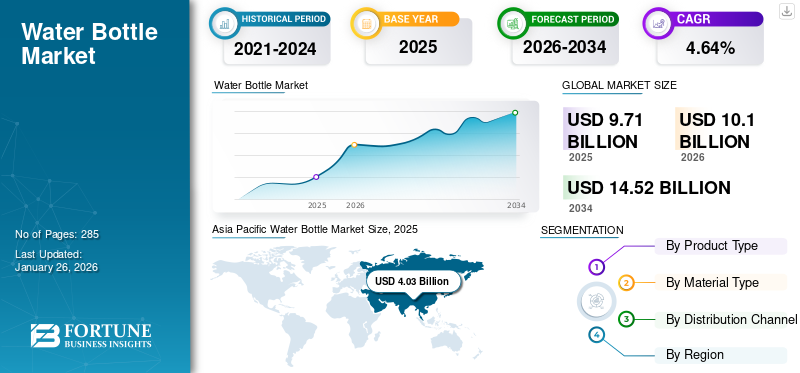
The global water bottle market size was valued at USD 9.71 billion in 2025. The market is projected to grow from USD 10.10 billion in 2026 to USD 14.52 billion by 2034, exhibiting a CAGR of 4.64% during the forecast period. Asia Pacific dominated the water bottle market with a market share of 41.96% in 2025.
A water bottle has become an everyday essential, as much as a wallet, smartphone, or car key, as it plays a key role in maintaining hydration throughout the day. Adequate water intake helps flush out toxins from the body, supports normal cellular functions, and sustains energy levels. Today’s market offers a wide variety of bottles: ranging from plastic, glass, and stainless steel to advanced, innovative designs. Many individuals are mindful in selecting their bottles, prioritizing options that minimize plastic waste and safeguard against harmful chemicals. Since proper hydration is fundamental to good health, carrying a bottle encourages regular water consumption and is particularly important during the summer months when fluid needs are higher.
The market encompasses several major players with Thermos L.L.C., Tupperware Brands Corporation, ZHEJIANG HAERS VACUUM CONTAINERS CO.,LTD., Klean Kanteen, and Vista Outdoor Operations LLC. leading at the forefront. Market players are aggressively launching new products with innovative bottle designs to boost product sales and attract new consumers.
Download Free sample to learn more about this report.
WATER BOTTLE MARKET KEY TAKEAWAYS
 Market Size & Forecast
- 2025 Market Size: USD 9.71 billion
- 2026 Market Size: USD 10.10 billion
- 2034 Forecast Market Size: USD 14.52 billion
- CAGR: 4.64% from 2026–2034
 Market Share
- Asia Pacific dominated the market with a 41.96% share in 2025.
- Non-insulated bottles will lead with a 34.46% share in 2026.
- Plastic material will dominate with a 35.25% share in 2026.
 Key Regional Highlights
North America
North America accounted for 29.99% of global revenue in 2025, valued at USD 2.93 billion, and is expected to reach USD 3.03 billion in 2026.
Europe
Europe held a 16.08% share in 2025, valued at USD 1.59 billion, and is projected to grow to USD 1.62 billion in 2026.
Asia Pacific
Asia Pacific generated USD 4.03 billion in 2025 and is projected to reach USD 4.24 billion in 2026, driven by rising reusable bottle adoption.
U.S.
The market is projected to reach USD 2.18 billion in 2026, supported by strong demand from hiking, camping, and fitness activities.
Japan
The market is projected to reach USD 0.85 billion in 2026, driven by growing preference for sustainable and reusable bottles.
Read More

MARKET DYNAMICS
MARKET DRIVERS
Increasing Number of Individuals Attending Educational Institutes to Trigger Product Adoption
A sizable number of educational institutes, including schools and colleges across countries globally, trigger demand for bottles as numerous students attending these institutes use bottles to frequently drink water and stay hydrated, which assists them in focusing on their studies. Governments globally consider education a priority and take initiatives to provide individuals with access to schooling. They emphasize improving school infrastructure and imposing regulations to increase the number of students in educational institutes. For instance, the U.K. government mandates education for kids between 5 and 16 across the country.
The growing number of individuals attending educational institutes worldwide boosts product sales and triggers global market growth.
- For instance, according to the U.S. Census Bureau, a Maryland, U.S.-based government agency providing data regarding the economy and American individuals, in 2022, total school enrollments reached 75.2 million students, witnessing a growth of around 1.3 million compared to 2021.
MARKET RESTRAINTS
Rising Consumer Consciousness Regarding Plastic Pollution to Hamper Product Demand
Consumers are increasingly cautious about what comes into contact with their drinking water and keen to understand the raw material used in the making of bottles. Countries worldwide face significant pollution challenges due to plastic waste, industrial emissions, mining, and other activities. For instance, according to UNESCO, a Paris, France, specialized agency under the United Nations, plastic waste contributes to around 80% of the plastic pollution globally, and approximately 8-10 million metric tons of plastic is disposed of in the ocean yearly. Governments globally are taking initiatives to prevent pollution and spread awareness regarding environmental protection.
- For instance, in 2022, the United States Agency for International Development (USAID), a government agency, introduced the Save Our Seas Initiative, focusing on preventing plastic from entering the environment. In this respect, the growing consumer consciousness regarding environmental protection will hamper the adoption of products such as plastic bottles. This will further boost the global reusable water bottle market growth.
MARKET OPPORTUNITIES
Smart and Multifunctional Bottles to Create Lucrative Growth Opportunities
Consumers today are increasingly health-conscious and tech-savvy, creating demand for reusable water bottles that can track daily water intake, remind users to stay hydrated through app connectivity, or even purify water using built-in UV sterilization. Pairing hydration with sustainability also presents a compelling opportunity. Bottles designed from eco-friendly, biodegradable, or recycled materials can appeal to environmentally conscious buyers who want to reduce single-use plastic. Additionally, customization and lifestyle-focused designs, such as insulated bottles that keep beverages hot or cold for extended periods, or compact foldable bottles for travelers, allow brands to tap into niche segments. By blending technology, sustainability, and personalization, the market can evolve from being a simple utility product to a lifestyle accessory with high consumer value.
WATER BOTTLE MARKET TRENDS
Shift toward High-Purity and GMP-Grade Exonuclease is One of the Significant Market Trends
In recent years, water bottles have been increasingly used in cell & gene therapy and advanced biological products manufacturing. Thus, demand for high-purity and GMP-grade exonuclease is rapidly increasing among the end users. This trend is primarily driven by stringent regulatory requirements needing regulatory compliance along with a rapidly expanding pipeline of cell & gene therapies from clinical trials into commercial scale.
- For instance, GMP-grade T5 Exonuclease has been introduced by New England Biolabs, which is intended to help biopharmaceutical
Download Free sample to learn more about this report.
Segmentation Analysis
By Type
Versatility and Easy Accessibility of Non-Insulated Bottles to Strengthen Segmental Growth
On the basis of the segmentation of type, the market is classified into insulated, non-insulated, filter, infuser, and others.
The non-insulated segment is anticipated to hold a dominant market share of 34.46% in 2026. Non-insulated water bottles are also known as standard or non-vacuum bottles and are typically made from plastic, single use plastic bottles, and glass. Moreover, non-insulated water bottles are more lightweight than insulated bottles due to the absence of additional insulating layers, driving their demand on a daily basis. Furthermore, these bottles are less complex and often fit with bottle holders, backpack pockets, and car cup holders, making them more popular among travelers and outdoor enthusiasts.
Additionally, these bottles are more affordable as compared to insulated bottles and are available in various colors and capacities. Moreover, the rising availability of water bottles with innovative lid options, including the straw lid, spout lid, lock top, narrow mouth, pull top, and screw top, propels the segment’s growth.
To know how our report can help streamline your business, Speak to Analyst
By Material Type
Increasing Focus on Sustainable and BPA-Free Plastic Materials to Fuel Segment’s Growth
In terms of material type, the market is categorized into plastic, stainless steel, glass, and others.
The plastic material segment captured the largest share of the market in 2025. In 2026, the plastic material segment is projected to lead the market with a 35.25% share. Plastic bottles are generally more affordable compared to alternatives, such as metal and glass bottles. The product’s low cost and widespread availability make it accessible to a broad range of consumers, driving the segment’s growth. Moreover, the rising availability of plastic bottles made using sustainable and BPA-free materials, including Tritan, boosts product demand among health-conscious and eco-conscious consumers.
The popularity of plastic infuser bottles and plastic collapsible bottles is growing significantly among health-conscious consumers and outdoor enthusiasts & travelers, offering health benefits and easy convenience.
The stainless steel segment is expected to grow at a CAGR of 5.08% over the forecast period.
By Distribution Channel
Widespread Presence of Brick & Mortar and Other Offline Stores to Drive Segment Expansion
Based on distribution channel, the market is segmented into online and offline.
The offline distribution channel held the dominating position in 2024. The offline segment is projected to dominate the market with a share of 69.11% in 2026. The offline channels include supermarkets, hypermarkets, convenience stores, department stores, specialty stores, and others. The extensive availability of a wide array of products, offering individuals multiple choices, propels the segment's growth. Moreover, offline channels allow consumers to check the quality of the products physically. Several players are launching their products across offline channels.
- For instance, in December 2022, Cove, a U.S.-based material company, launched its new biodegradable water bottles across all Erewhon stores (a California, U.S.-based supermarket chain) in Los Angeles.
The online distribution channel segment is set to flourish with a growth rate of 5.67% across the forecast period.
Water Bottle Market Regional Outlook
By region, the market is categorized into Europe, North America, Asia Pacific, Latin America, and Middle East & Africa.
Asia Pacific
Asia Pacific Water Bottle Market Size, 2025 (USD Billion)
To get more information on the regional analysis of this market, Download Free sample
The market in Asia Pacific reached USD 4.03 billion in 2025, representing 41.96% of total market revenue, and is projected to reach USD 4.24 billion in 2026. The factors fostering the dominance of the region include growing health and wellness awareness, rising urbanization and on-the-go lifestyles, environmental sustainability movements, along with increasing middle-class and lifestyle aspirations, among others. Expanding disposable incomes encourages consumers to choose premium, branded, or innovative bottles as lifestyle accessories rather than mere utility items. Moreover, the region has faced significant plastic waste challenges, leading governments, institutions, and individuals to adopt reusable bottles as a practical step toward reducing single-use plastic consumption. The Japan market is projected to reach USD 0.85 billion by 2026, the China market is projected to reach USD 1.3 billion by 2026, and the India market is projected to reach USD 1.02 billion by 2026.
- For instance, according to the Government of Dubai, in September 2022, the Dubai Can sustainability initiative cut down single-use plastic bottle usage by 3.5 million as the movement celebrated its six-month milestone.
North America
The North America market was valued at USD 2.93 billion in 2025, capturing 29.99% of global revenue, and is estimated to reach USD 3.03 billion in 2026. Other regions, such as North America and Europe, are anticipated to witness considerable growth in the coming years. The growth of the market in these regions is primarily driven by high consumption rates associated with hot beverages such as coffee and tea, and early adoption of stainless steel water containers. The growing importance of hydration and the rising trend of healthy lifestyles, along with the wide utilization of bottles for activities such as trekking & hiking, and gymming, among others boost product sales in the region. In countries such as the U.S., growing popularity of various outdoor activities, including hiking, camping, and trekking, boosts the demand for filter and collapsible water bottles among outdoor enthusiasts seeking durable and portable hydration solutions. The U.S. market is projected to reach USD 2.18 billion by 2026.
Europe
In 2025, Europe held 16.08% of the global market, reaching a valuation of USD 1.59 billion, and is projected to grow to USD 1.62 billion in 2026. Furthermore, strong emphasis of European consumers on using sustainable and eco-friendly materials in daily life, including water bottles, is fueling Europe market growth. The UK market is projected to reach USD 0.33 billion by 2026, while the Germany market is projected to reach USD 0.35 billion by 2026.
Latin America and Middle East & Africa
Over the forecast period, the Latin America and Middle East & Africa regions would witness significant growth in this industry. In 2025, the Middle East & Africa market stood at USD 0.73 billion, representing 7.55% of global demand, and is projected to grow to USD 0.76 billion in 2026. A rise in the participation rate of individuals in recreational and sports activities has increased massively, pushing product demand. In Latin America, awareness coupled with raising hygienic standards among the people is set to consolidate the market growth in the future years.
South America
South America recorded a market size of USD 0.43 billion in 2025, capturing 4.42% of the global market share, and is projected to reach USD 0.45 billion in 2026.
COMPETITIVE LANDSCAPE
Key Industry Players
Wide Range of Product Offerings and Strong Distribution Network of Key Players, Supported their Leading Position
A blend of sustainability, innovation, and lifestyle positioning is shaping the competitive scenario in the water bottle industry. Traditional players are no longer competing on utility alone; instead, brands are increasingly differentiating through eco-friendly materials, sleek aesthetics, and multifunctional features. Stainless steel and glass bottles are gaining ground as healthier, durable alternatives to plastic, while key players are experimenting with recycled or biodegradable materials to align with global sustainability movements.
For instance, in January 2024, S'well, a U.S.-based water bottle and insulated products company, launched its new bottle, the S'well Explorer. According to the company, the new bottle is made from 91% recycled and post-consumer stainless steel. Design has also become a competitive advantage for bottles, evolving from simple hydration tools into lifestyle accessories, where style, personalization, and portability influence consumer choice just as much as function.
LIST OF THE KEY WATER BOTTLE COMPANIES PROFILED
- ZHEJIANG HAERS VACUUM CONTAINERS CO., LTD. (China)
- Thermos L.L.C. (U.S.)
- Tupperware Brands Corporation (U.S.)
- Klean Kanteen (U.S.)
- Vista Outdoor Operations LLC. (U.S.)
- Lifetime Brands, Inc. (U.S.)
- Newell Brands (U.S.)
- O. Smith (U.S.)
- HYDAWAY (U.S.)
- SIGG Switzerland AG (Switzerland)
KEY INDUSTRY DEVELOPMENTS
- March 2025: Thermos L.L.C. expanded its product portfolio with the launch of the ‘Icon Series Lightweight Water Bottles’. The products are featured to be made with durable, lightweight Tritan material, and are available in multiple sizes, including 18oz, 26oz, and 32oz options.
- January 2025: Kerala Irrigation Infrastructure Development Corporation Ltd. (KIIDC) of India announced the launch of eco-friendly organic, compostable water bottles, which will be branded as ‘Hilly Aqua’. This initiative has been undertaken in collaboration with Green Bio Products, an Indian startup company specializing in biodegradable materials.
- January 2025: Echo Water, an Ireland-based provider of hydrogen water, launched its smart hydrogen bottle, the Echo Flask, at CES 2025 in Las Vegas, U.S. The product combines cutting-edge technology and has an in-built app, offering personalized tracking, hydration protocols, daily stats, and automatic reminders.
- August 2024: Temp X announced the launch of its innovative campaign for its new Revolutionary Smart Water Bottle. This initiative is designed to transform daily hydration through cutting-edge technology and sustainable design.
- August 2023: Boon, an India-based water tech startup, partnered with Oberoi Hotels, an India-based hospitality company, to eliminate plastic waste and provide safe drinking water through Boon’s Zero Mile Water technology. This is a cost-effective system assisting in packaging drinking water in environmentally friendly glass bottles, combating the plastic pollution problem.
Request for Customization to gain extensive market insights.
Report Scope & Segmentation
|
ATTRIBUTE |
DETAILS |
|
Study Period |
2021-2034 |
|
Base Year |
2025 |
|
Forecast Period |
2026-2034 |
|
Historical Period |
2021-2024 |
|
Growth Rate |
CAGR of 4.64% from 2026 to 2034 |
|
Unit |
Value (USD Billion) |
|
Segmentation |
By Product Type
Material Type
Distribution Channel
By Geography
|
Frequently Asked Questions
Fortune Business Insights says that the global market value stood at USD 10.10 billion in 2026 and is projected to reach USD 14.52 billion by 2034.
In 2025, the market value stood at USD 4.03 billion.
The market is expected to exhibit a CAGR of 4.64% during the forecast period.
The non-insulated segment led the market by product.
Increasing participation of individuals in sports and physical activities, along with growing awareness regarding sustainability & harmful effects of single-use water bottles, mainly drive the growth of the market.
Thermos L.L.C., Tupperware Brands Corporation, ZHEJIANG HAERS VACUUM CONTAINERS CO., LTD., Klean Kanteen, and Vista Outdoor Operations LLC. are some of the prominent players in the market.
Asia Pacific dominated the water bottle market with a market share of 41.96% in 2025.
The growing trend of hydration, emphasis on the incorporation of physical activities in daily regimes, and focus on sustainable and eco-friendly materials are some of the factors that are expected to favor the product adoption.



- 2021-2034
- 2025
- 2021-2024
- 285
-
(Offer valid till 30th Sep 2026)
Get 30-60 hrs Free Customization
Expand Regional and Country Coverage, Segments Analysis, Company Profiles, Competitive Benchmarking, and End-user Insights.



















-
US +1 833 909 2966 ( Toll Free )
-
Get In Touch With Us