Mass Spectrometry Market Size, Share & Industry Analysis, By Type (Instruments, Consumables & Services), By Application (Proteomics, Metabolomics), By Technology, By End-use, and Regional Forecast, 2026-2034
 Download Free Sample
Mass Spectrometry Market Overview
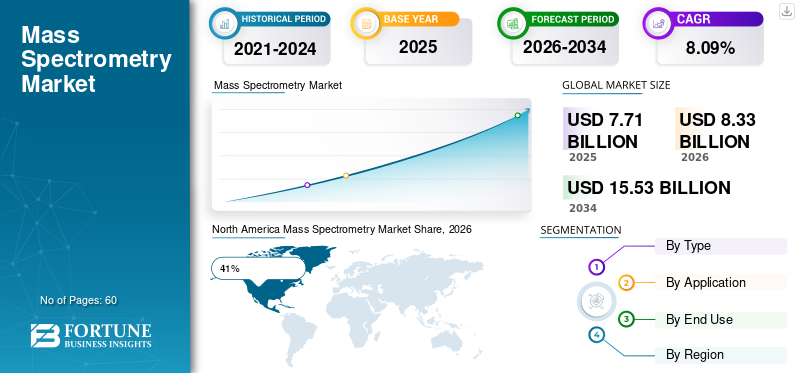
The global mass spectrometry market size was valued at USD 7.71 billion in 2025. The market is projected to grow from USD 8.33 billion in 2026 to USD 15.53 billion by 2034, exhibiting a CAGR of 8.09% during the forecast period.

The mass spectrometry market is witnessing strong expansion due to increasing applications in pharmaceutical research, biotechnology, food safety testing, environmental analysis, and clinical diagnostics. Mass spectrometry technologies are widely used for precise molecular identification, quantitative analysis, and biomarker detection across research laboratories and industrial testing facilities. The mass spectrometry market report highlights rising adoption of advanced analytical instrumentation capable of delivering high sensitivity, accuracy, and rapid testing performance. Growing investment in proteomics, metabolomics, personalized medicine, and drug discovery programs continues accelerating global demand for high-performance mass spectrometry systems across healthcare and life sciences industries.
The USA mass spectrometry market is expanding steadily due to strong pharmaceutical manufacturing infrastructure, advanced biotechnology research, and increasing government funding for analytical science programs. Academic research institutes, healthcare laboratories, and biopharmaceutical companies are heavily investing in advanced mass spectrometry platforms for molecular diagnostics and precision medicine applications. The USA mass spectrometry market analysis highlights rising adoption of high-resolution instruments, automated sample preparation systems, and AI-integrated analytical software. Increasing focus on cancer biomarker research, forensic testing, and food contamination analysis continues strengthening market demand throughout the United States.
Download Free sample to learn more about this report.
Mass Spectrometry Market Key Takeaways
 Global Market Size & Forecast
- 2025 Market Size: USD 7.71 Billion
- 2026 Market Size: USD 8.33 Billion
- 2034 Forecast Market Size: USD 15.53 Billion
- CAGR: 8.09% from 2026-2034
 Market Share
- The market in North America dominated with a regional share of 41% in 2025.
- Instruments held approximately 68% share of the global market.
- Proteomics accounted for approximately 57% share of the market.
 Key Regional Highlights
North America
North America led the market with a 41% regional share, supported by advanced research infrastructure.
Europe
Europe accounted for 29% of the market, driven by pharmaceutical and biotechnology research.
Asia-Pacific
Asia-Pacific held 22% share, supported by expanding healthcare and life sciences activities.
U.S.
The U.S. remains a major market, supported by strong pharmaceutical, biotechnology, and clinical research demand.
Japan
Japan accounted for 24% of the Asia-Pacific market, supported by advanced analytical research and healthcare capabilities.
Read More

Mass Spectrometry Market Latest Trends
The mass spectrometry market trends indicate rising integration of artificial intelligence, machine learning, and automation technologies into analytical workflows to improve testing speed, accuracy, and operational efficiency. Laboratories are increasingly adopting automated sample preparation systems and cloud-based data management platforms to streamline analytical operations and reduce human error. High-resolution mass spectrometry systems with enhanced sensitivity and multiplexing capabilities are becoming increasingly important across pharmaceutical and biotechnology research environments.
Another significant trend influencing the mass spectrometry market growth is the increasing use of hybrid mass spectrometry platforms in proteomics, metabolomics, and clinical diagnostics applications. Pharmaceutical companies are expanding utilization of tandem mass spectrometry and time-of-flight systems for drug development and biomarker identification. The mass spectrometry industry analysis also highlights growing adoption of portable and miniaturized mass spectrometry instruments for environmental monitoring, food safety testing, and field-based forensic investigations. Sustainability initiatives encouraging reduced solvent consumption and energy-efficient laboratory systems are additionally shaping product innovation strategies across the global market.
Download Free sample to learn more about this report.
Mass Spectrometry Market Dynamics
DRIVER
Rising Demand for Pharmaceutical and Biotechnology Research
The growing expansion of pharmaceutical research and biotechnology innovation remains one of the strongest drivers supporting mass spectrometry market growth. Drug discovery programs, biomarker identification studies, and precision medicine initiatives increasingly depend on high-resolution analytical technologies capable of identifying complex molecular structures with exceptional sensitivity and reliability. Pharmaceutical manufacturers are investing heavily in advanced mass spectrometry systems to improve analytical precision during clinical trials, toxicology analysis, and quality control procedures.
The mass spectrometry market research report highlights increasing demand for analytical instrumentation across genomics, proteomics, and metabolomics applications. Biotechnology companies are integrating tandem mass spectrometry systems and hybrid analytical platforms into research laboratories to accelerate therapeutic development and disease profiling activities. Growing prevalence of chronic diseases and rising focus on personalized healthcare solutions are further increasing laboratory testing requirements globally. Academic research institutions and government-funded laboratories are also contributing significantly to market expansion through continuous investment in advanced analytical science infrastructure.
RESTRAINT
High Cost of Advanced Analytical Instrumentation
One of the major restraints affecting the mass spectrometry market size is the high acquisition and maintenance cost associated with advanced analytical instruments. High-resolution mass spectrometry systems, tandem analyzers, and hybrid platforms require substantial investment in hardware, software integration, laboratory infrastructure, and skilled workforce training. Small and medium-sized laboratories often face financial limitations that restrict adoption of premium analytical technologies.
The mass spectrometry market analysis also identifies operational complexity and maintenance requirements as significant barriers influencing broader market penetration. Laboratories require specialized professionals capable of handling calibration, troubleshooting, data interpretation, and system optimization procedures. Consumables and service contracts additionally increase long-term operational expenses for end users. Regulatory compliance standards associated with pharmaceutical testing and clinical diagnostics further increase implementation complexity within analytical laboratories, especially across developing economies with limited healthcare infrastructure investment.
OPPORTUNITY
Expansion of Precision Medicine and Biomarker Discovery
The increasing focus on personalized medicine and biomarker discovery presents substantial opportunities for the mass spectrometry market opportunities segment. Precision healthcare initiatives require advanced analytical platforms capable of identifying disease-specific proteins, metabolites, and molecular signatures with high sensitivity. Healthcare providers and pharmaceutical companies are therefore investing heavily in next-generation mass spectrometry systems designed for targeted diagnostics and therapeutic development.
The mass spectrometry market forecast highlights strong opportunities within oncology research, neurological disorder analysis, and infectious disease diagnostics. Clinical laboratories are increasingly adopting mass spectrometry technologies for rapid pathogen identification and personalized treatment planning. Expansion of metabolomics and proteomics research programs across academic institutions and biotechnology companies is also generating long-term business opportunities for analytical instrument manufacturers. Continuous innovation in automation software, miniaturized instruments, and AI-powered data analytics continues strengthening future market potential globally.
CHALLENGE
Data Complexity and Shortage of Skilled Professionals
One of the key challenges influencing the mass spectrometry market outlook is the increasing complexity of analytical data generated by advanced instrumentation systems. High-resolution mass spectrometry platforms produce large datasets that require specialized expertise for interpretation, storage, and workflow integration. Laboratories lacking experienced analytical professionals often encounter operational inefficiencies and delayed research outcomes.
The mass spectrometry industry report also highlights challenges associated with instrument standardization, cross-platform compatibility, and regulatory compliance. Pharmaceutical and clinical laboratories must maintain highly accurate testing environments while meeting stringent quality assurance requirements. Integration of advanced software platforms and automated analytical workflows can further increase implementation complexity for smaller laboratories. Maintaining analytical precision, operational consistency, and cybersecurity protection for laboratory data remains a significant challenge within the global mass spectrometry industry.
Mass Spectrometry Market Segmentation
By Type
Instruments account for approximately 68% of the mass spectrometry market share due to increasing adoption of advanced analytical systems across pharmaceutical, biotechnology, environmental, and clinical research laboratories. High-resolution mass spectrometers, tandem mass spectrometry systems, and time-of-flight instruments remain essential for molecular characterization, biomarker discovery, and precision diagnostics. Pharmaceutical companies continue investing heavily in sophisticated analytical instrumentation to improve drug development efficiency and laboratory productivity.
The mass spectrometry market insights indicate strong demand for hybrid analytical platforms capable of delivering rapid analysis, high sensitivity, and accurate quantitative performance. Manufacturers are focusing on compact system design, automation integration, and AI-enabled analytical software to improve operational flexibility and testing reliability. Rising applications in food safety analysis, forensic science, and environmental monitoring continue strengthening the instruments segment within the global mass spectrometry industry analysis.
Consumables and services contribute approximately 32% of the mass spectrometry market share because laboratories require continuous supply of reagents, calibration standards, columns, sample preparation kits, and maintenance services for uninterrupted analytical operations. Service contracts and instrument maintenance programs remain critical for ensuring operational accuracy and system longevity within research and diagnostic laboratories.
The mass spectrometry market report highlights increasing demand for laboratory support services, analytical workflow optimization, and software upgrades across pharmaceutical and biotechnology facilities. Consumable manufacturers are introducing high-purity reagents and advanced sample preparation products designed for enhanced testing performance. Rising complexity of analytical workflows and increasing laboratory automation continue supporting long-term growth within the consumables and services segment globally.
To know how our report can help streamline your business, Speak to Analyst
By Application
Proteomics accounts for approximately 57% of the mass spectrometry market share because researchers increasingly rely on advanced analytical technologies for protein identification, biomarker discovery, and disease mechanism analysis. Pharmaceutical and biotechnology companies use proteomics-based mass spectrometry systems extensively during drug development, oncology research, and therapeutic target identification processes. Rising focus on precision medicine and molecular diagnostics continues driving strong adoption across clinical and academic laboratories.
The mass spectrometry market research report highlights growing integration of tandem mass spectrometry and hybrid analytical platforms into proteomics workflows for high-throughput analysis and quantitative protein profiling. Academic research institutions and healthcare laboratories are expanding investment in advanced proteomic analysis technologies to improve disease detection and treatment personalization capabilities. Continuous innovation in protein sequencing and bioinformatics integration further supports growth within the proteomics segment.
Metabolomics represents approximately 43% of the mass spectrometry market share because of increasing demand for comprehensive metabolic profiling and biomarker analysis across healthcare, agriculture, and environmental sciences. Researchers use mass spectrometry technologies to analyze metabolites and biochemical pathways associated with chronic diseases, nutritional studies, and pharmaceutical development programs.
The mass spectrometry market trends indicate rising adoption of metabolomics platforms in cancer diagnostics, toxicology analysis, and personalized healthcare applications. Pharmaceutical companies are increasingly using metabolomic profiling to improve drug efficacy evaluation and therapeutic response monitoring. Expansion of systems biology research and increasing integration of AI-driven analytical software continue accelerating market demand for metabolomics-based analytical solutions globally.
By Technology
Hybrid mass spectrometry technology accounts for approximately 54% of the mass spectrometry market share because of its superior analytical sensitivity, high-resolution capabilities, and broad application scope across pharmaceutical, biotechnology, and clinical research laboratories. Hybrid systems combine multiple analyzer technologies such as quadrupole-time-of-flight and orbitrap platforms to improve molecular characterization and biomarker identification efficiency. Pharmaceutical manufacturers increasingly utilize hybrid mass spectrometry systems for drug discovery, impurity profiling, and toxicology testing applications.
By End-use
Pharmaceutical and biotechnology companies account for approximately 48% of the mass spectrometry market share because these organizations rely heavily on advanced analytical technologies for drug discovery, biomarker analysis, clinical research, and therapeutic development. Mass spectrometry systems are extensively used for molecular characterization, impurity testing, and quality assurance processes throughout pharmaceutical production environments.
Mass Spectrometry Market Regional Outlook
North America
North America Mass Spectrometry Market Share, 2026 (%)
To get more information on the regional analysis of this market, Download Free sample
North America accounts for approximately 41% of the global mass spectrometry market share because of strong pharmaceutical research infrastructure, advanced biotechnology development, and substantial healthcare investment across the region. The United States and Canada host major pharmaceutical manufacturers, academic institutions, and biotechnology companies actively investing in high-performance analytical instrumentation. Rising demand for precision medicine and molecular diagnostics continues supporting regional market growth.
The mass spectrometry market analysis highlights increasing adoption of AI-integrated analytical platforms and automated laboratory systems across North America. Pharmaceutical research organizations and clinical laboratories are heavily investing in tandem mass spectrometry systems for biomarker analysis and therapeutic development. Expansion of forensic testing, food safety monitoring, and environmental analysis further contributes to strong regional demand for analytical technologies.
Europe
Europe contributes approximately 29% of the global mass spectrometry market share due to strong healthcare infrastructure, pharmaceutical manufacturing activity, and government-supported research programs across the region. Germany, the United Kingdom, France, and Switzerland remain major centers for biotechnology innovation and analytical science development. Rising focus on personalized medicine and clinical diagnostics continues accelerating market expansion.
The mass spectrometry market growth in Europe is supported by increasing laboratory automation, regulatory focus on food safety testing, and expansion of academic research facilities. Pharmaceutical companies are investing heavily in high-resolution analytical systems designed for drug discovery and proteomics research applications. Sustainability initiatives promoting energy-efficient laboratory technologies are additionally influencing product adoption trends throughout Europe.
Germany Mass Spectrometry Market
Germany accounts for approximately 28% of the European mass spectrometry market share because of strong pharmaceutical manufacturing capabilities and advanced industrial research infrastructure. German biotechnology firms and academic research institutions are heavily investing in analytical instrumentation for proteomics, metabolomics, and precision diagnostics applications. Expansion of pharmaceutical testing laboratories continues strengthening domestic demand for mass spectrometry systems.
The Germany mass spectrometry market outlook highlights increasing adoption of automated analytical workflows and AI-powered laboratory software. Healthcare laboratories are integrating advanced mass spectrometry platforms for clinical diagnostics and personalized medicine programs. Growing focus on oncology research, environmental analysis, and food quality testing further contributes to long-term market expansion within Germany.
United Kingdom Mass Spectrometry Market
The United Kingdom contributes approximately 23% of the European mass spectrometry market share due to increasing biotechnology innovation and strong academic research activity across the country. Pharmaceutical companies and healthcare laboratories are adopting high-resolution analytical platforms to support clinical diagnostics, biomarker discovery, and therapeutic development initiatives.
The United Kingdom mass spectrometry market insights indicate rising demand for proteomics and metabolomics analysis technologies across precision medicine research programs. Academic institutions and biotechnology startups are expanding investment in tandem mass spectrometry systems and laboratory automation infrastructure. Increasing focus on infectious disease diagnostics and pharmaceutical quality assurance continues driving analytical instrument adoption throughout the UK.
Asia-Pacific
Asia-Pacific accounts for approximately 22% of the global mass spectrometry market share because of rapid pharmaceutical manufacturing expansion, rising healthcare investment, and growing biotechnology research infrastructure across the region. China, Japan, India, and South Korea are increasingly investing in advanced analytical laboratories and clinical diagnostic technologies to support healthcare modernization initiatives.
The mass spectrometry market opportunities in Asia-Pacific are driven by increasing government support for life sciences research, expansion of pharmaceutical production facilities, and rising food safety testing requirements. Academic institutions and biotechnology firms are adopting high-performance analytical systems to improve molecular research capabilities. Growth in environmental monitoring and forensic science applications further contributes to strong regional market demand.
Japan Mass Spectrometry Market
Japan represents approximately 24% of the Asia-Pacific mass spectrometry market share because of strong technological innovation and advanced healthcare research infrastructure. Japanese pharmaceutical companies and research institutions are investing heavily in analytical instrumentation for proteomics, metabolomics, and biomarker identification applications. Rising demand for precision diagnostics continues supporting market expansion.
The Japan mass spectrometry market forecast highlights increasing integration of automation technologies and AI-powered analytical software into laboratory workflows. Clinical laboratories are expanding use of tandem mass spectrometry systems for disease detection and therapeutic monitoring applications. Growing investment in oncology research and pharmaceutical quality control remains central to long-term market development in Japan.
China Mass Spectrometry Market
China contributes approximately 47% of the Asia-Pacific mass spectrometry market share because of rapid pharmaceutical industry expansion and strong government investment in biotechnology research infrastructure. Chinese healthcare laboratories and pharmaceutical companies are increasingly adopting advanced analytical systems for clinical diagnostics, environmental testing, and drug development applications.
The China mass spectrometry market trends indicate rising deployment of automated analytical laboratories and high-throughput testing systems throughout research institutions and industrial facilities. Growth in precision medicine programs, food safety testing, and forensic science applications continues strengthening market demand. Increasing domestic production of analytical instrumentation and laboratory consumables further supports long-term industry expansion within China.
Rest of World
Rest of World accounts for approximately 8% of the global mass spectrometry market share because countries across Latin America, the Middle East, and Africa are gradually expanding healthcare infrastructure and analytical laboratory capabilities. Governments and healthcare providers are investing in clinical diagnostics, food safety monitoring, and pharmaceutical testing technologies to improve public health systems.
The mass spectrometry market forecast highlights growing adoption of compact analytical instruments and laboratory automation systems throughout emerging economies. Academic research institutions and industrial laboratories are increasingly investing in analytical technologies for environmental monitoring and agricultural testing applications. Expansion of healthcare modernization programs and biotechnology research initiatives continues supporting regional market development.
List of Top Mass Spectrometry Companies
- Thermo Fisher Scientific, Inc.
- Agilent Technologies, Inc.
- Danaher Corporation
- Waters Corporation
- Bruker Corporation
- Shimadzu Corporation
- PerkinElmer, Inc.
- Rigaku Corporation
- LECO Corporation
- JEOL Ltd.
Top two companies with the highest market share
- Thermo Fisher Scientific, Inc. – 22% market share
- Agilent Technologies, Inc. – 17% market share
Investment Analysis and Opportunities
The mass spectrometry market opportunities segment is attracting substantial investment from pharmaceutical manufacturers, biotechnology firms, healthcare laboratories, and academic research organizations. Companies are increasingly investing in high-resolution analytical platforms, laboratory automation technologies, and AI-driven software solutions designed to improve testing efficiency and molecular analysis accuracy. Expansion of precision medicine initiatives and personalized healthcare programs continues creating strong demand for advanced analytical infrastructure globally.
The mass spectrometry market research report highlights growing investment activity within oncology research, biomarker discovery, and metabolomics applications. Governments and private organizations are funding biotechnology research centers and clinical diagnostics laboratories equipped with next-generation analytical systems. Increasing demand for portable mass spectrometry devices and cloud-based laboratory management platforms additionally creates long-term business opportunities for instrument manufacturers and analytical software providers worldwide.
New Product Development
Innovation within the mass spectrometry market trends is increasingly focused on high-resolution analytical systems, AI-enabled software integration, and compact laboratory instrumentation. Manufacturers are introducing advanced hybrid mass spectrometry platforms capable of delivering enhanced sensitivity, faster testing cycles, and automated data interpretation for pharmaceutical and clinical research applications.
The mass spectrometry industry analysis highlights rising development of portable analytical devices for environmental testing, food safety analysis, and field-based forensic investigations. Companies are launching energy-efficient laboratory systems with integrated cloud connectivity and advanced workflow automation capabilities. Continuous innovation in proteomics analysis software, miniaturized instrumentation, and real-time biomarker detection technologies remains central to new product development strategies across the market.
Five Recent Developments (2023-2025)
- Thermo Fisher Scientific, Inc. launched upgraded high-resolution orbitrap mass spectrometry systems for advanced proteomics research in 2024.
- Agilent Technologies, Inc. introduced AI-integrated analytical workflow software for pharmaceutical laboratories in 2025.
- Waters Corporation expanded tandem mass spectrometry solutions for metabolomics and biomarker discovery applications in 2023.
- Shimadzu Corporation developed compact mass spectrometry systems designed for clinical diagnostics and food testing laboratories in 2024.
- Bruker Corporation launched advanced proteomics platforms optimized for precision medicine research during 2025.
Report Coverage of Mass Spectrometry Market
The mass spectrometry market report provides detailed analysis of analytical instrumentation technologies, laboratory automation systems, and application-specific testing solutions influencing the global industry landscape. The report evaluates instruments, consumables, and services segments while examining major applications including proteomics, metabolomics, pharmaceutical research, environmental monitoring, and clinical diagnostics. Market coverage additionally includes assessment of AI integration, automation technologies, and high-resolution analytical platform adoption across research laboratories and industrial facilities.
Request for Customization to gain extensive market insights.
The mass spectrometry market analysis also delivers comprehensive regional evaluation covering North America, Europe, Asia-Pacific, and Rest of World with detailed country-level insights for the United States, Germany, the United Kingdom, Japan, and China. The report examines competitive benchmarking, investment trends, product innovation strategies, laboratory modernization initiatives, and regulatory developments implemented by major market participants. Operational challenges, emerging research applications, and future analytical technology opportunities remain central focus areas within the global mass spectrometry industry report.
Frequently Asked Questions
Fortune Business Insights says that the global market value stood at USD 7.71 billion in 2025 and is projected to reach USD 15.53 billion by 2034.
The market is expected to exhibit a CAGR of 8.09% during the forecast period of 2026-2034.
Instruments were the leading type segment, accounting for approximately 68% of the market, driven by rising adoption of advanced analytical systems across pharmaceutical, biotechnology, environmental, and clinical research laboratories.
Key players include Thermo Fisher Scientific, Inc., Agilent Technologies, Inc., Danaher Corporation, Waters Corporation, Bruker Corporation, and Shimadzu Corporation.
Major trends include the growing integration of AI, machine learning, and automation into analytical workflows and increasing adoption of high-resolution and hybrid mass spectrometry platforms. North America held the largest regional share at approximately 41%.



- 2021-2034
- 2025
- 2021-2024
- 60
-

(Offer valid till 30th Sep 2026)
Get 30-60 hrs Free Customization
Expand Regional and Country Coverage, Segments Analysis, Company Profiles, Competitive Benchmarking, and End-user Insights.













.webp)






-
US +1 833 909 2966 ( Toll Free )
-
Get In Touch With Us