 Download Free Sample



Get a Quote
Receive a tailored pricing based on your needs.
- Choose license type
- Multiple user options
- Custom scope & coverage
- Fast turnaround
"Designing Growth Strategies is in our DNA"
 Listen to Audio Version
The global metabolomics market size was valued at USD 2.29 billion in 2025. The market is projected to grow from USD 2.52 billion in 2026 to USD 6.26 billion by 2034, exhibiting a CAGR of 12.07% during the forecast period. North America dominated the metabolomics market with a market share of 38.43% in 2025.
The global market is anticipated to grow exponentially in the coming years due to advances in proteomics and genomics research. Metabolomics provides an overview of metabolite levels, showcasing how metabolic flow through various pathways in response to stimuli. These platforms also offer advances in analytical capabilities. The widespread application of the study in proteomics and genomics research and biomarker discovery further fuels growth.
Furthermore, innovative techniques and technologies that deliver more sensitive results drive market growth.
Furthermore, leading players in the industry, such as Merck KGaA and DH Life Sciences, LLC, are directing their resources toward research and development, expanding their offerings, and strengthening their market positions.
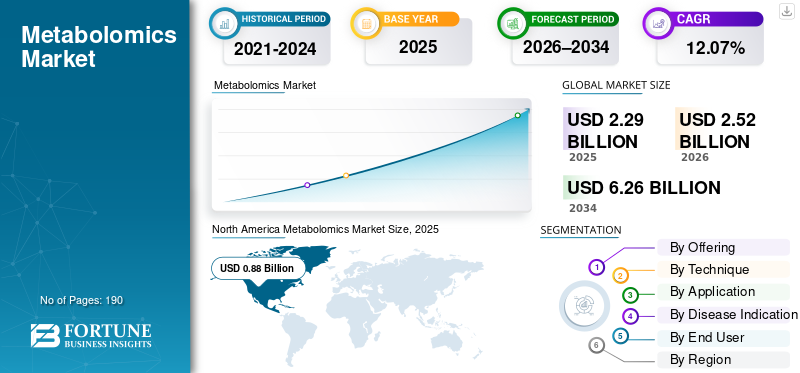
Download Free sample to learn more about this report.
 Market Size & Forecast
 Market Share
 Key Regional Highlights
Asia Pacific
Asia Pacific is projected to reach USD 0.73 billion in 2026.
North America
North America generated USD 0.88 billion in 2025.
Europe
Europe is projected to reach USD 0.73 billion in 2026, growing at an 11.17% CAGR.
U.S.
The metabolomics market is projected to reach USD 0.88 billion in 2026, accounting for approximately 34.94% of the global market.
Japan
The metabolomics market is projected to reach USD 0.88 billion in 2026, accounting for approximately 34.94% of the global market.
Read More

AI Integration in Bioinformatics Tools is a Significant Market Trend Observed
A significant global market trend is the shift toward automated bioinformatics platforms. Metabolomics datasets are expanding and becoming larger and more complex. Traditional workflows, such as exporting files, manual cleaning, scripting, and back-and-forth with bioinformaticians, increase the risk of inconsistent analysis as study sizes and the need for a single workspace where users can quickly run standard workflows increase. This shift toward automated bioinformatics tools overcomes these challenges, reducing turnaround time, improving repeatability across projects, and making metabolomics easier to scale. Underscoring these advantages, many key companies are increasingly investing in these solutions and advancing their bioinformatics platforms.
Download Free sample to learn more about this report.
Rising Investment in Research and Precision Medicine to Increase Demand for Metabolomics in Biomarker Discovery and Diagnostics
The rising investment in translational research and precision medicine is a driver of market growth. Many diseases, especially cancer, cardio-metabolic, and neurodegenerative diseases, are biologically diverse, limiting one-size-fits-all biomarkers and treatments. This pushes researchers to look for functional, real-time biology signals that sit closer to phenotype than genes alone. Metabolomics directly supports this need by enabling faster biomarker discovery, patient stratification, and treatment response monitoring, thereby increasing the spending on metabolomics testing, bioinformatics software, and repeat consumables across multi-site metabolomic studies and clinical translational programs. Such advantages attract co-development deals and accelerate adoption pathways.
High Cost Associated with Metabolomics to Hamper Market Growth
The metabolomics market growth is restrained mainly by high costs. The market cost soars as it requires high-end specialized instruments such as MS/NMR systems, which are expensive. Due to these factors, many key players delay purchases when research budgets tighten. Additionally, manual sample preparation and multi-step workflows can create variability across labs. Hence, organizations hesitate to scale metabolomics into larger, multi-site studies.
Outsourcing Metabolomics Services to Offer Market Growth Opportunity
Outsourcing metabolomics services presents a strong market growth opportunity in the forthcoming years. Many pharmaceutical and biotechnology companies use metabolomics data but struggle to integrate it and run it in-house. Metabolomics research workflows require expensive instrumentation, strict quality controls, a trained workforce, and extensive bioinformatics for annotation and interpretation. Due to these factors, various buyers are increasingly preferring specialized CRO/service with validated workflows, scalable throughput, and experienced data teams. This reduced turnaround time offers scalability opportunities in the market. This outsourcing model also helps customers control costs and risk, access advanced expertise more quickly, and scale studies without a significant capital investment.
Challenges in Inter-Laboratory Reproducibility to Hamper Market Growth
Inter-laboratory reproducibility is a major market challenge in metabolomics as results vary when different labs run the same study using different sample-prep steps, instruments, chromatography methods, calibration/QC routines, and data-processing pipelines. This variability creates batch effects and inconsistent metabolite identification and quantification. This slows timelines and reduces confidence in using metabolomics for high-stakes decisions such as clinical biomarker validation or regulated workflows. When end users cannot consistently reproduce findings across labs, they hesitate to scale metabolomics programs, which directly limits adoption and market growth.
Products Segment Led the Market with New Product Launches by Key Players
Based on offering, the market is categorized into products, software, and services.
Among these, the products segment dominated the global metabolomics market share in 2025. Metabolomics workflows depend on high-performance, sensitive instruments such as MS/NMR systems and chromatography. Further, the recurring consumables required to run samples reliably strengthen the segment's dominance. Most labs must buy or upgrade instruments and continuously purchase columns, solvents, standards, and QC materials to keep workflows running.
Furthermore, underscoring the importance of these instruments, various key companies are directing their resources toward new product launches that align with metabolomics workflows.
The services segment is expected to grow at a CAGR of 12.84% over the forecast period.
To know how our report can help streamline your business, Speak to Analyst
Advances in High Resolution Instrumentation to Drive Liquid Chromatography-Mass Spectrometry (LC-MS) Segmental Growth
Based on technique, the market is segmented into liquid chromatography-mass spectrometry (LC-MS), gas chromatography-mass spectrometry (GC-MS), nuclear magnetic resonance spectroscopy (NMR), and others.
In 2025, the liquid chromatography-mass spectrometry (LC-MS) segment dominated the market. The high share of LC-MS is due to advances in high-resolution, intelligent instrumentation for targeted and untargeted analyses. It also fits high-throughput needs for large-scale studies, which has led to a rise in the prioritization of LC-MS upgrades by labs over others.
Additionally, new product launches in liquid chromatography further reinforce the segment's dominance.
The gas chromatography-mass spectrometry (GC-MS) segment is projected to grow at a CAGR of 11.88% during the forecast period.
Increasing Product Launches to Expand Multi-omics Studies to Propel Biomarker Discovery Segmental Growth
Based on application, the market is segmented into biomarker discovery, drug discovery, toxicology testing, precision medicine, and others.
Among these, the biomarker discovery segment dominated the market in 2025. Metabolomics is often used to detect early signals of disease biology, treatment response, and patient stratification to study real-time phenotypes. Organizations fund discovery studies to find better biomarkers, reduce downstream trial failure, and improve decision-making. Additionally, new product launches by key players to expand multi-omics studies and capabilities reinforce the segment's dominance.
In addition, the precision medicine segment is projected to grow at a CAGR of 15.15% during the analysis period.
Cancer Segment Dominated the Market owing to High Research Expenditure on Oncology
Based on disease indication, the market is segmented into cancer, cardiovascular diseases, neurological disorders, metabolic disorders, and others.
In 2025, the cancer segment dominated the market as oncology has high research spend and a high unmet clinical need. This drives the global metabolomics demand for new biomarkers for early detection, prognosis, and therapy monitoring. Cancer metabolism is highly dysregulated. Hence, metabolomics is a practical approach for identifying actionable metabolic signatures and treatment-response signals. Underscoring these advantages, many key companies are also focusing on research and development for cancer diagnostics and treatment.
In addition, the metabolic disorder segment is projected to grow at a CAGR of 13.00% during the study period.
High Investment by Pharmaceutical and Biotechnological Companies in Research to Propel Segment Growth
Based on end user, the market is segmented into pharmaceutical and biotechnology companies, CROs/CMOs, academic & research institutes, diagnostic labs, and others.
The pharmaceutical and biotechnology companies dominate the market by end user. The large share is attributed to the substantial budgets and economic incentives to use metabolomics to improve target validation and identify toxicity signals earlier. Additionally, increasing research activities and conducting large, repeated studies increases total product spend. Strategic collaboration among these operating entities is poised to drive the growth of the segment.
The CROs/CMOs segment is projected to grow at a CAGR of 14.41% over the study period.
By geography, the market is categorized into Europe, North America, Asia Pacific, Latin America, and the Middle East & Africa.
North America Metabolomics Market Size, 2025 (USD Billion)
To get more information on the regional analysis of this market, Download Free sample
North America held the dominant share in 2024, valued at USD 0.80 billion, and maintained its leading position in 2025, with a value of USD 0.88 billion. The market in North America is expected to grow significantly over the forecast period, driven by large-scale discovery and translational programs. The region also has a dense ecosystem of CROs and specialized metabolomics service providers, which makes it easier for customers to scale studies without building everything in-house.
Given North America’s substantial contribution and the U.S. dominance in the region, the U.S. market is estimated to touch around USD 0.88 billion in 2026, accounting for roughly 34.94% of the global market.
Europe is projected to grow at a rate of 11.17% over the forecast period, the second-highest among all regions, and reach a valuation of USD 0.73 billion by 2026. The area is expected to experience robust growth driven by substantial public research funding and large multi-center biomedical programs.
The U.K. market is estimated to reach around USD 0.11 billion in 2026, representing roughly 4.48% of the global market.
The Germany market is projected to reach approximately USD 0.19 billion in 2026, equivalent to around 7.49% of the global market.
Asia Pacific is estimated to reach a value of USD 0.73 billion in 2026 and secure the position of the third-largest region in the market. The region is witnessing expanding research infrastructure, and manufacturers are accelerating access to modern systems and application workflows.
In 2026, the Japanese market is estimated to reach around USD 0.18 billion, accounting for approximately 7.00% of the global market.
The China market is projected to be one of the largest worldwide, with 2026 revenues estimated to touch around USD 0.24 billion, representing approximately 9.71% of global sales.
The India market is estimated to reach a value of around USD 0.06 billion in 2026, accounting for roughly 2.37% of global revenue.
The Latin America and Middle East & Africa regions are expected to witness moderate growth during the forecast period. The Latin America market is set to reach a valuation of USD 0.05 billion in 2026. The regional market growth is expanding driven by increased government support. In the Middle East & Africa, the GCC market is set to reach USD 0.03 billion in 2026.
The South Africa market is projected to reach approximately USD 0.01 billion by 2026, accounting for roughly 0.33% of the global revenue.
Leading Companies Focus on Strategic Collaborations and Pipelines to Expand Market Share
The global metabolomics market is highly consolidated, with companies such as Thermo Fisher Scientific Inc., Agilent Technologies, Inc., Waters Corporation, Bruker Corporation, and Metabolon holding a significant market share. Strategic partnerships, expanding pipelines, technological advancements, and increased investments in the sector drive these companies' market share.
Such developments are likely to propel market growth. Other notable companies in the global market comprise Merck KGaA, Panome Bio, and Bio-Rad Laboratories, Inc. These players are anticipated to prioritize strategic partnerships, technological advancements, and new product launches to consolidate their position during the forecast period.
Request for Customization to gain extensive market insights.
| ATTRIBUTE | DETAILS |
| Study Period | 2021-2034 |
| Base Year | 2025 |
| Estimated Year | 2026 |
| Forecast Period | 2026-2034 |
| Historical Period | 2021-2024 |
| Growth Rate | CAGR of 12.07% from 2026-2034 |
| Unit | Value (USD Billion) |
| Segmentation | By Offering, Technique, Application, Disease Indication, End User, and Region |
| By Offering |
|
| By Technique |
|
| By Application |
|
| By Disease Indication |
|
| By End User |
|
| By Region |
|
According to Fortune Business Insights, the global market value stood at USD 2.29 billion in 2025 and is projected to reach USD 6.26 billion by 2034.
In 2025, the market value stood at USD 0.88 billion.
The market is expected to grow at a CAGR of 12.07% over the forecast period of 2026-2034.
By offering, the products segment led the market in 2025.
Increasing research for omics and new product launches are key factors driving market growth.
Merck KGaA, Thermo Fisher Scientific Inc., DH Life Sciences, LLC., and Agilent Technologies, Inc. are the major market players in the global market.
North America dominated the market in 2025.

Get 30-60 hrs Free Customization
Expand Regional and Country Coverage, Segments Analysis, Company Profiles, Competitive Benchmarking, and End-user Insights.













.webp)






Get In Touch With Us
US +1 833 909 2966 ( Toll Free )
Receive a tailored pricing based on your needs.
Discuss your questions with our industry experts.
Have questions? Get quick answers before you purchase.

