Masterbatch Market Size, Share & Industry Analysis, By Type (White, Black, Color, Additive, and Fillers), By Polymer (Polyethylene, Polypropylene, Polyvinyl Chloride, Polyethylene Terephthalate, and Others), By End-Use (Packaging, Building & Construction, Consumer Good, Automotive, Agriculture, and Others), and Regional Forecast, 2026-2034
 Download Free Sample
Masterbatch Market Size and Industry Overview
 Listen to Audio Version
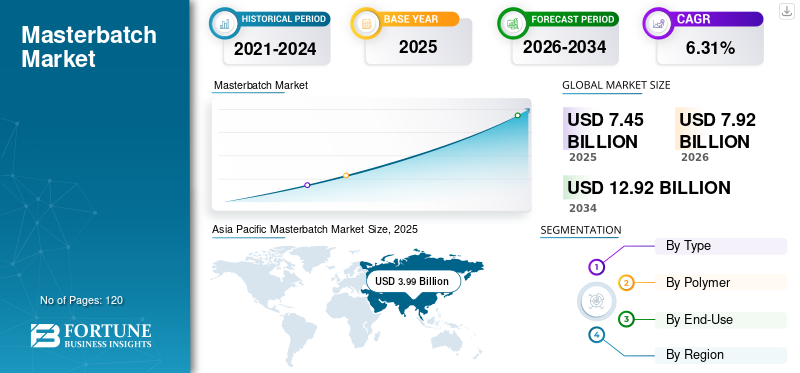
The global masterbatch market size was valued at USD 7.45 billion in 2025 and is projected to grow from USD 7.92 billion in 2026 to USD 12.92 billion by 2034, exhibiting a CAGR of 6.31% during the forecast period. Asia Pacific dominated the masterbatch market with a market share of 36.38% in 2025. Moreover, the U.S. masterbatch market is projected to reach USD 3.82 billion by 2026, supported by demand for polymer coloration and additive solutions.
Masterbatch is a solid or liquid additive used to paint or to transmit certain properties to plastics. Coloured Masterbatch is used to give color or shade to plastic items. They can be used to convey properties such as energy, effect, UV stabilizer, bio-degradable, antioxidant, and others. Ideally, the product consists of a pigment and additives mixture encapsulated in a carrier resin which is then cooled and cut in a granular form after a heat cycle. It helps the processor to colour raw polymers efficiently during the manufacturing process of plastics. It is cost-effective, provides colour to the polymer and helps the plastics manufacturers save a good amount. These additives are easy to use and provide a dirt-free and stable process, reducing the safety risk involved with the use of powder pigments.
Download Free sample to learn more about this report.
Masterbatch Market Key Takeaways
 Global Market Size & Forecast
- 2025 Market Size: USD 7.45 billion
- 2026 Market Size: USD 7.92 billion
- 2034 Forecast Market Size: USD 12.92 billion
- CAGR: 6.31% from 2026–2034
 Market Share
- Asia Pacific dominated the masterbatch market with a 36.38% share in 2025.
- The polyethylene segment accounted for a leading market share, driven by its extensive use across end-use industries.
- The titanium dioxide-based masterbatch contains 75% titanium dioxide, supporting clarity and visibility in synthetic products.
 Key Regional Highlights
Asia Pacific
Asia Pacific to Held the leading position With USD 3.99 billion, supported by strong demand from packaging, automotive, consumer goods, construction, and agriculture.
Europe
Europe Is expected to witness significant growth, driven by packaging, automotive, construction, and consumer goods applications.
North America
In North Americ Market growth is supported by strong demand for polymer coloration and additive solutions across packaging, automotive, building & construction, and consumer goods industries.
U.S.
The masterbatch market is projected to reach USD 3.82 billion by 2026, supported by demand for polymer coloration and additive solutions.
Japan
Market growth is supported by demand across packaging, automotive, and consumer goods applications.
Read More

MASTERBATCH MARKET TRENDS
Download Free sample to learn more about this report.
Growing Demand for Building & Construction Industry To Drive The Market Growth
The global construction industry is the world's largest consumer of raw materials. This industry is projected to expand at 4.2% annually in terms of market value due to growth in residential, non-residential and infrastructure projects. An increase in building growth globally is boosting the construction industry. Growing new infrastructure, coupled with increasing investments, especially in the transport, telecommunications, and energy & utility sectors, will add impetus to the market. In 2018, China's construction industry is expected to be driven by government expenditure on infrastructure. In 2018, the building industry in Thailand recovered, and the rate of growth is likely to boost due to increasing investment in public infrastructural development.
The building sector in Saudi Arabia is anticipated to rebound, backed by improvements in transport and mobility systems, innovations in social infrastructure, and electricity mega projects. The European construction industry is growing at a rapid pace due to low interest rates, strong economic growth, and pent-up needs. Growth in Europe's construction is backed by the residential, non-residential, and civil engineering sectors, both new and renovation. According to Business Monitor International (BMI), European construction witnessed a growth of 2.4% in 2018, on account of an improved outlook for commodity prices, increased trust in the industry, increased demand and strengthened exports. It is projected that half of the global construction expenditure will come from Asia Pacific countries, with China, Indonesia, Japan, South Korea and Malaysia showing the greatest potential for expansion.
- Asia Pacific witnessed a growth from USD 3820.9 Million in 2017 to USD 3998.1 Million in 2018.
In the building and construction industry, plastics & polymeric compounds are becoming increasingly important, often replacing traditional materials as they are more robust, long-lasting and are attractively tough, have high strength, and provide UV or weather resistance, have flammable and antimicrobial properties, and others. It is a plastics additive used mainly to color plastics or to impart beneficial physical properties in plastics. It is commonly used in building plastic materials such as the production of PVC profiles, PVC pipes, PPR pipes, glow signs, water storage tank insulation foam, door indicators, fire extinguishers, Starlite ceiling interior, and others. The growing building & construction industry is boosting the use of plastics materials in building & construction which is likely to drive the market during the forecast period.
MASTERBATCH MARKET DRIVERS
Growth in Plastic Packaging Industry is Driving Market
The plastic packaging industry witnessed high growth, with a steady move towards new retail formats. Growing sales rates also promote organized retail growth, thereby increasing demand for creative and attractive packaging. Food & beverages are one of the main growing segments in the retail sector. Growth in this sector is likely to promote the use for packaging, as plastic packaging helps to enhance food quality, and extends its shelf life. Packaged food is projected to be a rapidly expanding segment. Pharmaceuticals are another major user of packaging, in addition to food & beverage. The pharmaceutical industry is anticipated to expand by double-digit growth.
Pharmaceutical packaging is the core of the drug delivery system. Pharmaceutical companies rely increasingly on packaging and labelling as a way of preserving and marketing their goods, compliance with new legislation and increasing protection of patients. In addition, plastics have become increasingly important in pharmaceutical packaging due to properties such as high dimensional stability, moisture barrier, low water absorption, clarity, high impact strength, stress resistance, heat and flame resistance, and others. Therefore, due to increased expertise in food & beverage packaging, pharmaceutical, home & personal care, among other heavy industrial goods, plastic packaging is expanding rapidly.
Plastics has a wide range of applications within the food packaging segment. In order to provide the necessary qualities to plastics and functionalities, Masterbatch is applied to the base polymers. As conventional plastics take years to degrade and are used to accelerate the process of plastic product degradation while at the same time supplying the product with an appealing color. It is the most effective plastic coloring process, it helps to add functional and coloring characteristics to the plastic packaging. This is expected to boost the packaging industry, thereby aiding in the expansion of the market.
Increase in Demand from Automotive Industry Shall Boost Market
The automotive industry is booming due to growing sales of vehicles due to increasing disposable incomes. In 2018, 54 leading countries sold around 86 million vehicles. In 2018, worldwide sales of vehicles were 99.7 million. The automotive industry is projected to be driven by China, and India with increasing demand for vehicles, and new vehicle registration is projected to surpass 100 million units globally in 2019. The global automotive industry continues to grow mainly due to electric vehicle demand. China alone accounts for one-third of the automotive industry. Steady growth in the U.S. and economic progress in Europe to boost earnings from manufacturers shall augment the automotive industry growth.
On the other side, Asia Pacific region witnessed real GDP growth led by China and India, the two main markets of the automotive industry. Sales of light-duty vehicles in Europe, particularly in Germany, France, Italy, and Russia are boosting the automotive industry. Sales of new cars in Japan have increased, and a strong demand for small vehicles is driving the automotive industry. India became the fourth largest automobile market in 2018 with sales growing to 3.99 million units by 8.3% year-on-year. In 2018, it was the seventh-largest commercial vehicle producer.
The quantity of plastics used in the interior and exterior parts of cars is continuously increasing. The need for lightweight materials in the automotive industry stimulates metal substitution with plastics. Color is definitely one of the most significant aspects of vehicles. Color adds visual appeal, and market value, it is also an essential aspect of design and adds versatility to a vehicle. Masterbatch can be upgraded to increase reliability and pliability, become corrosion resistant, and to be flame retardant, among others. In the automotive industry, color and additive Masterbatch are commonly used for vehicle interiors, and outdoors for heavy and light vehicles, passenger cars, two and three-wheelers. The increasing usage of plastic in the automotive industry is anticipated to fuel the global market.
MARKET RESTRAINT
Fluctuation in Raw Material Prices May Hinder the Market
Polymers, titanium dioxide, and calcium carbonate are the main raw materials used in Masterbatch processing. Polymers make up around 50% of the total cost of manufacturing; they serve as a medium by which color pigments are administered and are therefore essential. Since polymers are crude oil derivatives their prices are as unpredictable as the prices of crude oil. The prices of key raw materials, namely polymers and other chemicals such as titanium dioxide, are naturally highly volatile. Prices of polymers rely on the movement of crude oil prices and are subject to high volatility.
MASTERBATCH MARKET SEGMENTATION ANALYSIS
By Type Analysis
Color Segment to Dominate the Market During the Forecast Period
Based on type, the market is classified into white, black, color, additive, and fillers. The white segment held the major share of the market. White Masterbatch is used in the final synthetic product to provide clarity, visibility, and is made of 75% titanium dioxide. The titanium dioxide has a right average particle size, 0.19 to 0.22 microns, opaqueness, and a high refractive index. Black Masterbatch is made up of 50% black part. It is used in many plastic applications as a black pigment. It is used due to its jetness, UV protection, conductivity, and other properties.
The color segment is expected to expand at a rapid pace during the forecast period. Color Masterbatch is known for its properties such as good light fastness, weather fastness, and others. They are also used for injection molding of household items, blow molding of bottles, insulation of cables, and others.
By Polymer Analysis
Polyethylene to be the Leading Segment Over The Forecast Period
In terms of application, the market is segmented into polyethylene, polypropylene, polyvinyl chloride, polyethylene terephthalate, and others. Polyethylene segment accounted for prime share owing to the growing use of various polyethylene forms, such as high-density polyethylene, low-density polyethylene, and linear low-density polyethylene in packaging, building & development, automotive, and other end-use industries.
The polypropylene segment is expected to expand rapidly. It is commonly used in consumer products, which has contributed to the rise in demand for polypropylene. It has many beneficial properties including antibacterial, and antimicrobial ones, making it useful for the manufacture of various building & construction related items.
By End-Use Analysis
To know how our report can help streamline your business, Speak to Analyst
Packaging Segment to Account for Major Share Over The Forecast Period
In terms of end-use, the market is segmented into packaging, building & construction, consumer good, automotive, agriculture, and others. The packaging segment accounts for the major share in the forecast timeframe.
Building & construction segment is anticipated to expand at a rapid pace during the forecast period. The building & construction industry is constantly evolving to meet the rising demands of modern urbanization. Plastics are mainly used in materials for building & construction. During storage, the product protects the additive from exposure to temperature, moisture, and UV light. It will greatly increase the additive's shelf-life, which can reduce the expense of products lost to degradation.
- The building & construction segment is expected to hold a 20.4% share in 2018.
Plastics and various blends are a favorite for the interior of automobiles. Often the external vehicle components have to withstand intense heat, cold and UV-ray effects. Thus, these are added to enhance the physical properties of the plastics.
REGIONAL ANALYSIS
Asia Pacific Masterbatch Market Size, 2025 (USD Billion)
To get more information on the regional analysis of this market, Download Free sample
Asia Pacific
Asia Pacific held the major share and is likely to maintain its dominance during the forecast period. In Asia Pacific countries such as India, China, and Taiwan witnessed strong demand for packaging, which is a key growth driver. The growing purchasing power of consumers and increasing demand for plastic goods is likely to boost the market in the region. Besides this, the rapid growth of the consumer goods, packaging, and automotive industries, coupled with the rising building & construction and agriculture sectors, which are among the main end-use sectors.
Europe
Europe's market size may witness significant growth by 2026. The increasing demand in the region is from various end-use industries such as packaging, automotive, building & construction, and consumer goods. Furthermore, growing demand for lightweight vehicles and rising plastic manufacturing are also expected to bolster growth in the region in the coming years.
KEY INDUSTRY PLAYERS
Key Players Blending Strategies to Continue Dominating Market
The global market share is fragmented in nature with the involvement of several players such as Clariant, Ampacet Corporation, A. Schulman, Inc., PolyOne, Cabot Corporation, PLASTIKA KRITIS S.A., Plastiblends, Hubron International, Tosaf, Penn Color Inc., and others, along with small and medium regional players operating in different parts of the globe. Industrial participants face strong competition from regional and international players with a large network of distribution and good supplier and regulatory expertise.
Major market players are engaged in research and development activities for producing colors of superior quality to provide enhanced features. Furthermore, the companies are now promoting strategic partnerships to improve the company's R&D efforts. The businesses put great emphasis on increasing the area of service to raise the market share and boost the company's revenues. The industry has the involvement of a large number of multinationals and small producers operating their companies by producing high volumes. Companies are dedicated to introducing new goods to suit the growing trends among consumers.
LIST OF TOP MASTERBATCH COMPANIES:
- Clariant
- Ampacet Corporation
- A. Schulman, Inc.
- PolyOne
- Cabot Corporation
- PLASTIKA KRITIS S.A.
- Plastiblends
- Hubron International
- Tosaf
- Penn Color Inc.
- Other Key Players
KEY INDUSTRY DEVELOPMENTS:
- December 2019 – PolyOne Corporation, a leading global manufacturer of specialized polymer products, services and solutions, announced it acquired Clariant Color and Masterbatch Additives Company. Both companies focus on offering specialized solutions and technologies for high growth global end markets such as packaging, apparel, and healthcare.
- October 2019 – Cabot Corporation announced the introduction of a new black series of post-industrial polymers manufactured from black and recycled carbon. The new black Masterbatch series are designed to enhance the properties of the plastics to meet sustainability targets across a wide variety of industries while maintaining full production.
REPORT COVERAGE
The masterbatch market report provides a detailed analysis of the market and focuses on key aspects such as leading companies, product types, and leading applications of the product. Besides this, the report offers insights into the market, current masterbatch industry trends, and highlights key industry developments. In addition to the aforementioned factors, the report encompasses several factors that have contributed to the growth of the market over recent years.
Request for Customization to gain extensive market insights.
Report Scope & Segmentation
|
ATTRIBUTE |
DETAILS |
|
Study Period |
2021–2034 |
|
Base Year |
2025 |
|
Forecast Period |
2026-2034 |
|
Historical Period |
2021–2024 |
|
Unit |
Value (USD Million) and Volume (Kilo Tons) |
|
Segmentation |
By Type
|
|
By Polymer
|
|
|
By End-Use
|
|
|
By Geography
|
Frequently Asked Questions
According to Fortune Business Insights, the global masterbatch market size was valued at USD 7.92 billion in 2026 and is projected to reach USD 12.92 billion by 2034, exhibiting a CAGR of 6.31% during the forecast period.
The masterbatch market is primarily driven by the rising demand for plastic products across industries such as packaging, automotive, and construction. The growth of organized retail, urban infrastructure projects, and lightweight automotive components is significantly boosting masterbatch consumption.
Growing at a CAGR of 6.31%, the market will exhibit steady growth in the forecast period (2026-2034).
Asia Pacific dominates the global masterbatch market, accounting for over 36% of the market share in 2025. Countries like China, India, and Taiwan are seeing strong demand for plastic packaging and construction materials, making the region a key growth hub.
Masterbatch is widely used in coloring and enhancing plastic properties for applications in packaging, building & construction, automotive, agriculture, and consumer goods. It improves UV resistance, antimicrobial properties, flame retardance, and durability of plastic products.
The color masterbatch segment is expected to witness the fastest growth due to its extensive use in injection molding, blow molding, cable insulation, and consumer goods. It offers excellent light and weather fastness, making it highly preferred for aesthetic and functional enhancements.
The automotive industry is increasingly using lightweight plastics to improve fuel efficiency and design flexibility. Masterbatch is crucial for coloring interiors and exteriors, and for imparting flame retardant, UV resistant, and anti-corrosive properties, especially in electric and hybrid vehicles.
Masterbatch enhances biodegradable and recyclable plastic formulations by adding functional additives that improve performance and appearance. This is crucial in sustainable food and pharmaceutical packaging, where shelf-life, safety, and regulatory compliance are key concerns.
Major companies in the global masterbatch market include Clariant, Ampacet Corporation, PolyOne, Cabot Corporation, PLASTIKA KRITIS S.A., and Plastiblends. These firms are focusing on product innovation, mergers, and sustainable solutions to maintain a competitive edge.



- 2021-2034
- 2025
- 2021-2024
- 120
Get 30-60 hrs Free Customization
Expand Regional and Country Coverage, Segments Analysis, Company Profiles, Competitive Benchmarking, and End-user Insights.


















-
US +1 833 909 2966 ( Toll Free )
-
Get In Touch With Us