Meat Products Market Size, Share & Industry Analysis, By Product Type (Fresh and Processed [Frozen, Canned, and Chilled]), By Animal Type (Poultry, Beef, Pork, and Others), By Distribution Channel (Foodservice and Retail [Supermarkets & Hypermarkets, Convenience Stores, Butcher Shops, Online Retail, and Others]), and Regional Forecast, 2026-2034
 Download Free Sample
(Offer valid till 30th Sep 2026)

Meat Products Market Size and Future Outlook
 Listen to Audio Version
The meat products market size was valued at USD 1,660.05 billion in 2025 and is projected to grow from USD 1,765.63 billion in 2026 to USD 2,656.77 billion by 2034, exhibiting a CAGR of 5.24% during the forecast period. Asia Pacific dominated the meat products market with a market share of 45.13% in 2025.
Meat products include fresh, frozen, canned, chilled, processed, and value-added products derived from poultry, pork, beef, sheep, goat, rabbit, and other edible animal sources. The market covers products sold through foodservice, modern retail, butcher shops, convenience stores, online platforms, institutional channels, and processed meat manufacturers. Demand is supported by rising protein consumption, population growth, urbanization, cold-chain expansion, quick-service restaurant penetration, premiumization of packaged meat, and the increasing use of frozen and chilled meat formats across both developed and emerging markets.
The market growth is supported by leading meat and protein companies such as JBS S.A., Tyson Foods, Inc., WH Group Limited, Cargill, Incorporated, BRF S.A., and others. These companies maintain strong positions across poultry, beef, pork, processed meat, frozen meat, chilled products, sausages, bacon, ham, ready-to-cook meat products, foodservice meat supplies, and branded retail meat portfolios.
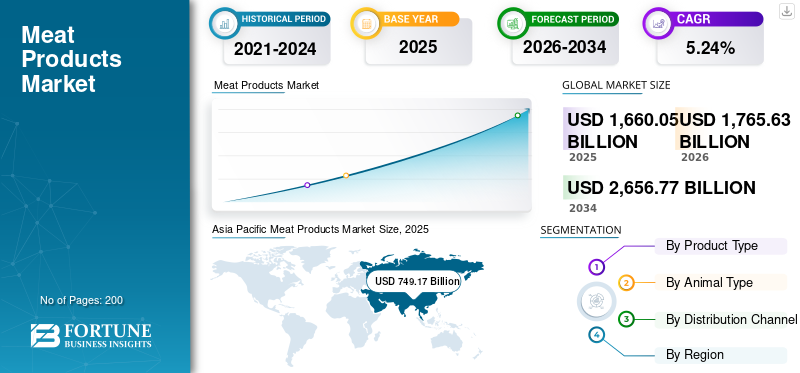
Download Free sample to learn more about this report.
MEAT PRODUCTS MARKET KEY TAKEAWAYS
 Global Market Size & Forecast
- 2025 Market Size: USD 1,660.05 billion
- 2026 Market Size: USD 1,765.63 billion
- 2034 Forecast Market Size: USD 2,656.77 billion
- CAGR: 5.24% from 2026–2034
 Market Share
- Asia Pacific dominated the market with a 45.13% share in 2025.
- The Fresh segment held the largest market share, valued at USD 916.22 billion in 2025.
- The Poultry segment held the largest market share, valued at USD 584.13 billion in 2025.
 Key Regional Highlights
Asia Pacific
Reached USD 749.17 billion in 2025 and is projected to grow at a 6.54% CAGR, driven by urbanization, rising incomes, and strong pork and poultry demand.
North America
Reached USD 385.45 billion in 2025 and is projected to reach USD 559.25 billion by 2034, supported by high meat consumption and strong foodservice demand.
Europe
Reached USD 323.30 billion in 2025 and is projected to reach USD 484.33 billion by 2034, driven by demand for processed and premium meat products.
U.S.
Reached USD 314.62 billion in 2025, driven by strong consumption of beef, poultry, pork, and processed meat products.
Japan
The market is driven by rising consumer demand, technological advancements, and increasing adoption of innovative products across key industries.
Read More

Meat Products Market Trends
Expansion of Processed and Packaged Meat Products to Shape Market Expansion
A trend closely linked to the meat products market growth is the rising demand for processed, packaged, and ready-to-cook meat products. Consumers are increasingly choosing frozen meat, sausages, nuggets, patties, bacon, ham, deli meats, canned meat, marinated meat, and chilled ready-to-cook products due to their convenience, longer shelf life, consistent taste, and reduced cooking time. This trend is especially strong among urban households, working professionals, foodservice operators, quick-service restaurants, institutional kitchens, and online grocery consumers.
Processed meat products support market growth as they generate higher value than unprocessed meat. While fresh meat is largely sold as a commodity, processed and packaged meat allows companies to add value through seasoning, portioning, branding, packaging, cold-chain distribution, and convenience-based positioning.
- The Food and Agriculture Organization reported that global meat production was forecast to reach 373 million tons in 2024, up 1.4% from 2023, with growth mainly supported by higher poultry and bovine meat production.
MARKET DYNAMICS
Market Drivers
Download Free sample to learn more about this report.
Rising Income Levels and Urbanization in Emerging Economies to Strengthen Market Growth
Rising household income, urbanization, and improving food access in emerging economies are major drivers of the market growth. As consumers move into higher income brackets, dietary patterns gradually shift from staple-heavy meals toward more diversified diets that include animal protein such as meat, dairy, fish, and eggs. Urban consumers also have better access to supermarkets, cold-chain retail, foodservice outlets, and online grocery platforms, which increases the availability of fresh, chilled, frozen, and packaged meat products.
This driver is particularly strong in Asia Pacific, Latin America, the Middle East, and parts of Africa, where growing middle-class populations are increasing spending on protein-rich foods.
- According to the State Council of China, per capita disposable income reached approximately USD 6,094.35 in 2024, while median per capita disposable income stood at around USD 5,119.73. Rural income growth was also stronger than urban income growth, indicating broader improvement in purchasing power beyond major urban centers.
Market Restraints
Animal Disease Outbreaks to Disrupt Supply Availability and Restrict Market Expansion
Animal disease outbreaks are one of the most critical restraints for the market, as they can directly reduce livestock and poultry availability, interrupt processing operations, restrict exports, and increase supply-chain costs. Diseases such as highly pathogenic avian influenza, African swine fever, foot-and-mouth disease, and other transboundary animal diseases can quickly affect production volumes and trade flows, especially in poultry and pork sectors where large-scale farms and integrated supply chains are highly sensitive to biosecurity risks.
- According to the Centers for Disease Control and Prevention, based on USDA APHIS data, from January 2022 to April 25, 2024, highly pathogenic avian influenza A(H5N1) detections affected more than 1,100 commercial and backyard flocks and over 90 million birds across 48 U.S. states. Such outbreaks can lead to culling, movement restrictions, higher farm-level biosecurity costs, temporary supply shortages, and price volatility in poultry meat and related products.
Market Opportunities
Expansion of Frozen and Chilled Meat Distribution to Create Growth Opportunities
The expansion of frozen and chilled meat distribution is expected to create strong growth opportunities for the market. Meat is a highly temperature-sensitive product, and the development of cold-chain logistics, refrigerated warehouses, supermarket chillers, frozen transport, and online grocery delivery systems allows processors to distribute meat products over longer distances while maintaining food safety, quality, and shelf life. This is especially important in emerging markets where organized retail, foodservice chains, and online grocery platforms are expanding rapidly.
- According to the China Federation of Logistics & Purchasing (CFLP), China’s total cold storage capacity reached 237 million cubic meters in June 2024, rising 7.73% year-on-year, with 9.42 million cubic meters of new cold storage capacity added in 2024.
This indicates rapid cold-chain infrastructure growth in a major meat-consuming country, supporting wider distribution of chilled and frozen meat through supermarkets, e-commerce, and foodservice channels.
SEGMENTATION ANALYSIS
By Product Type
Fresh Segment Dominated the Market Due to High Household Consumption, Traditional Retail Demand, and Strong Use Across Daily Diets
Based on product type, the market is segmented into fresh and processed, with processed further categorized into frozen, canned, and chilled.
The fresh segment held the largest meat products market share, valued at USD 916.22 billion in 2025. This is due to strong household consumption, cultural preference for fresh meat, high demand through butcher shops and wet markets, and regular use of fresh poultry, beef, pork, and other meat products in daily cooking. Fresh meat remains highly preferred in Asia Pacific, South America, the Middle East, and several European countries where consumers associate freshness with quality, taste, and trust.
The processed segment is projected to grow at the fastest CAGR of 5.42% during 2026-2034.
To know how our report can help streamline your business, Speak to Analyst
By Animal Type
Poultry Segment Dominated Due to Affordability, High Consumption Frequency, and Wide Foodservice Adoption
Based on animal type, the market is segmented into poultry, beef, pork, and others.
The poultry segment dominated the market, valued at USD 584.13 billion in 2025. This is owing to its affordability, broad religious and cultural acceptance, shorter production cycle, lower unit price compared with beef, and strong use across retail, foodservice, frozen meat, processed meat, and quick-service restaurant channels. Poultry is widely consumed in the form of fresh chicken, frozen chicken, nuggets, patties, sausages, wings, fillets, and marinated products. Its demand is especially strong in the Asia Pacific, North America, the Middle East, and Latin America due to price competitiveness and high adaptability to local cuisines.
The pork segment was valued at USD 529.65 billion in 2025 and is projected to grow at the fastest CAGR of 6.31% during the forcast period.
By Distribution Channel
Retail Segment Dominated Owing to Strong Household Purchasing Through Supermarkets, Butcher Shops, and Convenience Stores
Based on distribution channel, the market is segmented into foodservice and retail, with retail further categorized into supermarkets & hypermarkets, convenience stores, butcher shops, online retail, and others.
The retail segment dominated the market, valued at USD 1,121.72 billion in 2025. This is due to frequent household purchases of fresh, frozen, chilled, and processed meat products through supermarkets, hypermarkets, butcher shops, convenience stores, wet markets, and online grocery platforms. Supermarkets & hypermarkets formed the largest retail sub-segment, valued at USD 439.53 billion in 2025, supported by organized retail expansion, packaged meat visibility, private-label meat products, and wider access to frozen and chilled meat.
The foodservice segment was valued at USD 538.33 billion in 2025 and is projected to grow at the fastest CAGR of 6.29% during 2026-2034.
Meat Products Market Regional Outlook
Regionally, the market is studied across North America, Europe, Asia Pacific, South America, and the Middle East & Africa.
North America
Asia Pacific Meat Products Market Size, 2025 (USD Billion)
To get more information on the regional analysis of this market, Download Free sample
North America was valued at USD 385.45 billion in 2025. The region is projected to reach USD 559.25 billion by 2034, growing at a CAGR of 4.09%. Growth is driven by high per capita meat consumption, strong demand for beef and poultry, large-scale meat processing facilities, frozen food products penetration, foodservice demand, and strong retail availability of branded fresh, frozen, and processed meat products.
U.S. Meat Products Market
The U.S. dominates the North American market, valued at USD 314.62 billion in 2025, supported by strong consumption of beef, poultry, pork, sausages, bacon, deli meats, frozen meat, and ready-to-cook meat products.
Europe
Europe was valued at USD 323.30 billion in 2025 and is projected to reach USD 484.33 billion by 2034, growing at a CAGR of 4.47%. Growth is supported by strong demand for processed meat, pork, poultry, chilled meat, premium cuts, sausages, ham, bacon, salami, and convenience-oriented retail products. The region has a mature meat processing base and strong consumer demand for traceability, animal welfare, origin labeling, and premium chilled products.
Germany Meat Products Market
Germany was valued at approximately USD 74.12 billion in 2025, supported by strong pork consumption, sausage production, processed meat demand, chilled meat retailing, and established meat processing companies.
France Meat Products Market
France was valued at approximately USD 58.35 billion in 2025, driven by demand for poultry, beef, pork, charcuterie, premium cuts, and chilled meat products. The market benefits from strong retail distribution, foodservice demand, and consumer preference for origin-certified and quality-assured meat products.
Asia Pacific
Asia Pacific dominated the market and was valued at USD 749.17 billion in 2025. The region is projected to reach USD 1,340.34 billion by 2034, growing at the fastest CAGR of 6.54%. Growth is driven by population size, rising disposable income, urbanization, expanding cold-chain logistics, strong pork and poultry consumption, foodservice growth, and increasing demand for frozen and processed meat products.
China Meat Products Market
China dominates the regional market, valued at approximately USD 398.28 billion in 2025, supported by large pork consumption, expanding poultry demand, processed meat adoption, foodservice growth, and cold-chain expansion.
India Meat Products Market
India was valued at approximately USD 65.65 billion in 2025, supported primarily by poultry demand, expanding foodservice chains, rising protein awareness, growth in frozen chicken, and increasing adoption of packaged meat through organized retail and online grocery platforms.
South America and Middle East & Africa
South America was valued at USD 129.96 billion in 2025 and is projected to reach USD 184.91 billion by 2034, growing at a CAGR of 3.87%. Growth is driven by strong beef and poultry production, export-oriented meat processing, rising domestic consumption, and expanding packaged meat availability.
The Middle East & Africa market was valued at USD 72.17 billion in 2025 and is projected to reach USD 87.94 billion by 2034, growing at a CAGR of 2.06%. Growth is supported by rising demand for poultry, halal meat, frozen meat imports, foodservice expansion, tourism, and premium retail meat products in Gulf countries.
Brazil Meat Products Market
Brazil dominates the South American market, valued at approximately USD 88.79 billion in 2025, supported by large-scale beef and poultry production, strong domestic consumption, export-oriented meat processing, and the presence of major global meat companies.
COMPETITIVE LANDSCAPE
Key Industry Players
Expansion of Poultry Processing and Value-added Product Portfolio to Strengthen Market Competition
Key players in the market are increasingly focusing on poultry processing expansion and value-added product development to strengthen their market position. Poultry remains one of the most scalable meat categories due to its shorter production cycle, comparatively lower production cost, and strong demand across retail, foodservice, and institutional channels. Companies are investing in integrated poultry operations, processing plants, automated cutting lines, freezing facilities, and branded packaged poultry products to improve supply reliability and margin performance.
Key Players in the Market
|
Rank |
Company Name |
|
1 |
JBS S.A. |
|
2 |
Tyson Foods, Inc. |
|
3 |
WH Group Limited |
|
4 |
Cargill, Incorporated |
|
5 |
BRF S.A. |
List of Key Meat Products Companies Profiled
- JBS S.A. (Brazil)
- Tyson Foods, Inc. (U.S.)
- WH Group Limited (China)
- Cargill, Incorporated (U.S.)
- BRF S.A. (Brazil)
- Hormel Foods Corporation (U.S.)
- Marfrig Global Foods S.A. (Brazil)
- Danish Crown A/S (Denmark)
- NH Foods Ltd. (Japan)
- Smithfield Foods, Inc. (U.S.)
KEY INDUSTRY DEVELOPMENTS
- May 2026: Applegate Farms, LLC, the nation's leading natural and organic meat brand, launched its latest product innovation, APPLEGATE NATURALS Natural Uncured Pork & Beef Hot Dog, timed perfectly for summer gatherings. This new blended hot dog combines pork and beef to expand Applegate's lineup of natural and organic hot dogs, which already includes beef and turkey varieties, giving consumers more choices for summer entertaining.
- December 2025: Tanmiah Food Company, a Riyadh-based poultry leader listed on the Saudi Exchange, launched a new Frozen Breaded Chicken range for both retail and foodservice channels. This is the first frozen breaded chicken product in the category made entirely from 100% fresh Saudi chicken (domestically raised), setting a new benchmark for quality and local sourcing.
- May 2025: Amylu Foods, a leader in natural, better-for-you, fully-cooked chicken products, launched its Organic Chicken Sausage Line, marking the company's first certified organic sausage line. The new organic chicken sausage range includes four delicious flavors: Apple, Sweet Italian, Spinach & Feta, and Basil & Cracked Black Pepper.
- April 2025: Applegate Farms, LLC, a subsidiary of Hormel Foods and the nation's leading natural and organic meat brand, expanded its frozen chicken portfolio by launching two new products under the APPLEGATE NATURALS line, namely Lightly Breaded Chicken Tenders and Lightly Breaded Popcorn Chicken.
- June 2024: Al Islami Foods, a UAE-based pioneer in wholesome halal poultry and meat products, launched its new Heat & Eat product called “Original Tempura Nuggets”, redefining convenience and nutrition for families. These fully cooked nuggets are made from hand-slaughtered, never-stunned halal chicken with no added hormones, offering parents a trusted and safe option for their children.
REPORT COVERAGE
The global meat products market report analyses the market in depth and highlights crucial aspects such as market trends, market dynamics, supply chains, prominent companies, investment in research and development, and end-use. Besides this, the report also provides insights into the market analysis and highlights significant industry developments.
Request for Customization to gain extensive market insights.
Report Scope & Segmentation
| ATTRIBUTE | DETAILS |
| Study Period | 2021-2034 |
| Base Year | 2025 |
| Estimated Year | 2026 |
| Forecast Period | 2026-2034 |
| Historical Period | 2021-2024 |
| Growth Rate | CAGR of 5.24% from 2026 to 2034 |
| Unit | Value (USD Billion) |
|
Segmentation |
By Product Type
|
|
By Animal Type
|
|
|
By Distribution Channel
|
|
|
By Region
|
Frequently Asked Questions
Fortune Business Insights says that the global market was valued at USD 1,660.05 billion in 2025 and is anticipated to reach USD 2,656.77 billion by 2034.
At a CAGR of 5.24%, the global market will exhibit steady growth over the forecast period.
By product type, the fresh segment is leading the market.
Asia Pacific held the largest market share in 2025.
Rising income levels and urbanization in emerging economies is driving the global market.
JBS S.A., Tyson Foods, Inc., WH Group Limited, Cargill, Incorporated, and BRF S.A. are the leading players in the market.
The increasing expansion of processed and packaged meat products is a key market trend.



- 2021-2034
- 2025
- 2021-2024
- 200
-
(Offer valid till 30th Sep 2026)
Get 30-60 hrs Free Customization
Expand Regional and Country Coverage, Segments Analysis, Company Profiles, Competitive Benchmarking, and End-user Insights.




















Related Reports
-
US +1 833 909 2966 ( Toll Free )
-
Get In Touch With Us