Medical Polyethylene Market Size, Share & Industry Analysis, By Application (Medical Tubing, Disposables, Medical Bags, Medical Implants, Containers, Drug Testing Equipment), By Country, and Regional Forecast, 2026-2034
 Download Free Sample
Medical Polyethylene Market Overview
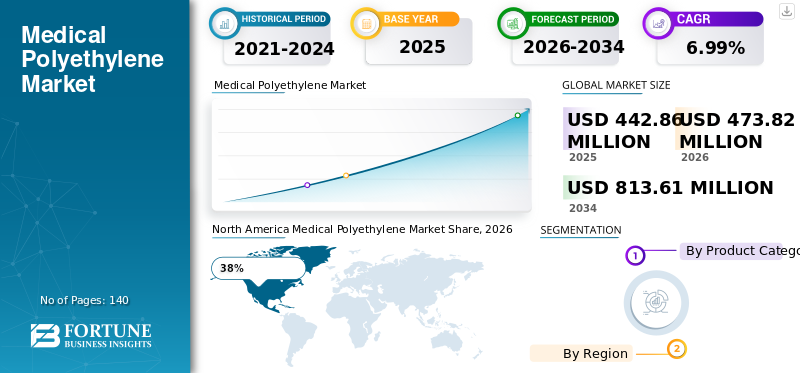
The medical polyethylene market size was valued at USD 442.86 Million in 2025. The market is projected to grow from USD 473.82 Million in 2026 to USD 813.61 Million by 2034, exhibiting a CAGR of 6.99% during the forecast period.

The medical polyethylene market is a critical segment of the healthcare materials industry, driven by the extensive use of polyethylene in medical-grade packaging, diagnostic devices, tubing systems, disposable products, implantable components, and laboratory equipment. Medical polyethylene offers excellent chemical resistance, biocompatibility, durability, sterilization compatibility, and lightweight characteristics, making it a preferred material across healthcare applications. Manufacturers are increasingly focusing on high-purity grades that meet stringent regulatory requirements. Growing demand for infection control products, single-use medical devices, and advanced healthcare packaging continues to support medical polyethylene market growth. The medical polyethylene market report indicates rising adoption across hospitals, pharmaceutical manufacturing facilities, and diagnostic laboratories.
The United States represents one of the most significant contributors to the medical polyethylene market due to its advanced healthcare infrastructure, large medical device manufacturing base, and continuous investment in healthcare innovation. Medical-grade polyethylene is widely utilized in pharmaceutical packaging, disposable medical products, diagnostic equipment, and surgical applications. Regulatory compliance standards encourage the adoption of premium-quality polyethylene materials with superior purity and performance characteristics.
The increasing prevalence of chronic diseases, expansion of outpatient care centers, and growing emphasis on infection prevention have strengthened demand for disposable medical products manufactured from polyethylene. The country remains a major hub for research, development, and commercialization of advanced medical polymers, supporting long-term medical polyethylene market opportunities and Medical Polyethylene Industry Analysis.
Download Free sample to learn more about this report.
Key Takeaways
Market Size & Growth
- Global market size 2025: USD 442.86 Million
- Global market size 2034: USD 813.61 Million
- CAGR (2026–2034): 6.99%
Market Share – Regionals
- North America: 38%
- Europe: 27%
- Asia-Pacific: 25%
- Rest of World: 10%
Country-Level Shares
- Germany: 29% of Europe’s market
- United Kingdom: 22% of Europe’s market
- Japan: 21% of Asia-Pacific market
- China: 36% of Asia-Pacific market
medical polyethylene market Latest Trends
One of the most prominent medical polyethylene market Trends is the increasing shift toward sustainable and recyclable medical polymers. Healthcare providers and manufacturers are evaluating environmentally responsible materials while maintaining strict safety and regulatory standards. This trend has encouraged investments in advanced polyethylene grades capable of supporting circular economy initiatives without compromising performance.
Download Free sample to learn more about this report.
Another important trend involves the development of ultra-high molecular weight polyethylene for orthopedic and implant applications. Enhanced wear resistance, improved mechanical properties, and longer service life are contributing to greater adoption in specialized medical procedures. Manufacturers are also introducing medical-grade polyethylene formulations designed for improved sterilization compatibility.
Digital healthcare expansion has increased demand for diagnostic equipment, laboratory consumables, and medical packaging solutions. As a result, polyethylene consumption across healthcare supply chains continues to expand. Furthermore, automation in medical device manufacturing has improved production consistency and quality control. These developments collectively strengthen medical polyethylene market Insights, medical polyethylene market Analysis, and Medical Polyethylene Industry Report findings across global healthcare sectors.
medical polyethylene market Dynamics
DRIVER
Rising Demand for Disposable and Infection-Control Medical Products
The increasing use of disposable healthcare products remains the primary driver of the medical polyethylene market. Hospitals, clinics, diagnostic laboratories, and pharmaceutical facilities continue to prioritize infection prevention and contamination control. Medical polyethylene is extensively used in disposable gloves packaging, tubing systems, fluid management products, specimen collection containers, medical bags, and protective healthcare components.
Healthcare institutions increasingly prefer single-use products because they reduce cross-contamination risks and simplify sterilization requirements. Polyethylene offers excellent flexibility, durability, chemical resistance, and cost efficiency, making it suitable for large-scale disposable product manufacturing. Expanding healthcare access in emerging economies has also increased demand for affordable medical supplies. Additionally, pharmaceutical packaging applications rely heavily on medical-grade polyethylene to maintain product integrity and safety. These factors collectively support medical polyethylene market growth and reinforce favorable medical polyethylene market Forecast expectations across healthcare manufacturing sectors.
RESTRAINT
Stringent Regulatory Compliance Requirements
Regulatory compliance remains a major restraint for the medical polyethylene market. Medical-grade materials must satisfy extensive quality, safety, traceability, and biocompatibility requirements before being approved for healthcare applications. Manufacturers face substantial testing and validation obligations throughout product development and commercialization processes.
Changes in healthcare regulations can require reformulation, recertification, or additional documentation, increasing operational complexity. Healthcare providers demand materials that consistently meet strict performance standards under sterilization conditions. Any deviation can result in product recalls, reputational damage, or delays in market entry. Furthermore, regulatory requirements vary across countries, creating challenges for multinational suppliers. Compliance-related expenses can affect smaller manufacturers more significantly than larger industry participants. These factors may restrict rapid product introductions and influence medical polyethylene market Size expansion in highly regulated healthcare environments.
OPPORTUNITY
Expansion of Advanced Medical Device Manufacturing
The growing production of sophisticated medical devices presents substantial opportunities within the medical polyethylene market. Demand for minimally invasive surgical equipment, wearable healthcare technologies, diagnostic systems, and specialized implantable components continues to increase worldwide. Medical polyethylene manufacturers are developing advanced grades tailored to these applications.
Technological advancements allow producers to engineer materials with improved strength, clarity, chemical resistance, and sterilization performance. Expanding healthcare investments in Asia-Pacific, Latin America, and Middle Eastern countries create additional opportunities for suppliers of medical-grade polymers. Customized polyethylene solutions designed for specific clinical applications are gaining traction among medical device manufacturers. Rising healthcare spending and growing patient populations further strengthen long-term demand. These developments support favorable medical polyethylene market Outlook and create significant opportunities for innovation-driven manufacturers.
CHALLENGE
Raw Material Volatility and Supply Chain Disruptions
Raw material availability and supply chain uncertainty represent major challenges for the medical polyethylene market. Polyethylene production depends on petrochemical feedstocks, making pricing vulnerable to fluctuations in energy markets and global supply conditions. Unexpected disruptions can affect production schedules and procurement strategies.
Healthcare manufacturers require uninterrupted access to certified medical-grade materials, making supply consistency critically important. Transportation bottlenecks, geopolitical tensions, and manufacturing interruptions can impact lead times and product availability. Maintaining adequate inventory levels while controlling costs presents an ongoing challenge for industry participants. In addition, increasing sustainability expectations may require investments in alternative production processes and recyclable material technologies. Addressing these challenges is essential for maintaining competitiveness and ensuring reliable medical polyethylene market share performance.
medical polyethylene market Segmentation
By Product Category
Medical tubing represents one of the largest segments within the medical polyethylene market. Polyethylene tubing is widely used in intravenous delivery systems, drainage systems, catheter assemblies, respiratory devices, and fluid transfer applications. The material's flexibility, chemical resistance, and sterilization compatibility make it highly suitable for critical healthcare environments.
Healthcare providers increasingly require reliable tubing systems capable of maintaining performance under demanding clinical conditions. Manufacturers continue to develop advanced tubing solutions with enhanced durability and purity characteristics. The segment benefits from expanding hospital infrastructure and increasing procedural volumes worldwide. Medical Tubing remains a key contributor to medical polyethylene market growth due to its broad utilization across healthcare settings.
Disposables account for the largest share of the medical polyethylene market. The segment includes single-use healthcare products designed to reduce contamination risks and improve patient safety. Polyethylene is extensively utilized in disposable packaging, protective coverings, specimen containers, and numerous healthcare consumables.
Growing awareness regarding infection prevention continues to drive demand for disposable products. Healthcare institutions increasingly adopt single-use solutions to streamline operations and enhance hygiene standards. Medical-grade polyethylene offers an optimal combination of performance, affordability, and manufacturing efficiency, making it indispensable for disposable healthcare applications.
Medical bags constitute an important segment of the medical polyethylene market. These products include blood bags, fluid collection bags, drainage bags, and pharmaceutical storage solutions. Polyethylene provides excellent flexibility, leak resistance, and compatibility with sterilization processes.
Healthcare facilities require durable and contamination-resistant bag systems capable of supporting critical medical procedures. Manufacturers continue to introduce enhanced bag designs focused on patient safety and operational efficiency. Demand is further supported by increasing surgical procedures and expanding healthcare services globally.
Medical implants represent a specialized segment within the medical polyethylene market. Ultra-high molecular weight polyethylene is commonly used in orthopedic implants due to its wear resistance, biocompatibility, and long-term durability. Joint replacement procedures remain a significant demand driver for this category.
Research initiatives focused on improving implant longevity continue to encourage innovation in polyethylene materials. Healthcare providers increasingly seek advanced implant solutions capable of improving patient outcomes and reducing revision procedures. This segment remains strategically important despite its comparatively smaller market share.
Medical containers play a vital role in specimen collection, pharmaceutical storage, diagnostic testing, and laboratory operations. Polyethylene containers provide excellent chemical resistance and protection against contamination. Their lightweight construction also supports efficient transportation and handling.
Growing diagnostic testing volumes and expanding pharmaceutical production activities contribute to sustained demand for medical containers. Manufacturers continue to focus on precision-engineered container solutions that meet strict healthcare quality standards.
Polyethylene components are widely incorporated into drug testing equipment and diagnostic systems. These materials offer dimensional stability, contamination resistance, and manufacturing versatility. Drug testing applications require high-quality materials capable of maintaining analytical accuracy and reliability.
The expansion of laboratory testing services and increased healthcare screening programs continue to support this segment. Demand is also influenced by growing investments in diagnostic infrastructure and healthcare quality improvement initiatives.
medical polyethylene market Regional Outlook
North America Medical Polyethylene Market Share, 2026 (%)
To get more information on the regional analysis of this market, Download Free sample
North America
North America remains a leading region in the medical polyethylene market 38% due to advanced healthcare systems, strong medical device manufacturing capabilities, and extensive healthcare spending. The region benefits from widespread adoption of disposable medical products and advanced packaging technologies. Healthcare institutions prioritize high-quality materials that meet rigorous regulatory requirements, supporting sustained demand for medical-grade polyethylene.
The presence of established healthcare manufacturers and significant investments in research and development further strengthen regional growth. Hospitals, pharmaceutical companies, and diagnostic laboratories continue to expand utilization of polyethylene-based products. Growing demand for infection prevention solutions and specialized healthcare materials contributes to regional leadership in medical polyethylene market Analysis.
Europe
Europe represents a mature and technologically advanced medical polyethylene market 27% characterized by strong regulatory frameworks and extensive healthcare infrastructure. The region benefits from widespread adoption of high-performance medical polymers in healthcare packaging, diagnostic systems, and disposable products.
Sustainability initiatives are influencing material innovation across Europe. Manufacturers increasingly focus on recyclable and environmentally responsible healthcare solutions while maintaining compliance with strict quality standards. Continuous investment in healthcare modernization supports long-term market development.
Germany medical polyethylene market
Germany represents one of Europe's most influential markets 29% for medical polyethylene. The country possesses a strong medical device manufacturing sector, advanced industrial capabilities, and extensive healthcare infrastructure. Medical-grade polyethylene is widely utilized across diagnostic equipment, packaging systems, laboratory applications, and disposable healthcare products.
German manufacturers emphasize precision engineering, quality assurance, and regulatory compliance. Ongoing investments in healthcare innovation continue to support demand for advanced polymer materials. The country's robust export-oriented healthcare industry also contributes significantly to polyethylene consumption. With approximately of the European market, Germany remains a key growth center within regional Medical Polyethylene Industry Analysis.
United Kingdom medical polyethylene market
The United Kingdom maintains a significant position within the European medical polyethylene market. 22% Demand is supported by a well-established healthcare system, active pharmaceutical sector, and growing medical technology industry. Polyethylene-based products are widely utilized in healthcare packaging, laboratory equipment, and disposable medical devices.
Innovation remains a major focus area, with manufacturers exploring advanced material technologies and sustainable healthcare solutions. Increased healthcare modernization efforts and growing diagnostic activity continue to create opportunities for medical polyethylene suppliers. The United Kingdom accounts for approximately of Europe's medical polyethylene market share.
Asia-Pacific
Asia-Pacific is emerging as one of the fastest-expanding regions in the medical polyethylene market. 25% Rising healthcare investments, expanding manufacturing capacity, and increasing healthcare access support substantial demand growth. Medical device production and pharmaceutical manufacturing activities continue to expand across major economies.
Governments throughout the region are investing heavily in healthcare infrastructure development. Growing populations and increasing healthcare awareness contribute to rising demand for medical consumables, packaging materials, and diagnostic products. These factors strengthen the regional medical polyethylene market Outlook.
Japan medical polyethylene market
Japan's medical polyethylene market 21% is characterized by technological sophistication and strong healthcare quality standards. Medical polyethylene is widely used in advanced diagnostic systems, implantable devices, and precision healthcare applications. The country's aging population supports ongoing demand for healthcare products and services.
Manufacturers emphasize innovation, product reliability, and regulatory compliance. Research activities focused on advanced polymers continue to encourage adoption of specialized polyethylene grades. Japan accounts for approximately 21% of the Asia-Pacific market.
China medical polyethylene market
China represents the largest medical polyethylene market 36% within Asia-Pacific. Rapid healthcare infrastructure expansion, increasing medical device production, and growing pharmaceutical manufacturing activities support strong demand. Medical polyethylene consumption continues to rise across hospitals, laboratories, and healthcare manufacturing facilities.
Government support for healthcare modernization and domestic medical technology development further strengthens market opportunities. The country's extensive manufacturing capabilities position it as a major consumer and producer of medical-grade polyethylene materials. China accounts for approximately 36% of the Asia-Pacific market.
Rest of World
The Rest of World region includes Latin America, the Middle East, and Africa. 10% Demand for medical polyethylene is increasing due to healthcare infrastructure development, rising healthcare expenditures, and expanding access to medical services. Disposable healthcare products and pharmaceutical packaging applications remain key demand drivers.
Governments and private healthcare providers are investing in modernization initiatives to improve healthcare delivery. Growing awareness regarding infection control and patient safety supports increased adoption of polyethylene-based healthcare products. Regional demand is expected to strengthen as healthcare capabilities continue to expand.
List of Top Medical Polyethylene Companies
- Celanese Corporation
- SABIC
- Dow Inc.
- Tekni-Plex Inc.
- Exxon Mobil Corporation
- LyondellBasell Industries Holdings B.V.
- Orthoplastics Ltd.
- Biesterfeld AG
Top Two Companies by Market Share
- Dow Inc. – 16%
- SABIC – 13%
Investment Analysis and Opportunities
Investment activity in the medical polyethylene market is increasingly focused on capacity expansion, product innovation, and healthcare sustainability initiatives. Manufacturers are investing in advanced production technologies to improve material performance, consistency, and regulatory compliance. High-purity medical-grade polyethylene remains a priority area due to increasing healthcare quality requirements.
Emerging economies present attractive investment opportunities as healthcare infrastructure continues to expand. Demand for medical devices, pharmaceutical packaging, and diagnostic equipment is creating favorable conditions for market participants. Strategic partnerships between polymer producers and medical device manufacturers are becoming more common.
Investors are also focusing on sustainable healthcare materials and recyclable polymer technologies. Research programs aimed at improving biocompatibility, sterilization resistance, and environmental performance are expected to generate future growth opportunities. These developments support positive medical polyethylene market opportunities across global healthcare supply chains.
New Product Development
Innovation remains a defining characteristic of the medical polyethylene market. Manufacturers are introducing advanced polyethylene grades with enhanced purity, durability, and sterilization compatibility. New product development efforts focus on improving performance in demanding healthcare environments.
Ultra-high molecular weight polyethylene continues to attract attention for orthopedic and implant applications. Companies are also developing specialized materials for wearable medical technologies, minimally invasive devices, and advanced diagnostic systems. Improved processing technologies enable the production of precision-engineered components with consistent quality.
Sustainability-driven innovation is another key focus area. Manufacturers are exploring recyclable medical materials and production processes that reduce environmental impact. These innovations support evolving healthcare requirements while maintaining compliance with strict regulatory standards.
Five Recent Developments (2023–2025)
- Expansion of medical-grade polyethylene production capacity by major polymer manufacturers to address healthcare demand.
- Introduction of advanced ultra-high molecular weight polyethylene formulations for orthopedic implant applications.
- Increased investment in recyclable and sustainability-focused medical polyethylene solutions.
- Strategic collaborations between medical device producers and polymer suppliers to develop customized healthcare materials.
- Launch of enhanced sterilization-compatible polyethylene grades for pharmaceutical packaging and disposable medical products.
Report Coverage
The medical polyethylene market Research Report provides comprehensive analysis of industry structure, competitive dynamics, product categories, application areas, and regional performance. The report evaluates factors influencing demand across healthcare, pharmaceutical, diagnostic, and medical device sectors.
Request for Customization to gain extensive market insights.
Coverage includes medical polyethylene market Trends, medical polyethylene market Insights, Medical Polyethylene Industry Analysis, and medical polyethylene market Forecast assessments. Detailed segmentation highlights the role of tubing, disposables, medical bags, implants, containers, and testing equipment within the industry.
The report also examines regional developments, investment activities, innovation trends, competitive positioning, and emerging opportunities. Market participants can utilize the findings to identify growth areas, optimize strategic planning, and strengthen decision-making processes across healthcare material value chains.



- 2021-2034
- 2025
- 2021-2024
- 140
-

(Offer valid till 30th Sep 2026)
Get 30-60 hrs Free Customization
Expand Regional and Country Coverage, Segments Analysis, Company Profiles, Competitive Benchmarking, and End-user Insights.













.webp)






-
US +1 833 909 2966 ( Toll Free )
-
Get In Touch With Us