Medical Scheduling Software Market Size, Share & Industry Analysis, By Type (Patient, Care Provider), By Deployment Modeland (Cloud-based, On-premise), By End Use, and Regional Forecast, 2026-2034
 Download Free Sample
Medical Scheduling Software Market Overview
The medical scheduling software market size was valued at USD 415.33 million in 2025. The market is projected to grow from USD 470.23 million in 2026 to USD 1269.54 million by 2034, exhibiting a CAGR of 13.22% during the forecast period.

The medical scheduling software market is witnessing strong adoption across healthcare systems as hospitals, clinics, specialty care centers, and telehealth providers focus on improving patient access and operational efficiency. Medical scheduling platforms help healthcare organizations automate appointment booking, patient reminders, physician availability management, and resource allocation. The increasing shift toward digital healthcare administration, combined with growing patient expectations for self-service scheduling, is strengthening demand across both public and private healthcare facilities. medical scheduling software market analysis indicates that healthcare organizations are prioritizing workflow optimization, reduced appointment no-shows, and improved patient engagement. The market is also benefiting from integration with electronic health records, telemedicine platforms, and patient communication systems.
The United States remains the leading contributor to the medical scheduling software market due to advanced healthcare infrastructure and widespread digital transformation initiatives. Healthcare providers are investing heavily in cloud-enabled scheduling solutions to streamline patient flow and improve administrative productivity. Growing adoption of telehealth services, rising demand for online appointment booking, and increasing pressure to reduce healthcare operational costs continue to drive software implementation. medical scheduling software market research report findings indicate that integrated scheduling platforms are becoming essential for hospitals, physician groups, ambulatory centers, and specialty clinics. Artificial intelligence-enabled scheduling, automated reminders, and patient engagement tools are gaining significant traction across the U.S. healthcare ecosystem.
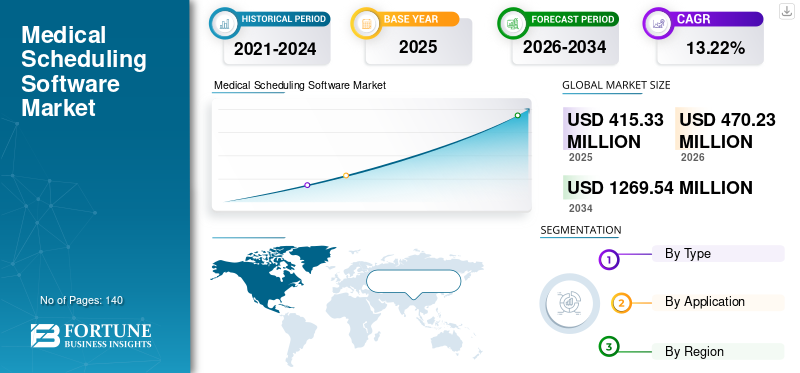
Download Free sample to learn more about this report.
Medical Scheduling Software Market Key Takeaways
 Global Market Size & Forecast
- 2025 Market Size: USD 415.33 Million
- 2026 Market Size: USD 470.23 Million
- 2034 Forecast Market Size: USD 1,269.54 Million
- CAGR: 13.22% from 2026–2034
 Market Share
- North America dominated with a revenue share of 42% in 2025.
- Patient scheduling held the largest type share at approximately 58%.
- Cloud-based deployment accounted for the largest deployment share at approximately 69%.
 Key Regional Highlights
North America
North America led the market with a 42% share in 2025, supported by rapid healthcare digitization and strong software adoption.
Europe
Europe accounted for 28% of the market, driven by increasing demand for efficient healthcare workflow management.
Asia-Pacific
Asia-Pacific held a 22% share, supported by expanding healthcare infrastructure and digital transformation initiatives.
U.S
The U.S. market is supported by widespread adoption of cloud-based healthcare software and growing demand for automated scheduling solutions.
Japan
Japan accounted for 18% of the Asia-Pacific market, supported by healthcare digitalization and increasing demand for efficient appointment management.
Read More

Medical Scheduling Software Market Latest Trends
One of the most influential medical scheduling software market Trends is the growing adoption of AI-powered scheduling systems. Healthcare organizations are increasingly implementing predictive scheduling tools capable of analyzing appointment history, patient behavior, provider availability, and cancellation patterns. These systems help reduce scheduling conflicts and improve patient satisfaction. Intelligent automation is also enabling healthcare providers to optimize workforce utilization while reducing administrative burdens.
Download Free sample to learn more about this report.
Another major trend shaping the Medical Scheduling Software Industry Report is the expansion of cloud-based scheduling platforms integrated with telehealth services. Healthcare providers now require scheduling systems capable of managing both in-person and virtual consultations through a unified interface. Mobile scheduling applications, patient self-service portals, and real-time appointment updates are becoming standard features across modern healthcare environments. Furthermore, interoperability between scheduling software, electronic health records, and billing systems is emerging as a critical purchasing factor among healthcare organizations seeking comprehensive digital healthcare management solutions.
Medical Scheduling Software Market Dynamics
DRIVER
Rising Demand for Patient-Centric Healthcare Management
The primary growth driver in the medical scheduling software market is the increasing focus on patient-centered healthcare delivery. Healthcare providers are actively adopting technologies that simplify appointment management while improving patient experiences. Modern scheduling platforms allow patients to book appointments online, receive automated reminders, modify schedules remotely, and access provider availability in real time. These capabilities significantly improve convenience and accessibility.
The growing volume of outpatient visits and chronic disease management programs has further accelerated the need for efficient scheduling systems. medical scheduling software market growth is supported by healthcare organizations seeking to reduce appointment no-show rates, optimize physician utilization, and enhance operational efficiency. Digital scheduling tools also improve communication between providers and patients, enabling better care coordination. As healthcare facilities continue modernizing administrative processes, demand for advanced scheduling platforms remains strong across hospitals, clinics, diagnostic centers, and telemedicine providers.
RESTRAINT
Data Privacy and Regulatory Compliance Concerns
Data security challenges continue to represent a significant restraint for the medical scheduling software market . Healthcare organizations handle large volumes of sensitive patient information, making cybersecurity and compliance critical priorities. Any scheduling platform managing patient records, appointment histories, and personal data must adhere to strict healthcare regulations.
Many healthcare providers remain cautious about migrating sensitive scheduling operations to cloud environments due to concerns regarding unauthorized access, ransomware attacks, and data breaches. Smaller clinics often face budget limitations that make advanced cybersecurity investments difficult. medical scheduling software industry analysis indicates that compliance requirements increase implementation complexity and operational costs for software vendors. Regulatory differences across regions further complicate software deployment and customization efforts, creating additional challenges for multinational healthcare organizations and technology providers.
OPPORTUNITY
Expansion of Cloud-Based Healthcare Ecosystems
The rapid evolution of cloud healthcare infrastructure presents substantial opportunities within the medical scheduling software market . Cloud-based platforms offer scalability, remote accessibility, lower maintenance requirements, and simplified updates compared with traditional on-premise systems. Healthcare organizations increasingly prefer subscription-based deployment models that minimize upfront investments while providing continuous software enhancements.
medical scheduling software market opportunities are expanding through integration with telemedicine, electronic health records, patient engagement solutions, and healthcare analytics platforms. Emerging healthcare markets are also investing heavily in digital health initiatives, creating new growth avenues for scheduling software vendors. Artificial intelligence, predictive analytics, and machine learning capabilities are expected to generate additional value by optimizing appointment utilization, reducing wait times, and improving healthcare resource planning. These advancements position scheduling software as a critical component of future healthcare delivery ecosystems.
CHALLENGE
Complex Integration with Legacy Healthcare Systems
A major challenge facing the medical scheduling software market involves integration with existing healthcare technology infrastructure. Many hospitals and healthcare networks continue operating legacy systems developed over several decades. Integrating modern scheduling platforms with older electronic health record systems, billing software, and practice management tools often requires significant technical customization.
medical scheduling software market forecast studies indicate that interoperability challenges remain a key concern among healthcare administrators evaluating software investments. Differences in data standards, software architecture, and vendor ecosystems can delay deployment timelines and increase implementation expenses. Staff training requirements and workflow adjustments further complicate adoption processes. Healthcare organizations must carefully balance operational continuity with technology modernization efforts, making integration challenges a persistent market obstacle.
Medical Scheduling Software Market Segmentation
By Type
Patient scheduling represents the largest segment within the medical scheduling software market , accounting for approximately 58% market share. This segment focuses on solutions that enable patients to schedule appointments through online portals, mobile applications, automated call systems, and healthcare websites. The growing consumer preference for digital healthcare services continues driving adoption of patient scheduling platforms across hospitals and outpatient facilities.
medical scheduling software market insights indicate that patient scheduling systems reduce administrative workloads while improving patient convenience. Features such as appointment reminders, waitlist management, online rescheduling, and self-service booking have become essential capabilities. Healthcare providers increasingly deploy patient-centric scheduling solutions to reduce no-show rates and improve access to care. Integration with electronic health records further enhances operational efficiency by ensuring accurate appointment management and patient information synchronization.
Patient scheduling software is particularly valuable for multi-specialty clinics and healthcare networks handling large appointment volumes. Advanced systems leverage analytics to optimize scheduling patterns and improve provider utilization. The continued expansion of telehealth services is also increasing demand for platforms capable of managing virtual and physical appointments through unified interfaces.
Care provider scheduling accounts for nearly 42% of the medical scheduling software market share. This segment focuses on workforce scheduling, physician availability management, shift coordination, resource allocation, and clinical staff planning. Healthcare organizations increasingly rely on provider scheduling solutions to manage complex staffing requirements while maintaining operational efficiency.
medical scheduling software market research report findings indicate that hospitals are adopting provider scheduling systems to address workforce shortages and optimize clinical resource utilization. These platforms help administrators coordinate physician schedules, operating room availability, nursing shifts, and specialty care resources. Automated scheduling capabilities reduce administrative complexity while supporting regulatory compliance and workforce planning objectives.
Provider scheduling software is becoming increasingly sophisticated through the integration of predictive analytics and artificial intelligence. These technologies help healthcare organizations anticipate patient demand, balance workloads, and improve staff productivity. As healthcare systems continue expanding outpatient services and telemedicine programs, demand for advanced provider scheduling platforms is expected to remain strong.
To know how our report can help streamline your business, Speak to Analyst
By Application
Cloud-based deployment dominates the medical scheduling software market with approximately 69% market share. Healthcare providers increasingly favor cloud solutions because of their scalability, flexibility, and lower infrastructure requirements. Cloud platforms enable real-time access to scheduling information across multiple facilities while supporting remote workforce management and telehealth integration.
medical scheduling software market Trends demonstrate growing preference for software-as-a-service models that reduce upfront capital expenditures. Cloud scheduling systems provide automated updates, centralized data management, enhanced collaboration, and simplified maintenance. These advantages make cloud deployment particularly attractive for healthcare organizations managing distributed operations.
The ability to integrate scheduling functions with electronic health records, billing systems, and patient communication platforms further strengthens adoption. Healthcare providers also benefit from improved disaster recovery capabilities and enhanced accessibility. Cloud deployment remains a key focus area for software vendors seeking to expand market penetration and deliver comprehensive healthcare workflow solutions.
On-premise deployment holds approximately 31% of the medical scheduling software market share and remains relevant among organizations prioritizing direct infrastructure control. Large hospitals, government healthcare facilities, and institutions with stringent security requirements often prefer on-premise solutions for managing sensitive patient information.
medical scheduling software industry analysis highlights that on-premise platforms provide healthcare organizations with greater customization capabilities and internal governance over scheduling operations. These systems can be tailored to support complex workflows and specialized healthcare environments. Organizations with existing information technology investments may also prefer maintaining scheduling systems within internal infrastructure.
Despite the growing popularity of cloud solutions, on-premise deployment continues serving healthcare providers with unique regulatory, security, or operational requirements. Hybrid deployment models combining cloud accessibility with localized data management are also gaining attention among organizations seeking balanced technology strategies.
Hospitals and healthcare systems account for approximately 49% of medical scheduling software market demand. Large healthcare organizations require advanced scheduling platforms capable of coordinating physicians, nursing staff, operating rooms, diagnostic equipment, and patient appointments across multiple departments.
medical scheduling software market outlook indicates that hospitals are increasingly investing in integrated scheduling ecosystems to improve patient throughput and operational performance. These platforms support complex appointment structures while enabling efficient resource management. Features such as automated reminders, referral coordination, and real-time availability tracking help improve patient experiences and clinical outcomes.
Growing healthcare service demand and workforce management challenges continue driving software adoption across hospital environments. Advanced scheduling systems support strategic planning initiatives by providing valuable operational insights and analytics capabilities.
Clinics, ambulatory centers, and specialty practices represent approximately 51% of medical scheduling software market usage. These healthcare providers require flexible scheduling solutions that streamline patient booking while supporting specialized care delivery models.
medical scheduling software market opportunities are particularly strong within independent clinics and specialty practices seeking affordable digital transformation solutions. Scheduling software helps reduce administrative burdens, improve patient communication, and optimize appointment utilization. Cloud-based deployment options have made advanced scheduling capabilities accessible to smaller healthcare organizations with limited information technology resources.
Specialty practices increasingly utilize scheduling platforms integrated with patient engagement tools, telemedicine services, and automated communications. These capabilities improve operational efficiency while supporting patient retention and service quality objectives.
Medical Scheduling Software Market Regional Outlook
North America
North America leads the medical scheduling software market with approximately 42% market share. The region benefits from advanced healthcare infrastructure, widespread adoption of healthcare information technology, and strong investment in digital health initiatives. Hospitals, physician networks, and outpatient care providers continue implementing advanced scheduling platforms to improve patient access and operational efficiency.
The increasing prevalence of telehealth services, electronic health records, and patient engagement technologies supports sustained demand for scheduling software throughout the region. Healthcare organizations are actively adopting artificial intelligence-enabled scheduling systems to reduce administrative costs and improve resource utilization. Strong regulatory frameworks promoting healthcare interoperability further contribute to market development. The United States remains the dominant contributor, while Canada continues expanding digital healthcare modernization programs.
Europe
Europe accounts for approximately 28% of the medical scheduling software market share. Healthcare systems across the region are investing in digital transformation initiatives designed to improve patient access, reduce administrative complexity, and optimize healthcare delivery. Government-supported healthcare modernization programs are encouraging broader adoption of scheduling software solutions.
medical scheduling software market analysis indicates growing demand for integrated platforms capable of supporting multilingual healthcare environments and diverse regulatory requirements. Hospitals and clinics increasingly utilize cloud-based scheduling solutions to improve operational flexibility and patient communication. Rising adoption of telemedicine services, coupled with ongoing healthcare digitization efforts, continues strengthening market expansion across European healthcare systems.
Germany Medical Scheduling Software Market
Germany represents approximately 24% of the European medical scheduling software market . The country's advanced healthcare infrastructure and strong commitment to healthcare digitization support extensive adoption of scheduling technologies. Hospitals and physician networks are implementing integrated scheduling platforms to improve appointment coordination and reduce administrative inefficiencies.
medical scheduling software market insights show that German healthcare providers increasingly prioritize interoperability between scheduling software, electronic health records, and patient management systems. Digital healthcare reforms and growing patient expectations for online services continue driving software investments. Healthcare organizations are also exploring artificial intelligence applications to optimize appointment management and workforce scheduling. The country's emphasis on healthcare quality and operational efficiency positions Germany as a significant regional market for scheduling software providers.
United Kingdom Medical Scheduling Software Market
The United Kingdom accounts for approximately 19% of the European medical scheduling software market . Public and private healthcare organizations are adopting scheduling technologies to address patient access challenges and improve healthcare service delivery. Increasing demand for digital healthcare services is encouraging investments in advanced appointment management systems.
medical scheduling software market research report assessments indicate that cloud-based scheduling solutions are particularly popular among UK healthcare providers seeking scalable and cost-effective deployment models. Telehealth expansion, patient self-service adoption, and healthcare workforce optimization remain important market drivers. Healthcare organizations are implementing scheduling platforms integrated with patient communication tools to improve engagement and reduce missed appointments. Continued healthcare digitization initiatives support long-term market development across the United Kingdom.
Asia-Pacific
Asia-Pacific holds approximately 22% of the medical scheduling software market share and represents one of the fastest-evolving regional markets. Rapid healthcare infrastructure development, increasing healthcare expenditures, and growing digital transformation initiatives are contributing to software adoption across the region.
medical scheduling software market growth in Asia-Pacific is supported by expanding urban populations, increasing chronic disease prevalence, and government-led healthcare modernization programs. Hospitals and clinics are implementing scheduling systems to manage rising patient volumes efficiently. Cloud deployment models are particularly attractive due to affordability and scalability advantages. The growing popularity of mobile healthcare applications and telemedicine services further accelerates demand for scheduling technologies throughout the region.
Japan Medical Scheduling Software Market
Japan accounts for approximately 18% of the Asia-Pacific medical scheduling software market . The country's technologically advanced healthcare sector is actively adopting digital scheduling solutions to improve operational efficiency and patient experiences. Aging population trends are increasing demand for healthcare services, creating a strong need for optimized appointment management systems.
Medical Scheduling Software Industry Report findings indicate that Japanese healthcare providers are investing in automation technologies capable of streamlining administrative workflows. Scheduling platforms integrated with electronic health records and patient engagement tools are becoming increasingly common. Telemedicine expansion and healthcare workforce optimization efforts continue supporting market growth. The emphasis on healthcare quality and technology innovation positions Japan as a major regional market for scheduling software providers.
China Medical Scheduling Software Market
China represents approximately 34% of the Asia-Pacific medical scheduling software market . Rapid healthcare digitization and significant investments in healthcare infrastructure are driving widespread adoption of scheduling technologies. Hospitals and healthcare networks increasingly rely on appointment management platforms to handle large patient populations and improve operational efficiency.
medical scheduling software market opportunities in China are expanding through government-supported healthcare modernization programs and growing demand for digital health services. Mobile healthcare applications, online consultation platforms, and patient self-service scheduling systems are gaining popularity across urban healthcare environments. Healthcare providers are also exploring artificial intelligence-enabled scheduling solutions to manage patient demand effectively. Continued healthcare technology investments are expected to support long-term market expansion.
Rest of World
The Rest of World region accounts for approximately 8% of the medical scheduling software market share. Healthcare organizations across Latin America, the Middle East, and Africa are increasingly adopting scheduling technologies to improve patient access and administrative efficiency. Digital healthcare transformation initiatives are creating new opportunities for software providers operating in emerging markets.
medical scheduling software market forecast evaluations indicate growing demand for cloud-based solutions due to their affordability and ease of implementation. Governments and private healthcare organizations are investing in healthcare information technology to enhance service delivery and resource management. Telehealth adoption, healthcare infrastructure development, and increased awareness of digital healthcare benefits continue driving market expansion across these regions. Vendors offering scalable and localized scheduling solutions are well positioned to capitalize on emerging opportunities.
List of Top Medical Scheduling Software Companies
- Kareo
- Oracle
- NXGN Management, LLC.
- American Medical Software
- Q-nomy Inc.
- Biosoftworld Medical Software
- Caspio
- SuperSaaS
- PatientStudio
- AdvancedMD, Inc.
- TIMIFY
- Sign In Solutions Inc
- Kyruus
Top Two Companies with Highest Market Share
- Oracle – 16%
- Kyruus – 12%
Investment Analysis and Opportunities
Investment activity within the medical scheduling software market continues to accelerate as healthcare organizations prioritize digital transformation initiatives. Venture capital firms, private equity investors, and healthcare technology companies are actively funding software platforms that improve patient access, workforce efficiency, and healthcare resource utilization. Strategic acquisitions are also increasing as larger healthcare technology providers seek to strengthen scheduling and patient engagement capabilities.
medical scheduling software market opportunities are particularly strong in cloud-based deployment, artificial intelligence integration, predictive analytics, and telehealth scheduling. Investors are focusing on platforms capable of supporting interoperable healthcare ecosystems while delivering measurable operational improvements. Emerging markets present attractive expansion opportunities due to ongoing healthcare infrastructure modernization. Healthcare providers increasingly seek comprehensive software suites combining scheduling, communication, analytics, and patient management functions, creating favorable conditions for continued investment activity.
New Product Development
Innovation remains a defining characteristic of the medical scheduling software market . Software vendors are introducing advanced scheduling platforms equipped with artificial intelligence, machine learning, and predictive analytics capabilities. These technologies help healthcare organizations optimize appointment utilization, reduce wait times, and improve patient experiences. Automated scheduling assistants and intelligent recommendation engines are becoming increasingly common features.
medical scheduling software market Trends also highlight growing development of mobile-first scheduling applications and omnichannel patient engagement platforms. Vendors are enhancing interoperability with electronic health records, telehealth systems, and revenue cycle management software. Real-time scheduling visibility, voice-enabled appointment booking, and chatbot-assisted scheduling are emerging as competitive differentiators. Product development efforts increasingly focus on delivering seamless patient experiences while supporting healthcare providers with data-driven operational insights and workflow automation capabilities.
Five Recent Developments (2023-2025)
- Oracle expanded healthcare scheduling integration capabilities within its healthcare cloud ecosystem to improve patient access management.
- Kyruus enhanced provider search and appointment scheduling functionality using advanced patient matching technologies.
- AdvancedMD introduced upgraded cloud-based scheduling automation features supporting telehealth appointment management.
- Kareo expanded patient self-scheduling capabilities and mobile appointment management functions for independent practices.
- Multiple healthcare software vendors launched artificial intelligence-enabled scheduling tools designed to reduce appointment no-shows and improve resource allocation.
Report Coverage
The medical scheduling software market report provides comprehensive analysis of industry structure, technology trends, competitive dynamics, regional developments, and segment performance. The report evaluates market behavior across patient scheduling, provider scheduling, cloud deployment, on-premise deployment, hospitals, clinics, and specialty healthcare environments. It examines key factors influencing adoption patterns, purchasing decisions, and technology investments.
Request for Customization to gain extensive market insights.
medical scheduling software market research report coverage includes analysis of healthcare digitization initiatives, patient engagement trends, telehealth integration, and software interoperability developments. Competitive assessment evaluates major vendors, strategic initiatives, product innovations, and expansion activities. Regional analysis explores market conditions across North America, Europe, Asia-Pacific, and Rest of World markets. The report also investigates investment opportunities, emerging technologies, operational challenges, and future market outlook factors influencing long-term industry development.
Frequently Asked Questions
Fortune Business Insights says that the global market value stood at USD 415.33 million in 2025 and is projected to reach USD 1,269.54 million by 2034.
The market is expected to exhibit a CAGR of 13.22% during the forecast period of 2026-2034.
Patient scheduling was the leading type segment, accounting for approximately 58% of the market, driven by growing demand for online appointment booking and self-service scheduling.
Key players include Kareo, Oracle, NXGN Management, LLC., American Medical Software, Q-nomy Inc., and Kyruus.
Major trends include the growing adoption of AI-powered scheduling systems and expansion of cloud-based platforms integrated with telehealth services. North America led the market with approximately 42% share, supported by advanced healthcare infrastructure and digital health adoption.



- 2021-2034
- 2025
- 2021-2024
- 140
-

(Offer valid till 15th Oct 2026)
Get 30-60 hrs Free Customization
Expand Regional and Country Coverage, Segments Analysis, Company Profiles, Competitive Benchmarking, and End-user Insights.













.webp)






-
US +1 833 909 2966 ( Toll Free )
-
Get In Touch With Us