 Download Free Sample



Get a Quote
Receive a tailored pricing based on your needs.
- Choose license type
- Multiple user options
- Custom scope & coverage
- Fast turnaround
"Designing Growth Strategies is in our DNA"
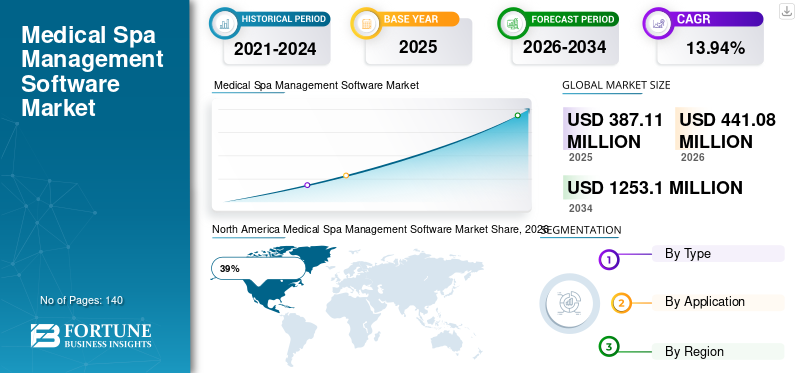
The medical spa management software market size was valued at USD 387.11 Million in 2025. The market is projected to grow from USD 441.08 Million in 2026 to USD 1253.1 Million by 2034, exhibiting a CAGR of 13.94% during the forecast period.

The medical spa management software market is evolving as medical spas, aesthetic clinics, wellness centers, and cosmetic treatment providers increasingly adopt digital platforms to manage daily operations. These software solutions integrate appointment scheduling, electronic records, billing, customer relationship management, marketing automation, inventory tracking, staff management, and analytics into a unified ecosystem. The market is being shaped by growing demand for operational efficiency, personalized client experiences, regulatory compliance, and cloud-enabled business management. Medical spa operators are focusing on automation to reduce administrative burdens and improve patient engagement. The medical spa management software market report highlights strong adoption among multi-location facilities seeking centralized control and data-driven decision-making.
The United States represents the most mature market for medical spa management software due to the large concentration of medical spas, cosmetic clinics, dermatology centers, and aesthetic treatment providers. Software adoption is accelerating as operators seek advanced scheduling, digital intake forms, teleconsultation support, HIPAA-compliant record management, and integrated payment systems. Demand is particularly strong among businesses offering injectables, laser treatments, skin rejuvenation services, and wellness therapies. The U.S. market benefits from a highly digital healthcare environment and widespread acceptance of cloud-based software platforms. Medical spa management software market analysis indicates that software vendors are increasingly introducing AI-enabled scheduling, automated marketing campaigns, and predictive analytics tailored for aesthetic service providers.
Download Free sample to learn more about this report.
 Global Market Size & Forecast
 Market Share
 Key Regional Highlights
North America
North America led the market with a 39% share, supported by strong adoption of digital healthcare solutions and advanced medical spa services.
Europe
Europe accounted for 27% of the market, driven by established healthcare infrastructure and increasing adoption of management software.
Asia-Pacific
Asia-Pacific held a 24% share, supported by expanding medical spa services and growing digitalization.
U.S
The U.S. remains a key market, supported by a large medical spa industry and strong adoption of cloud-based software solutions.
Japan
Japan accounted for approximately 23% of the Asia-Pacific market, supported by advanced healthcare infrastructure and growing adoption of digital management technologies.
Read More

The medical spa management software market Trends reveal a significant shift toward cloud-native platforms that allow practitioners and administrators to manage operations remotely. Medical spas increasingly require mobile accessibility, online booking, digital consent forms, integrated payment processing, and centralized customer records. Cloud deployment has become the preferred model because it offers scalability, lower maintenance requirements, and easier software updates. Vendors are also incorporating business intelligence dashboards to help operators monitor appointment utilization, treatment popularity, staff productivity, and customer retention.
Download Free sample to learn more about this report.
Another major trend in the Medical Spa Management Software Industry Analysis is the integration of artificial intelligence and automation tools. AI-powered appointment optimization, personalized marketing campaigns, automated reminders, treatment recommendations, and customer engagement systems are becoming standard features. Medical spas are increasingly using software to manage memberships, loyalty programs, and subscription-based wellness services. Integration with telehealth capabilities, electronic documentation, inventory forecasting, and digital photography management is also gaining momentum. These developments are helping providers deliver a more seamless client experience while improving operational efficiency and compliance management.
Rising Demand for Integrated Digital Management Solutions in Aesthetic Clinics
The primary growth driver in the medical spa management software market is the expanding demand for integrated digital management systems across aesthetic clinics and medical spas. As treatment portfolios become more sophisticated, providers require comprehensive software capable of managing scheduling, client records, inventory, billing, marketing, and staff operations through a single platform. Medical spas are increasingly focused on delivering personalized experiences while maintaining operational efficiency. This requirement has accelerated the adoption of software solutions that automate routine administrative tasks.
The medical spa management software market research report indicates that operators are prioritizing platforms that improve customer retention through automated communication, loyalty programs, and targeted marketing. Growing demand for non-invasive cosmetic procedures and wellness services is generating higher client volumes, making digital workflow management essential. Multi-location operators also require centralized visibility into performance metrics, customer behavior, and financial operations. These factors continue to strengthen software adoption across the industry.
Data Security and Regulatory Compliance Concerns
One of the most significant restraints in the medical spa management software market is concern regarding data privacy, cybersecurity, and regulatory compliance. Medical spas manage sensitive client information, including medical histories, treatment records, photographs, and payment data. Any security breach can lead to reputational damage, legal complications, and operational disruption.
Many smaller clinics remain cautious about migrating sensitive records to cloud environments because of concerns related to unauthorized access and compliance obligations. Regulatory requirements vary across jurisdictions, creating additional implementation complexity. Software vendors must continuously invest in encryption technologies, secure hosting environments, access controls, and compliance certifications. The need for ongoing cybersecurity monitoring increases operational costs for both vendors and end users. As a result, some organizations delay software upgrades or continue using legacy systems despite the operational advantages offered by modern platforms.
Expansion of Multi-Location Medical Spa Chains
A major opportunity within the medical spa management software market lies in the rapid expansion of multi-location medical spa chains and franchise-based aesthetic businesses. As organizations scale operations across multiple locations, centralized software platforms become critical for maintaining consistency in service delivery, reporting, customer engagement, and staff management.
medical spa management software market opportunities are expanding as enterprise operators seek advanced analytics, centralized appointment management, integrated CRM capabilities, and cross-location inventory tracking. Vendors that offer scalable cloud architecture, API integrations, and customizable reporting are well positioned to benefit. Emerging wellness concepts, membership programs, and subscription-based treatment packages further increase demand for sophisticated management systems. Growth in wellness tourism and aesthetic healthcare services is creating additional opportunities for software providers targeting larger medical spa networks.
Integration Complexity with Existing Systems
A significant challenge facing the medical spa management software market is integration with existing business and clinical systems. Many medical spas utilize multiple standalone applications for scheduling, payment processing, customer communication, accounting, and electronic records. Transitioning to a unified platform often requires substantial planning, staff training, and data migration.
Implementation challenges can lead to temporary workflow disruptions and productivity losses. Custom integration requirements may also increase deployment costs. Staff resistance to new technologies can slow adoption, particularly in organizations with established operational processes. Vendors must therefore focus on intuitive user interfaces, seamless migration tools, and comprehensive training programs. The ability to integrate with third-party payment platforms, accounting software, and marketing systems remains a critical competitive differentiator within the medical spa management software market outlook.
On-premise medical spa management software continues to maintain relevance among organizations that prioritize direct control over data storage and infrastructure management. This deployment model is particularly attractive to medical spas operating under strict internal governance policies or those with dedicated IT resources. Many facilities prefer on-premise solutions because they allow complete ownership of hardware environments and data management processes.
The medical spa management software market share for on-premise solutions remains substantial due to concerns regarding cybersecurity and regulatory compliance. Larger organizations with customized workflows often select on-premise deployments because they offer extensive configuration capabilities and direct system oversight. Despite slower adoption compared to cloud solutions, demand persists among operators requiring high levels of customization and local data hosting. The segment remains important within the broader Medical Spa Management Software Industry Report as organizations continue evaluating security, control, and operational flexibility requirements.
Web and cloud-based solutions dominate the medical spa management software market because of their scalability, flexibility, and accessibility. Cloud platforms allow medical spa operators to manage appointments, customer records, billing, inventory, and marketing activities from virtually any location. These systems eliminate the need for extensive on-site infrastructure and simplify software maintenance through automatic updates.
medical spa management software market Insights indicate that cloud adoption is accelerating among both independent clinics and large enterprise operators. Cloud-based platforms support remote management, mobile access, integrated analytics, and multi-location oversight. Vendors increasingly offer subscription-based pricing models that reduce upfront investment requirements. The ability to integrate customer engagement tools, AI-driven automation, and digital marketing functions has further strengthened adoption. As organizations seek operational efficiency and scalability, cloud deployment remains the preferred choice across the industry.
Appointment management represents the largest application segment within the medical spa management software market. Efficient scheduling directly influences customer satisfaction, staff utilization, treatment room availability, and revenue optimization. Modern platforms provide online booking, automated reminders, waitlist management, calendar synchronization, and real-time schedule adjustments.
Medical spa management software market analysis demonstrates that appointment management solutions help reduce no-shows, improve operational efficiency, and enhance customer convenience. Advanced systems use intelligent scheduling algorithms to maximize resource utilization while minimizing administrative workloads. Multi-provider facilities particularly benefit from centralized scheduling capabilities that coordinate practitioners, equipment, and treatment rooms. As customer expectations continue evolving toward digital self-service experiences, appointment management remains a core functionality driving software adoption.
Customer relationship management is another critical application segment within the medical spa management software market. CRM functionality enables providers to maintain detailed customer profiles, treatment histories, communication records, purchasing behavior, and engagement metrics. These insights support personalized marketing campaigns and long-term customer retention strategies.
Medical spas increasingly utilize CRM modules to manage loyalty programs, membership offerings, targeted promotions, and post-treatment follow-up communications. Advanced CRM systems leverage analytics to identify customer preferences and predict future service demand. By strengthening client relationships and improving retention rates, CRM applications contribute significantly to business performance. As competition intensifies among medical spas, investment in customer relationship management capabilities continues to expand across the market.
North America Medical Spa Management Software Market Share, 2025 (%)
To get more information on the regional analysis of this market, Download Free sample
North America remains the leading regional market for medical spa management software. The region benefits from a highly developed aesthetic healthcare industry, extensive digital infrastructure, and strong adoption of cloud-based healthcare technologies. Medical spas throughout the United States and Canada increasingly invest in integrated software solutions to manage operations, enhance customer experiences, and streamline regulatory compliance.
The medical spa management software market forecast for North America remains favorable because operators continue expanding service portfolios that require sophisticated scheduling, billing, inventory management, and customer engagement systems. Enterprise-level medical spa chains are contributing significantly to demand for centralized software platforms. The region also benefits from strong vendor presence, ongoing technology innovation, and widespread awareness regarding operational efficiency improvements achievable through digital transformation.
Europe represents a substantial share of the medical spa management software market. Growth is supported by increasing interest in non-invasive cosmetic treatments, wellness services, and preventive aesthetic care. Medical spa operators throughout the region are adopting digital solutions to improve workflow management, enhance customer engagement, and strengthen business intelligence capabilities.
European organizations place strong emphasis on data privacy and regulatory compliance, encouraging adoption of secure software platforms. Cloud-based deployment models are becoming increasingly popular among operators seeking scalability and operational flexibility. The medical spa management software market outlook for Europe is further supported by rising investment in wellness tourism and premium aesthetic service offerings.
Germany represents one of Europe's most advanced medical spa management software markets. The country's strong healthcare infrastructure, technology adoption culture, and growing aesthetic treatment sector support software implementation across medical spas and wellness centers. Providers increasingly seek integrated platforms that combine scheduling, electronic records, inventory management, and customer communication.
German operators emphasize compliance, data security, and operational transparency, driving demand for robust software solutions. Cloud adoption continues to rise as organizations pursue scalability and remote management capabilities. Software providers are responding with localized features, multilingual support, and enhanced reporting functionality tailored to regulatory requirements. The market continues benefiting from growing demand for premium wellness and cosmetic services.
The United Kingdom is a major contributor to the European medical spa management software market. A strong aesthetic medicine sector, widespread digital adoption, and growing demand for wellness services are supporting software deployment across medical spas and cosmetic clinics. Providers increasingly invest in platforms that improve scheduling efficiency, customer retention, and business performance tracking.
Cloud-based solutions are particularly popular due to their flexibility and lower infrastructure requirements. Medical spas are leveraging CRM functionality, automated marketing tools, and online booking systems to improve customer experiences. Competitive market conditions encourage operators to adopt technology that enhances efficiency and supports business growth. These factors continue driving software demand throughout the United Kingdom.
Asia-Pacific is emerging as the fastest-expanding regional market for medical spa management software. Rising disposable income, growing interest in aesthetic treatments, wellness tourism, and increasing healthcare digitization are driving adoption throughout the region. Medical spas increasingly require software solutions capable of managing expanding client volumes and complex service offerings.
Cloud-based deployment is gaining popularity because it enables scalability without substantial infrastructure investment. Growing numbers of medical spa startups and expanding wellness chains are contributing to market development. Vendors are introducing localized platforms that address regional language, regulatory, and operational requirements.
Japan maintains a sophisticated medical spa management software market supported by advanced technology infrastructure and strong consumer interest in aesthetic wellness services. Medical spas increasingly implement integrated platforms to streamline appointment management, customer engagement, inventory tracking, and operational reporting.
The market is characterized by demand for precision, efficiency, and high-quality customer experiences. Japanese providers often seek software solutions that support automation, mobile access, and personalized treatment planning. As aesthetic treatments become increasingly mainstream, software adoption continues expanding across both independent clinics and larger wellness organizations.
China represents one of the most dynamic opportunities within the Asia-Pacific medical spa management software market. Rapid urbanization, growing middle-class populations, increasing aesthetic awareness, and expanding wellness industries are contributing to software demand. Medical spas are investing heavily in digital platforms to support business growth and improve customer engagement.
Cloud technology adoption continues accelerating across the country, enabling operators to scale services efficiently. Integration of mobile applications, online booking tools, and customer relationship management features is particularly important in the Chinese market. Vendors are increasingly targeting the region with localized offerings designed to meet evolving business requirements and consumer expectations.
The Rest of World region, including Latin America, the Middle East, and Africa, is experiencing growing adoption of medical spa management software. Increasing awareness of aesthetic treatments, expansion of wellness facilities, and rising digital transformation initiatives are creating favorable market conditions.
Medical spas in these regions are increasingly seeking cost-effective cloud-based platforms that improve scheduling, billing, inventory management, and customer communication. International wellness tourism and expanding private healthcare investments are further supporting software demand. Although adoption remains lower than in more developed markets, significant long-term opportunities exist for software vendors targeting emerging economies.
Investment activity within the medical spa management software market is increasingly focused on cloud technologies, artificial intelligence, customer engagement platforms, and enterprise-scale management solutions. Investors are attracted to software providers serving aesthetic healthcare because of recurring subscription models, strong customer retention rates, and expanding end-user demand. Medical spa operators continue investing in digital transformation initiatives designed to improve operational efficiency and enhance client experiences.
medical spa management software market opportunities are particularly strong in cloud-based deployment, analytics, automation, and multi-location business management. Strategic acquisitions, technology partnerships, and product expansion initiatives are expected to remain common as vendors seek competitive differentiation. Emerging markets also present attractive investment potential as aesthetic service industries continue maturing. Investors increasingly favor companies capable of integrating CRM, marketing automation, appointment management, inventory control, and reporting functions into unified platforms. AI-enabled customer engagement and predictive business analytics are expected to attract significant capital allocation across the industry.
Innovation remains a defining characteristic of the medical spa management software market. Vendors are continuously developing new capabilities that improve efficiency, customer engagement, and business intelligence. Recent product development efforts focus heavily on AI-powered scheduling, predictive analytics, automated marketing workflows, and personalized treatment recommendations.
Software providers are also expanding mobile functionality, allowing practitioners and managers to access business operations remotely. Advanced CRM tools, digital consent management, electronic treatment documentation, integrated payment processing, and inventory forecasting solutions are becoming increasingly common. Emerging platforms incorporate customer self-service portals, loyalty program management, and omnichannel communication capabilities.
Another important area of innovation involves integration between practice management systems and teleconsultation tools. Enhanced analytics dashboards provide real-time insights into appointment utilization, staff productivity, customer retention, and treatment performance. These developments continue strengthening the value proposition of medical spa management software across both independent clinics and enterprise operators.
The medical spa management software market report provides comprehensive analysis of industry structure, competitive positioning, technology developments, deployment trends, and application adoption patterns. Coverage includes evaluation of operational software used by medical spas, aesthetic clinics, cosmetic treatment providers, and wellness centers. The report examines software functionality across appointment scheduling, customer relationship management, billing, inventory management, marketing automation, analytics, and regulatory compliance.
Request for Customization to gain extensive market insights.
The Medical Spa Management Software Industry Report also assesses market segmentation by deployment type and application category. Regional analysis evaluates demand patterns across North America, Europe, Asia-Pacific, and Rest of World markets. Competitive assessment includes major software providers, innovation strategies, product development initiatives, and investment trends. The report further explores key drivers, restraints, opportunities, and challenges shaping industry evolution. Emphasis is placed on cloud adoption, artificial intelligence integration, customer engagement technologies, and enterprise-scale management solutions that are transforming the medical spa software landscape.
Fortune Business Insights says that the global market value stood at USD 387.11 million in 2025 and is projected to reach USD 1,253.1 million by 2034.
The market is expected to exhibit a CAGR of 13.94% during the forecast period of 2026-2034.
Web & cloud-based solutions were the leading type segment, driven by their scalability, flexibility, remote accessibility, and lower infrastructure requirements.
Key players include Acuity Scheduling - A Squarespace Company, AestheticsPro, Book4Time Inc., GlamPlus, Meditab, and Millennium Systems International.
Major trends include the shift toward cloud-native platforms and increasing integration of AI-powered automation for scheduling, marketing, treatment recommendations, and customer engagement. North America led with a 39% share in 2025.


(Offer valid till 31st Oct 2026)
Get 30-60 hrs Free Customization
Expand Regional and Country Coverage, Segments Analysis, Company Profiles, Competitive Benchmarking, and End-user Insights.







.webp)




Get In Touch With Us
US +1 833 909 2966 ( Toll Free )
Receive a tailored pricing based on your needs.
Discuss your questions with our industry experts.
Have questions? Get quick answers before you purchase.

