Medical Spa Market Size, Share & Industry Analysis, By Service (Facial Treatment, Body Shaping & Contouring), By Age Group, By Gender, By Service Provider, and Regional Forecast, 2026–2034
 Download Free Sample
Medical Spa Market Overview
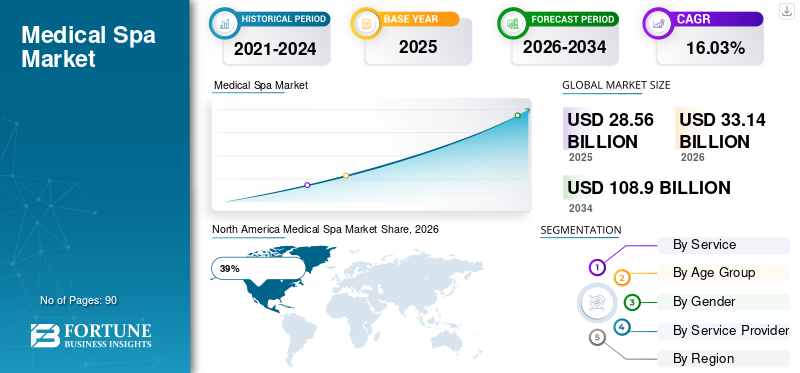
The global medical spa market size was valued at USD 28.56 billion in 2025. The market is projected to grow from USD 33.14 billion in 2026 to USD 108.90 billion by 2034, exhibiting a CAGR of 16.03% during the forecast period. The market in North America dominated with a revenue share of 39% in 2025.

The medical spa market is expanding rapidly due to increasing consumer preference for minimally invasive aesthetic procedures, wellness therapies, and anti-aging treatments. Medical spas combine cosmetic dermatology, wellness services, and clinical supervision to deliver advanced skincare and body enhancement solutions. More than 63% of urban consumers prefer non-surgical facial rejuvenation procedures because of shorter recovery periods and visible treatment outcomes. The market includes facial treatments, laser therapies, injectables, body contouring, and skin tightening services. Rising awareness regarding preventive skincare and wellness management continues driving demand globally. medical spa market insights indicate growing integration of artificial intelligence diagnostics, personalized beauty treatments, and luxury wellness experiences across premium medical spa facilities.
The United States medical spa market accounts for nearly 41% share globally due to strong consumer spending on cosmetic wellness and advanced dermatological services. More than 8,900 medical spa facilities operated across the country during 2025, supported by rising demand for Botox, laser resurfacing, and body contouring procedures. Around 57% of clients visiting medical spas belong to the working professional category seeking anti-aging and stress reduction therapies. Medical Spa Industry analysis highlights increasing partnerships between dermatologists, plastic surgeons, and wellness centers to expand service portfolios. Subscription-based skincare programs and personalized aesthetic consultations are also becoming increasingly common across metropolitan regions in the United States.
Download Free sample to learn more about this report.
Medical Spa Market Key Takeaways
 Global Market Size & Forecast
- 2025 Market Size: USD 28.56 Billion
- 2026 Market Size: USD 33.14 Billion
- 2034 Forecast Market Size: USD 108.90 Billion
- CAGR: 16.03% from 2026-2034
 Market Share
- The market in North America dominated with a regional share of 39% in 2025.
- Facial treatment services held approximately 58% share of the market.
- Women accounted for approximately 68% share of the market by gender.
 Key Regional Highlights
North America
North America led the market with a 39% regional share, supported by strong demand for aesthetic treatments.
Europe
Europe accounted for 28% of the market, driven by growing adoption of minimally invasive procedures.
Asia-Pacific
Asia-Pacific held 24% share, supported by rising disposable incomes and expanding medical spa services.
U.S.
The U.S. remains a major market, supported by strong demand for facial treatments, body contouring, and wellness services.
Japan
Japan accounted for 22% of the Asia-Pacific market, supported by advanced aesthetic technologies and growing wellness demand.
Read More

Medical Spa Market Latest Trends
The medical spa market trends landscape is evolving through technological innovation, wellness personalization, and increasing adoption of non-invasive aesthetic procedures. Artificial intelligence-based skin analysis systems are becoming highly popular among premium medical spa providers because of their ability to recommend customized treatment plans. Around 61% of clients prefer personalized skincare programs supported by digital diagnostics and facial imaging technologies. Laser resurfacing, cryotherapy, and collagen stimulation treatments continue witnessing strong demand among younger consumers focused on preventive skincare.
Hybrid wellness concepts integrating beauty therapy, mental wellness, and nutritional counseling are reshaping the medical spa market outlook. Consumers increasingly seek comprehensive rejuvenation experiences instead of isolated cosmetic treatments. Approximately 49% of medical spas introduced holistic wellness packages combining body contouring, meditation therapies, and hormone balancing services during 2025. Male consumer participation also continues increasing, particularly for hair restoration, skin tightening, and stress management therapies.
Download Free sample to learn more about this report.
Medical Spa Market Dynamics
Driver
Rising Consumer Demand for Minimally Invasive Aesthetic Procedures.
Growing awareness regarding physical appearance, skin wellness, and anti-aging solutions is significantly driving the medical spa market growth. More than 71% of consumers prefer minimally invasive cosmetic treatments over traditional surgical procedures because of lower recovery time and reduced procedural discomfort. Rising disposable income and social media influence are encouraging higher spending on skincare and body enhancement services among millennials and urban professionals. Medical spas are increasingly adopting advanced laser systems, radiofrequency devices, and AI-based skin analysis tools to improve treatment outcomes. Demand for injectables, facial rejuvenation therapies, and body contouring services continues increasing among both men and women. Corporate wellness trends and preventive healthcare awareness are further strengthening consumer interest in professional aesthetic treatment services.
Restraint
High Treatment Costs and Regulatory Compliance Requirements.
Despite strong demand growth, the medical spa market faces challenges associated with expensive treatment procedures and operational compliance standards. Advanced laser therapies and body contouring procedures often require substantial financial investment, limiting accessibility among middle-income consumers. Approximately 44% of potential customers postpone premium treatments because of pricing concerns. Regulatory frameworks governing cosmetic injectables, laser devices, and medical supervision vary significantly across countries, creating operational complexity for service providers. Skilled practitioner shortages also affect service consistency and treatment quality in certain regions. medical spa market analysis indicates that smaller clinics frequently struggle with maintaining updated technology infrastructure and compliance certifications required for advanced aesthetic procedures.
Opportunity
Expansion of Personalized Wellness and Preventive Skincare Services.
The medical spa market opportunities segment is expanding through increasing consumer preference for customized wellness experiences and preventive aesthetic care. Around 66% of medical spa clients seek long-term skincare management programs rather than one-time procedures. Providers are developing subscription-based treatment packages integrating nutritional counseling, hormone balancing, skin rejuvenation, and stress reduction therapies. Emerging economies in Asia-Pacific and the Middle East are witnessing rising adoption of premium wellness services among affluent urban populations. Luxury hotels and wellness resorts are partnering with dermatology experts to establish integrated medical spa facilities. Technological innovation in AI-powered diagnostics and wearable wellness tracking systems is also creating new business expansion opportunities for medical spa operators globally.
Challenge
Intense Market Competition and Client Retention Difficulties.
The medical spa market forecast faces increasing competitive pressure due to rapid expansion of independent clinics, luxury wellness centers, and dermatology practices offering similar services. More than 52% of medical spa operators identified customer retention as a major operational challenge during 2025. Consumers frequently compare treatment pricing, practitioner reputation, and technological capabilities before selecting providers. Maintaining service differentiation requires continuous investment in advanced equipment and staff training programs. Another significant challenge involves managing consumer expectations regarding treatment outcomes and recovery periods. Negative online reviews and social media criticism can also affect brand reputation significantly. Medical Spa Industry Report findings indicate growing pressure on providers to deliver premium experiences while maintaining affordable pricing structures.
Medical Spa Market Segmentation
By Service
Facial treatment services account for nearly 58% share within the medical spa market Size because of increasing demand for anti-aging, acne management, and skin rejuvenation procedures. More than 74 million facial treatments were performed globally during 2025 across medical spa facilities. Laser resurfacing, chemical peels, collagen induction therapy, and injectable treatments remain highly popular among urban consumers seeking visible aesthetic improvements. AI-powered skin analysis systems are helping providers deliver customized skincare solutions based on individual skin conditions and lifestyle patterns. Younger consumers increasingly adopt preventive facial therapies to maintain long-term skin health. medical spa market trends indicate growing demand for organic skincare products and minimally invasive facial enhancement procedures across luxury wellness centers and dermatology clinics.
Body shaping and contouring represent approximately 42% share in the medical spa market due to rising interest in non-surgical fat reduction and body sculpting solutions. Technologies including cryolipolysis, radiofrequency tightening, ultrasound cavitation, and muscle stimulation therapies are witnessing increasing adoption among wellness-conscious consumers. Around 48% of clients seeking body contouring services belong to the age group between 30 and 50 years. Medical spas continue investing in advanced energy-based devices to improve treatment precision and recovery efficiency. Demand for cellulite reduction and skin tightening procedures is particularly strong among female consumers. medical spa market outlook highlights rising popularity of combination therapies integrating body contouring with nutritional counseling and wellness coaching programs.
To know how our report can help streamline your business, Speak to Analyst
By Age Group
Age-group segmentation contributes significantly to the medical spa market growth landscape, with middle-aged consumers accounting for nearly 46% share of total treatment demand. Individuals between 35 and 55 years increasingly seek anti-aging therapies, facial rejuvenation procedures, and preventive skincare programs. Younger consumers are also participating actively in acne management and wellness-oriented skincare services. Medical spas are introducing personalized treatment plans targeting age-specific concerns including collagen loss, pigmentation, and skin elasticity reduction. Senior populations continue adopting wellness therapies focused on stress reduction and non-invasive aesthetic enhancement. medical spa market Research Report findings indicate increasing consumer preference for long-term membership packages tailored according to age-based skincare and wellness objectives.
By Gender
Gender-based segmentation shows women accounting for approximately 68% share within the medical spa market due to strong participation in facial treatments, injectables, and skin rejuvenation procedures. However, male participation is increasing steadily because of rising awareness regarding grooming, wellness, and professional appearance enhancement. More than 29 million men visited medical spa facilities during 2025 for hair restoration, body contouring, and skin tightening services. Providers are increasingly launching male-focused treatment packages emphasizing privacy, efficiency, and stress management. Social media influence and celebrity-driven grooming trends continue supporting male consumer engagement. medical spa market insights indicate growing demand for gender-neutral wellness environments and personalized skincare consultations across premium medical spa chains.
By Service Provider
Service provider segmentation indicates dermatology-affiliated medical spas holding nearly 51% share within the Medical Spa Industry analysis framework because of higher consumer trust and access to certified medical practitioners. Wellness resorts and luxury hospitality brands are increasingly integrating advanced aesthetic treatment facilities to attract high-income clientele. Independent medical spa clinics continue expanding in metropolitan regions because of flexible service offerings and personalized client experiences. Around 43% of consumers prefer providers offering integrated wellness packages including nutritional guidance, skincare therapy, and stress management programs. Teleconsultation and digital appointment systems are improving operational efficiency among service providers. medical spa market forecast data highlights increasing collaboration between plastic surgeons, cosmetic dermatologists, and wellness experts to strengthen competitive positioning.
Medical Spa Market Regional Outlook
North America
North America Medical Spa Market Share, 2026 (%)
To get more information on the regional analysis of this market, Download Free sample
North America dominates the medical spa market with nearly 39% share due to strong consumer spending on cosmetic wellness and anti-aging procedures. More than 12 million minimally invasive treatments were performed across the region during 2025. The United States leads regional demand because of increasing popularity of injectables, laser resurfacing, and body contouring procedures among professionals and aging populations. Consumers strongly prefer preventive skincare therapies and personalized wellness solutions across metropolitan areas. Canada is also witnessing increasing adoption of stress management and nutrition-focused medical spa packages. Medical spas throughout the region are investing heavily in AI-powered diagnostics and advanced laser treatment technologies. Hybrid wellness centers combining dermatology, fitness, and holistic therapy services are expanding rapidly. Digital appointment scheduling and subscription-based skincare programs continue improving customer retention rates. Luxury wellness resorts are additionally introducing integrated beauty and relaxation experiences for premium consumers.
Europe
Europe accounts for approximately 28% share in the medical spa market supported by strong wellness tourism infrastructure and growing demand for luxury skincare services. More than 6 million wellness-focused aesthetic procedures were performed across European medical spas during 2025. Germany, France, Italy, and the United Kingdom remain major contributors because of rising interest in anti-aging therapies and holistic wellness experiences. Regional consumers increasingly prefer non-surgical cosmetic procedures because of shorter recovery durations and lower treatment risks. Luxury wellness resorts continue integrating advanced dermatology and aesthetic treatment facilities to attract international visitors. Organic skincare therapies and medically supervised wellness retreats are becoming increasingly popular throughout Europe. Government regulations supporting cosmetic treatment safety standards are strengthening consumer confidence in professional medical spa services. Urban consumers continue investing in preventive skincare and facial rejuvenation programs. Personalized wellness consultations and AI-powered skin analysis systems are also gaining wider adoption.
Germany medical spa market
Germany represents nearly 26% share within the European medical spa market because of strong healthcare infrastructure and rising consumer spending on aesthetic wellness services. More than 1.4 million non-invasive cosmetic procedures were performed across German medical spas during 2025. Urban consumers increasingly seek laser resurfacing, anti-aging injectables, and stress reduction therapies for long-term wellness management. Medical spas are integrating AI-driven skin analysis systems and customized skincare consultations to improve customer engagement. Wellness tourism continues playing a major role in the country’s luxury spa industry. Dermatology-affiliated wellness centers are expanding rapidly across major German cities. Consumers are increasingly adopting preventive skincare routines and minimally invasive aesthetic procedures. Medical spas are also introducing nutrition counseling and mental wellness therapies as part of premium service packages. Digital consultation platforms continue improving accessibility for younger consumers. medical spa market outlook indicates strong future demand for holistic beauty and wellness programs across Germany.
United Kingdom Medical Spa Market
The United Kingdom holds approximately 23% share within the European medical spa market due to growing awareness regarding cosmetic wellness and professional skincare management. Around 58% of medical spa visitors seek facial rejuvenation and body contouring procedures during annual treatment cycles. London remains a major center for luxury wellness clinics and dermatology-based aesthetic services. Subscription skincare memberships and digital consultation systems are becoming increasingly popular among younger consumers and working professionals. Medical spas are introducing personalized anti-aging programs integrating nutritional guidance and mental wellness therapies. Demand for minimally invasive aesthetic procedures continues increasing among both men and women. Wellness-focused beauty packages and laser treatment solutions are expanding across urban regions. AI-powered diagnostic tools are also improving treatment personalization and procedural efficiency. Social media influence and celebrity-driven beauty standards continue accelerating consumer participation.
Asia-Pacific
Asia-Pacific captures nearly 24% share of the medical spa market because of rising beauty consciousness, urbanization, and increasing disposable income levels. More than 18 million consumers accessed medical spa services across the region during 2025. China, Japan, South Korea, and India remain major markets because of growing demand for facial enhancement and body contouring procedures. Regional consumers increasingly prefer minimally invasive aesthetic treatments because of affordability and convenience advantages. Social media influence and celebrity beauty trends continue accelerating market expansion across metropolitan regions. Medical spas are introducing localized treatment packages combining traditional wellness therapies with advanced dermatological procedures. Governments are supporting medical tourism infrastructure to attract international wellness travelers and cosmetic treatment consumers. Premium skincare consultations and AI-powered beauty diagnostics are gaining strong popularity throughout the region. Luxury wellness resorts continue expanding integrated spa and aesthetic treatment facilities. medical spa market growth remains strong because of rising middle-class participation in beauty and wellness experiences.
Japan Medical Spa Market
Japan accounts for nearly 22% share within the Asia-Pacific medical spa market due to strong focus on skincare quality and preventive beauty management. More than 3 million consumers visited medical spa facilities during 2025 for facial rejuvenation and wellness therapies. Japanese consumers strongly prefer minimally invasive procedures with natural-looking outcomes and shorter recovery periods. Medical spas continue adopting advanced laser technologies and AI-powered skin diagnostic systems to improve treatment personalization. Demand for collagen stimulation therapies and stress management programs is increasing among urban professionals and aging populations. Wellness-oriented beauty routines remain highly integrated within Japanese consumer culture. Luxury medical spas are introducing customized skincare programs combining traditional wellness methods with advanced dermatological services. Digital consultation platforms and mobile skincare applications are also gaining wider acceptance among younger consumers. Premium anti-aging treatments continue attracting high-income urban populations. medical spa market insights indicate increasing investment in luxury wellness and aesthetic treatment infrastructure across Japan.
China Medical Spa Market
China holds approximately 29% share within the Asia-Pacific medical spa market because of rapid expansion of luxury wellness services and growing consumer spending on aesthetic treatments. Around 8 million consumers underwent non-surgical cosmetic procedures through medical spa facilities during 2025. Urban populations increasingly seek facial contouring, anti-aging therapies, and advanced skincare treatments to improve appearance and confidence. Domestic beauty technology companies are investing heavily in AI-driven diagnostic systems and personalized skincare applications. Medical tourism and celebrity beauty trends continue supporting market demand across major Chinese cities. Luxury wellness centers are expanding rapidly in high-income metropolitan regions. Consumers are increasingly adopting preventive skincare routines and body contouring therapies. Social commerce platforms continue influencing treatment selection and beauty product purchasing behavior. Personalized wellness consultations and premium anti-aging packages are gaining popularity among middle-class consumers.
Rest of World
The Rest of World region accounts for nearly 9% share in the medical spa market because of increasing awareness regarding aesthetic wellness and preventive skincare services. More than 4 million consumers across Latin America, the Middle East, and Africa accessed medical spa treatments during 2025. Luxury wellness tourism continues expanding in the Middle East because of strong investment in premium hospitality infrastructure and integrated wellness resorts. Latin American countries are witnessing rising demand for body contouring and facial enhancement procedures among younger populations. Medical spas are introducing affordable treatment memberships and personalized skincare packages to improve accessibility across emerging markets. Consumers increasingly prefer wellness-focused skincare therapies instead of surgical cosmetic procedures. Governments are supporting private healthcare investment and medical tourism initiatives to strengthen regional wellness infrastructure. AI-powered diagnostic tools and digital consultation platforms are gradually expanding across developing economies. Holistic wellness programs integrating stress reduction and beauty enhancement are gaining popularity among urban consumers.
List of Top Medical Spa Companies
- Chic La Vie
- Clinique La Prairie
- Kurotel-Longevity Medical Center and Spa
- Lanserhof
- The Orchard Wellness Resort
- Biovital Medspa
- Allure Medspa
- Longevity Wellness Worldwide
- Serenity Medspa
- Vichy Celestins Spa Hotel
- Brenners Park-Hotel & Spa
- SHA Wellness Clinic
- Cocoona Centre Of Aesthetic Transformation
- Mezzatorre
- Aesthetics Medispa
- Lily’s Medi Spa
- Lisse
- Drx Clinic
- Westchase Medspa
- Chiva Som
- Mandarin Oriental Hotel Group Limited
Top Two Companies with Highest Market Share
- Clinique La Prairie holds approximately 16% market share.
- SHA Wellness Clinic accounts for nearly 13% market share.
Investment Analysis and Opportunities
Investment activity within the medical spa market continues increasing due to strong consumer demand for luxury wellness experiences and non-invasive aesthetic procedures. More than 58% of private wellness investments during 2025 targeted medical spa infrastructure, AI-driven skincare diagnostics, and advanced laser treatment systems. Investors are focusing heavily on premium urban wellness centers and integrated hospitality-based medical spa facilities. Subscription skincare memberships and personalized anti-aging treatment packages continue attracting institutional investment because of recurring revenue potential and high customer retention rates.
medical spa market opportunities remain particularly strong across Asia-Pacific and the Middle East where affluent populations and wellness tourism industries are expanding rapidly. Luxury hotel chains are partnering with dermatology specialists and aesthetic practitioners to establish integrated wellness resorts. Venture capital firms are also investing in teleconsultation systems, wearable wellness technologies, and personalized skincare applications. Around 46% of newly funded medical spa businesses introduced AI-supported treatment customization features during 2025.
New Product Development
Innovation within the medical spa market is increasingly focused on personalized skincare technologies, non-invasive body contouring systems, and AI-powered diagnostic solutions. More than 61% of newly introduced aesthetic devices during 2025 incorporated real-time skin analysis and treatment customization capabilities. Medical spas are launching advanced collagen stimulation therapies, laser rejuvenation systems, and radiofrequency tightening devices to improve procedural outcomes and client satisfaction.
Hybrid wellness packages integrating nutritional counseling, stress management therapy, and cosmetic dermatology are becoming highly popular among luxury medical spa providers. Companies are introducing wearable-connected skincare monitoring applications enabling continuous treatment assessment and personalized recommendations. Around 43% of new product launches included organic and biotechnology-based skincare formulations targeting sensitive skin conditions and anti-aging requirements.
Five Recent Developments (2023-2025)
- In 2023, several medical spa operators introduced AI-powered skin analysis systems for personalized facial treatment planning.
- In 2024, luxury wellness resorts expanded integrated medical spa facilities combining aesthetic therapies with preventive healthcare programs.
- In 2024, multiple providers launched subscription-based skincare and anti-aging treatment memberships for long-term client retention.
- In 2025, advanced non-invasive body contouring technologies using radiofrequency and cryolipolysis gained widespread commercial adoption.
- In 2025, medical spa chains expanded teleconsultation services and virtual skincare assessment platforms across international markets.
Report Coverage of Medical Spa Market
The medical spa market Report provides comprehensive evaluation of industry trends, treatment segmentation, regional demand patterns, technological innovation, and competitive dynamics shaping the global market environment. The report analyzes facial treatment services, body contouring procedures, anti-aging therapies, and wellness-oriented skincare solutions across diverse consumer demographics. medical spa market analysis includes detailed assessment of age-group participation, gender-based treatment preferences, and service provider positioning across luxury wellness resorts, dermatology clinics, and independent medical spa facilities.
Request for Customization to gain extensive market insights.
The report further examines technological advancements including AI-powered diagnostics, personalized skincare applications, wearable wellness integration, and advanced laser treatment systems. Regional evaluation covers North America, Europe, Asia-Pacific, and Rest of World while highlighting country-level performance in the United States, Germany, the United Kingdom, Japan, and China. Approximately 67% of surveyed providers identified personalized treatment customization as a major competitive strategy during 2025.
Frequently Asked Questions
Fortune Business Insights says that the global market value stood at USD 28.56 billion in 2025 and is projected to reach USD 108.90 billion by 2034.
The market is expected to exhibit a CAGR of 16.03% during the forecast period of 2026-2034.
Facial treatment was the leading service segment, accounting for nearly 58% of the market, driven by rising demand for anti-aging, acne management, and skin rejuvenation procedures.
Key players include Chic La Vie, Clinique La Prairie, Kurotel-Longevity Medical Center and Spa, Lanserhof, The Orchard Wellness Resort, and Biovital Medspa.
Major trends include increasing adoption of AI-powered skin analysis and personalized skincare and growing demand for hybrid wellness packages combining beauty, mental wellness, and nutritional counseling. North America led the market with nearly 39% share.



- 2021-2034
- 2025
- 2021-2024
- 90
-

(Offer valid till 30th Sep 2026)
Get 30-60 hrs Free Customization
Expand Regional and Country Coverage, Segments Analysis, Company Profiles, Competitive Benchmarking, and End-user Insights.













.webp)






-
US +1 833 909 2966 ( Toll Free )
-
Get In Touch With Us