 Download Free Sample



Get a Quote
Receive a tailored pricing based on your needs.
- Choose license type
- Multiple user options
- Custom scope & coverage
- Fast turnaround
"Designing Growth Strategies is in our DNA"
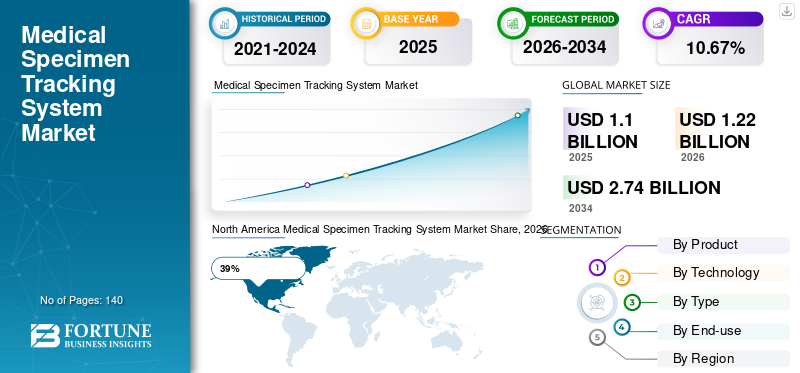
The global medical specimen tracking system market size was valued at USD 1.1 billion in 2025. The market is projected to grow from USD 1.22 billion in 2026 to USD 2.74 billion by 2034, exhibiting a CAGR of 10.67% during the forecast period

The medical specimen tracking system market is expanding rapidly due to increasing laboratory automation, rising diagnostic testing volumes, and growing requirements for patient safety. Healthcare organizations are implementing advanced tracking solutions to reduce specimen identification errors, improve chain-of-custody management, and strengthen regulatory compliance. Barcode and RFID-enabled tracking platforms are becoming standard across pathology laboratories, hospitals, and research centers. The medical specimen tracking system market report highlights rising adoption of cloud-integrated laboratory workflows and real-time monitoring technologies. Demand for accurate specimen transportation, digital record management, and automated verification systems continues to strengthen medical specimen tracking system market growth across clinical and research environments.
The USA medical specimen tracking system market represents the largest regional demand center due to extensive laboratory networks, advanced healthcare infrastructure, and strict patient safety regulations. More than 70% of large healthcare institutions in the country have integrated barcode-based specimen identification processes. The increasing number of diagnostic procedures, pathology testing, and clinical research activities is supporting technology adoption. Medical laboratories are prioritizing automation to minimize specimen loss and reporting delays. The Medical Specimen Tracking System industry report indicates that hospitals are increasingly investing in RFID-enabled tracking platforms, mobile specimen management tools, and integrated laboratory information systems to improve workflow efficiency and operational accuracy.
Download Free sample to learn more about this report.
 Global Market Size & Forecast
 Market Share
 Key Regional Highlights
North America
North America led the market with a 39% share, supported by advanced healthcare infrastructure and growing laboratory automation.
Europe
Europe accounted for 27% of the market, driven by increasing adoption of digital laboratory solutions and specimen management systems.
Asia-Pacific
Asia-Pacific held a 24% share, supported by expanding healthcare infrastructure and rising demand for automated diagnostic workflows.
U.S
The U.S. remains a key market, supported by advanced laboratory systems and increasing adoption of specimen tracking technologies.
Japan
Japan accounted for approximately 19% of the Asia-Pacific market, supported by advanced healthcare infrastructure and growing laboratory automation.
Read More

The medical specimen tracking system market analysis identifies digital transformation as one of the strongest trends influencing industry development. Healthcare providers are deploying cloud-based specimen management platforms that allow real-time visibility across collection, transportation, storage, and testing stages. RFID adoption is increasing because healthcare facilities require faster identification and automated tracking of high-value biological samples. Artificial intelligence integration is improving workflow prioritization and reducing manual documentation tasks.
Another major trend within the medical specimen tracking system market research report is the growing use of Internet of Things-enabled monitoring systems. These solutions support temperature-sensitive specimen transportation and maintain sample integrity during transit. Laboratories are increasingly integrating tracking platforms with laboratory information management systems to establish centralized operational control. Mobile scanning applications are becoming common among healthcare professionals due to their ability to provide instant specimen status updates. Demand for digital pathology, biobank management, and clinical trial specimen monitoring continues to expand, creating new opportunities for solution providers. Automated alert systems, predictive maintenance capabilities, and analytics-driven workflow management are further strengthening medical specimen tracking system market trends across healthcare institutions worldwide.
Rising Demand for Laboratory Automation and Patient Safety
The medical specimen tracking system market growth is primarily driven by increasing demand for laboratory automation and enhanced patient safety standards. Healthcare facilities process millions of biological samples every day, creating strong requirements for accurate tracking solutions. Mislabeling, specimen loss, and processing delays can directly affect clinical outcomes and operational efficiency. Barcode and RFID technologies are helping laboratories improve sample identification accuracy and maintain complete chain-of-custody documentation. Hospitals are investing in digital specimen management systems to reduce manual intervention and support regulatory compliance. The growing number of diagnostic procedures, pathology examinations, and molecular testing applications is further accelerating deployment of automated tracking infrastructure. Laboratory managers increasingly prioritize solutions that improve workflow visibility and reduce operational errors, strengthening medical specimen tracking system market outlook.
High Implementation and Integration Costs
The major restraint affecting the medical specimen tracking system market is the substantial cost associated with implementation and system integration. Advanced RFID infrastructure, specialized scanners, software licensing, and data migration activities require significant capital investment. Small and medium-sized laboratories often face budget limitations that delay technology adoption. Integration with existing laboratory information systems can create operational complexities and require extensive staff training. Healthcare facilities operating in developing regions frequently prioritize core diagnostic equipment over tracking technologies. Additional concerns related to cybersecurity, software maintenance, and infrastructure upgrades also influence purchasing decisions. These factors may slow penetration rates in cost-sensitive healthcare environments despite growing awareness regarding specimen safety and workflow optimization.
Expansion of Precision Medicine and Biobanking
Precision medicine programs and biobanking initiatives are creating substantial opportunities within the medical specimen tracking system market. research organizations increasingly manage large collections of biological samples requiring continuous monitoring and documentation. Advanced tracking solutions enable precise location management, storage verification, and retrieval processes. Pharmaceutical companies conducting clinical trials depend on accurate specimen handling to maintain data integrity and regulatory compliance. Personalized medicine initiatives require reliable sample tracking throughout testing and treatment pathways. The growth of genomic research, molecular diagnostics, and cell therapy development is supporting demand for sophisticated specimen management systems. Vendors that offer cloud connectivity, automated analytics, and multi-site tracking capabilities are expected to benefit significantly from expanding research and healthcare applications.
Data Security and Interoperability Concerns
One of the key challenges in the Medical Specimen Tracking System industry analysis involves data security and interoperability limitations. Healthcare organizations handle sensitive patient information that must remain protected throughout specimen management processes. Integrating multiple software platforms, laboratory databases, and hospital information systems can create cybersecurity vulnerabilities. Regulatory compliance requirements continue to evolve, increasing operational complexity for healthcare providers. Different laboratories often operate with incompatible data standards, limiting seamless information exchange. Maintaining real-time visibility across decentralized healthcare networks remains difficult without standardized infrastructure. Vendors must continuously invest in cybersecurity enhancements, software upgrades, and interoperability frameworks to address these concerns while maintaining system performance and user accessibility.
Software accounts for approximately 58% market share within the medical specimen tracking system market. Laboratory information integration, workflow automation, analytics dashboards, and cloud-based monitoring capabilities are supporting strong demand for software platforms. Healthcare providers rely on software solutions to maintain digital specimen records, automate reporting processes, and improve compliance management. Real-time monitoring tools enable laboratory personnel to track specimen status throughout collection, transportation, storage, and testing stages. Increasing demand for interoperability between laboratory information systems and hospital databases continues to strengthen software adoption.
Hardware represents nearly 42% market share in the medical specimen tracking system market. This segment includes barcode printers, RFID readers, scanners, labeling devices, handheld terminals, and tracking sensors. Laboratories require reliable hardware infrastructure to ensure accurate specimen identification and workflow execution. RFID hardware adoption is increasing in large healthcare institutions because it supports contactless scanning and real-time location monitoring. Portable scanning devices are helping healthcare professionals improve specimen collection accuracy at the point of care. Hardware innovation continues to focus on durability, wireless connectivity, and high-speed processing capabilities.
To know how our report can help streamline your business, Speak to Analyst
RFID technology holds approximately 36% market share within the medical specimen tracking system market. Hospitals and research facilities increasingly deploy RFID solutions to enable automated specimen identification and real-time tracking. RFID tags provide enhanced visibility during transportation and storage processes while reducing manual scanning requirements. Clinical trial organizations frequently utilize RFID systems for high-value biological samples requiring strict chain-of-custody monitoring. Increasing investment in smart healthcare infrastructure is supporting wider RFID implementation.
Barcode technology accounts for nearly 64% market share in the medical specimen tracking system market due to affordability and widespread implementation. Healthcare facilities rely on barcode labels to support specimen identification, verification, and workflow management. Barcode systems offer cost-effective deployment and compatibility with existing laboratory information systems. Small and medium-sized laboratories often prefer barcode solutions because of lower implementation expenses and simplified maintenance requirements. Continuous advancements in printing quality and scanning accuracy are supporting long-term utilization. medical specimen tracking system market Size expansion continues to benefit from the extensive installed base of barcode-enabled healthcare infrastructure worldwide.
Patient testing applications represent approximately 68% market share within the medical specimen tracking system market. Diagnostic laboratories process large volumes of blood, tissue, urine, and molecular samples daily, creating substantial demand for accurate tracking systems. Automated specimen verification supports faster turnaround times and minimizes identification errors. Clinical trial tissue specimen applications account for nearly 32% market share and continue expanding due to increasing pharmaceutical research activities. research institutions require advanced monitoring capabilities to manage complex biological sample inventories and maintain regulatory compliance. Growing investment in precision medicine and genomic studies further supports adoption across specialized testing environments.
Hospitals and clinics account for approximately 61% market share within the medical specimen tracking system market. These facilities require integrated specimen management platforms to support diagnostic workflows and patient safety initiatives. Increasing patient volumes and laboratory automation programs continue driving adoption. Pathology laboratories represent nearly 29% market share due to high specimen handling requirements and quality control standards. The remaining 10% market share includes research organizations, biobanks, and academic institutions. medical specimen tracking system market opportunities continue expanding as healthcare providers seek solutions that improve operational visibility, compliance management, and workflow efficiency.
North America Medical Specimen Tracking System Market Share, 2026 (%)
To get more information on the regional analysis of this market, Download Free sample
North America commands approximately 39% market share within the medical specimen tracking system market. The region benefits from mature healthcare infrastructure, widespread laboratory automation, and strong adoption of digital health technologies. Healthcare institutions continue investing in specimen tracking platforms to improve patient safety and operational performance. Regulatory emphasis on diagnostic accuracy and chain-of-custody documentation supports consistent demand. RFID implementation rates remain among the highest globally due to advanced healthcare budgets and established information technology ecosystems. The United States contributes the majority of regional demand through extensive hospital networks and diagnostic testing activity. Canada continues expanding laboratory modernization programs, supporting adoption of barcode and RFID solutions. research organizations and pharmaceutical companies are increasing investment in specimen management systems to support clinical trials and precision medicine initiatives. medical specimen tracking system market trends across North America include cloud-based deployment, predictive analytics integration.
Europe accounts for approximately 27% market share in the medical specimen tracking system market. The region demonstrates strong adoption of healthcare digitization technologies and laboratory automation systems. Public healthcare institutions and private diagnostic centers increasingly implement specimen tracking solutions to improve patient safety and regulatory compliance. Demand for integrated laboratory information systems continues expanding across major healthcare economies. European laboratories are emphasizing process standardization and quality management, creating favorable conditions for advanced tracking infrastructure. Healthcare providers are investing in digital pathology workflows and automated specimen verification technologies to enhance operational efficiency. The medical specimen tracking system market outlook remains positive due to rising diagnostic testing demand and growing research activities. Several countries continue allocating resources toward healthcare modernization initiatives, supporting long-term deployment of barcode and RFID-based tracking systems throughout hospital and laboratory environments.
Germany represents approximately 28% share of the European medical specimen tracking system market. The country maintains a highly developed healthcare infrastructure supported by advanced diagnostic laboratories and research institutions. Hospitals increasingly deploy automated specimen tracking systems to improve operational efficiency and patient safety. Strong adoption of laboratory information management solutions continues to drive software demand. Barcode technologies remain widely utilized, while RFID implementation is expanding across large healthcare facilities. Growing molecular diagnostics activity and increasing pathology testing volumes are supporting sustained medical specimen tracking system market growth throughout Germany.
The United Kingdom contributes nearly 22% share of the European medical specimen tracking system market. National healthcare digitization initiatives continue encouraging adoption of advanced specimen management platforms. Diagnostic laboratories are investing in automated tracking systems to reduce manual errors and improve turnaround times. Healthcare organizations increasingly prioritize digital workflow optimization and compliance monitoring. Cloud-based laboratory management platforms are gaining traction across public and private healthcare facilities. The Medical Specimen Tracking System industry report for the United Kingdom highlights growing interest in real-time tracking technologies, mobile scanning applications, and integrated pathology management solutions.
Asia-Pacific accounts for approximately 24% market share within the medical specimen tracking system market and represents one of the fastest developing regions. Rapid healthcare infrastructure expansion, growing diagnostic testing volumes, and increasing investment in healthcare technology are supporting market development. Governments across the region are prioritizing digital healthcare modernization and laboratory automation initiatives. Countries including China, Japan, India, South Korea, and Australia are expanding diagnostic capacity and implementing advanced specimen management solutions. Rising patient populations and increasing chronic disease testing requirements continue driving demand. Healthcare providers are adopting barcode and RFID systems to improve specimen traceability and workflow accuracy. medical specimen tracking system market opportunities remain substantial due to ongoing healthcare digitization projects and expanding research activities. Local technology providers are also introducing cost-effective solutions tailored to regional healthcare requirements.
Japan holds approximately 19% share of the Asia-Pacific medical specimen tracking system market. Advanced healthcare infrastructure and strong laboratory automation adoption support consistent market expansion. Healthcare facilities emphasize precision, efficiency, and quality assurance throughout specimen management processes. RFID deployment continues increasing due to its ability to provide real-time monitoring and reduce handling errors. Aging population trends and rising diagnostic testing requirements contribute to sustained demand. medical specimen tracking system market Insights indicate strong adoption of integrated software platforms and automated specimen verification technologies across Japanese healthcare institutions.
China accounts for approximately 26% share of the Asia-Pacific medical specimen tracking system market. Rapid healthcare modernization and expanding hospital infrastructure are major growth factors. Government support for healthcare technology implementation continues encouraging adoption of advanced specimen tracking systems. Large diagnostic networks increasingly deploy barcode and RFID solutions to manage rising testing volumes. research institutions and pharmaceutical organizations are strengthening demand through expanding clinical trial activities. medical specimen tracking system market forecast trends indicate continued technology investment as healthcare providers seek greater efficiency, regulatory compliance, and operational visibility.
The Rest of World region represents approximately 10% market share within the medical specimen tracking system market. Latin America, the Middle East, and Africa are experiencing gradual adoption of laboratory automation technologies and digital healthcare infrastructure. Healthcare providers increasingly recognize the importance of specimen traceability for patient safety and regulatory compliance. Government initiatives supporting healthcare modernization are encouraging implementation of barcode-based tracking solutions. Private healthcare institutions remain among the leading adopters due to greater technology investment capabilities. Clinical laboratories and research organizations are introducing digital specimen management platforms to improve operational efficiency. RFID deployment remains relatively limited compared with developed regions, although adoption is increasing in major healthcare centers. medical specimen tracking system market analysis indicates strong long-term opportunities as healthcare systems continue investing in digital transformation and laboratory process optimization across emerging economies.
The medical specimen tracking system market is attracting substantial investment due to increasing demand for laboratory automation, healthcare digitization, and patient safety solutions. Venture capital firms and healthcare technology investors are focusing on companies developing RFID-enabled tracking systems, cloud-based specimen management software, and real-time monitoring platforms. Healthcare organizations are allocating larger budgets toward digital laboratory transformation projects that improve workflow efficiency and reduce specimen handling errors.
Investment opportunities are particularly strong in precision medicine, genomic research, and clinical trial management. Pharmaceutical companies require advanced specimen tracking infrastructure to support expanding research pipelines and international trial operations. Demand for integrated software ecosystems that combine laboratory information management, transportation monitoring, and analytics capabilities continues rising. Emerging markets also present attractive opportunities due to ongoing healthcare modernization programs. medical specimen tracking system market opportunities are further expanding through adoption of artificial intelligence, predictive analytics, and Internet of Things-enabled specimen monitoring technologies.
New product development activities within the medical specimen tracking system market are increasingly focused on automation, connectivity, and data intelligence. Vendors are introducing cloud-native specimen management platforms that enable centralized monitoring across multiple healthcare facilities. Advanced RFID solutions now offer real-time location tracking and automated inventory management capabilities, reducing manual intervention requirements.
Artificial intelligence integration is becoming a significant innovation area. Modern tracking systems can identify workflow bottlenecks, predict specimen processing delays, and generate operational performance insights. Mobile-enabled applications are allowing healthcare professionals to scan, verify, and update specimen records directly from collection points. Temperature-monitoring technologies are also advancing, supporting secure transportation of sensitive biological materials.
The medical specimen tracking system market report provides comprehensive evaluation of industry structure, technology developments, operational trends, and competitive positioning across major healthcare sectors. Coverage includes detailed assessment of software and hardware segments, technology adoption patterns, and application-specific demand across hospitals, pathology laboratories, research institutions, and clinical trial organizations. The report examines barcode and RFID implementation trends, digital workflow transformation initiatives, and advancements in laboratory automation.
Request for Customization to gain extensive market insights.
The medical specimen tracking system market research report also analyzes regional performance across North America, Europe, Asia-Pacific, and Rest of World markets. Market share assessments, investment trends, innovation activities, and competitive developments are evaluated to provide actionable business intelligence. The report reviews regulatory influences, healthcare digitization programs, specimen safety requirements, and operational efficiency drivers affecting adoption. Detailed company profiling, product development analysis, and opportunity mapping support strategic decision-making for healthcare providers, technology vendors, investors.
Fortune Business Insights says that the global market value stood at USD 1.1 billion in 2025 and is projected to reach USD 2.74 billion by 2034.
The market is expected to exhibit a CAGR of 10.67% during the forecast period of 2026-2034.
Patient testing applications led the market with approximately 68% share, driven by high specimen volumes in diagnostic laboratories and the need for accurate automated verification.
Key players include RMS Omega, Peak Technologies (Vision ID), GAO Group, TrakCel, Kuehne + Nagel (Quick International Courier), and Cryoport Systems, LLC.
Major trends include cloud-based real-time specimen tracking and increasing RFID and AI integration. North America led with approximately 39% market share.


(Offer valid till 31st Oct 2026)
Get 30-60 hrs Free Customization
Expand Regional and Country Coverage, Segments Analysis, Company Profiles, Competitive Benchmarking, and End-user Insights.













.webp)






Get In Touch With Us
US +1 833 909 2966 ( Toll Free )
Receive a tailored pricing based on your needs.
Discuss your questions with our industry experts.
Have questions? Get quick answers before you purchase.

