Medical Terminology Software Market Size, Share & Industry Analysis By End Use (Healthcare Providers, Healthcare IT Vendors), By Application (Quality Reporting, Data Aggregation), and Regional Forecast, 2026-2034
 Download Free Sample
Medical Terminology Software Market Overview
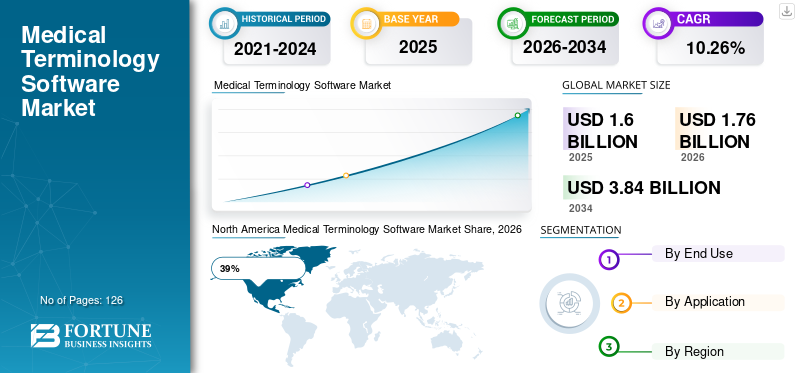
The global medical terminology software market size was valued at USD 1.60 billion in 2025. The market is projected to grow from USD 1.76 billion in 2026 to USD 3.84 billion by 2034, exhibiting a CAGR of 10.26% during the forecast period. The market in North America dominated with a revenue share of 39% in 2025.

The medical terminology software market is expanding steadily due to the rapid digitalization of healthcare documentation, electronic health record integration, and standardized clinical communication requirements. Healthcare organizations increasingly depend on terminology management systems to improve coding accuracy, patient data consistency, and interoperability between healthcare platforms. medical terminology software market Analysis shows that hospitals, diagnostic centers, and healthcare IT providers are investing in automated terminology mapping solutions to reduce clinical documentation errors and improve operational efficiency. Demand for cloud-based terminology management platforms has increased as healthcare facilities seek scalable infrastructure. medical terminology software market Trends also indicate growing adoption of AI-assisted coding support and multilingual terminology standardization tools.
The United States medical terminology software market holds approximately 34% share within North America due to advanced healthcare IT infrastructure and extensive electronic health record adoption. More than 79% of large healthcare systems in the country utilize standardized clinical terminology platforms to improve coding precision and regulatory compliance. Medical terminology software industry analysis indicates that healthcare providers increasingly deploy automated vocabulary management tools to support value-based care initiatives and interoperability standards. Rising patient data volumes across hospitals and insurance organizations continue driving demand for advanced terminology integration systems. Healthcare analytics providers in the United States also prioritize terminology normalization solutions for large-scale clinical data aggregation and reporting.
Download Free sample to learn more about this report.
Medical Terminology Software Market Key Takeaways
 Global Market Size & Forecast
- 2025 Market Size: USD 1.6 Billion
- 2026 Market Size: USD 1.76 Billion
- 2034 Forecast Market Size: USD 3.84 Billion
- CAGR: 10.26% from 2026-2034
 Market Share
- North America dominated with a 39% market share in 2025.
- Healthcare providers led by end use with a 57% market share.
- Quality reporting led by application with a 54% market share.
 Key Regional Highlights
North America
North America held the largest regional share at 39%.
Europe
Europe accounted for 27% of the global market.
Asia-Pacific
Asia-Pacific represented 24% of the global market.
U.S.
The U.S. market is driven by growing adoption of healthcare IT and electronic health records.
Japan
Japan accounted for 29% of the Asia-Pacific market, supported by increasing healthcare digitization.
Read More

Medical Terminology Software Market Latest Trends
The medical terminology software market is witnessing significant transformation due to increasing adoption of artificial intelligence, natural language processing, and cloud-integrated healthcare management systems. Healthcare organizations are implementing advanced terminology software to streamline coding workflows, improve clinical data quality, and reduce administrative burden across medical facilities. medical terminology software market Research Report findings indicate that nearly 68% of healthcare providers prefer integrated terminology platforms capable of supporting real-time data validation and automated code mapping.
Another important trend in the medical terminology software market outlook is the rising use of interoperability-focused platforms. Healthcare institutions are increasingly integrating SNOMED CT, ICD, CPT, and LOINC terminology databases within centralized systems to support seamless patient information exchange. More than 72% of healthcare IT vendors are enhancing terminology software compatibility with electronic health record systems and telehealth applications. medical terminology software market Insights further reveal increasing demand for multilingual terminology support due to cross-border healthcare services and medical tourism expansion.
Download Free sample to learn more about this report.
Medical Terminology Software Market Dynamics
DRIVER
Rising Adoption of Electronic Health Records and Interoperability Standards
The increasing implementation of electronic health record systems across hospitals, clinics, and diagnostic laboratories is a major driver supporting medical terminology software market Growth. Healthcare providers require standardized clinical language frameworks to improve patient record consistency and ensure accurate communication among healthcare professionals. More than 74% of healthcare facilities globally have accelerated investment in terminology mapping systems to support interoperability initiatives and healthcare data exchange standards. medical terminology software market analysis indicates that terminology platforms help minimize coding errors, improve patient safety, and enhance administrative efficiency. Healthcare organizations are also prioritizing terminology standardization to comply with evolving healthcare regulations and reporting frameworks. Integrated terminology software supports automated classification systems, reducing manual documentation workload for medical professionals. Medical terminology software market opportunities are increasing as healthcare institutions seek scalable solutions capable of managing growing patient data volumes.
RESTRAINT
High Implementation Complexity and Integration Costs
The medical terminology software market faces restraints associated with implementation complexity, infrastructure modernization requirements, and integration expenses. Small and medium-sized healthcare facilities often struggle to deploy advanced terminology management systems due to limited IT budgets and shortage of skilled technical professionals. Nearly 46% of regional healthcare centers report operational difficulties during migration from legacy systems to standardized terminology platforms. Medical terminology software industry analysis indicates that customization requirements and compatibility issues with existing electronic health record systems can delay deployment timelines. Healthcare organizations also encounter challenges related to employee training and workflow adaptation. Clinical staff members require specialized education to efficiently utilize automated terminology software and coding systems. Integration of multiple healthcare databases and terminology libraries can create operational disruptions during initial implementation phases.
OPPORTUNITY
Expansion of Ai-Driven Clinical Documentation Solutions
Artificial intelligence integration presents strong growth opportunities within the medical terminology software market. Healthcare providers increasingly deploy AI-enabled terminology management systems capable of automating medical coding, identifying documentation inconsistencies, and improving clinical decision support accuracy. Approximately 63% of healthcare IT organizations are investing in machine learning algorithms for predictive coding and automated terminology standardization. medical terminology software market Trends indicate growing preference for intelligent platforms capable of reducing physician documentation burden and improving operational productivity. The expansion of healthcare analytics and population health management initiatives further strengthens market opportunities. Advanced terminology software supports large-scale clinical data aggregation, enabling healthcare providers to generate accurate analytical insights for treatment optimization and resource planning. Medical terminology software market research report findings show increasing adoption of cloud-native terminology systems integrated with natural language processing capabilities.
CHALLENGE
Frequent Updates in Healthcare Coding Standards
Continuous modifications in healthcare coding systems and regulatory requirements remain a major challenge for the medical terminology software market. Medical coding classifications, reimbursement guidelines, and clinical terminology standards frequently evolve, requiring software providers to maintain constant updates and system revisions. Nearly 58% of healthcare organizations experience operational disruptions during transitions between updated coding frameworks and compliance regulations. Medical terminology software market outlook analysis highlights that maintaining compatibility with evolving standards such as ICD updates and interoperability frameworks increases software maintenance complexity. Healthcare providers also face challenges related to synchronization of terminology databases across multiple departments and healthcare networks. Inconsistent terminology updates can lead to billing inaccuracies, reporting errors, and administrative inefficiencies. Medical terminology software market share analysis indicates that smaller software vendors often struggle to provide rapid updates and continuous technical support required by healthcare organizations.
Medical Terminology Software Market Segmentation
By End Use
Healthcare providers account for approximately 57% market share because hospitals, specialty clinics, and diagnostic laboratories increasingly depend on terminology management systems for standardized clinical communication. medical terminology software market analysis shows that healthcare providers utilize terminology software to reduce coding inaccuracies, improve patient safety, and streamline reimbursement processing. More than 73% of multi-specialty hospitals have integrated automated terminology solutions with electronic health record platforms to support real-time clinical documentation.
Healthcare IT vendors hold nearly 43% market share due to increasing demand for integrated healthcare software ecosystems and interoperability-focused infrastructure solutions. Medical terminology software industry report analysis indicates that software vendors are actively developing terminology management tools compatible with electronic health records, telemedicine systems, and healthcare analytics platforms. More than 66% of healthcare IT vendors now include terminology standardization features within broader clinical information management solutions. Healthcare IT vendors are also investing heavily in artificial intelligence and natural language processing capabilities to enhance automated coding support and clinical data mapping accuracy.
To know how our report can help streamline your business, Speak to Analyst
By Application
Quality reporting applications account for approximately 54% market share because healthcare organizations increasingly focus on regulatory compliance, patient outcome monitoring, and performance benchmarking. medical terminology software market Insights indicate that terminology platforms support accurate classification of clinical data required for quality reporting initiatives and healthcare audits. More than 71% of healthcare institutions utilize terminology software to improve consistency in patient documentation and reduce reporting discrepancies. Healthcare providers also rely on terminology management systems for automated compliance tracking and standardized reporting across departments. Medical terminology software market Growth is supported by rising demand for value-based healthcare models requiring accurate quality metrics and patient safety indicators
Data aggregation applications represent nearly 46% market share due to increasing need for centralized healthcare information management and population health analytics. Medical terminology software market analysis shows that healthcare organizations deploy terminology software to consolidate patient information from multiple clinical systems and improve interoperability. More than 69% of healthcare analytics platforms utilize standardized terminology frameworks for accurate clinical data aggregation and predictive healthcare analysis. The growing use of big data analytics and AI-driven healthcare research further supports demand for terminology-enabled data aggregation systems. medical terminology software market opportunities are expanding as healthcare providers seek integrated platforms capable of managing large patient datasets and supporting evidence-based treatment planning.
Medical Terminology Software Market Regional Outlook
North America
North America Medical Terminology Software Market Share, 2026 (%) To get more information on the regional analysis of this market, Download Free sample
North America dominates the medical terminology software market with approximately 39% market share because healthcare institutions across the United States and Canada heavily invest in digital healthcare transformation initiatives. More than 81% of hospitals within the region utilize terminology management platforms integrated with electronic health record systems to improve coding accuracy and regulatory compliance. medical terminology software market Research Report findings indicate that healthcare analytics expansion and interoperability mandates continue driving adoption of advanced terminology software solutions. The region benefits from strong presence of healthcare IT companies, advanced cloud infrastructure, and large-scale healthcare data management requirements. Healthcare organizations increasingly implement AI-assisted terminology systems to automate coding workflows and improve clinical documentation efficiency.
Europe
Europe accounts for approximately 27% market share within the medical terminology software market due to increasing healthcare digitization and regulatory focus on standardized clinical communication. Healthcare organizations across the region continue investing in terminology software to support interoperability frameworks, electronic patient records, and cross-border healthcare collaboration. More than of large hospitals in Europe utilize terminology management platforms for accurate medical coding and healthcare data exchange. medical terminology software industry analysis indicates that healthcare providers in Europe prioritize multilingual terminology systems to support diverse patient populations and international healthcare coordination. The expansion of healthcare analytics and value-based care initiatives has increased demand for automated terminology mapping and compliance management solutions. Cloud-based terminology systems are gaining popularity because healthcare organizations require scalable infrastructure for remote accessibility and centralized data management.
Germany Medical Terminology Software Market
Germany represents approximately 31% share within the Europe medical terminology software market due to advanced hospital infrastructure and strong healthcare digitalization initiatives. More than of healthcare institutions in Germany utilize electronic documentation systems requiring standardized medical terminology integration. medical terminology software market analysis indicates increasing demand for terminology software supporting clinical interoperability and healthcare analytics applications across hospitals and research institutions. German healthcare providers increasingly deploy AI-enabled terminology management systems to improve coding accuracy and administrative efficiency. The country also experiences rising investment in cloud-based healthcare platforms and predictive healthcare analytics. medical terminology software market trends show strong focus on compliance automation and secure patient data exchange across healthcare networks. Expansion of digital healthcare services and telemedicine infrastructure continues supporting terminology software adoption throughout Germany.
United Kingdom Medical Terminology Software Market
The United Kingdom accounts for approximately 24% share within the Europe medical terminology software market because healthcare providers continue modernizing digital health infrastructure and patient information systems. More than of NHS-affiliated healthcare organizations utilize standardized terminology frameworks for clinical reporting and interoperability management. medical terminology software market Insights indicate growing investment in AI-assisted coding solutions and automated healthcare documentation systems. Healthcare institutions in the United Kingdom increasingly prioritize terminology software integration with telehealth platforms and healthcare analytics systems. Demand for cloud-native terminology management platforms is also increasing due to expansion of remote healthcare services and centralized patient record systems. medical terminology software market Forecast analysis highlights rising adoption of predictive coding and multilingual terminology support within healthcare networks across the country.
Asia-Pacific
Asia-Pacific holds approximately 24% market share in the medical terminology software market due to rapid healthcare infrastructure expansion and increasing adoption of digital health technologies. Healthcare providers across China, Japan, India, South Korea, and Southeast Asian countries are investing in electronic medical record systems and terminology management platforms to improve clinical efficiency. More than 69% of newly established tertiary hospitals in the region utilize standardized terminology systems for healthcare documentation and patient data integration. medical terminology software market Trends indicate strong growth in cloud-based healthcare software adoption across Asia-Pacific due to expanding telemedicine services and healthcare analytics requirements. Governments within the region are also promoting healthcare interoperability and digital transformation initiatives, supporting demand for terminology standardization tools.
Japan Medical Terminology Software Market
Japan contributes approximately 29% share within the Asia-Pacific medical terminology software market due to advanced healthcare technology adoption and strong emphasis on clinical precision. More than of large hospitals in Japan utilize terminology management systems integrated with electronic patient records and healthcare analytics platforms. Medical terminology software market research Report findings indicate increasing demand for AI-assisted coding automation and predictive healthcare documentation tools. Healthcare providers in Japan are actively implementing cloud-based terminology systems to support interoperability and remote healthcare collaboration. The country also focuses heavily on healthcare robotics, precision medicine, and digital patient management systems, creating additional demand for terminology standardization solutions. medical terminology software market Growth is further supported by aging population trends and rising healthcare data management requirements across hospitals and research institutions.
China Medical Terminology Software Market
China accounts for approximately 16% share within the Asia-Pacific medical terminology software market because of rapid healthcare digitalization and large-scale hospital modernization projects. More than of urban hospitals in China have adopted electronic medical record systems requiring integrated terminology management capabilities. medical terminology software market analysis indicates increasing investment in cloud healthcare infrastructure and AI-enabled clinical documentation platforms. Healthcare providers in China increasingly deploy terminology software to improve coding consistency, patient information exchange, and healthcare analytics capabilities. Expansion of telemedicine services and smart hospital initiatives further supports market demand. medical terminology software market Outlook highlights growing adoption of multilingual terminology systems and predictive coding technologies across public healthcare institutions and private healthcare networks throughout China.
Rest of World
The Rest of World segment holds approximately 10% market share within the medical terminology software market due to ongoing healthcare infrastructure modernization across Latin America, the Middle East, and Africa. Healthcare organizations in these regions increasingly implement digital healthcare platforms and standardized terminology systems to improve clinical documentation and patient data management. More than of large private hospitals in developing economies have initiated investments in terminology-enabled electronic health record systems. medical terminology software market Insights indicate rising government support for healthcare digitization and interoperability initiatives across emerging economies. Cloud-based terminology software adoption is increasing because healthcare institutions seek cost-efficient solutions capable of supporting remote healthcare operations and centralized data management. Healthcare providers also prioritize terminology systems that improve reporting accuracy and regulatory compliance.
List of Top Medical Terminology Software Companies
- Wolters Kluwer N.V.
- 3M
- BT Clinical Computing
- Intelligent Medical Objects, Inc.
- Apelon, Inc
- CareCom
- Clinical Architecture, LLC
- BiTAC
- B2i Healthcare
- HiveWorx
Top Two Companies with Highest Market Share
- 3M – 18% market share
- Wolters Kluwer N.V. – 15% market share
Investment Analysis and Opportunities
The medical terminology software market is attracting substantial investment due to increasing healthcare digitization, interoperability initiatives, and demand for advanced clinical documentation systems. Healthcare organizations continue allocating larger technology budgets toward terminology management platforms capable of improving coding accuracy, operational efficiency, and patient data standardization. medical terminology software market analysis indicates that nearly 64% of healthcare IT investors prioritize cloud-native terminology systems supporting scalable healthcare infrastructure and real-time data integration.
Artificial intelligence and natural language processing technologies represent major investment areas within the market. Software developers are investing heavily in predictive coding tools, automated terminology mapping systems, and AI-assisted compliance management solutions. medical terminology software market opportunities are expanding as healthcare analytics adoption accelerates across hospitals, insurance providers, and research organizations. Venture capital firms are also supporting startups specializing in interoperability-focused terminology platforms and multilingual healthcare documentation solutions.
New Product Development
New product development within the medical terminology software market focuses heavily on artificial intelligence integration, cloud scalability, and interoperability enhancement. Software vendors are introducing AI-powered terminology management platforms capable of automating medical coding, identifying documentation inconsistencies, and improving clinical workflow efficiency. medical terminology software market trends indicate that more than 62% of recently launched terminology platforms include natural language processing features supporting automated clinical vocabulary standardization.
Cloud-native terminology software remains a major innovation area because healthcare organizations increasingly require remote accessibility and centralized patient data management. Vendors are developing flexible subscription-based terminology platforms compatible with electronic health record systems, telemedicine applications, and healthcare analytics infrastructure. medical terminology software market Insights reveal rising demand for multilingual terminology management systems supporting international healthcare collaboration and medical tourism operations.
Five Recent Developments (2023-2025)
- 3M expanded its AI-enabled clinical documentation improvement platform in 2024 to support automated terminology mapping and predictive coding workflows.
- Wolters Kluwer N.V. introduced advanced cloud-based terminology management integration tools in 2023 for healthcare analytics and interoperability enhancement.
- Intelligent Medical Objects, Inc. launched upgraded natural language processing capabilities in 2025 to improve clinical search functionality and terminology standardization.
- Clinical Architecture, LLC enhanced its healthcare interoperability platform in 2024 with expanded terminology normalization and patient data integration features.
- B2i Healthcare introduced multilingual terminology support solutions in 2025 targeting cross-border healthcare collaboration and international clinical research operations.
Report Coverage of Medical Terminology Software Market
The medical terminology software market report provides extensive analysis of healthcare terminology management systems, interoperability platforms, and clinical documentation technologies utilized across hospitals, healthcare IT organizations, diagnostic laboratories, and research institutions. medical terminology software market Research Report coverage includes detailed evaluation of market dynamics, industry trends, technological advancements, investment patterns, and competitive landscape developments influencing market expansion.
Request for Customization to gain extensive market insights.
The report examines segmentation by type and application, highlighting demand variations among healthcare providers, healthcare IT vendors, quality reporting systems, and data aggregation platforms. medical terminology software market analysis also includes regional performance assessment across North America, Europe, Asia-Pacific, and Rest of World markets. Key healthcare digitization initiatives, interoperability regulations, cloud adoption trends, and artificial intelligence integration strategies are evaluated comprehensively.
Frequently Asked Questions
Fortune Business Insights says that the global market value stood at USD 1.60 billion in 2025 and is projected to reach USD 3.84 billion by 2034.
The market is expected to exhibit a CAGR of 10.26% during the forecast period of 2026-2034.
Healthcare providers was the leading end-use segment, accounting for approximately 57% of the market, driven by growing use of terminology systems for standardized clinical communication.
Key players include Wolters Kluwer N.V., 3M, BT Clinical Computing, Intelligent Medical Objects, Inc., Apelon, Inc., and CareCom.
Major trends include increasing adoption of AI, natural language processing, and cloud-integrated platforms, alongside growing demand for interoperability-focused terminology systems. North America led the market with approximately 39% share.



- 2021-2034
- 2025
- 2021-2024
- 126
-

(Offer valid till 15th Sep 2026)
Get 30-60 hrs Free Customization
Expand Regional and Country Coverage, Segments Analysis, Company Profiles, Competitive Benchmarking, and End-user Insights.




















-
US +1 833 909 2966 ( Toll Free )
-
Get In Touch With Us