Metamaterials Market Size, Share & Industry Analysis, By Type (Electromagnetic, Mechanical, Terahertz, Piezoelectric, Photonic, Non-Linear, Acoustic, and Others), By End-Use Industry (Aerospace & Defence, Telecommunication, Consumer Electronics, Robotics, Healthcare, and Others), and Regional Forecast, 2026-2034
 Download Free Sample
KEY MARKET INSIGHTS
 Listen to Audio Version
The global metamaterials market size was valued at USD 2.81 billion in 2025 and is projected to grow from USD 3.6 billion in 2026 to USD 31.67 billion by 2034, exhibiting a CAGR of 31.20% during the forecast period. North America dominated the metamaterials market with a market share of 40% in 2025. Kyameta Corporation, Metamagnetics, Echodyne, TeraView, and Meta Materials Inc. are the key players operating in the industry.
Metamaterials are engineered materials with unique properties, not found in natural substances. They gain characteristics from their structure rather than their composition, enabling control over electromagnetic waves, sound, or heat. Common types include electromagnetic, acoustic, and mechanical.
Moreover, these materials are highly valued in the aerospace and defense sector for their ability to manipulate electromagnetic waves, which is crucial for technologies including radar, stealth, and communication systems. For instance, stealth technology benefits from these materials by reducing the radar cross-section of aircraft, making them harder to detect. These materials can also improve sensor systems, offering higher precision in detecting targets or monitoring conditions. As defense spending increases globally, the demand for innovative materials is expected to grow, further advancing the market growth.
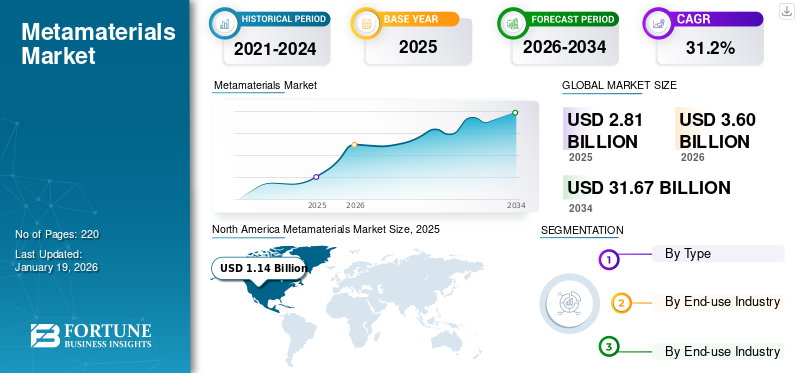
Download Free sample to learn more about this report.
METAMATERIALS MARKET TAKEAWAYS
 Market Size & Forecast
- 2025 Market Size: USD 2.81 Billion
- 2026 Market Size: USD 3.60 Billion
- 2034 Forecast Market Size: USD 31.67 Billion
- CAGR: 31.20% from 2026–2034
 Market Share
- North America dominated the metamaterials market with a 40.00% share in 2025.
- The electromagnetic segment is projected to account for a 28.33% share in 2026.
- The aerospace & defense segment is projected to hold a 26.94% share in 2026.
 Key Regional Highlights
Asia Pacific
Asia Pacific accounted for USD 1.71 billion in 2025 and is expected to reach USD 1.82 billion in 2026.
North America
North America generated USD 1.75 billion in 2025 and is projected to reach USD 1.83 billion in 2026.
Europe
Europe generated USD 0.71 billion in 2025 and is projected to reach USD 0.74 billion in 2026.
U.S.
The metamaterials market is projected to reach USD 1.06 billion in 2026.
Japan
The metamaterials market is projected to reach USD 0.17 billion in 2026.
Read More

Metamaterials Market Trends
Growing Focus on Terahertz Technologies is the Latest Trend
A notable latest trend in the market is the growing focus on terahertz (THz) technologies. Terahertz radiation lies between microwave and infrared frequencies on the electromagnetic spectrum, offering a unique combination of properties that can be harnessed for various applications, including imaging, communications, and sensing. Metamaterials are playing a critical role in unlocking the potential of THz waves.
THz frequencies can support ultra-fast data transmission, potentially revolutionizing wireless communication systems, including 5G and beyond. The advanced materials are being developed to manipulate THz waves for better signal control, leading to faster, more reliable communication networks.
- North America witnessed a growth from USD 1.14 billion in 2025 to USD 1.45 billion in 2025.
Moreover, advances in product design and fabrication are improving the control over THz waves, making it possible to engineer devices that perform more efficiently in THz applications. This has sparked growth in industries such as defense, medical technology, and electronics.
Download Free sample to learn more about this report.
Market Dynamics
Market Drivers
Growing Demand for Advanced Communication Technologies to Boost Market Demand
The growing demand for advanced communication technologies, particularly in the context of 5G, is a significant market driver. The material plays an essential role in enhancing these systems as the global telecom industry moves toward faster and more efficient communication networks.
The introduction of 5G networks promises faster data speeds, lower latency, and more reliable connections. However, 5G requires complex antennas and signal processing systems that can manage higher frequencies and increased data traffic. Metamaterials, with their ability to manipulate electromagnetic waves, offer compact, high-performance antennas capable of handling these advanced requirements. They also help in signal transmission and reception over a wider range of frequencies, which is crucial for 5G's global implementation. As research in THz technology continues to advance, the product is crucial for unlocking the full capabilities of this emerging field, driving innovation across several industries.
Demand for Energy-Efficient Materials is Expected to Drive the Market Growth
Metamaterials can improve the efficiency of energy harvesting systems, such as solar panels and thermoelectric devices. By manipulating light or heat, these materials can increase the amount of energy captured from natural sources. For example, certain products are designed to optimize the absorption of sunlight, enabling solar cells to capture more energy even in low-light conditions. This is particularly valuable as the world seeks to transition to renewable energy sources.
Moreover, the product improves thermal management in energy systems, such as electronics and industrial machinery. It can be engineered to control heat flow by enhancing heat dissipation or improving insulation. This helps reduce energy consumption by preventing overheating and ensuring optimal performance of devices.
As industries continue to prioritize green technologies and the reduction of environmental impact, the demand for energy-efficient materials is expected to grow, making it a significant driver in the market.
Market Restraint
High Manufacturing Cost to Restrict Market Growth
The product is typically engineered at a microscopic or nanoscopic scale, requiring highly precise and intricate fabrication techniques. This often involves lithography, 3D printing, or nanofabrication methods, which are technologically complex and expensive. The material must be tailored to specific frequencies or properties, making the design and production process labor-intensive and costly. These challenges can make scaling up production difficult for large volumes, limiting their availability and increasing prices.
Moreover, many materials require rare or specialized materials, such as metals or polymers, that are difficult to manipulate at the nanoscale. The cost of acquiring these materials, along with the use of specialized equipment for their fabrication, further increases the overall cost of production.
Market Opportunities
Advancement of Medical Technologies to Act as an Opportunity for Market Growth
One significant opportunity for the market lies in the advancement of medical technologies. As healthcare continues to evolve, the product has growing potential to transform diagnostics, imaging, and therapeutic treatments, offering new possibilities for non-invasive procedures and personalized healthcare.
Metamaterials can enhance medical imaging systems including MRI, ultrasound, and X-ray by improving resolution and sensitivity. For example, metamaterial-based lenses and filters can focus or manipulate electromagnetic waves in ways that traditional materials cannot. This could lead to more detailed and precise imaging, allowing doctors to detect abnormalities at earlier stages, potentially saving lives and improving treatment outcomes.
Additionally, the product can be used to create highly sensitive biosensors that detect specific biological markers at very low concentrations. These sensors could be employed for rapid disease detection, monitoring blood sugar levels, or detecting pathogens in the bloodstream. The miniaturization of such sensors could lead to more portable and affordable diagnostic tools, expanding access to healthcare in remote or underserved areas. As the healthcare industry focuses on improving patient outcomes, reducing costs, and advancing precision medicine, the product presents a growing opportunity for innovation in medical devices and diagnostics.
Market Challenges
Lack Of Mass Production Techniques Pose A Challenge To Market Expansion
The lack of mass production techniques is a significant challenge for the market. Most products are currently produced using complex and labor-intensive fabrication processes, such as nanofabrication, 3D printing, or laser structuring. These techniques are ideal for producing small quantities of highly customized materials but are not easily scalable to large-volume production.
Further, fabrication methods such as top-down fabrication, where structures are patterned on substrates, or bottom-up methods, which involve building materials atom by atom or molecule by molecule, require specialized equipment and highly skilled labor. As a result, these methods are costly and not suitable for large-scale, cost-effective production.
Impact of COVID-19
The COVID-19 pandemic had a mixed impact on the metamaterials market growth. Initially, the market faced supply chain disruptions, delayed projects, and a reduction in R&D investments as many industries paused or reduced operations due to lockdowns and economic uncertainty. This particularly affected sectors including aerospace, defense, and healthcare, which are key product consumers.
However, the pandemic also created opportunities. With the global focus on healthcare, medical devices, and remote communications, the demand for advanced technologies surged, leading to an increased interest in the product. For example, metamaterials played a role in developing medical imaging systems, biosensors, and wearable health devices. Additionally, telecommunication advancements, especially in the development of 5G networks, gained momentum, creating more demand for metamaterial-based antennas and signal processors.
Segmentation Analysis
By Type
Electromagnetic Segment Holds the Largest Market Share Due to its Distinctive Properties
In terms of type, the global market is segmented into electromagnetic, mechanical, terahertz, piezoelectric, photonic, non-linear, acoustic, and others.
The electromagnetic segment is projected to dominate the market with a share of 28.33% in 2026 and is the fastest-growing segment. Electromagnetic type is an artificial material engineered to have properties that are not found in naturally occurring substances. Electromagnetic product represents a frontier in material science, with the ability to unlock revolutionary advancements in communications, defense, healthcare, and beyond.
The mechanical segment accounted for the second-largest share in 2024. Industries including aerospace, automotive, and construction are constantly looking for ways to reduce the weight of materials without compromising strength. Mechanical type offers the ability to design lightweight, high-strength components that improve energy efficiency and performance.
The acoustic segment is expected to grow with a significant CAGR, driven by increasing demand for noise control, vibration isolation, and advanced sound manipulation technologies. As urbanization, consumer electronics, and healthcare technologies continue to advance, the demand for innovative acoustic solutions will continue to expand.
By End-Use Industry
To know how our report can help streamline your business, Speak to Analyst
Aerospace & Defense Segment to Account for Maximum Revenue Share Due to Superior Properties
In terms of end-use industry, the global market is segmented into aerospace & defense, telecommunication, consumer electronics, robotics, healthcare, and others.
The aerospace & defense segment is projected to dominate the market with a share of 26.94% in 2026. The product plays an increasingly important role in the aerospace and defense sectors due to its ability to manipulate electromagnetic waves, sound waves, and mechanical forces in innovative ways. As military forces increasingly focus on survivability and stealth, the product is seen as critical for reducing detection by radar and other sensors. The development of stealth aircraft, drones, and ships is a significant driver for the growth of material applications in defense.
The telecommunication is the fastest-growing segment. The product offers tremendous potential to transform telecommunication systems by enhancing signal processing, improving network efficiency, and enabling new capabilities including beam steering and high-frequency communication. As 5G and 6G technologies continue to evolve, the product will play a key role in enabling faster, more reliable, and higher-capacity networks, driving the future of global communications.
The healthcare segment is expected to grow significantly during the forecast period. The product holds immense potential in healthcare, from improving medical imaging and diagnostics to enabling targeted therapies and innovative prosthetics. As research continues and manufacturing techniques advance, the product plays a key role in revolutionizing healthcare by providing more precise, personalized, and non-invasive solutions. The Consumer Electronics segment is expected to hold a 17% share in 2024.
Metamaterials Market Regional Outlook
Based on region, the global market has been segmented into North America, Europe, Asia Pacific, Latin America, and Middle East & Africa.
North America
North America Metamaterials Market Size, 2025 (USD Billion)
To get more information on the regional analysis of this market, Download Free sample
North America contributed 39.00% to the global market in 2025, with a valuation of USD 1.75 billion, and is projected to reach USD 1.83 billion in 2026.
U.S., in particular, dominates the market with significant research and development activities in areas including advanced sensing and communication. Surge in aerospace applications and the increasing demand for miniaturized electronic devices further fuel growth in the region. The presence of leading manufacturers and a supportive regulatory environment contributes to the region's market dominance. The country generated a value of USD 1.06 billion in 2026.
- In U.S., the Consumer Electronics segment is estimated to hold a 17.1% market share in 2024.
To know how our report can help streamline your business, Speak to Analyst
Asia Pacific
The Asia Pacific market was valued at USD 1.71 billion in 2025, capturing 38.00% of global revenue, and is estimated to reach USD 1.82 billion in 2026. The market in Asia Pacific region is fueled by rapid industrialization and growing investments in research and development. China, Japan, and South Korea are key players, focusing on applications of the product in telecommunications, electronics, and advanced manufacturing. The growing demand for high-performance electronic devices and increasing investments in 5G infrastructure drive product adoption. Additionally, government support through funding programs and infrastructure development further accelerates market expansion. The region's cost-competitive manufacturing landscape makes it an attractive base for material production. The Japan market is anticipated to reach USD 0.17 billion by 2026, the China market is set to expand to USD 0.29 billion by 2026, and the India market is estimated to reach USD 0.12 billion by 2026.
Europe
Europe accounted for USD 0.71 billion in 2025, representing 16.00% of the global market share, and is projected to reach USD 0.74 billion in 2026. A strong emphasis on research and development collaborations characterizes the European market. Government initiatives promoting advanced materials science and photonics contribute significantly. Key growth drivers include the rising product demand in security applications, particularly in imaging and detection technologies. The region's automotive industry is also exploring products for improved vehicle performance and safety.
Germany leads the charge, investing heavily in smart surfaces and energy harvesting technologies. Government funding and collaborations between research institutions and industry players are key drivers. The emphasis on sustainable technologies and advancements in medical imaging contributes to the country’s market growth. The UK market is expected to reach USD 0.15 billion by 2026, and the Germany market is forecast to attain USD 0.30 billion by 2026.
Latin America
The Latin American market is relatively nascent but holds significant potential. The increasing adoption of advanced technologies in various sectors including agriculture, telecommunications, and healthcare drives regional market growth. The demand for improved communication infrastructure and the growing need for security solutions are key drivers. Increasing investments in research and development, coupled with government initiatives promoting technological advancements, are expected to boost the market.
Middle East & Africa
The Middle East & Africa region is an emerging market, driven primarily by significant investments in telecommunications and renewable energy. The region's growing population and increasing internet penetration fuel demand for advanced telecommunications infrastructure. Advanced materials are being explored to improve antenna performance and signal enhancement. Furthermore, rising energy demands and the need for sustainable energy solutions drive the product adoption in solar energy harvesting. Government initiatives promoting diversification and technological advancements are crucial drivers for the market growth.
COMPETITIVE LANDSCAPE
Key Market Players in Metamaterials Market
To know how our report can help streamline your business, Speak to Analyst
Key Players Adopted Product Innovation Strategies to Gain Market Share
Kyameta Corporation, Metamagnetics, Echodyne, TeraView, and Meta Materials Inc. are among the leading companies in the industry. The fragmentation is due to several factors, including the interdisciplinary nature of material technology, which spans material science, physics, nanotechnology, and engineering. As a result, companies across various sectors and from multiple regions are entering the space, leading to diverse market players.
Startups, particularly in specialized fields including medical imaging or acoustic materials, are entering the market with innovative solutions. The large technology firms, including those in telecommunications and defense, are also exploring advanced materials to enhance their product offerings. The global market is highly fragmented, with the top 5 players accounting for around 25% of the market share.
LIST OF KEY METAMATERIALS COMPANIES PROFILED
- Kyameta Corporation (U.S.)
- Metamagnetics Inc. (U.S.)
- Echodyne Corp. (U.S.)
- TeraView (U.K.)
- Meta Materials Inc. (Canada)
- Evolv Technologies (U.S.)
- Multiwave Technologies AG (Switzerland)
- Fractal Antenna Systems (U.S.)
- NKT Photonics A/S (Denmark)
- JEM Engineering (U.S.)
KEY INDUSTRY DEVELOPMENTS
- June 2025 - Kymeta announced a major technological leap by simultaneously operating across both Ku and Ka satellite bands in a single, compact antenna, laying the technical groundwork to enable seamless connectivity across satellite networks.
- May 2025 - Eutelsat OneWeb and Kymeta launched the Goshawk u8, a flat-panel terminal for the government and military. This multi-orbit terminal leverages both GEO and LEO networks, offering resilient and flexible connectivity across domains and meeting the growing demand for sovereign SATCOM amid increased defense spending.
- August 2024 - TeraView introduces a new sensor for measuring anode coatings in lithium-ion batteries, critical for EVs and energy storage. Expanding their TeraCota line, this technology complements their existing cathode sensor, using patented tech and advanced algorithms to achieve less than 1% measurement error without requiring prior material knowledge.
- September 2023- Meta Materials and Panasonic Industry collaborated to enhance the production and applications of Meta's NANOWEB transparent conductive films. By leveraging Panasonic's scalable process technology, the partnership aims to strengthen the supply chain and accelerate growth in the transparent conductive film market. This collaboration will focus on design and mass production, opening up innovative possibilities within the automotive and consumer electronics industries.
- May 2022- TeraView launched a new product to address the growing need for advanced IC packaging. TeraView is pleased to announce the launch of the purpose-built integrated circuit package inspection system, the EOTPR 4500.
REPORT COVERAGE
The market research report provides a detailed market analysis and focuses on crucial aspects such as leading companies, products, and end-use industries. Additionally, the report offers insights into market trends and highlights vital industry developments. In addition to the factors mentioned above, the report encompasses various factors contributing to the market's growth in recent years.
This report includes historical data & forecasts revenue growth at global, regional, and country levels, and analyzes the industry's latest market dynamics and opportunities.
Request for Customization to gain extensive market insights.
Report Scope & Segmentation
|
ATTRIBUTE |
DETAILS |
|
Study Period |
2021-2034 |
|
Base Year |
2025 |
|
Estimated Year |
2026 |
|
Forecast Period |
2026-2034 |
|
Historical Period |
2021-2024 |
|
Unit |
Value (USD Billion) |
|
Growth Rate |
CAGR of 31.20% from 2026 to 2034 |
|
Segmentation |
By Type
|
|
By End-use Industry
|
|
|
By Region
|
Frequently Asked Questions
Fortune Business Insights says that the global market was valued at USD 2.81 billion in 2025 and is projected to reach USD 31.67 billion by 2034.
In 2025, the North America market size stood at USD 1.14 billion.
Growing at a CAGR of 31.2%, the market will exhibit steady growth during the forecast period.
By application, aerospace & defense segment led the market in 2025.
Increasing demand for advanced communication technologies is a key factor driving market growth.
Kyameta Corporation, Metamagnetics, Echodyne, TeraView, and Meta Materials Inc. are among the leading companies in the market.
North America dominated the market with a share of 40% in 2026.
The growing focus on terahertz technologies and demand for energy-efficient materials is expected to drive product adoption.



- 2021-2034
- 2025
- 2021-2024
- 220
Get 30-60 hrs Free Customization
Expand Regional and Country Coverage, Segments Analysis, Company Profiles, Competitive Benchmarking, and End-user Insights.


















Related Reports
-
US +1 833 909 2966 ( Toll Free )
-
Get In Touch With Us