Micro Lending Market Size, Share & Industry Analysis, By Providers (Banks, Microfinance Institutions (MFIs), Non-Banking Financial Company (NBFC), and Others), By End User (Individuals, Women Entrepreneurs, and Micro Enterprises), and Regional Forecast, 2026–2034
 Download Free Sample
KEY MARKET INSIGHTS
 Listen to Audio Version
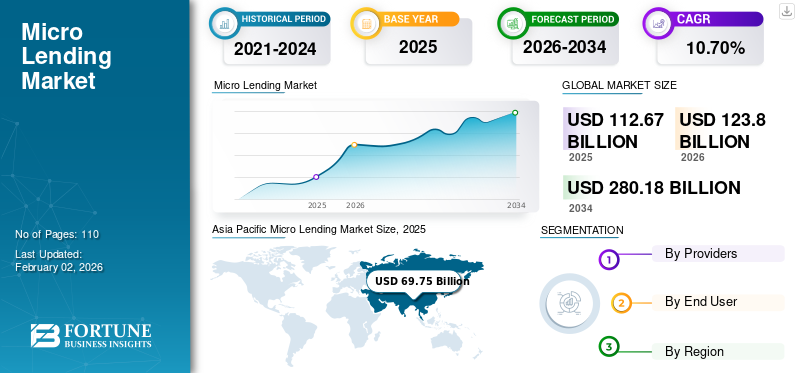
The global micro lending market size was valued at USD 112.67 billion in 2025. It is projected to grow from USD 123.80 billion in 2026 to USD 280.18 billion by 2034, exhibiting a compound annual growth rate CAGR of 10.70% during the forecast period. Asia Pacific dominated the market with a share of 61.90% in 2025.
Microloans are small loans, ranging from USD 1k to USD 50k, designed for entrepreneurs who are unable to secure capital from traditional financial institutions, such as banks or credit unions. Microloan lenders are primarily nonprofit organizations that receive money through donations and other charitable sources. Micro lenders use this money to provide affordable debts to micro businesses and individuals without collaterals and security. It involves inherent risk for both investors and borrowers, intermediary lenders mitigate this by diversifying their portfolio, investing small amounts across a broad range of microloans.
The global market size is poised for substantial growth, driven by the escalating need for financial loans for women-led businesses and micro-enterprises. The rising number of young entrepreneurs in emerging economies further supports this growth. As the market continues to evolve, key players and new entrants focus on innovative and collateral-free loans, contributing to revenue growth in emerging economies.
Prominent micro lenders such as Grameen America and Kiva Microfunds are focusing on a specific category of borrowers, such as family-owned small and medium businesses, women-led businesses, and small business owners. This helps expand market reach and deliver attractive returns for the investors.
Download Free sample to learn more about this report.
Micro Lending Market Key Takeaways
 Global Market Size & Forecast
- 2025 Market Size: USD 112.67 billion
- 2026 Market Size: USD 123.80 billion
- 2034 Forecast Market Size: USD 280.18 billion
- CAGR: 10.70% from 2026-2034
 Market Share
- Asia Pacific dominated the micro lending market with a 61.90% share in 2025.
- The Microfinance Institutions (MFIs) segment held the largest share of 47.05% in 2026.
- The individuals segment accounted for the largest share of 62.71% in 2026.
 Key Regional Highlights
North America
North America reached USD 6.13 billion in 2025 and is projected to grow to USD 6.40 billion in 2026.
Asia Pacific
Asia Pacific accounted for USD 69.75 billion in 2025 and is expected to reach USD 77.15 billion in 2026.
Europe
Europe stood at USD 3.74 billion in 2025 and is projected to reach USD 3.88 billion in 2026.
U.S.
The market is projected to reach USD 5.06 billion in 2026.
Japan
The market is projected to reach USD 3.94 billion in 2026.
Read More

IMPACT OF STARTUP ECOSYSTEM AND ENTREPRENEURSHIP
Growing Demand for Micro Loans across Emerging Economies is Driving Good ROI
Micro lending plays a major role in financing micro-enterprises, which require a very small amount of capital to launch. This model strongly backs the startup ecosystem in emerging economies. Furthermore, women entrepreneurs are a major reason for the growth of micro lending businesses globally, as their businesses often demonstrate strong potential, generating a good Return on Investment (RoI) for lenders.
- For instance, in April 2024, Grameen America, a leading microfinance organization, launched a campaign to raise USD 600 million over the next five years. The initiative aims to invest USD 1 billion in capital and allocate USD 40 billion toward empowering entrepreneurial women across the U.S.
MICRO LENDING MARKET TRENDS
AI-Based Credit Assessment to Minimize Risk of Fraud is a Key Market Trend
Artificial Intelligence (AI) and data analytics are reshaping the market by revolutionizing risk assessment practices. AI makes the lending platforms more transparent, data-driven, and inclusive. Traditionally, MFIs and NBFCs relied on conventional risk assessment methods, such as income evaluation and collateral-based assessments to determine creditworthiness. However, with the integration of AI, microfinance institutes and banks can easily evaluate the creditworthiness of individuals or businesses using alternative data sources, minimizing the risk of fraud and enabling them to serve a broader customer base. These advancements are playing a key role in expanding the micro lenders market over the forecast period.
- According to secondary analysis, financial institutions are actively investing in artificial intelligence. In April 2025, Bank of America allocated USD 4 billion to AI and other tech initiatives. The promising enhanced consumer insights and competitive pressure fuel this surge.
MARKET DYNAMICS
Market Drivers
e-KYC and Easy Loan Disbursal Availability Feature to Drive Market Growth
The market is propelled by key drivers that collectively contribute to its sustained growth. One key driver is the adoption of e-KYC (Know Your Customer) processes, which play a critical role in streamlining the micro lending sector. By enabling data-driven onboarding, online loan approvals, and efficient credit assessments, e-KYC enhances operational efficiency. The proliferation of smartphones and the 5G revolution are transforming the digitalization of the financial sector and helping individuals and businesses avail microloans at their doorsteps with easy KYC and online loan disbursals, driving the micro lending market growth.
- For instance, in March 2025, Muthoot Microfin received approval to conduct Aadhaar-enabled e-KYC for its onboarding process. The digital KYC will enable seamless onboarding for rural women entrepreneurs, underserved communities, and joint-leading groups.
Market Challenges
Regulatory Changes and Strict Laws to Restraint the Modern Lending Businesses
Modern micro-lending businesses are facing several restraints that can inhibit market growth. Regulatory uncertainty and stringent lending laws in jurisdictions can increase operational complexities and compliance costs for lenders. Other big concerns for microlenders are the strict data privacy laws and cybersecurity concerns aligned with the digital lending business. These factors can deter lenders' reputations and the trust of potential borrowers. Regulatory bodies are strictly mandating e-KYC and Anti Money Laundering (AML) procedures to prevent fraudulent activities from reaching genuine borrowers.
- For instance, in February 2025, the Reserve Bank of India lowered risk weights for bank financing to NBFCs and microfinance loans to unlock more funds and boost credit. However, it increased the risk weight by Twenty-five percentage points on commercial banks to NBFCs, reflecting a more cautious approach to risk management.
Market Opportunities
Increasing Efforts Toward Financial Inclusions to Provide Ample Growth Opportunities
The microloan industry in emerging economies is experiencing rapid growth, driven by the increasing number of borrowers and evolving customer expectations. This transformation is largely fueled by increasing efforts toward financial inclusion, which are enabling the emergence of new MFIs and NBFCs that leverage digital loan facilities and AI credit assessments. This approach expands financial competitiveness reduces the loan default rate and creates ample opportunities to steadily expand microlending services in the underserved and rural markets.
- For instance, in June 2024, the Asian Development Bank (ADB) and Ngern Tid Lor (TIDLOR) signed a USD 150 million loan agreement to support the development of micro, small, and medium-sized enterprises (MSMEs) in Thailand. The scheme is dedicated particularly to women-led businesses operating in the country’s agriculture value chain.
SEGMENTATION ANALYSIS
By Providers
MFIs Segment Leads the Market due to its Ability to Serve Larger Customer Base
By providers, the market is divided into banks, Microfinance Institutions (MFIs), Non-Banking Finance Companies (NBFCs), and others (small banks).
The Microfinance Institutions (MFIs) segment holds the largest share of 47.05% the market in 2026, leveraging their extensive experience in serving a larger customer base. MFIs are focusing on delivering services through digital platforms and accelerator programs aimed at reaching underserved communities and supporting women entrepreneurs, key drivers of their continued growth.
NBFCs are also emerging as significant players in the segment, driven by the increasing preference for microloans among customers in rural and underprivileged zones.
Banks and other financial institutions are trailing behind owing to stringent regulatory requirements and underdeveloped digital services offerings, hindering their ability to attract and retain microloan customers.
To know how our report can help streamline your business, Speak to Analyst
By End User
Continued Focus on Micro Business Investing Promotes Individual End User Dominance
By end user, the market is categorized into individuals, women entrepreneurs, and microenterprises.
The individuals segment is dominating the market with 62.71% in 2026, due to the government's push to support micro-businesses and individual businesses with collateral-free and low-interest loans. The emergence of MFIs and NBFCs' digital loan facilities significantly helps sole owners and individual businesses raise small loans easily.
Women entrepreneur businesses' share in microloan disbursement is increasing steadily, reflecting a global trend among financial institutions to prioritize lending to women-led businesses due to their strong repayment records and alignment with broader financial inclusion goals.
The microenterprises segment holds the lowest share, as strict regulations for larger loan amounts and mandatory credit assessment continue to restrain segment growth.
MICRO LENDING MARKET REGIONAL OUTLOOK
By region, the market is divided into North America, Europe, Asia Pacific, Latin America, and the Middle East and Africa.
Asia Pacific
Asia Pacific Micro Lending Market Size, 2025 (USD Billion)
To get more information on the regional analysis of this market, Download Free sample
The Asia Pacific market generated USD 69.75 billion in 2025, representing 61.90% of the global market landscape, and is expected to reach USD 77.15 billion in 2026, propelled by the growing disbursement of affordable micro-financed services to borrowers in developing markets. Furthermore, widespread smartphone adoption and improved digital infrastructure have enhanced access to micro lending services for underserved populations. China, India, Japan, and Southeast Asia are emerging financial markets with favorable policies and digital infrastructure to support business expansion with microloans. The Japan market is projected to reach USD 3.94 billion by 2026, the China market is projected to reach USD 13.77 billion by 2026, and the India market is projected to reach USD 27.68 billion by 2026.
Download Free sample to learn more about this report.
China holds the largest market share in the Asia Pacific region, due to rising inflation and customers' demand for small and microloans. Mortgages and residential projects are expected to expand micro lending market share over the forecast period.
North America
North America recorded a market size of USD 6.13 billion in 2025, capturing 5.50% of the global market share, and is projected to reach USD 6.4 billion in 2026. The market in North America is mature and growing steadily, owing to high digital penetration and the strong presence of established players. The rising gig economy has increased demand for flexible and short-term loans to support entrepreneurial ventures.
In the U.S., micro lending is a well-developed segment, though only a fraction of the population actively seeks such loans to fulfill their business needs. Strict government regulations and a growing focus on women entrepreneurs are expected to significantly drive market growth during the forecast period. The U.S. market is projected to reach USD 5.06 billion by 2026.
Europe
In 2025, Europe represented USD 3.74 billion, accounting for 3.30% of the worldwide market, and is projected to grow to USD 3.88 billion in 2026. The European market exhibits moderate growth, driven by the secure and transparent lending environment. However, its expansion is somewhat limited by stringent regulatory frameworks such as the EU’s Payment Service Directives (PSD2). Furthermore, the rising adoption of digital channels across micro-financed platforms is positively contributing to market growth. The UK market is projected to reach USD 0.27 billion by 2026, while the Germany market is projected to reach USD 0.33 billion by 2026.
Middle East and Africa
Middle East & Africa accounted for USD 11.97 billion in 2025, representing 10.60% of the global market share, and is projected to reach USD 13.17 billion in 2026. The market in the Middle East and Africa is experiencing robust growth, fueled by increasing mobile phone penetration and expanding internet access, which is broadening market reach. Additionally, government-led initiatives such as the “National Strategy for Financial Literacy” are expanding the borrower base.
Latin America
The market in Latin America showcases a high-growth nature, driven by improving internet access across developing countries such as Brazil, Mexico, and the Rest of Latin America. Government initiatives promoting financial inclusion and SME development are fueling demand for microloans.
COMPETITIVE LANDSCAPE
KEY INDUSTRY PLAYERS
Key Players Focus on Expansion to Target Underserved and Women Micro-Entrepreneurs
Businesses and microlenders are focusing on strategically expanding their market reach to target underserved and women micro-entrepreneurs. As the market continues to mature, the integration of AI technologies and the influence of microeconomic factors shape the growth of the microlending sector.
- For instance, in September 2024, Grameen America, the nation’s fastest-growing microfinance nonprofit, announced the opening of its second branch in Houston, Texas. This strategic expansion is empowering more financially underserved women by providing them with affordable capital and essential financial services.
List of Key Micro Lending Companies Studied
- LendingClub Corporation (U.S.)
- Windmill Microlending (U.S.)
- Zopa Bank Limited (U.K.)
- Grameen America (U.S.)
- Kiva Microfunds (U.S.)
- PayPal Working Capital (U.S.)
- Accion International (U.S.)
- ASA International (Amsterdam)
- Square Capital (U.S.)
- Bangladesh Rural Advancement Committee (Bangladesh)
- Avant, LLC (U.S.)
- Funding Circle (U.K.)
- SocietyOne (Australia)
- Bandhan Bank (India)
- Bharat Financial Inclusion Limited (India)
- LendUp Loans (U.S.)
- RenMoney (Nigeria)
- M-Pesa (Kenya)
- Banco Santander's Microfinance (Spain)
- CreditAccess Grameen Limited (China)
KEY INDUSTRY DEVELOPMENTS
- June 2025: The Social Security System (SSS) is set to partner with UnionDigital Bank, Inc. to develop a micro lending program aimed at providing technical assistance for ongoing digitalization. SSS agreed in principle to coordinate with the bank to enhance service delivery.
- April 2025: European Bank for Reconstruction and Development (EBRD) and Jordan’s microfund for Women signed USD 4 million for the Green Economy Financing Facility (GEFF), supporting the expansion of green lending to MSMEs. It includes USD 1 million of co-financing from the Green Climate Fund (GCF).
- July 2024: Indonesia is considering revisions to its microloan subsidy program in response to regulatory resistance over proposed loan restructuring measures. The evolving policy has prompted a comprehensive review, intended to improve liquidity in the financial system during periods of capital outflow.
- March 2024: Mizhou Americas, a U.S. banking arm of Japan’s Mizhou Financial Group, announced a USD 5 million loan to Grameen America that helps low-income women entrepreneurs build small businesses. The debt capital would fund GA’s microlending program and Mizhou’s ongoing commitment to CDFIs and Financial Inclusion.
- January 2024: Windmill Microlending announced a USD 1.1 million partnership with Definity Insurance Foundation. The investment would help expand access to low-interest career loans for skilled newcomers in Canada, supporting their career advancement. This partnership addresses barriers to socioeconomic prosperity through innovative blended and peer to peer financing.
REPORT COVERAGE
The micro lending report provides a detailed analysis of the market. It focuses on key aspects such as leading lenders and end users. It also offers insights into market trends and highlights key industry developments. In addition to the factors above, the report encompasses several factors that contributed to the market's growth in recent years.
Request for Customization to gain extensive market insights.
REPORT SCOPE & SEGMENTATION
|
ATTRIBUTE |
DETAILS |
|
Study Period |
2021-2034 |
|
Base Year |
2025 |
|
Estimated Year |
2026 |
|
Forecast Period |
2026-2034 |
|
Historical Period |
2021-2024 |
|
Growth Rate |
CAGR of 10.70% from 2026 to 2034 |
|
Unit |
Value (USD Billion) |
|
Segmentation |
By Providers
By End User
By Region
|
|
Companies Profiled in the Report |
LendingClub Corporation (U.S.), Windmill Microlending (USA), Zopa Bank Limited (U.K.), Grameen America (USA), Kiva Microfunds (USA), PayPal Working Capital (US), Accion International (U.S.), ASA International (Amsterdam), Square Capital (U.S.), and Bangladesh Rural Advancement Committee (Bangladesh) |
Frequently Asked Questions
The market is projected to reach USD 280.18 billion by 2034.
In 2025, the market was valued at USD 112.67 billion.
The market is projected to grow at a CAGR of 10.70% during the forecast period.
By providers, the MFIs segment leads the market.
E-KYC and easy loan disbursal availability features drive market growth.
The top players in the market are LendingClub Corporation, Windmill Microlending, Zopa Bank Limited, Grameen America, Kiva Microfunds, PayPal Working Capital, Accion International, ASA International, Square Capital, and Bangladesh Rural Advancement Committee.
The Asia Pacific region leads the market.
The individual user segment is dominating the market.



- 2021-2034
- 2025
- 2021-2024
- 110
Get 30-60 hrs Free Customization
Expand Regional and Country Coverage, Segments Analysis, Company Profiles, Competitive Benchmarking, and End-user Insights.












-
US +1 833 909 2966 ( Toll Free )
-
Get In Touch With Us