Microreactor Technology Market Size, Share & Industry Analysis, By Type (Lab Use, Production Use), By Application (Specialty Chemicals, Pharmaceuticals, Commodity Chemicals) and Regional Forecast, 2026-2034
 Download Free Sample
Microreactor Technology Market Overview
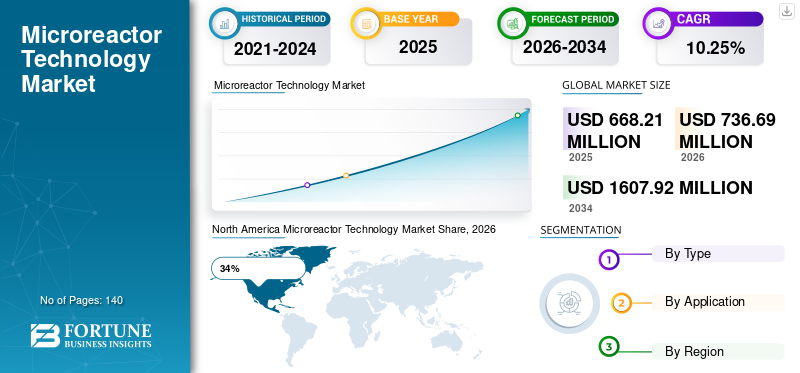
The microreactor technology market size was valued at USD 668.20 million in 2025. The market is projected to grow from USD 736.68 million in 2026 to USD 1607.91 million by 2034, exhibiting a CAGR of 10.25% during the forecast period.

The microreactor technology market is gaining significant momentum across chemical processing, pharmaceutical manufacturing, specialty material production, and advanced laboratory research applications. Microreactors are compact systems that enable continuous-flow processing with improved reaction control, enhanced safety, reduced waste generation, and higher production efficiency. The growing emphasis on sustainable manufacturing and precision chemical synthesis is encouraging industries to transition from traditional batch processing to microreactor-based systems. As organizations seek scalable and energy-efficient production methods, demand for advanced microreactor platforms continues to expand. The microreactor technology market report highlights increasing adoption across research institutions and commercial production facilities, supporting long-term microreactor technology market Growth and broader industrial transformation.
The United States remains one of the most influential contributors to the microreactor technology market due to strong pharmaceutical innovation, advanced chemical manufacturing infrastructure, and extensive investments in process automation. Universities, biotechnology companies, and specialty chemical manufacturers are increasingly deploying microreactor systems for rapid experimentation and continuous manufacturing. Regulatory focus on process safety and sustainable production methods is also supporting adoption. The presence of major technology developers and equipment suppliers has accelerated commercialization of next-generation microreactor platforms. The USA microreactor technology market analysis indicates growing integration of continuous-flow chemistry solutions in industrial operations, strengthening the country's position within the global Microreactor Technology Industry Report landscape.
Download Free sample to learn more about this report.
Microreactor Technology Market Key Takeaways
 Global Market Size & Forecast
- 2025 Market Size: USD 668.20 Million
- 2026 Market Size: USD 736.68 Million
- 2034 Forecast Market Size: USD 1,607.91 Million
- CAGR: 10.25% from 2026-2034
 Market Share
- The market in North America dominated with a revenue share of 34% in 2025.
- Production-use microreactors dominated by type with a market share of approximately 58%.
- Pharmaceutical applications dominated by application with a market share of approximately 39%.
 Key Regional Highlights
North America
North America led the market with a 34% share, supported by strong adoption of advanced manufacturing and research technologies.
Europe
Europe accounted for 29% of the market, driven by growing pharmaceutical and specialty chemical manufacturing.
Asia-Pacific
Asia-Pacific held a 27% share, supported by expanding industrial production and increasing adoption of continuous-flow technologies.
U.S
The U.S. remains a key market, supported by advanced pharmaceutical, chemical, and research infrastructure.
Japan
Japan accounted for approximately 26% of the Asia-Pacific market, supported by advanced manufacturing capabilities and growing adoption of microreactor technologies.
Read More

Microreactor Technology Market Latest Trends
One of the most important trends influencing the microreactor technology market is the growing implementation of continuous-flow manufacturing across pharmaceutical and specialty chemical production facilities. Manufacturers are increasingly replacing conventional batch reactors with compact microreactor systems that offer superior temperature control, improved reaction selectivity, and reduced processing times. The trend is particularly visible among organizations seeking higher productivity and consistent product quality.
Download Free sample to learn more about this report.
Another notable trend is the integration of automation, artificial intelligence, and real-time monitoring technologies into microreactor systems. Smart sensors and digital process controls are enabling predictive maintenance and enhanced operational efficiency. Companies are also focusing on modular reactor designs that can be scaled rapidly according to production requirements. The microreactor technology market research report further identifies increasing collaboration between equipment manufacturers, research institutions, and industrial end users to accelerate innovation. Sustainability objectives, energy conservation initiatives, and stricter environmental regulations are additionally driving demand for advanced microreactor solutions across global manufacturing industries.
Microreactor Technology Market Dynamics
DRIVER
Rising Demand for Continuous-Flow Chemical Manufacturing
The primary growth driver within the microreactor technology market is the increasing demand for continuous-flow manufacturing processes across pharmaceuticals, specialty chemicals, and fine chemical production. Traditional batch processing methods often face limitations related to reaction control, safety management, and production consistency. Microreactor systems address these challenges through precise control of mixing, heat transfer, and reaction parameters. As a result, manufacturers can achieve higher yields while minimizing waste generation and operational risks.
Continuous-flow production has become particularly attractive for organizations seeking process intensification and improved resource utilization. Pharmaceutical companies are adopting microreactors for active pharmaceutical ingredient synthesis, while specialty chemical producers are implementing the technology to improve reaction efficiency and product quality. Furthermore, increasing pressure to reduce environmental impact and optimize energy consumption is strengthening market demand. The microreactor technology market Outlook suggests that continuous manufacturing will remain a critical factor supporting adoption across both developed and emerging industrial economies.
RESTRAINT
High Initial Implementation and Integration Costs
Despite significant advantages, high implementation costs remain a major restraint for the microreactor technology market. Transitioning from established batch-processing infrastructure to advanced microreactor systems often requires substantial investments in equipment procurement, facility modifications, automation systems, and workforce training. Small and medium-sized enterprises may find these capital requirements difficult to justify, particularly when existing production methods continue to meet operational needs.
Integration challenges also contribute to slower adoption rates. Many manufacturing facilities operate complex legacy systems that are not easily compatible with modern microreactor technologies. Process validation requirements, regulatory approvals, and technical customization further increase implementation complexity. Some industries remain cautious regarding large-scale deployment because of concerns related to scalability and long-term operational reliability. Consequently, while the microreactor technology market Opportunities remain substantial, cost barriers continue to influence purchasing decisions among budget-conscious manufacturers and research organizations.
OPPORTUNITY
Expansion of Pharmaceutical and Specialty Chemical Applications
A major opportunity within the microreactor technology market lies in the expanding use of microreactors for pharmaceutical synthesis and specialty chemical manufacturing. Pharmaceutical companies are increasingly prioritizing precision, safety, and flexibility in drug development and production processes. Microreactors enable rapid experimentation, efficient reaction screening, and continuous production of high-value compounds, making them highly attractive for modern pharmaceutical operations.
The specialty chemicals sector is also generating strong opportunities due to growing demand for customized formulations and high-purity products. Manufacturers are leveraging microreactor technology to improve process consistency and reduce production variability. Emerging applications in advanced materials, nanotechnology, agrochemicals, and fine chemicals are creating additional avenues for market expansion. The microreactor technology market forecast indicates that technological advancements and increasing industrial awareness will continue opening new commercial opportunities for equipment providers, system integrators, and technology developers across multiple sectors.
CHALLENGE
Technical Complexity and Standardization Limitations
Technical complexity represents a significant challenge for the microreactor technology market. Designing and operating microreactor systems requires specialized expertise in fluid dynamics, reaction engineering, heat transfer, and process control. Many organizations face difficulties recruiting professionals with the necessary technical knowledge to manage advanced microreactor operations effectively.
Another challenge involves the lack of universal standardization across equipment designs and operating protocols. Different manufacturers offer customized reactor configurations, making interoperability and integration more complicated for end users. Industries requiring strict regulatory compliance must also conduct extensive validation procedures before implementing new technologies. Scaling laboratory processes to commercial production volumes can present additional engineering challenges. These factors contribute to longer adoption timelines and increased project complexity. Addressing standardization, training, and technical support requirements will be critical for sustaining future microreactor technology market Growth and improving industry-wide adoption rates.
Microreactor Technology Market Segmentation
By Type
Lab-use microreactors account for approximately 42% of the microreactor technology market share. These systems are extensively utilized in academic institutions, pharmaceutical research laboratories, biotechnology centers, and chemical development facilities. Researchers prefer lab-use microreactors because they enable precise reaction control, rapid experimentation, and reduced consumption of expensive reagents. Their compact design allows scientists to evaluate multiple reaction pathways efficiently while maintaining high safety standards. The growing focus on drug discovery, catalyst development, and process optimization continues to drive demand for laboratory-scale microreactors. Research organizations are increasingly adopting automated microreactor platforms equipped with advanced monitoring systems and data analytics capabilities. These technologies help accelerate innovation while reducing development timelines. The Microreactor Technology Industry Analysis indicates that laboratory applications will remain an important foundation for future technological advancements and commercialization efforts throughout the market.
Production-use microreactors represent nearly 58% of the microreactor technology market Size and are becoming increasingly important for industrial-scale manufacturing. These systems are widely employed in pharmaceutical production, specialty chemical synthesis, fine chemical manufacturing, and advanced material processing. Industrial users benefit from continuous-flow operations, enhanced product consistency, and improved energy efficiency compared with conventional batch-processing methods. The ability to scale production through modular reactor configurations has significantly increased interest among manufacturers seeking flexible production capabilities. Production-use microreactors also contribute to lower operational risks by minimizing hazardous material inventories and improving process safety. Many companies are investing in large-scale deployment projects to support sustainability goals and manufacturing modernization initiatives. The growing demand for efficient and environmentally responsible production processes continues to strengthen adoption within this segment, supporting broader microreactor technology market Trends worldwide.
To know how our report can help streamline your business, Speak to Analyst
By Application
The specialty chemicals segment holds approximately 36% of the microreactor technology market share. Manufacturers within this sector require precise control over reaction conditions to produce high-performance chemicals with consistent quality characteristics. Microreactor systems provide superior mixing efficiency, heat transfer performance, and process reproducibility, making them highly suitable for specialty chemical production. Demand for customized formulations across industries such as electronics, coatings, adhesives, and advanced materials is supporting market expansion. Producers are increasingly adopting continuous-flow technologies to improve production efficiency while reducing waste generation and energy consumption. The microreactor technology market research report highlights growing investments in specialty chemical manufacturing facilities that incorporate advanced microreactor systems. These developments are expected to strengthen the segment's contribution to overall market expansion in the coming years.
Pharmaceutical applications account for nearly 39% of the microreactor technology market Size, making this the largest application segment. Pharmaceutical manufacturers are adopting microreactors to enhance drug synthesis efficiency, improve process safety, and accelerate product development cycles. Continuous-flow processing supports greater consistency in active pharmaceutical ingredient production while reducing contamination risks and material waste. The increasing complexity of modern drug formulations has amplified demand for technologies capable of delivering precise reaction control. Microreactors also support rapid scale-up from laboratory research to commercial manufacturing. Regulatory agencies increasingly recognize the benefits of continuous manufacturing approaches, further encouraging adoption. As pharmaceutical companies seek greater operational flexibility and production reliability, microreactor technology continues to emerge as a strategic investment area across global healthcare and life sciences industries.
Commodity chemicals represent approximately 25% of the microreactor technology market share. While adoption in this segment has traditionally been slower compared to pharmaceuticals and specialty chemicals, increasing pressure to improve efficiency and sustainability is encouraging broader implementation. Commodity chemical producers are exploring microreactor systems to optimize reaction performance, reduce energy requirements, and improve process economics. Large-scale chemical manufacturers are evaluating modular microreactor installations for selected production processes where enhanced heat transfer and reaction control can generate measurable operational benefits. Environmental regulations and carbon reduction initiatives are further supporting interest in continuous-flow manufacturing technologies. The microreactor technology market insights indicate that ongoing technological improvements and declining equipment costs could accelerate adoption within commodity chemical applications over the next several years.
Microreactor Technology Market Regional Outlook
North America
North America Microreactor Technology Market Share, 2025 (%)
To get more information on the regional analysis of this market, Download Free sample
North America accounts for approximately 34% of the global microreactor technology market share. The region benefits from advanced pharmaceutical manufacturing capabilities, strong chemical processing infrastructure, and significant investments in industrial automation. The United States remains the primary contributor, supported by extensive research activities and widespread adoption of continuous manufacturing technologies. Universities, biotechnology companies, and specialty chemical manufacturers continue to drive demand for advanced microreactor systems.
Regulatory emphasis on sustainable manufacturing and process safety has encouraged organizations to invest in innovative production technologies. Market participants are increasingly collaborating with research institutions to develop next-generation reactor platforms capable of supporting complex chemical synthesis. Strong venture capital activity and technology commercialization initiatives further contribute to regional market growth. North America remains a key innovation hub within the microreactor technology market analysis landscape.
Europe
Europe holds approximately 29% of the global microreactor technology market share and remains a leading center for chemical engineering innovation. Countries across the region are actively promoting sustainable manufacturing practices, industrial modernization, and advanced process technologies. Pharmaceutical and specialty chemical producers are increasingly adopting microreactor systems to improve production efficiency and reduce environmental impact.
The region benefits from strong academic research networks and well-established chemical manufacturing industries. Regulatory frameworks supporting cleaner production methods have accelerated adoption of continuous-flow technologies. Several prominent microreactor equipment manufacturers maintain operations within Europe, contributing to technological advancement and market competitiveness. Ongoing investments in process intensification and green chemistry initiatives continue to strengthen Europe's role within the global Microreactor Technology Industry Report.
Germany Microreactor Technology Market
Germany represents approximately 31% of the European microreactor technology market. The country's highly developed chemical manufacturing sector and strong engineering expertise create favorable conditions for technology adoption. German pharmaceutical companies, specialty chemical producers, and industrial research organizations are increasingly implementing microreactor systems to improve manufacturing precision and process efficiency.
Government support for sustainable industrial practices and advanced manufacturing technologies has further encouraged market growth. Germany's emphasis on innovation, automation, and energy-efficient production processes aligns closely with the advantages offered by microreactor platforms. Numerous collaborative projects involving universities, research institutes, and industrial companies continue driving technological advancement. The Germany microreactor technology market Outlook remains positive as manufacturers pursue modernization initiatives and next-generation production strategies.
United Kingdom microreactor technology market
The United Kingdom accounts for approximately 22% of the European microreactor technology market. Strong pharmaceutical research capabilities and a growing focus on advanced manufacturing technologies are supporting adoption across multiple industries. Research institutions and biotechnology companies are utilizing microreactor systems for drug development, chemical synthesis, and process optimization applications.
The country's emphasis on innovation-driven industrial growth has encouraged investment in continuous manufacturing technologies. Several microreactor technology providers maintain research, development, and commercialization activities within the United Kingdom. Growing collaboration between academia and industry is accelerating product innovation and expanding application possibilities. The United Kingdom microreactor technology market research report indicates increasing demand for scalable and sustainable production technologies capable of supporting future industrial requirements.
Asia-Pacific
Asia-Pacific represents approximately 27% of the global microreactor technology market share and is emerging as one of the fastest-growing regional markets. Rapid industrialization, expanding pharmaceutical manufacturing capacity, and increasing investments in chemical processing infrastructure are driving demand across the region. Countries such as China, Japan, India, and South Korea are actively exploring advanced manufacturing technologies to improve competitiveness and operational efficiency.
The region's growing focus on environmental sustainability and resource optimization is supporting broader adoption of continuous-flow processing solutions. Government initiatives promoting industrial modernization and technological innovation are creating favorable conditions for market expansion. Rising research and development activities within pharmaceutical and specialty chemical industries further strengthen regional growth prospects. Asia-Pacific continues to attract significant investment from both domestic and international market participants.
Japan Microreactor Technology Market
Japan accounts for approximately 26% of the Asia-Pacific microreactor technology market. The country has a strong reputation for precision engineering, advanced manufacturing, and chemical process innovation. Japanese companies are actively investing in microreactor technologies to improve production quality, operational efficiency, and sustainability performance.
Pharmaceutical manufacturers and specialty chemical producers are increasingly integrating continuous-flow systems into research and production operations. Strong collaboration between industry and academic institutions supports ongoing technological advancement. Japan's commitment to energy efficiency and environmental responsibility further enhances market adoption. The Japan microreactor technology market analysis indicates steady expansion driven by technological sophistication and growing demand for highly controlled manufacturing processes.
China Microreactor Technology Market
China represents approximately 38% of the Asia-Pacific microreactor technology market and serves as the region's largest contributor. Rapid expansion of pharmaceutical manufacturing, chemical processing, and industrial automation sectors has significantly increased demand for advanced production technologies. Chinese manufacturers are investing heavily in process modernization to improve efficiency, quality, and environmental performance.
Government initiatives promoting technological innovation and sustainable industrial development are supporting widespread adoption. Domestic equipment suppliers and international technology providers are expanding their presence to capture growing market opportunities. China's large-scale manufacturing capabilities and increasing research investments continue strengthening its position within the global microreactor technology market forecast. Demand from pharmaceutical, specialty chemical, and advanced materials industries remains particularly strong.
Rest of World
The Rest of World region accounts for approximately 10% of the global microreactor technology market share. Markets across Latin America, the Middle East, and Africa are gradually increasing adoption as industrial modernization efforts gain momentum. Chemical manufacturers and research organizations are exploring microreactor technologies to improve process efficiency and reduce operational costs.
Growing interest in sustainable manufacturing, energy conservation, and advanced production methods is creating new opportunities across emerging economies. International technology providers are expanding distribution networks and partnership strategies to strengthen regional market penetration. While adoption levels remain lower than those observed in North America, Europe, and Asia-Pacific, ongoing industrial development initiatives continue supporting future market potential. Investments in pharmaceutical manufacturing and specialty chemical production are expected to contribute significantly to regional demand.
List of Top Microreactor Technology Companies
- Corning
- Chemtrix
- Little Things Factory
- AM Technology
- Soken Chemical & Engineering
- Ehrfeld Mikrotechnik BTS
- Microinnova Engineering
- Nakamura Choukou
- Uniqsis
- YMC
- Future Chemistry
- Syrris
- Vapourtec
- Suzhou Wenhao
Top Two Companies by Market Share
- Corning – 16%
- Chemtrix – 12%
Investment Analysis and Opportunities
Investment activity within the microreactor technology market continues to increase as industries seek advanced manufacturing solutions capable of improving efficiency, sustainability, and process control. Venture capital firms, industrial equipment manufacturers, and strategic investors are supporting technology development initiatives focused on continuous-flow processing systems. Research collaborations between academic institutions and commercial enterprises are generating new opportunities for product innovation and market expansion.
Significant investment opportunities exist within pharmaceutical manufacturing, specialty chemicals, advanced materials, and process automation sectors. Companies developing modular microreactor platforms are attracting considerable attention due to their scalability and operational flexibility. Emerging economies are also creating opportunities through industrial modernization programs and expanding chemical production capabilities. The microreactor technology market Opportunities landscape remains highly attractive for organizations focused on next-generation manufacturing technologies, digital process integration, and environmentally responsible production systems.
New Product Development
Innovation remains a defining characteristic of the microreactor technology market. Manufacturers are introducing advanced reactor designs featuring improved heat transfer capabilities, enhanced mixing performance, and integrated automation technologies. New product development efforts increasingly focus on modular architectures that enable rapid customization and scalable deployment across diverse industrial applications.
Companies are also integrating artificial intelligence, machine learning algorithms, and real-time analytical tools into reactor platforms to optimize process performance. Advanced materials capable of withstanding aggressive chemical environments are expanding application possibilities. Pharmaceutical and specialty chemical manufacturers are demanding systems that support faster development cycles and improved production consistency. Consequently, equipment providers continue investing heavily in research and development activities aimed at delivering highly efficient, intelligent, and sustainable microreactor solutions for global markets.
Five Recent Developments (2023-2025)
- Westinghouse expanded development activities for advanced microreactor commercialization through dedicated manufacturing and engineering initiatives in 2023.
- Prodigy Clean Energy entered a strategic collaboration focused on deploying transportable microreactor-based power solutions for remote industrial operations in 2024.
- Several leading microreactor equipment manufacturers introduced enhanced continuous-flow platforms with integrated automation and process monitoring capabilities during 2024.
- Pharmaceutical companies increased investments in microreactor-based continuous manufacturing facilities to improve production efficiency and regulatory compliance in 2025.
- Multiple technology providers expanded partnerships with research institutions to accelerate innovation in modular reactor design, process intensification, and advanced chemical synthesis applications during 2025.
Report Coverage of Microreactor Technology Market
The microreactor technology market report provides comprehensive coverage of industry developments, competitive dynamics, technological innovations, and application trends across major global regions. The report evaluates market performance across lab-use and production-use segments while examining demand patterns within specialty chemicals, pharmaceuticals, and commodity chemicals. It also assesses strategic initiatives undertaken by leading market participants and identifies emerging opportunities across developing industrial sectors.
Request for Customization to gain extensive market insights.
The report includes detailed microreactor technology market analysis covering regional performance, investment activity, technological advancements, and industry challenges. Key market drivers, restraints, opportunities, and competitive strategies are examined to provide a complete understanding of current industry conditions. Furthermore, the study evaluates innovation trends, manufacturing developments, and adoption patterns influencing future market expansion across global industrial and research environments.
Frequently Asked Questions
Fortune Business Insights says that the global market value stood at USD 668.20 million in 2025 and is projected to reach USD 1,607.91 million by 2034.
The market is expected to exhibit a CAGR of 10.25% during the forecast period of 2026-2034.
Production-use microreactors led the type segment with nearly 58% share, driven by their growing use in pharmaceutical and specialty chemical manufacturing.
Key players include Corning, Chemtrix, Little Things Factory, AM Technology, Soken Chemical & Engineering, and Ehrfeld Mikrotechnik BTS.
Major trends include the shift toward continuous-flow manufacturing and integration of automation, AI, and real-time monitoring. North America led with approximately 34% market share.



- 2021-2034
- 2025
- 2021-2024
- 140
-

(Offer valid till 15th Oct 2026)
Get 30-60 hrs Free Customization
Expand Regional and Country Coverage, Segments Analysis, Company Profiles, Competitive Benchmarking, and End-user Insights.


















-
US +1 833 909 2966 ( Toll Free )
-
Get In Touch With Us