 Download Free Sample



Get a Quote
Receive a tailored pricing based on your needs.
- Choose license type
- Multiple user options
- Custom scope & coverage
- Fast turnaround
"Designing Growth Strategies is in our DNA"
 Listen to Audio Version
The microservices in the healthcare market were valued at USD 499.2 million in 2025. The market is projected to grow from USD 583.1 million in 2026 to USD 1,969.2 million by 2034, exhibiting a CAGR of 16.4% during the forecast period. North America dominated the microservices in healthcare market with a market share of 45.39% in 2025.
Microservices in healthcare refer to a software architecture in which healthcare applications are built as small, independent services rather than a single, extensive system. Each service handles a specific function, such as patient records, billing, lab data, or appointment scheduling. The market is anticipated to grow significantly as healthcare providers shift from legacy IT systems to flexible, cloud-based digital platforms.
Furthermore, Amazon Web Services, Inc., Microsoft, and Oracle are offering healthcare-specific microservices tools, which are accelerating adoption across hospitals, payers, and digital health companies.
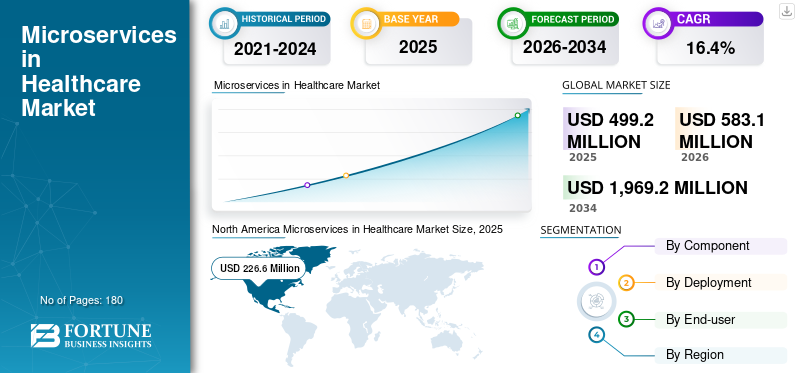
Download Free sample to learn more about this report.
Shift Toward Cloud-Native and API-first Healthcare Systems to Emerge as a Key Trend
Currently, there has been an increasing shift toward cloud-native, API-first healthcare platforms. In response, key players are designing healthcare software built directly on microservices rather than converting legacy systems. Also, FHIR-based APIs are being widely used to enable data exchange. This trend is helping healthcare organizations to easily plug in third-party applications and respond quickly to regulatory or clinical needs.
 Global Market Size & Forecast
 Market Share
 Key Regional Highlights
North America
North America reached USD 226.6 million in 2025, driven by advanced healthcare IT infrastructure and cloud adoption.
Europe
Europe is projected to reach USD 143.3 million by 2026, supported by strong healthcare technology adoption.
Asia Pacific
Asia Pacific is expected to reach USD 132.6 million by 2026, fueled by healthcare startups and digital transformation.
U.S.
The U.S. market is projected to reach USD 244.0 million in 2026, accounting for around 41.8% of global revenue.
Japan
Japan is expected to reach USD 49.1 million in 2026, representing nearly 8.4% of the global market.
Read More

Download Free sample to learn more about this report.
Growing Need for Scalable and Interoperable Healthcare IT Fuels Market Expansion
Over the past few years, healthcare organizations have been dealing with large volumes of clinical and administrative data from many systems. In such a scenario, microservices enable different applications to communicate easily via APIs, thereby supporting interoperability. Moreover, hospitals adopting telemedicine and digital front doors are increasing demand for systems that scale quickly without downtime, driving them to modernize their IT infrastructure and adopt microservices-based platforms and services. Such a scenario is anticipated to drive the global microservices in healthcare market growth.
High Complexity and Migration Challenges Restrict Market Growth
Despite significant benefits, moving from legacy monolithic systems to microservices is complex and costly. As per regulations, healthcare organizations must redesign applications, retrain IT staff and ensure data security and compliance.
In such scenarios, smaller hospitals often lack in-house expertise to manage microservice environments. Also, data migration risks and potential system downtime are slowing adopting, which is anticipated to hinder market growth.
Expansion of Digital Health and Telehealth Platforms to Create Significant Opportunities
In recent years, there has been rapid growth in digital health solutions, such as telehealth platforms, mobile health apps and AI-driven diagnostics, which require flexible backend systems. This is creating substantial opportunities for microservices in healthcare, allowing faster feature updates and easier integration of new tools.
Moreover, several companies are adopting cloud-native, microservices-based architectures to scale virtual care services.
Data Security, Privacy and Compliance Risks to Challenge Market Expansion
From a security perspective, healthcare data is highly sensitive and microservices increase the number of endpoints that must be secured. Each service needs proper authentication, encryption, and monitoring. In such a scenario, ensuring compliance with regulations such as GDPR and HIPAA across multiple services becomes challenging.
Also, the cybersecurity incidents in healthcare have increased, making providers cautious. Furthermore, managing security across cloud and on-premise environments adds complexity. Such challenges require strong governance and increase reliance on specialized security and compliance services.
Increasing Healthcare IT Modernization Projects to Boost the Services Segment’s Growth
Based on component, the market is segmented into microservices platforms & frameworks and services.
To know how our report can help streamline your business, Speak to Analyst
The services segment accounted for the largest microservices in the healthcare market share in 2025 as healthcare organizations need expert support to design, deploy and manage microservice systems, including consulting, migration, maintenance, system integration and managed services. Moreover, the growing number of healthcare IT modernization projects is boosting demand for professional and managed services, further driving the segment’s growth.
Additionally, the microservices platforms & frameworks segment is projected to grow at a 16.8% CAGR during the forecast period.
Increasing Preference For Cloud Platforms to Fuel Segment’s Growth
By deployment, the market is segmented into on-premises, cloud-based and hybrid.
The cloud-based segment accounted for the largest market share in 2025. The growth is attributed to an increasing number of healthcare providers preferring cloud platforms for telehealth, analytics and remote access, as they offer scalability, flexibility, and lower upfront costs. Moreover, the segment is estimated to hold a 49.2% share in 2026.
Additionally, the hybrid segment is anticipated to grow at a 16.4% CAGR over the forecast period.
Established Hospital Networks in Developed Countries to Drive Healthcare Provider Segment’s Growth
Based on end-user, the market is segmented into healthcare providers, healthcare payers, pharmaceutical & life sciences companies, and others.
In 2025, healthcare providers dominated the market as end users. The growth is attributed to increased adoption of microservices by healthcare providers to modernize EHRs, patient engagement platforms, billing systems and clinical workflows. Moreover, established hospital networks in developed countries are expected to fuel the segment’s growth. Furthermore, the segment is set to hold a 51.2% share in 2026.
In addition, the healthcare payers segment is projected to grow at a 16.2% CAGR over the forecast period.
Based on geography, the market is classified into North America, Europe, Asia Pacific, Latin America, and Middle East & Africa.
North America Microservices in Healthcare Market Size, 2025 (USD Million)
To get more information on the regional analysis of this market, Download Free sample
North America accounted for the largest share of revenues in 2024, valued at USD 192.0 million and USD 226.6 million at 2025. The growth is attributed to advanced healthcare IT infrastructure and the high adoption of cloud technologies, which are driving greater utilization of microservices in healthcare.
In 2026, the U.S. is projected to reach USD 244.0 million, accounting for approximately 41.8% of the global market.
Europe is projected to record a 15.4% growth rate during the forecast period, the second-highest globally, reaching USD 143.3 million by 2026. The growth is attributed to the significant presence of key players, which is contributing to the penetration of microservices in the region.
The U.K. market is expected to reach USD 29.9 million by 2026, accounting for roughly 5.1% of global revenues.
Germany's market is projected to reach USD 41.5 million by 2026, accounting for approximately 7.1% of global revenue.
By 2026, the Asia Pacific's market is expected to reach USD 132.6 million, ranking third globally. Several healthcare startups in the region are adopting microservice-based systems from the outset, which is expected to accelerate growth.
Japan is forecasted to generate USD 49.1 million in revenue by 2026, capturing nearly 8.4% of the global market.
China’s market is projected to reach approximately USD 53.8 million by 2026, representing nearly 9.2% of global revenues.
India’s market is expected to reach approximately USD 8.3 million by 2026, accounting for around 1.4% of global market revenue.
Both Latin America and Middle East & Africa are projected to witness moderate growth, with the Latin America market anticipated to reach USD 36.1 million by 2026. Multinational cloud companies are expanding their presence in the region as private hospital chains grow and telehealth services expand, thereby driving demand for scalable microservices platforms.
By 2026, the GCC market is estimated to reach approximately USD 6.0 million, representing around 1.0% of global revenues.
Diversified Offering of Key Solutions and Services to Strengthen the Market Position of Key Players
In 2025, Amazon Web Services (AWS), Microsoft, and Oracle held the majority of the global market share. These companies have a diversified offering of global cloud infrastructure, AI integration, and strong developer tools. Moreover, key players are implementing strategic initiatives, such as maintaining strong relationships with hospitals, pharmaceutical companies, and healthcare insurance companies to improve their market position.
The report provides a detailed analysis of all covered segments. It examines key drivers, trends, opportunities, restraints, and challenges shaping the market. The study also highlights major technological advancements in microservices for healthcare, as well as significant industry developments, such as mergers, acquisitions, and partnerships. In addition, it includes company market share analysis and comprehensive profiles of leading market players.
Request for Customization to gain extensive market insights.
| ATTRIBUTE | DETAILS |
| Study Period | 2021-2034 |
| Base Year | 2025 |
| Estimated Year | 2026 |
| Forecast Period | 2026-2034 |
| Historical Period | 2021-2024 |
| Growth Rate | CAGR of 16.4% from 2026-2034 |
| Unit | Value (USD Million) |
| Segmentation | By Component, Deployment, End-user, and Region |
| By Component |
|
| By Deployment |
|
| By End-user |
|
| By Geography |
|
1) How much is the microservices in healthcare market worth?
In 2025, the North America market value stood at USD 226.6 million.
The market is expected to grow at a CAGR of 16.4% over the forecast period of 2026-2034.
The services segment led the market in terms of component.
The key factor driving the market is growing need for scalable, interoperable healthcare IT.
Amazon Web Services (AWS), Microsoft, and Oracle are among the prominent players in the market.
North America dominated the market in 2025.

Get 30-60 hrs Free Customization
Expand Regional and Country Coverage, Segments Analysis, Company Profiles, Competitive Benchmarking, and End-user Insights.













.webp)






Related Reports
Get In Touch With Us
US +1 833 909 2966 ( Toll Free )
Receive a tailored pricing based on your needs.
Discuss your questions with our industry experts.
Have questions? Get quick answers before you purchase.

