 Download Free Sample



Get a Quote
Receive a tailored pricing based on your needs.
- Choose license type
- Multiple user options
- Custom scope & coverage
- Fast turnaround
"Designing Growth Strategies is in our DNA"
 Listen to Audio Version
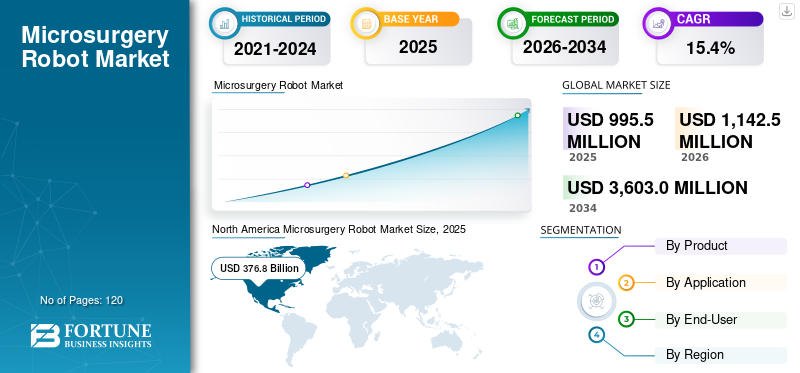
The global microsurgery robot market size was valued at USD 995.5 million in 2025. The market is projected to grow from USD 1,142.5 million in 2026 to USD 3,603.0 million by 2034, exhibiting a CAGR of 15.4% during the forecast period. North America dominated the microsurgery robot market with a market share of 37.85% in 2025.
Robotic microsurgery systems are highly precise robotic platforms that help surgeons to perform very small and delicate procedures with better control, less hand tremor, and finer movement than the human hand alone. These systems are used in areas where accuracy matters most, such as eye surgery, reconstructive microsurgery, lymphatic surgery, nerve repair, and some neurosurgical procedures. The market’s growth is attributed to rising demand for surgical precision, focus on adoption of advanced systems in hospitals, and launch of new products, supported by funding and regulatory approvals.
Furthermore, key industry players, such as Intuitive Surgical, Stryker Corporation, Zimmer Biomet, Medical Microinstruments, and Preceyes B.V. are focusing on developing innovative technologies to offer products with improved accuracy and efficiency.
Download Free sample to learn more about this report.
 Global Market Size & Forecast
 Market Share
 Key Regional Highlights
North America
The market reached USD 376.8 million in 2025, driven by technological advancements and minimally invasive surgery adoption.
Asia Pacific
The market is projected to reach USD 293.9 million by 2026, emerging as the third-largest regional market.
Europe
The market is projected to reach USD 330.9 million by 2026, growing at a CAGR of 14.9%.
U.S.
The market is projected to reach USD 368.0 million by 2026, driven by advanced surgical technologies.
Japan
The market is projected to reach USD 51.0 million by 2026, supported by increasing robotic surgery adoption.
Read More

More Integration of Robotics with Digital Tools is one of the Important Trend
Integration of digital tools with surgical robotics is one of the prominent trends observed in the market. Advancements of new software technologies are enabling hustle-free workflows, enhanced surgical precision, and superior digital visualization. Moreover, healthcare facilities are also focusing on superior systems which allows better control, data support, and easier workflow integration. Due to this, newer product announcements increasingly mention digital features along with robotic capability.
Download Free sample to learn more about this report.
Growing Demand for Higher Surgical Precision to Accelerate Market Growth
The need for better precision in very delicate procedures primarily drives the microsurgery robot market growth. Moreover, increasing emphasis on minimally invasive surgical procedures is also projected to have a positive impact on the global market. In microsurgery, surgeons work on tiny blood vessels, nerves, and tissues where a small hand movement can affect results. Robotic systems help by filtering tremor, scaling motion, and improving stability. This makes them a preferred option in procedures where accuracy is critical and surgeon fatigue can be a problem. In addition, market players are also focusing on launching of new systems which are capable of providing such enhanced precision.
High Cost and Slow Hospital Buying Cycles to Deter Market Growth
A key restraint is the high cost of these systems. Robotic microsurgery platforms require major investment in the robot, instruments, training, and service support due to which hospitals spend more time for evaluation compared to standard surgical tools. Many centers also want strong clinical evidence before making a purchase, which slows adoption, especially in smaller facilities. Companies continuing to raise large funding rounds to support commercialization shows that the market is still capital-intensive.
Expansion into New Specialties to Offer Lucrative Market Growth Opportunities
A major opportunity is expanding robotic microsurgery into more specialties beyond early use areas. Ophthalmology and reconstructive microsurgery are important starting points, but companies are now pushing into lymphatic surgery, head and neck procedures, and even neurosurgery. This creates room for more installed systems, more clinical studies, and broader hospital interest. The market opportunity becomes stronger each time a company proves that robotics can support a new type of microsurgery.
Training Surgeons and Changing Workflows to Pose a Critical Challenge to Market Growth
These systems require training, learning time, and workflow adjustment before they can be used smoothly. Even highly skilled microsurgeons need time to become comfortable with robotic controls and new procedure steps. Hospitals also need to align operating room teams, scheduling, and service support. This means adoption is not just about buying the technology.
Higher Capital Investments for Robotic Microsurgery Systems Boosts its Dominance
Based on product, the market is divided into robotic microsurgery systems and accessories & consumables.
The robotic microsurgery systems segment is anticipated to account for the largest microsurgery robot market share. Robotic microsurgery systems hold the largest share because they are the core technology. In addition, instruments, software, and accessories depend on the installed robotic platform, so the system captures the main value. Furthermore, hospitals usually make the biggest spending decision at the platform level, and later add instruments, upgrades, and service contracts around it.
The accessories & consumables segment is anticipated to rise with a CAGR of 16.3% over the forecast period.
To know how our report can help streamline your business, Speak to Analyst
Ophthalmology is the Leading Application as Robotics Provide Advantage for Microsurgeries
Based on application, the market is sub-segmented into neurosurgery, ophthalmology, ENT, plastic & reconstructive surgery, and others.
In 2025, the ophthalmology segment dominated the global market. Ophthalmology holds a high market share as eye surgery requires some of the finest and most stable movements in medicine. Small movements make major impacts when surgeons work on the eye; robotics offer a clear advantage in precision and steadiness. This makes ophthalmology one of the most natural and attractive use areas for robotic microsurgery. The segment’s development is also supported by strong company activity.
The plastic & reconstructive surgery segment is anticipated to rise with a CAGR of 16.4% over the forecast period.
Higher Surgical Procedure and Availability of Specialized Settings in Hospital & ASCs Accelerate Segment Growth
Based on end-user, the market is segmented into hospitals & ASCs, specialty clinics, and others.
In 2025, hospitals & ASCs held the highest market share as these systems are used in specialized surgical settings where trained surgeons, operating room support, and advanced infrastructure are already available. Hospitals usually adopt these systems first as they handle the most complex cases and are able to support expensive technology and training. ASCs are also becoming more relevant as surgical care shifts toward efficient outpatient settings. Furthermore, the segment is set to hold 87.3% share in 2026.
In addition, the specialty clinics segment is projected to grow at a CAGR of 16.1% during the study period.
By geography, the market is categorized into Europe, North America, Asia Pacific, Latin America, and the Middle East & Africa.
North America Microsurgery Robot Market Size, 2025 (USD Billion)
To get more information on the regional analysis of this market, Download Free sample
North America held the dominant share in 2024, valuing at USD 329.4 million, and also maintained the leading share in 2025, with USD 376.8 million. The market in North America is expected to increase due to technological advancements, rising emphasis on minimally invasive surgical procedures, and integration of intelligent technologies.
Based on North America’s strong contribution and the U.S. dominance within the region, the U.S. market can be analytically approximated at around USD 368.0 million in 2026, accounting for roughly 32.2% of global sales.
Europe is projected to record a growth rate of 14.9% in the coming years, and reach USD 330.9 million in 2026. The region is estimated to witness considerable market growth due to rising investments for new product development, and growing number of surgical procedures.
The U.K. market in 2026 is estimated at around USD 53.6 million, representing roughly 4.7% of global revenues.
Germany is projected to reach approximately USD 74.4 million in 2026, equivalent to around 6.5% of global sales.
Asia Pacific is estimated to reach USD 293.9 million in 2026 and secure the position of the third-largest region in the market.
In 2026, Japan is estimated at around USD 51.0 million, accounting for roughly 4.5% of global revenues.
China’s market is projected to be one of the largest worldwide, with 2026 revenues estimated at around USD 97.6 million, representing roughly 8.5% of global sales.
India in 2026 is estimated at around USD 65.2 million, accounting for roughly 5.7% of global revenues.
The Latin America and the Middle East & Africa are expected to witness moderate growth during the forecast period. Latin America is set to reach USD 49.7 million in 2026. In the Middle East & Africa, the GCC is set to reach a value of USD 13.5 million in 2026.
South Africa market is projected to reach around USD 5.5 million in 2026, representing roughly 0.49% of global revenues.
Rising Number of Product Launches Coupled with Focus on Collaborations Key Players to Boost Market Progress
The global microsurgery robot market holds a semi-consolidated market structure, constituting prominent players such as Intuitive Surgical, Stryker Corporation, Zimmer Biomet, Medical Microinstruments, and Preceyes B.V. The significant market share of these companies is due to numerous strategic activities, including distribution collaborations and implementation of new programs.
Other notable players in the global market include Synaptive Medical, Smith+Nephew, Brainlab AG, and Accuray Incorporated. These companies are expected to prioritize collaborations to increase their global market share during the forecast period.
The global microsurgery robot market analysis includes a comprehensive study of the market size & forecast by all the market segments included in the report. It includes details on the market dynamics and trends expected to drive the market over the forecast period. It provides information on key aspects, including an overview of technological advancements, the regulatory environment, and product launches. Additionally, it details partnerships, mergers & acquisitions, as well as key industry developments and investments by key regions. The report also provides a depth competitive landscape with information on the market share and profiles of key operating players.
Request for Customization to gain extensive market insights.
| ATTRIBUTE | DETAILS |
| Study Period | 2021-2034 |
| Base Year | 2025 |
| Estimated Year | 2026 |
| Forecast Period | 2026-2034 |
| Historical Period | 2021-2024 |
| Growth Rate | CAGR of 15.4% from 2026-2034 |
| Unit | Value (USD Million) |
| Segmentation | By Product, Application, End-User, and Region |
| By Product |
|
| By Application |
|
| By End-User |
|
| By Region |
|
According to Fortune Business Insights, the global market value stood at USD 995.5 million in 2025 and is projected to reach USD 3,603.0 million by 2034.
In 2025, North Americas market value stood at USD 376.8 million.
The market is expected to exhibit a CAGR of 15.4% during the forecast period of 2026-2034.
By product, the robotic microsurgery systems segment is expected to lead the market.
Growing demand for higher surgical precision to accelerate market expansion.
Intuitive Surgical, Stryker Corporation, Zimmer Biomet, Medical Microinstruments, and Preceyes B.V. are the major players in the global market.
North America dominated the market in 2025 by holding the largest share.

Get 30-60 hrs Free Customization
Expand Regional and Country Coverage, Segments Analysis, Company Profiles, Competitive Benchmarking, and End-user Insights.













.webp)






Related Reports
Get In Touch With Us
US +1 833 909 2966 ( Toll Free )
Receive a tailored pricing based on your needs.
Discuss your questions with our industry experts.
Have questions? Get quick answers before you purchase.

